UPDATE: THIS STORY WAS UPDATED 10/2/2025 WITH A NEW COMPOSITE IMAGE PROVIDED BY THE ARTIST.
When the Grand Lodge of Texas built their magnificent art deco/Egyptian-revival grand lodge building in Waco in the 1940s, a mural was designed originally to be installed behind the auditorium's Grand East. It was never completed, for reasons lost in the mists of time. Cheapness, laziness, changes in taste, or never getting around to it. The point is, it was never put in place.
According to PGM and Grand Secretary Brad Billings, it was included in the building committee meeting talks up until 1945. An architectural model was created when the building was proposed by architect Raoul Jossett, and it was built almost exactly as the model specified. But the mural itself was never installed. A look at the immense size of the auditorium stage gives you some idea of just how huge this would have been.
"Speculation is cost or they likely couldn't find a local artist to make that size painting," says Brad.
Fast forward to this past year.
An artistic Texas Brother named Sean Starr got hold of the original proposed artwork and has painted a scaled-down version for the Grand Secretary's office in three 5-foot by 5-foot panels. (Composite image above provided by the artist.)
It appears to depict Hiram Abiff (or perhaps King Solomon?) flanked by art deco depictions of the Holy Sts John, combined with the circle and parallel lines of our symbolism.
GS Billings says the mural will be projected behind the Grand East at the next annual communication of Grand Lodge. He adds, "We plan to make prints to help offset the cost of the artist to make it! I’m happy to answer any questions or give a quote. Such a cool thing to be a part of!"
The near-miraculous rebuilding of Paris' Notre Dame Cathedral after the horrific fire of 2019 culminated in its internationally celebrated reopening over the weekend, with great fanfare and well-deserved accolades from all corners of the globe.
English language readers, have a look at the Friends of Notre Dame de Paris website for lots of photos and details of the rebuilding and restoration work. And you might consider a donation to the efforts, if you haven't already done so.
And here a couple of stunning restoration shots from the NPR website courtesy of AFP last week.
But I suppose it wouldn't be France, Paris, or a massive, high-visibility construction project if some puerile, bored, knuckle-dragging keyboard troll didn't hurl a couple of pinheaded attempts at alleging a 'Masonic conspiracy' that is clearly HIDDEN IN PLAIN SIGHT!™ regarding the cathedral's reconstruction. The top guffaw-inducing ones I saw over the weekend run the complete comedy spectrum from hee to haw.
viz:
French President Macron DELIBERATELY made an inverted Masonic pyramid symbol with his fingertips, ALERTING THE ILLUMINATI MASONS!!
The black and white checkered mosaic floor was ADDED BY FREEMASONS during the reconstruction to deliberately resemble A MASONIC LODGE!!
A medallion mounted at the apex of the pointed arch near the entrance shows some unidentified figure surrounded by MASONIC STARS!!
(You'll note the double exclamation points to emphasize the Earth-shattering nature of these breathless revelations. Doubtless the Earth shattered at least a smidgin while you were reading them. I plumb reckon.)
When it gets to the point of the France24 English-language news service feeling the need to explain and debunk such idiocy (video below), surely you must realize you've hit the bottom of the barrel with these kinds of absurdities. Interestingly, they are alleging the source to be a well-known Russia-based peddler of online propaganda, mischief and other assorted hogwash in the conspiracy-monger realm.
Of course, the great cathedral has been around since the 15th century and has had quite literally thousands of operative stone masons working on it over the centuries. Their handiwork and craftsmanship can be seen in every square inch of this incredible temple of faith. It was the art, the beauty, the architecture, the engineering, and the symbolism of this and so many other medieval churches that inspired 17th and 18th century Enlightenment thinkers to adapt the tools, terminology and symbolism of those ancient stone masons and the temples they created into a new kind of fraternal organization in the first place. A fraternity that seeks to create temples in the hearts of men, exhorting them to make their own bodies, hearts and minds into more perfect edifices that are suitable for the proper worship and presence of God. And in turn, making the world a better place to live in, however momentarily that might be for all of us.
If you want to believe that's conspiratorial, that's your choice.
by Christopher HodappThere's still time to sign up and attend theKansas Masonic Con this coming weekend, Friday - Sunday, July 26-28, 2024, at Rosedale Lodge 333 in Mission, Kansas (near Kansas City).
Jon Ruark – “Stoic Resilience in an Age of Uncertainty”
Nicholas Laine – “The Creation of Enlighteners in Lodge”
James R. Morgan III – “The Lost Empire: Black Freemasonry in the Old West”
Duane Marshall – “The Journey of a Mason”
Chad Kopenski – “The Power of Masonic Myth”
Lincoln Wilson – “How Much Masonry Do You Want?
Rosedale Lodge 333, Mission, Kansas
There will be a Friday evening 'meet and greet' with the speakers, with the bulk of the program on Saturday, followed by a masquerade festive board Saturday night, and wrapping up with an outing on Sunday. Tickets can be had for each event individually, an all program pass, and for virtual attendees who wish to watch online.
by Christopher HodappMore proof that we Freemasons are everywhere, hiding in plain sight. Even in fast food establishments.
First it was Taco Bell back in 2018, with hidden squares and compasses in their exterior light fixtures, followed by an entire ad campaign linking secret societies, secret lapel pins, tacos, and the Illuminati. The Belluminati.
Now it's Arby's with the "Masonic" all-seeing eye over an unfinished "Masonic" pyramid, just like the "Masonic" symbols on the back of the "Masonic" dollar bill.
Actually, it's announcing the return of Arby's longtime signature side item, the triangular-shaped potato cake. And at the base? Dipping sauces and the Roman numerals for 'July 1, 2024.'
by Christopher HodappThe long-runningAntiques Road Show on PBS visited Akron, Ohio for this week's program, and a local Mason showed up with a unique 1930s Navajo rug woven with Masonic symbols.
As he explains, his grandfather was Freemason in the 30's, as well as a construction worker. While previously visiting a lodge near Gallup, New Mexico, he spotted one of these hand-woven rugs filled with Masonic symbolism, and the local brethren told him the nearby tribe had made it. Subsequently, he installed flooring for several buildings on the nearby reservation in return for them making this rug. Over time, it was passed to his lodge, then came back to the family.
Masonic authors and historians Mark Tabbertand Scotland's Robert Cooper have recently embarked on a new joint podcast, a unique book review program called MAGI Reviews: The Masonic Authors' Guild International. Mark and Robert started their podcast a couple of months ago, and they've done 16 episodes so far.
Robert L.D. Cooper served for almost 30 years as the curator for the Grand Lodge of Scotland's Library & Museum in Edinburgh. He the author of The Red Triangle, an indispensable work about the history of anti-Masonic movements and persecutions; the outstanding Rosslyn Hoax, that examines the many legends and theories about the Knights Templar, Freemasonry, and the enigmatic Rosslyn Chapelin Scotland.Both of these brethren are members of the Society of Blue Friars, an honorary organization of Masonic authors.
Because they are academic historians and not just a couple of aged, obsessive Masons with a warm glow in their hearts for dusty old Masonic books (not that there's anything wrong with that), they approach their reviews by discussing the pedagogical, academic value of the works themselves. Are they well-researched and well documented? Are they truthful? Are they backed up by useful, in-depth footnotes and references? Are their premises serious, looney, or just plain wishful thinking? Are they really thought-provoking, or are they so far off the rails that you'd be better off using them to prop up a rocky table leg? And what makes a more useful and more trustworthy Masonic book, from an academic point of view, anyway?
Consequently, there's been a good mix on the podcast so far – Masonic classics like Joseph Fort Newton'sThe Builders and David Stephenson's excellentOrigins of Freemasonry: Scotland's Century;academic works like Mark C. Carnes’ Secret Ritual and Manhood in Victorian America and Steven C. Bullock's indispensable Revolutionary Brotherhood: Freemasonry and the Transformation of the American Social Order, 1730-1840.Over in the deep end of the pool are the more... let's call them speculative books, like Stephen Knight's paranoid fairy tale book The Brotherhood: Secret World of the Freemasons (the completely unsubstantiated book of nonsense that launched England into a three-decade anti-Masonic fervor) and David Ovason's inexplicably popular astrological Secret Architecture of our Nation’s Capital: The Masons and the Building of Washington, DC.
Back in the early 2000s when the world was young and dinosaurs ruled the Earth, the entire publishing industry was attempting to cash in on novelist Dan Brown's as yet-unreleased sequel to The DaVinci Code, rumored at that time to be entitled The Solomon Key (eventually The Lost Symbol). By 2003, Da Vinci Code was already the 6th most popular book in the history of the English language, and readers all over the world were breathlessly awaiting the next entry in his series of stories featuring Harvard University 'symbologist' (whatever that is), Robert Langdon. While speaking off the record at a small gathering of local citizens in his New Hampshire hometown, he let it slip that the title of his next book would likely be The Solomon Key and be about Freemasons in Washington D.C. That bit of seemingly innocuous news turned into an international headline, and the feeding frenzy began.
Stacks of books about the Masons were hurled out by the mainstream press; History Channel shows began talking about the Masons; everyone from National Geographic to the stuffy US News & World Reportpublished expensive, glossy, full-color specialty magazines about Freemasonry, the Knights Templar, old cathedrals, the Illuminati, Bohemian Grove, and anything else they could possibly heave into the mix that sounded ancient, mysterious, spooky, and secret society-ish. Then, Disney rushed the Masonic-themed movie National Treasure into production, and it was released in November 2004. National Treasure would never have been made if not for Dan Brown's tardiness in delivering his sequel manuscript; and my own Freemasons For Dummies would never have been published if National Treasure hadn't been the #1 box office hit of 2004. In fact, Bob Cooper's own book, Cracking the Freemasons Code, was released during this same period for much the same reason – to get a jump on what Masons everywhere feared might be bad fictional treatment by Brown's book.
So. In 2005 I was contacted by Ulysses Press, a small, independent publisher located in Berkeley, California, and asked to write a book that would attempt to second-guess Brown's still as-yet unknown story points, debunk any sort of Masonic claims that he might include in his sequel, and explain his as-yet unseen storyline—whatever that might be—from the standpoint of the Masonic fraternity. And I was given a whopping four months to deliver the manuscript (a month longer than Wiley gave me to write Freemasons For Dummies).
It hit on the Masonic membership and activities of several of America's founding fathers, talked about possible Masonic influences on the Constitution, and explored the run-up to the Enlightenment period in England and how the Freemasons sprung from it. It detailed the Masonic cornerstone ceremonies for the White House, the U.S. Capitol building, the Washington Monument and more. Chapters debunked some of the most common fantasies about the Masons – Albert Pike, All-Seeing Eyes, the 'Masonic' symbols on the dollar bill and why they aren't actually 'Masonic', and, of course, the nonsense about the supposed 'Masonic' patterns in the streets of America's federal city. The back half of the book was a Masonic travel guide to Washington D.C., listing the many Masonic halls around the city, current and former grand lodge locations, Alexandria's George Washington Masonic National Memorial, the Scottish Rite SJ's House of the Temple, the city's original 'cornerstone', plus other noteworthy landmarks, buildings and monuments with both real and imaginary Masonic connections.
Solomon's Builders still holds up pretty well 18 years after it was published, if I do say so myself. When I wrote it, I tried to keep the specific Brown-related mentions to a minimum so it wouldn't become obsolete.I'm gratified that it still remains in print today, because so many other really excellent books that were released about the same time by respected Masonic authors have gone out of print and vanished into the anonymity of Half-Price Books metaphysical section.
Masonic/Dan Brown mania had a big die-back after his The Lost Symbolwas finally published in 2009 – fortunately for us, the Masons actually turned out to be the good guys in the book, and not the evil, bald-headed, cat-stroking supervillains most of us feared. And the fraternity did have a momentary uptick in men joining lodges who were inspired either by Brown's novel or by one of the myriad Masonic books that came out at the time. But that faded after a couple of years.
Yet, Solomon's Builders remains a decent, handy Masonic guide to D.C. today. Albert Pike's statue in Judiciary Square did get yanked down in the fevered summer of George Floyd riot-related statue toppling. And the city of Alexandria and the parks department put some decent money into sprucing up the area around the first boundary marker for the District of Columbia that was installed and dedicated by Freemasons. And a few other changes have happened throughout the city. But most of the information is still valid today. So, many thanks to Mark and Bob for hitting it with a spotlight again. I'm honored just by the mere mention.
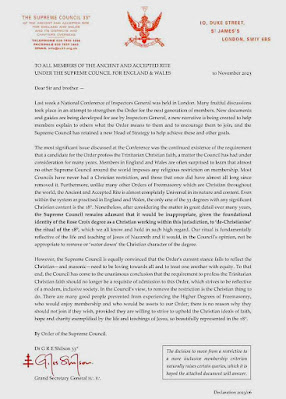
by Christopher HodappThe Supreme Council 33° of the Ancient and Accepted Rite for England and Wales(what American Masons know as the Scottish Rite) announced a significant policy change in its jurisdiction this week. Following a National Conference of Inspectors General, a letter was issued Friday stating that they are removing their longstanding requirement for petitioners to specifically declare a belief in Trinitarian Christianity.
This is an important change in this jurisdiction's membership prerequisites. Prior to this, the requirements for Masons seeking membership in the Ancient and Accepted Rite for England and Wales were as follows:
"All candidates for membership of the Ancient and Accepted Rite under the jurisdiction of the Supreme Council for England and Wales must profess the Trinitarian Christian faith and have been Master masons for at least one year in UGLE, or have joined a lodge under UGLE from a recognized Grand Lodge."
Friday's announcement reads, in part:
Members in England and Wales are often surprised to learn that almost no other Supreme Council around the world imposes any religious restriction on membership. Most Councils have never had a Christian restriction, and those that once did have almost all long since removed it. Furthermore, unlike many other Orders of Freemasonry which are Christian throughout the world, the Ancient and Accepted Rite is almost completely Universal in its nature and content. Even within the system as practiced in England and Wales, the only one of the 33 degrees with any significant Christian content is the 18°.
Nonetheless, after considering the matter in great detail over many years, the Supreme Council remains adamant that it would be inappropriate, given the foundational identity of the Rose Croix degree as a Christian working within this jurisdiction, to 'de-Christianize’ the ritual of the 18°, which we all know and hold in such high regard. Our ritual is fundamentally reflective of the life and teaching of Jesus of Nazareth and it would, in the Council's opinion, not be appropriate to remove or 'water down' the Christian character of the degree.
However, the Supreme Council is equally convinced that the Order's current stance fails to reflect the Christian—and Masonic—need to be loving towards all and to treat one another with equity. To that end. the Council has come to the unanimous conclusion that the requirement to profess the Trinitarian Christian faith should no longer be a requisite of admission to this Order, which strives to be reflective of a modem, inclusive society. In the Council's view, to remove the restriction is the Christian thing to do. There are many good people prevented from experiencing the Higher Degrees of Freemasonry, who would enjoy membership and who would be assets to our Order; there is no reason why they should not join if they wish, provided they are willing to strive to uphold the Christian ideals of faith, hope and charity exemplified by the life and teachings of Jesus, so beautifully represented in the 18°.
As alluded to in the letter, the traditional Rose Croix 18° as it is worked in the majority of Scottish Rite jurisdictions today is founded upon Christian imagery and symbolism — events in the life of Christ are used as an allegory for its lessons of monotheistic universality and the importance of Faith, Hope, and Charity.
In many Scottish Rite systems around the world, the 18th is the culmination of the first half of the Rite's degrees, and it can take many years to attain that level outside of the U.S. It's not uncommon for many Scottish Rite members in certain jurisdictions to never rise above the 18th — their degrees are taken one at a time, in order, often months (or even years) apart. This dramatically differs from the U.S. where a candidate generally becomes a full 32° Scottish Rite Mason in a single day or weekend.
Albert Pike's post-Civil War revision of the 18° for the Southern Jurisdiction of the Scottish Rite in the U.S. kept the original structure and allegory of the Rose Croix degree that had originally come to America from France through Etienne Morin as part of the hauts grades making up the Rite of Perfection. (Refer to the Francken Manuscript for this early version.) While it tells the story of the life, death, and resurrection of Jesus Christ, Pike removed the original degree's obligation to live a specifically Christian life and accept all of the tenets of Christianity. He felt such an obligation violated the most basic Masonic principles of universality and tolerance. So he kept the story, but reworked the obligation of the degree.
The Northern Masonic Jurisdiction of the Scottish Rite in the U.S. took a bit longer to remove the specifically Christian obligation from the 18°. In the degree, Jesus of Nazareth is the Exemplar, and any monotheistic believer can confidently take the obligation.
The NMJ's website explains their own current version of the 18° (as revised in 1941 and later, in 1964) this way:
In 1941, Sovereign Grand Commander Melvin M. Johnson appealed to revise the 18° so it could be better suited for men of all faiths. He said: "This is the heart of what the Rite seeks to inculcate in its degree of Rose Croix, this common faith. (That good will overcome evil) When the battle is won, Freemasonry’s greatest secret – secret only, because the world will not learn it – will be secret no longer for then humanity will find peace in brotherhood."
[snip]
[T]he Knight of the Rose Croix of H.R.D.M (Heredom), relays the life and death of Jesus. The allegory is based on the New Law he declared at the Last Supper: the law of love, which all men everywhere may understand and practice. His teachings exemplify the universal principles of life and encourage candidates to be virtuous, endeavor to eliminate vice, and practice tolerance and love. Upon the doctrine of Universality, the 18° should be interpreted by each Brother according to his own faith.
While Craft Lodge Freemasonry has been historically non-sectarian in its membership requirements since at least 1717, there are several Masonic-related appendant organizations that a Freemason can join that do have a specifically Trinitarian Christian requirement. These include the Knights Templar, the Masonic version of the Rosicrucians (SRICF), the Red Cross of Constantine, the White Shrine of Jerusalem, and more. The Supreme Council 33° for England and Wales has been unusual by having such a requirement, since no other Scottish Rite jurisdiction does.
Just as a bit of background, in May 1801, the first Supreme Council 33° for the Ancient Accepted Scottish Rite was opened in Charleston, South Carolina,and eventually became known as the Southern Jurisdiction of the USA. It was followed by France (1804), Spain (1811) and the Northern Masonic Jurisdiction of the USA (1813). Ireland (1826) was the sixth, England and Wales (1845) — receiving its Patent from the Northern Masonic Jurisdiction — was the eleventh, and Scotland (1846) the twelfth. There are now independent Supreme Councils in over 60 countries.
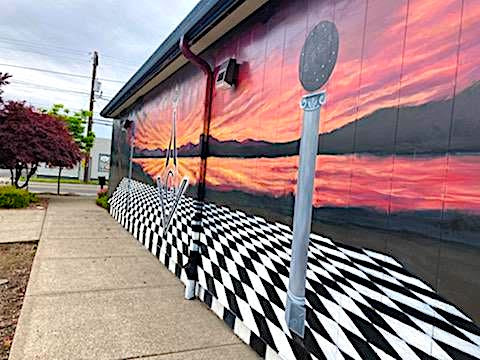
The Freemasons of Washington Lodge 46 in Portland, Oregon dedicated a stunning outdoor mural at the Washington Masonic Center on September 14th during their Past Masters Dinner.
Mural design and artwork was done over the summer by artist Joe Riso. In a recent post by Senior Warden Dave Munson, he said, "It looks nice and doesn’t 'shout' but draws positive attention to who we are."
The city of Portland is planted thick with all sorts of murals painted on community buildings, and they're often mentioned on travel websites and in tourism articles. But I'll freely admit I'm pretty partial to this one.
According to the Call For Entries posted in May, all artwork entries must display a visual interpretation of some aspect of Freemasonry in Pennsylvania, whether it be philosophical, historical, scientific, social, fraternal, charitable, architectural, etc. Selected artwork will be exhibited in the Masonic Temple in Philadelphia.
Criteria All artwork entries must display a visual interpretation of some aspect of Freemasonry in Pennsylvania, whether it be philosophical, historical, scientific, social, fraternal, charitable, architectural, etc. Selected artwork will be exhibited in the Masonic Temple in Philadelphia.
Eligibility Any amateur or professional artist or college art student may enter, but all will be judged as equals for competition purposes. Artists must be at least 18 years of age. All submissions must be original; they may have been created within the past two years and may have been previously exhibited. No work previously produced on a commission will be accepted. All submissions must be available for purchase.
Categories Oil, Three-dimensional, Drawing and Print-making, Water-Based Medium, Digital Imagery
Awards
$200 Prize per winner, per category $500 Grand Master’s Prize $1,000 Best in Show Prize
Entrance Fee
First entry: $25
Second and Third Entry: $10
(Limit of 3 entries per artist)
Auction If the artists in the Grand Exhibition choose to participate, their entered works may be auctioned off at the Exhibition Gala, with 80% of the auction value going to them and 20% to The Masonic Library and Museum of Pennsylvania. The artist may set a reserve price, as well as a direct purchase price for the original work to be revealed AFTER the auction.
Jurors Brother Travis Simpkins, Artist John McDaniel, Artist Elaine Erne, Artist/Teacher
Entry Deadline Thursday, August 11, 2022 by midnight, E.D.T. Submissions must be made online through Call For Entries
Opening Reception The Grand Exhibition Gala will be held at the Masonic Temple in Philadelphia on Friday, October 7th, featuring a cocktail and hors d’oeuvres reception, live music, announcement of winners and a silent auction of selected artwork.
Public Exhibition The Grand Exhibition will be open to the public for viewing starting on Tuesday, October 11, 9 a.m. – 5 p.m., Tuesdays – Saturdays, until November 12th. The exhibit will be at the Masonic Temple, One N. Broad Street, Philadelphia, PA 19107-2598.
by Christopher HodappA lady with the last name of Tobias sent me an email early this morning asking for help identifying what she thought was a Masonic sword that belonged to her grandfather. The engraved name on the sword blade was 'U.S. Grant Tobias.' It was a very typical fraternal group sword from Ward or Ames or Pettibone, or one of the several other companies making these since the 1860s. And they made thousands of them.
While attempting to save her message after reading it on my phone, I accidentally deleted her note and the photos. And I don't mean 'rescue-it-from-your-trash-folder' deleted, but double deleted it even from that folder. I've tried all the restoration tricks I know of, to no avail.
So, if you are Ms. Tobias, the answer is no, the sword in your photos is not Masonic. Unfortunately, I only glanced at the photos for a few seconds before I stupidly deleted them. But I did look at them long enough to identify the symbols.
The scabbard is indeed from the American Legion veterans association. But the sword itself has the very Masonic-looking square and compass with an upraised arm holding a hammer in the center that denotes the Junior Order of United American Mechanics on its counter-guard. It's easy to get it confused with the Masonic symbol, but the two groups are not related.
It's odd that the JrO. U.A.M. sword would have an American Legion scabbard - perhaps he belonged to the two groups simultaneously. Or he may have lost or damaged the proper one for the JrO. U.A.M. and just substituted the American Legion scabbard so it would be protected.
Both organizations are still in operation today.
In any case, the best source of information for identifying these antique swords is John D. Hamilton's indispensable book, The American Fraternal Sword: An Illustrated Reference Guide.Highly recommended, especially for fraternal museums, collectors and antique dealers.
NBC's Peacock streaming network has announced that there will only be the single season of Dan Brown'sThe Lost Symbolthat has already aired. The 10-episode series aired between September and November 2021, and there are no plans for future episodes.
Based on Brown's 2009 blockbuster Masonic-themed novel, The Lost Symbol starred Ashley Zukerman as symbologist Robert Langdon, along with Valorie Curry (“Blair Witch”), Sumalee Montano (“10 Cloverfield Lane”), Rick Gonzalez (“Arrow”), Beau Knapp (“Seven Seconds”), and actor and comedian Eddie Izzard as Peter Solomon. According to the announcement in Variety on Monday, "Peacock and producers believed that the series adaptation of the book told the complete story of the source material." The completed series will continue to be offered to subscribers on the Peacock streaming platform.
The creative team for the series made an early decision to modify much of the Masonic content of Brown's original novel and invent a super-secret level of Freemasons within the fraternity (called 'Leviathan') in order to free the show from having to stick to known facts, symbolism and practices of Masonry. And I was told a major consideration of the producers was their legal departments' advice to not show the square and compass in order to avoid any possibility of being sued for copyright or trademark infringement by the fraternity. (I'm only reporting it.)
Apparently the Peacock advertising department never got that memo...
The so-called "Leviathan cross" depicted in the show is actually the alchemical symbol for sulphur (also for volcanic brimstone), and series creators invented the fictional group as a special collection of powerful, select, brainy, unseen Masonic masters who protect the really secret secrets to life, the universe and everything.
The Scottish Rite Southern Jurisdiction created an eleven-part YouTube series that acts as a Masonic viewers' guide to the Lost Symbol program. Hosted by Brother Maynard Edwards, ° KCCH, the multi-part program, Symbols & Secrets, explores and explains the symbols, terminology and accuracy of The Lost Symbol. As the program explains, this is NOT a Masonic symbol.
by Christopher HodappMy Brethren, the roll of the workmen has been called, and one Master Mason has not answered to his name. Brother Shawn Eyer reported on his Facebook page that esteemed Masonic author William Kirk MacNulty has laid down his working tools at the age of 88.
WB MacNulty was the author of three deeply thoughtful and philosophical books about Masonic symbolism: The Way of the Craftsman (1988), Freemasonry: A Journey Through Ritual and Symbol(1991), and Freemasonry: Symbols, Secrets, Significance(2006). MacNulty’s writing focuses on the impact of Masonic history, philosophy and symbolism on the psychological and spiritual development of the individual. For many Masons, his books introduced them to a whole new understanding of our esoteric symbolism and philosophy, and he urged all Masons to seek out and find our personal interpretations.
He was three times Master of Lodge of Living Stones, was a member of the Lodge of the Nine Muses No. 1776 in D.C. and of Alexandria-Washington Lodge No. 22 in Virginia. He also was a member of Quatuor Coronati Lodge. In recognition of his contributions to Masonic literature, he was named as Friar No. 94 in the Society of Blue Friars in 2005.
From the Craftsmen Online Facebook page:
W. Kirk MacNulty was born in California in 1932. He studied at Stanford University and the University of Tennessee, and had a career in the United States Marine Corps and in corporate information technology.
His interest and involvement in Freemasonry spans more than fifty-five years. He received the degrees of Masonry in 1961 at Carson Valley Lodge No. 33 of Gardnerville, Nevada. He later affiliated with lodges in Hawaii, Tennessee, England, and Virginia. He was Worshipful Master of the Lodge of Living Stones No. 4957 in Leeds, England, in 1979, 1980, and 1991. He is the Charter Master (1997) of the Lodge of the Nine Muses No. 1776, a Traditional Observance Lodge in the District of Columbia.
His literary efforts have earned outstanding recognition. In 2008, he was received as a member of London's prestigious Quatuor Coronati Lodge No. 2076, the world's premier lodge of research. In 2016, he was recognized as a Fellow of the Philalethes Society for his many contributions to the literature of Freemasonry.
He was born in Long Beach, California. His father was an Officer in the Marine Corps, and Kirk traveled to many places during his childhood. When his father retired, his parents settled in San Mateo, California; and he attended San Mateo High School, and graduated from Stanford University. Kirk became an Officer in the Marine Corps where he served for several years. Upon leaving the Marine Corps he became a Freemason in 1961 while living in Gardnerville, Nevada. It was a small country town, with a Masonic Lodge and a dedicated group of members. As he went through the ritual of the Third Degree, he had some profound insights about his own life, the meaning of life, and the meaning of Freemasonry. That started him on a quest to learn more, to know more, and to communicate to others a real and deeper meaning of Masonry than many of its members are aware. Then, while living in London for 18 years, he had the opportunity to get to know Lord Northampton, John Hamill, and other luminaries of the United Grand Lodge of England, and they encouraged him in my Masonic writing.
In addition, he has run, and participated in, Masonic Study groups both in the US and the UK, using the kinds of concepts described in his latest book: Contemplating Craft Freemasonry, in the process gaining enormous insight into his own life, as well as a deeper understanding of the nature of the Craft.
"The Philosophical Background of Masonic Symbolism" - W. Kirk McNulty
As of Tuesday evening, I have not seen any notices about funeral services.
He has laid down the working tools of the Craft and with them he has left that mortal part for which he no longer has use. His column is broken, and his Brethren mourn.
A story appeared on the website of Australia's 9News TV station in Sydney on August 19th, reporting on financial losses for Qantas Airlines.Many international flights between the U.S. and Australia have been temporarily halted this year because of the international COVID shutdowns and restrictions. So at the beginning of the report, a half-second long shot showed a mothballed Qantas airliner being towed into storage at the Mojave Air and Space Port as part of a cost-cutting move by the airline.
Some eagle-eyed viewers looked closely at the fleeting opening shot and spotted black engine storage covers on one jet that were adorned with a giant All Seeing Eye and a square and compass. Consequently, social media had a brief blowup over the last couple of days over the Masonic symbols on the plane.
A YouTube conspiracy video entitled 'Qantas busted' has already racked up more than 10,000 views over the weekend. And no, I'm not linking to the thing.
Qantas’ loss of AU$1.9 billion is the greatest drop in revenues in the Australian national airline's 100 year history, and represents a 91% drop in profits. Some 20,000 employees have been laid off, and 6,000 have been pressured to retire (in the chilling English parlance of human obsolescence, "made redundant"). So naturally, lots of people have lots of reasons to look for someone or something to blame.
Nine News contacted the airline and the Mojave storage facility to get to the bottom of this 'controversy' (which means it's been a realllllly slow news week in Australia). The covers are giant plastic tarps stuck to the engine cowlings with high-visibility yellow tape. And according to the airline, it seems that the ground crews occasionally become artistic or bored, and create designs on the covers with tape, as the smiley faces and other markings show in the photo below.
According to the report today, officials said,
"Aircraft engine cover art is a thing," they said.
"As you can see, the yellow tape can sometimes be used quite creatively.
"We've obviously got a few engineers who are fans of The Da Vinci Code, but we've asked them to stick to emojis and smiley faces."
Something in me thinks the brethren in Barstow are toasting each other and cheerfully singing the Stonecutter's anthem tonight.
Whether the Masonic symbols were installed by an arty lodge member, or by a prankster who was just trying to excite the Internet crazies, there's no way of knowing. But "the Freemasons" didn't have anything to do with Qantas’ bad fortunes this year.
But then, that's just what you'd be expecting me to say.
UPDATE APRIL 6, 2020: I just received word as of today that the MSA is now officially sold out of ALL editions of these books - both the Master Mason cloth bindings and the grand Master leather ones! Richard asks that you please not try to order any more.
That said, Carl Davis' weekly devotional book also mentioned in this original post , Making Good Men Better, is NOT sold out and still very much available!
--------
A major bargain on expensive Masonic books doesn't happen very often, but this is a real opportunity for lodges, libraries and individual Masons seeking a massive educational resource.
As reported here several months ago, the Masonic Service Association is moving its headquarters from Maryland to Iowa. The complete six-volume set of hardbound editions of the Short Talk Bulletins starting in the 1920s is now on sale at what is almost a giveaway price. The full set of the Master Mason cloth-bound, hardback edition is just $120, and this combined set contains over 1,000 Short Talk Bulletins. If you are looking for the higher quality leather bound Grand Master editions, they are going for $40 apiece. All of these prices are less than a third of their original cover price. This means you could have a complete set of these books for less than the price of two of them when they were first printed. Don't let this deal slip by. Every Masonic Lodge and Masonic research library really should have these sets. There are hundreds of hidden gems, historical tales, ritual information, symbolism explanations and exploration, and scores of other sorts of topics to be found in these beautiful volumes. Every Single Short Talk Bulletin from 1923 through 2017 has been edited, re-typeset and blessedly indexed for these books by S. Brent Morris of the Scottish Rite Research Society. You could literally read one article every single day for almost the next three years. Never be at a loss for 'Masonic education' at you meetings ever again - you can walk into your lodge, literally open any of these books and start reading one aloud (once we can all meet again). The sale was announced in the most recent mailing of the MSA Short Talk Bulletin and Emessay Notes. Note that the sale price is NOT reflected on the MSA's webpage, so you'll need to contact them directly. (Nothing on the MSA website seems to have been updated since Simon LaPlace left several months ago.) Email: msaoffice@msana.com Tel: (301) 476-7330 Toll-free: (855) 476-4010
A new book has just been released by WB Carl W. Davis, and it couldn't come at a more opportune time. Making Good Men Better: A 52 Week Personal Growth Plan Based on the Teachings of Freemasonry is designed as a weekly Masonic devotional designed to instruct and inspire the contemplative Brother with a year’s worth of lessons about our symbolism, our philosophy, and even the phrases we use. Since we are all trapped in our houses for the duration of the COVID pandemic, Carl's book gives you the chance to advance your own personal thinking about Masonic principles and concepts as the weeks go by.
The daily or weekly devotional reader was once one of those common items that almost everyone in the Western world was familiar with, at least until the last 50 years or so. Most commonly circulated in the Christian tradition, these little booklets provided short readings, Biblical quotations, homilies, stories, and other inspirational content to be used during a daily time of prayer or spiritual meditation. The brief passages were meant to inspire or prompt the reader’s own deeper thoughts and reflection throughout the course of a week, a month, or a year.
Making Good Men Better is divided into 52 chapters, intended to be read one per week, and each chapter is followed by space to record your own reflections or notes. Because Carl has traveled extensively and visited Masonic lodges in a wide variation of jurisdictions, he combines concepts from several rituals with which you may not be entirely familiar with in an effort to examine and broaden our understanding of them. Sometimes it's helpful to look at a very different expression of the same symbol or ritualistic aspect through the eyes from a different state or country. Our rituals weren't carved in stone in most cases until the late 19th century when printed ciphers began to unify the work in any given state. Up until then, jurisdictions or individual lodges often added or subtracted paragraphs or entire lectures seen or heard or invented elsewhere.
WB Davis' book covers all kinds of elements, from ritual and symbolism, to certain practices and traditions we observe in lodge every day without examining how or why we do them. And the book is designed to digest these interpretations in small chunks, with space to record your own thoughts. Put it on your bedside table, set a weekly reminder on your phone, and try to use it as it was intended. It's a worthwhile habit to take up.Sadly, the widespread tradition of the devotional reader has fallen by the wayside among the wider population today (although ironically, in these days of self-publishing, there is no shortage of them to be found in print and online today). Society could use more quiet contemplation these days. The current enforced isolation gives us all a new opportunity to pick up new habits. This is a good one.