"To preserve the reputation of the Fraternity unsullied must be your constant care."

BE A FREEMASON

Showing posts with label Scottish Rite SJ. Show all posts

Saturday, September 05, 2026

National 'Brethren In Unity 9/11 Memorial' in Indianapolis Friday


by Christopher Hodapp

On Friday, September 11th, the Indianapolis Scottish Rite Cathedral will be the site of an extraordinary 9/11 Memorial service. All four of the Supreme Commanders of the Scottish Rite Supreme Councils of the United States will join together on the same stage with our city's first responders, veterans, and Freemasons to present a special donation to the Tunnel To Towers Foundation as part of the Scottish Rite Brethren in Unity 2026 Campaign.

To donate to this campaign, visit the website HERE: https://dogood.t2t.org/campaign/scottish-rite-freemasonry-brethren-in-unity-2026/c782074

DONATIONS WILL CONTINUE TO BE ACCEPTED THROUGH SEPTEMBER 30TH


Doors to the Cathedral will open at 8:00AM Friday and the program will begin at 8:45AM:
    • Doors Open - Guests Arrive 
    • Tunnel to Towers Video 
    • Processional of Sovereign Grand Commanders 
    • Welcome by Dr. Eugene Anderson 
    • Pledge of Allegiance by Rear Admiral William G. Sizemore II, USN (Ret.) 
    • National Anthem by Randolph Seipel 
    • Fireman's Bell Ringing - Troy Clements 
    • Invocation by Dr. Kenneth Allen 
    • Remarks on Scottish Rite Unity and the Tunnel to Towers Foundation Remarks — Brigadier General Jon M. Taylor, Alabama Air National Guard 
    • III. Walter F. Wheeler, 33°, Sovereign Grand Commander, Supreme Council, Northern Masonic Jurisdiction, USA 
    • III. Melvin J. Bazemore, 33°, Sovereign Grand Commander, United Supreme Council, Northern Masonic Jurisdiction, Prince Hall Affiliation, USA 
    • III. Corey D. Hawkins, 33°, Sovereign Grand Commander, United Supreme Council, Southern Masonic Jurisdiction, Prince Hall Affiliation, USA 
    • Ill. James D. Cole, 33°, Sovereign Grand Commander, Supreme Council, Southern Masonic Jurisdiction, USA 
    • Presentation of Check to Troy Clements and Team 
    • Closing Remarks -Lt. Phil Burton, Court Operations & Security-Judicial Enforcement Division, Marion County Sheriff's Office 
    • Closing Benediction - Chaplain (MAJ Kelly Mathis, FTS Chaplain 219th EN BDE-Traditional 
    • Recessional of the Sovereign Grand Commanders

If you are intending to attend in person, veterans, active service persons and responders are asked to dress in uniform, if possible, and Masons are requested to dress in suits and ties. There is free parking at the Cathedral.


Monday, June 01, 2026

Scottish Rite SJ Celebrates 250th Anniversary in Charleston


by Christopher Hodapp

The Supreme Council of the Ancient Accepted Scottish Rite Southern Jurisdiction, the "Mother Supreme Council of the World," was established in Charleston, South Carolina on May 31st of 1801 at Shepheard's Tavern on the corner of Broad and Church Streets (which had also been where South Carolina Freemasonry was originally established in 1754).

While originated in Charleston, the SJ moved its headquarters to Washington DC in 1870 and is located in the House of the Temple.

The AASR-SJ celebrated the 225th anniversary of their founding with a live broadcast of its special session in Charleston over the weekend. The replay can be seen via YouTube HERE or by clicking the video at the top of this post.


While we in the U.S. think of the Scottish Rite as an appendant body within Freemasonry that confers degrees 4-33, it is actually a complete degree ritual system that has its own initiatory degrees 1-3. Outside the U.S., the Rite's total 1-33 degree lineup is actually the most widely-worked degree system in the world, in both regular and irregular, unrecognized jurisdictions. It's also the source of one of the greatest misconceptions about the Masonic world. Because they number their degrees, largely for convenience, most non-Masons mistakenly believe those higher numbers denote higher rank within the fraternity. 

Tip for non-Masons: asking a Mason "How high a degree are you?" is the fastest way to show that you have no idea what you're talking about. 

Likewise, a "high ranking Mason" doesn't really exist, with the exception of the grand office holders in any given jurisdiction. A Grand Master within a Grand Lodge, such as the Grand Lodge of New York or the United Grand Lodge of England, does wield authority over the Masons in his region, but only for the duration of his elected term.

Wednesday, October 29, 2025

He's Back – Pike Statue Restored in Washington DC

Photo: Fox News


by Christopher Hodapp - 
(Revised 10/30/2025, 2:00AM)

The bronze statue of Scottish Rite sage Albert Pike has been restored by the National Parks Service and put back in place in Judiciary Square in Washington, D.C. after being defaced and toppled during George Floyd-related protests in 2020. The restoration was carried out by the NPS under President Trump's executive orders on "Making the District of Columbia Safe and Beautiful" and "Restoring Truth and Sanity to American History."

In a statement, the NPS said, "The restoration aligns with federal responsibilities under historic-preservation law and recent executive orders to beautify the nation’s capital and restore pre-existing statues."

Pike was originally placed in this general vicinity across the street from the original Supreme Council headquarters of the Ancient Accepted Scottish Rite - Southern Jurisdiction in 1901. He lived in the building for many years and the statue was erected to honor his scholarship and long leadership within the fraternity of Freemasonry.

Pike's statue was considered controversial by some because he was compelled by Southern leaders to serve for just five months in the Confederate Army when he lived in Arkansas. But despite press accounts and inflammatory rhetoric to the contrary, this was never a 'confederate statue.' It celebrated his lifetime of accomplishments, prominently highlighting his scholarship in the Scottish Rite. The only reference to his military record appears in the list of his achievements: 'author, poet, scholar, soldier, jurist, orator, philanthropist and philosopher.' And calling him a soldier arguably covers his time in the 1840s spent fighting for the United States in the Mexican American War far more than his time in the Confederate Army. The sculpture does not depict him in a military uniform, nor is he seen even wearing a sword. Instead, he holds in his hand a copy of his masterwork, Morals and Dogma, a vast volume of philosophy, religious ideas, and Masonic idealism.

In previous times, statues were erected to people we called heroes because they were considered role models who accomplished great things, in spite of their flaws. Men like Albert Pike were unique, and he was certainly far greater than the brief episode at the Battle of Pea Ridge, a job he neither sought nor really wanted. And after Pike's Indian troops scalped their Union soldier captives in violation of his orders, he resigned his commission in disgust and went back to practicing law. As for allegations that he was involved in the creation of the post-Civil War Ku Klux Klan, such charges have never been proved by any evidence. Anyone who believes he wrote the KKK's original ceremonial rituals needs to compare them to Pike's actual rituals he created for the Scottish Rite. There is no similarity whatsoever in style or vocabulary.

When H. B. F. McFarland, President of the District Commission, accepted the Pike memorial from the Scottish Rite on behalf of the American people at the 1901 dedication, he addressed Pike's stint in the Confederate Army, saying:

"Although Albert Pike was a soldier in the Civil War, this statue will commemorate him rather as a victor in the honorable rivalries of peace. It is well that you thus add to the comparatively small number of statues in the city of Washington that honor the victories of peace rather than of war."

Tuesday, August 05, 2025

Albert Pike's Masonic Statue To Be Reinstalled in Washington D.C.


by Christopher Hodapp

The National Parks Service has announced it will restore and re-install the iconic bronze statue of Scottish Rite sage Albert Pike on its former plinth in Washington, DC's Judiciary Square. On June 19, 2020, the statue was toppled by rioters, covered in paint, doused with lighter fluid, and ignited, a victim of the national Confederate-related statue-toppling mania that went on in the wake of the death of George Floyd in Minneapolis.

According to a press release from the NPS issued yesterday,

Micro-abrasive cleaning of the Albert Pike statue to remove corrosion 
and paint in order to review the conditions of the bronze prior to repairs 
NPS photo
The restoration aligns with federal responsibilities under historic preservation law as well as recent executive orders to beautify the nation’s capital and re-instate pre-existing statues.

Originally authorized by Congress in 1898 and dedicated in 1901, the statue honors Pike’s leadership in Freemasonry, including his 32 years as Sovereign Grand Commander of the Ancient Rite of Scottish Freemasonry. The statue has been in secure storage since its removal and is currently undergoing restoration by the National Park Service’s Historic Preservation Training Center.

This action supports both the Executive Order on Making the District of Columbia Safe and Beautiful and the Executive Order on Restoring Truth and Sanity to American History, which direct federal agencies to protect public monuments and present a full and accurate picture of the American past.

Site preparation to repair the statue’s damaged masonry plinth will begin shortly, with crews repairing broken stone, mortar joints, and mounting elements. The NPS is targeting October 2025 for completing the reinstallment of the fully restored statue.
Upon the announcement, Washington D.C.'s longtime non-voting delegate to Congress, Eleanor Holmes Norton, announced her intention to introduce a new bill in Congress to prevent its reinstallation and to, instead, donate it to a museum, saying, "a statue honoring a racist and a traitor has no place on the streets of D.C."

Before its toppling, detractors had long objected to the statue on the grounds that Pike had owned several slaves when he lived in Arkansas, and served for just five months in the Confederate Army as a Brigadier General before resigning in disgust, making it the only statue of a "former Confederate soldier" in the District. There has also been a longstanding, unsubstantiated allegation that Pike had been a founder of the post-war Ku Klux Klan, claiming he had written their original rituals. And, oof course, there's a whole raft of conspiracy theories about Pike, topped by the absurd notion that he was a Luciferian whose rituals turned Freemasonry into Satanic ceremonies.

Pike was a complex, intellectual and deeply profound man in his day, and attempting to portray him as a "racist and a traitor" ignores just how complex he really was, reducing his lifetime to just two misleading adjectives. And wrapping up such a superficial judgement with lies and conspiracy theories is a deliberate attempt to rewrite history to win likes and clicks.

(See Scottish Rite SJ Grand Archivist Arturo DeHoyos' statement from 2020 about Pike's real writings and activities HERE.)

Pike's statue had first been erected by the Scottish Rite SJ across from the location of their original 'House of the Temple' headquarters. For thirty years, protesters and the press characterized Pike's sculpture as a "Confederate monument," despite the fact that it was never anything of the kind. His statue was not erected by pro-Confederate veterans groups, or by alleged Ku Klux Klan members (it predated the 1920s resurgence of the KKK by many years). The statue was originally erected on a tiny sliver of land between two diverging diagonal streets. The streets and the statue were moved slightly when a new highway on-ramp was built there in the 1950s. The 11-foot tall bronze sculpture by Italian artist Gaetano Trentanove was erected in 1901 and donated to the city by the Scottish Rite Southern Jurisdiction to commemorate their own 100th anniversary. 

Out of their first 90 years, Albert Pike had served as the AASR-SJ's Sovereign Grand Commander for 32 of them—over a third of the Supreme Council's entire lifespan at that time. The original House of the Temple held their headquarters, their auditorium for putting on degrees, their vast and growing library, and Albert Pike lived and died there. So did his TWO successors. That made this particular corner historically significant.


The sculpture did NOT depict Pike as a Confederate soldier, nor did it commemorate or celebrate the five months in which he served as a general in the Confederate army. It was a Masonic representation of Pike's lifetime accomplishments as an author, philosopher, orator, lawyer, historian, polyglot, and a soldier (not only in his brief stint in the Confederate army, but also in the Mexican-American War). He wasn't atop a horse; he had no sword dangling from his belt; there was no declaration of heroship, and no phony bromide about 'healing a divided nation' that are the hallmarks of Civil War statues. Pike stood there with a book in his hand and the inscription Vixit Laborum Ejus Super Stites Sunt Fructus. "He has lived. The fruits of his labors live after him." Yet few - if any - who tore it down had any interest in actually looking up what the fruits of his labors really were.

There were no references to the Confederacy, only that Pike had been a "soldier" and the banner in the hand of the Grecian figure is not a Confederate flag or symbol, but a Scottish Rite one featuring the double-headed eagle. It was purely a Masonic statue and an homage to his life's many accomplishments. Nevertheless, it was felled by the mob and hauled away to an unspecified location by the District's Parks Department.


This morning, an NPR reporter sent me an email asking for a comment about the statue's restoration. Unfortunately, I returned her call too late for her deadline. The last thing any Freemason wants is for this whole controversy to bubble up again and used to fling mud on the fraternity. I've never been of the opinion that Pike needed to be beatified by Masons, and he didn't either, if his own writings were any indication. He once wrote: “When I am dead, I wish my monument to be builded only in the hearts and memories of my Brethren of the Ancient and Accepted Scottish Rite, and my name to be remembered by them in every country, no matter what language men may speak there, where the light of the Ancient and Accepted Scottish Rite shall shine, and its oracles of Truth and Wisdom be reverently listened to.”

Besides, Washington Masonic sites get enough vandalism from the lunatic crowd without giving them another one. But I despise it when the hysterics go out of their way to spread lies about the fraternity, especially when the truth is easily discovered.

For more than you'll ever want to know about Pike and the statue, see Albert Pike, Statues, History and Hysteria from back in 2017. In the 1980s and 90s, it became something of a crusade for perennial presidential candidate and famed nutcase Lyndon LaRouche to demand its removal.

Every time this particular subject arises, I always add the same post script. In February 1993, the Philalethes magazine published a piece about the Pike statue controversy that was raging back then. It was written by the Reverend Howard L. Woods, a Christian minister who served for ten years as the Grand Master of the Most Worshipful Prince Hall Grand Lodge of Arkansas F&AM. In 1991, he had been invited as the Lecturer for the Philalethes Society, the first Prince Hall Mason ever asked to do so, and still many years before Prince Hall recognition became widespread. GM Woods wrote before more recent scholarship has brought to light more of Pike's writings and verification that Pike did indeed provide his revised Scottish Rite rituals to help the Prince Hall aligned Scottish Rite.*(see note)

The Reverend Grand Master Woods' perspective in 1993 deserves to be repeated now, both for our own members and the general public. It still rings true 32 years later.
The Albert Pike Statue: Let It Stand
There is no love lost between Prince Hall Masons and the memory of the late Albert Pike, Masonic Historian, writer, alleged ritualist for the Ku Klux Klan, but, if Freemasonry is to remain the bulwark of free-thinking people, then, "Let the statue remain!"
Like the natures he wrote about, Albert Pike showed the light and dark sides of his own soul, when with one breath he spoke of his willingness to give up his Freemasonry rather than recognize the Negro as a 'Masonic Brother' and with another breath, declared that every man should be free, for a free man is an asset, while a slave is a liability. Mankind is that way, and as long as the statue stands, America and Freemasonry will survive.
Let the statue be torn down and America and Freemasonry will be in jeopardy, for one would have to wonder, "What would be next?" As a Prince Hall Mason, an African American and supposedly free-thinker, I can see a higher power than the mortal mind of Albert Pike guiding his pen as he wrote such beautiful words of life without an occasional helping hand from someone "bigger than you or I."
Let the statue stand, even if it is proven that Albert Pike did write ritual for the Ku Klux Klan; more ignoble deeds have been done by others without sacrifice of their historic heroism.
Let the statue stand as a reminder that the good and evil of men are in equilibrium within us, and we all should strive for perfection now and in the future, not in the past. Let the statue stand!
 --Rev. Howard L. Woods, Grand Master, Prince Hall Masons of Arkansas.

*NOTE: Between 1887 and 1891, Albert Pike happily shared personal, autographed copies of his Scottish Rite Masonic degree rituals with his counterpart, Thornton A. Jackson, in the parallel Scottish Rite Southern Jurisdiction for black Prince Hall Masons, in order to assist their fledgling organization. Pike's correspondence has not survived, but in writings of the period, Jackson described Pike as his friend. Later comparisons of their two sets of rituals confirmed that the Prince Hall AASR-SJ today remain very close to those Pike wrote in the years before 1887.

Post-riot photos by Brother Efrian Olujimi Dalle

Monday, March 18, 2024

Guthrie, Oklahoma Scottish Rite Spring Reunion April 5-7


by Christopher Hodapp


The Guthrie, Oklahoma Valley of the Ancient Accepted Scottish Rite - SJ has one of the most magnificent Masonic buildings in the U.S., and they are understandably proud of their architectural treasure. But Guthrie also is renowned for its outstanding presentations of the complete AASR Southern Jurisdiction’s Pike-derived rituals of the 4th-32nd degrees.


Their Spring 2024 Reunion will be held April 5-7th. Registration opens Friday at 7AM, and the opening ceremonies will begin at 8AM. (Click the schedule below to enlarge.)


If you’re an existing Scottish Rite member in either the NMJ or SJ, don’t miss the opportunity to experience these degrees as they were meant to be staged, in person, in this beautiful temple, and in full pageantry. If you’re not a member and you are a recognized Master Mason in Guthrie’s jurisdiction, contact them directly and ask about membership.


Saturday, November 11, 2023

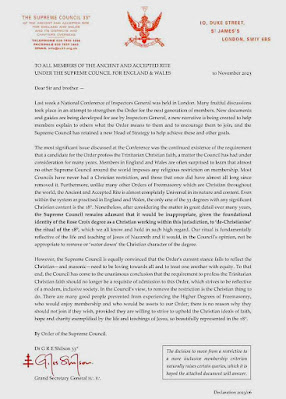
Ancient & Accepted Rite for England and Wales Drops Trinitarian Christian Requirement


by Christopher Hodapp

The Supreme Council 33° of the Ancient and Accepted Rite for England and Wales (what American Masons know as the Scottish Rite) announced a significant policy change in its jurisdiction this week. Following a National Conference of Inspectors General, a letter was issued Friday stating that they are removing their longstanding requirement for petitioners to specifically declare a belief in Trinitarian Christianity.

This is an important change in this jurisdiction's membership prerequisites. Prior to this, the requirements for Masons seeking membership in the Ancient and Accepted Rite for England and Wales were as follows: 

"All candidates for membership of the Ancient and Accepted Rite under the jurisdiction of the Supreme Council for England and Wales must profess the Trinitarian Christian faith and have been Master masons for at least one year in UGLE, or have joined a lodge under UGLE from a recognized Grand Lodge."

Friday's announcement reads, in part:

Members in England and Wales are often surprised to learn that almost no other Supreme Council around the world imposes any religious restriction on membership. Most Councils have never had a Christian restriction, and those that once did have almost all long since removed it. Furthermore, unlike many other Orders of Freemasonry which are Christian throughout the world, the Ancient and Accepted Rite is almost completely Universal in its nature and content. Even within the system as practiced in England and Wales, the only one of the 33 degrees with any significant Christian content is the 18°.

Nonetheless, after considering the matter in great detail over many years, the Supreme Council remains adamant that it would be inappropriate, given the foundational identity of the Rose Croix degree as a Christian working within this jurisdiction, to 'de-Christianize’ the ritual of the 18°, which we all know and hold in such high regard. Our ritual is fundamentally reflective of the life and teaching of Jesus of Nazareth and it would, in the Council's opinion, not be appropriate to remove or 'water down' the Christian character of the degree.

However, the Supreme Council is equally convinced that the Order's current stance fails to reflect the Christian—and Masonic—need to be loving towards all and to treat one another with equity. To that end. the Council has come to the unanimous conclusion that the requirement to profess the Trinitarian Christian faith should no longer be a requisite of admission to this Order, which strives to be reflective of a modem, inclusive society. In the Council's view, to remove the restriction is the Christian thing to do. There are many good people prevented from experiencing the Higher Degrees of Freemasonry, who would enjoy membership and who would be assets to our Order; there is no reason why they should not join if they wish, provided they are willing to strive to uphold the Christian ideals of faith, 
hope and charity exemplified by the life and teachings of Jesus, so beautifully represented in the 18°.


As alluded to in the letter, the traditional Rose Croix 18° as it is worked in the majority of Scottish Rite jurisdictions today is founded upon Christian imagery and symbolism — events in the life of Christ are used as an allegory for its lessons of monotheistic universality and the importance of Faith, Hope, and Charity. 

In many Scottish Rite systems around the world, the 18th is the culmination of the first half of the Rite's degrees, and it can take many years to attain that level outside of the U.S. It's not uncommon for many Scottish Rite members in certain jurisdictions to never rise above the 18th — their degrees are taken one at a time, in order, often months (or even years) apart. This dramatically differs from the U.S. where a candidate generally becomes a full 32° Scottish Rite Mason in a single day or weekend. 

Albert Pike's post-Civil War revision of the 18° for the Southern Jurisdiction of the Scottish Rite in the U.S. kept the original structure and allegory of the Rose Croix degree that had originally come to America from France through Etienne Morin as part of the hauts grades making up the Rite of Perfection. (Refer to the Francken Manuscript for this early version.) While it tells the story of the life, death, and resurrection of Jesus Christ, Pike removed the original degree's obligation to live a specifically Christian life and accept all of the tenets of Christianity. He felt such an obligation violated the most basic Masonic principles of universality and tolerance. So he kept the story, but reworked the obligation of the degree.

The Northern Masonic Jurisdiction of the Scottish Rite in the U.S. took a bit longer to remove the specifically Christian obligation from the 18°. In the degree, Jesus of Nazareth is the Exemplar, and any monotheistic believer can confidently take the obligation. 

The NMJ's website explains their own current version of the 18° (as revised in 1941 and later, in 1964) this way:

In 1941, Sovereign Grand Commander Melvin M. Johnson appealed to revise the 18° so it could be better suited for men of all faiths. He said: "This is the heart of what the Rite seeks to inculcate in its degree of Rose Croix, this common faith. (That good will overcome evil) When the battle is won, Freemasonry’s greatest secret – secret only, because the world will not learn it – will be secret no longer for then humanity will find peace in brotherhood."

[snip] 


[T]he Knight of the Rose Croix of H.R.D.M (Heredom), relays the life and death of Jesus. The allegory is based on the New Law he declared at the Last Supper: the law of love, which all men everywhere may understand and practice. His teachings exemplify the universal principles of life and encourage candidates to be virtuous, endeavor to eliminate vice, and practice tolerance and love. Upon the doctrine of Universality, the 18° should be interpreted by each Brother according to his own faith.

While Craft Lodge Freemasonry has been historically non-sectarian in its membership requirements since at least 1717, there are several Masonic-related appendant organizations that a Freemason can join that do have a specifically Trinitarian Christian requirement. These include the Knights Templar, the Masonic version of the Rosicrucians (SRICF), the Red Cross of Constantine, the White Shrine of Jerusalem, and more. The Supreme Council 33° for England and Wales has been unusual by having such a requirement, since no other Scottish Rite jurisdiction does.

Just as a bit of background, in May 1801, the first Supreme Council 33° for the Ancient Accepted Scottish Rite was opened in Charleston, South Carolina, and eventually became known as the Southern Jurisdiction of the USA. It was followed by France (1804), Spain (1811) and the Northern Masonic Jurisdiction of the USA (1813). Ireland (1826) was the sixth, England and Wales (1845) — receiving its Patent from the Northern Masonic Jurisdiction — was the eleventh, and Scotland (1846) the twelfth. There are now independent Supreme Councils in over 60 countries.

Monday, October 30, 2023

NEW BOOK: 'Freemasonry From the 1st to the 33rd Degree' (1875) translated by Kamel Oussayef


by Christopher Hodapp

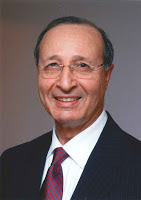
Illus. Kamel Oussayef 33° has just released a new book through the Scottish Rite Northern Masonic Jurisdiction as part of an ongoing program of rediscovering a treasure trove of 18th and 19th century French Masonic manuscripts. Entitled Freemasonry From the 1st to the 33rd Degree: the Complete Ritual of the Sovereign Grand Inspector General of the 33rd and Last Degree of the Ancient Accepted Scottish Rite, it is an English translation of an original document in French, written down in 1875 by an unknown Mason during an international Scottish Rite Congress held at Lausanne, Switzerland. 

They loved book titles in the 19th century that were so long they ended in a different zip code.

While Albert Pike was presenting his newly-revised degrees in the Southern Jurisdiction's Supreme Council in the U.S., this document is a record of the Scottish Rite rituals being worked contemporaneously in Switzerland.

Illus. Brother Kamel has been volunteering for almost 20 years at the Scottish Rite (NMJ) Museum & Library working on this series of very special translation and publication projects. The archives of the museum contain a priceless collection of rare, handwritten French manuscripts that have languished in the vaults for a century or more without ever having been translated into English. His previous books include: Freemasonry By Questions and Answers; Saint Edoüard: A 1748 Masonic Scottish Lodge During the French Enlightenment; The Spirit of Freemasonry; and The Book of Wisdom - all of which have been published in beautiful side-by-side translation editions by the Scottish Rite Northern Masonic Jurisdiction. 


Like his other books, The Complete Ritual  is presented in a photographic facsimile manner, with a color photo of each original manuscript page on the left side, and the English translation on the right. 


The degree rituals themselves are summarized, and there are no real "dramatic vignettes" as in the American Northern and Southern jurisdictions. They describe the transmission of signs and passwords, designs for aprons, sashes or other regalia for each degree, and perhaps a historical or philosophical explanation, as presented in the original document. 

The degrees include the Entered Apprentice, Fellow Craft and Master Mason as part of the overall Scottish Rite system. The Rite has always been a self-contained system of its own, but in most jurisdictions, they agree not to work their first, second, and third degrees in order to coexist with an established grand lodge's sovereignty. Some countries don't follow this model, and there are many jurisdictions in the world in which the complete Scottish Rite degree system is their grand lodge. In more than a few places, this led to schisms that remain to this day of sovereign grand lodges competing with a parallel Scottish Rite Supreme Council/grand lodge.

There is also an outstanding historical introduction by Illus. Jacques G. Ruelland, Scottish Rite Deputy for the Province of Quebec, Canada that provides much background information about the Lausanne Congress, the circumstance in which this manuscript had been written. He provides a detailed social, political and Masonic background for this important period that has been rarely examined here in the U.S.

The Lausanne Congress of 1875 was important, in part, because pro-secularism French Masons in the Grand Orient de France were attempting to convince French-speaking Masonic bodies to remove all references to God, a "supreme being," or the "Grand Architect of the Universe" from their degree systems and as a requirement for petitioners. 

France's secular Grand Orient craft lodge degrees consisted of (and still do) the Scottish Rite's first three degree rituals, and they were (unsuccessfully) attempting to strong-arm the Swiss into purging God from all of their rituals at this time. Doing so is an awkward situation since many of the Scottish Rite degrees are centered around the Biblical story of building or re-building Solomon's Temple (and are also very similar to what we call in America the York Rite degrees). It's tough to remove references to God successfully from Masonry's Biblical symbolism, especially if you're trying to leave out the Universe's Great Architect from the story of building sacred temples in the hearts of men, patterned after the holiest place on Earth and erected to God by Solomon. Apparently the Swiss thought so too, and didn't follow the Grand Orient's recommendations.

Research has shown that the earliest haute grades ("high degrees") of what we call Scottish Rite Freemasonry had been created or influenced by late-1700s Jacobites - pro-Catholic Scottish and English exiles living in France who had supported the Stuart line of kings back in their homelands. Their Catholic beliefs clashed with the secular forces of the French Revolution period that sought to remove the Church's influence from all government, education, and social aspects of life – even Freemasonry. But even though French movements for "complete freedom of thought" continued to grow in popularity, the French Masonic bodies retained the belief in God as a requirement after the Revolution. That clash of ideologies eventually led to the Grand Orient de France removing the requirement of its members of believing in a Deity in 1877 (two years after the Lausanne Congress), which created a schism in worldwide Freemasonry that exists to this day, and which is why the smaller but widely-recognized Grande Loge Nationale Française is considered the only regular grand lodge in that country by the vast majority of the Masonic world. 

In 2020, Illus. Kamel Oussayef 33° became the 110th author to be admitted into the Society of Blue Friars, a very special organization formed in 1932 to specifically honor Masonic authors.

Friar Oussayef was born in Sétif, Algeria and attended school in France, where he lived for many years. He holds an MA from the Fletcher School of Law and Diplomacy at Tufts University and an MS from the School of Public Communications at Boston University.

Kamel is a Past Master of William Parkman Lodge and Converse Lodge in Massachusetts (
Masons in that state do not number their lodges). He has been awarded the prestigious Henry Price and Joseph Warren medals for distinguished service to Freemasonry in Massachusetts. In the AASR, he is an Assistant Master of Ceremonies with the Massachusetts Consistory of the Valley of Boston.

Freemasonry From the 1st to the 33rd Degree: the Complete Ritual of the Sovereign Grand Inspector General of the 33rd and Last Degree of the Ancient Accepted Scottish Rite is available as an oversize 272-page paperback from the Scottish Rite Northern Masonic jurisdiction's website for $72.80, or as a Kindle edition for $9.99 for cheapskates, skinflints, and starving Masons... (I can't stand e-books myself, but it still does present each full-color manuscript page, followed by the English translation on alternating pages, which makes it a little more cumbersome to read than the dead tree edition.)