"To preserve the reputation of the Fraternity unsullied must be your constant care."

BE A FREEMASON

Showing posts with label George Washington. Show all posts

Tuesday, February 24, 2026

Masonic Gavel Used By George Washington For Capitol Cornerstone At Tonight's State of the Union Address

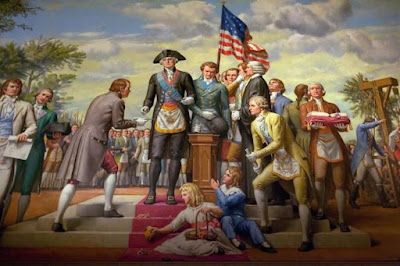
Allyn Cox 1955 mural at the George Washington Masonic National Memorial

by Christopher Hodapp

President Donald Trump's State of the Union message is taking place tonight, and there will be an important Masonic artifact there for this special occasion. 


The famous gavel used by George Washington at the Masonic cornerstone ceremony for the new U.S. Capitol building in 1793 will be displayed on the Speaker's podium in the House of Representatives tonight during the joint session of Congress.


Speaker Mike Johnson requested the gavel be present at the State of the Union address for the first time in history. The gavel is owned by Potomac Lodge No. 5 in Washington, DC.

The ceremony has been depicted several times by artists. The image at the top of this article was painted by Allyn Cox as a massive mural at the George Washington Masonic National Monument in Alexandria, Virginia. Installed in 1955, the mural underwent careful restoration in 2017. Cox also painted another version of the ceremony that is in the Cox Corridor of the U.S. Capitol.


Today, the U.S. Capitol Historical Society proudly announced that Speaker Mike Johnson will become the first House Speaker in history to display George Washington’s Gavel during the State of the Union Address to Congress. The historic Gavel was first used in 1793 to lay the cornerstone of the United States Capitol building: “The People’s House” and the physical manifestation of our democracy. Since that ceremony, the Gavel has been in the care of Potomac Lodge No. 5, the oldest Masonic Lodge in Washington, D.C. The U.S. Capitol Historical Society worked diligently with the Lodge and Speaker’s Office to enable the Gavel to rest on the rostrum during this year’s Address—marking the 250th anniversary of America’s founding.

“The U.S. Capitol Historical Society would like to thank Speaker Johnson and Potomac Lodge No. 5 for working with us to ensure the display of a historic treasure for this year’s historic Address,” said Roswell Encina, President & CEO of the U.S. Capitol Historical Society. “Complementing the State of the Union with George Washington’s Gavel beautifully reflects the importance of preserving and sharing the Capitol’s history; helping Americans connect with the people, places, and traditions that continue to shape our nation. A significant part of the Society’s mission is to bring Congress to the People. During America250, it is especially satisfying to have helped bring the People to Congress.”

In 1793, U.S. President and Master Mason, George Washington, laid the cornerstone of the United States Capitol Building. At the time, a growing schism between “Federalists” and “Republicans” threatened the American experiment in its infancy. Washington therefore lent his prestige to such events as the laying of the Capitol cornerstone to give credence to the new U.S. Government: established in 1789 after our Constitution was ratified.
Allyn Cox painting of the Masonic cornerstone ceremony in the Cox Corridor
of the U.S. Capitol.
 
On the morning of September 18, 1793, Washington and a procession of artillery and Masonic lodges crossed the Potomac River to the new Federal City. They did so, a newspaper reported, “with music playing, drums beating, colors flying, and spectators rejoicing.” At the Capitol site, Washington stepped into a dug trench, laid a silver plate onto the ground, and set the cornerstone atop it. He was accompanied by brethren who conducted a Masonic ritual with corn (a symbol of nourishment), wine (a symbol of refreshment), and oil (a symbol of joy). Witnesses then chanted and celebrated until night.

After the ceremony, Washington bestowed the Gavel to Valentine Reintzel, the head of Potomac Lodge No. 5, who assisted that day and cared for the artifact until his death. In the two centuries since, Potomac Lodge No. 5 has been the Gavel’s custodian, loaning it to other cornerstone ceremonies, including the Washington Monument, National Cathedral, and Smithsonian Institution.

<snip>

As Washington himself told Congress in his first State of the Union Address:

“Knowledge is in every Country the surest basis of public happiness…To the security of a free Constitution it contributes in various ways: By convincing those, who are entrusted with the public administration, that every valuable end of Government is best answered by the enlightened confidence of the people: And by teaching the people themselves…to discriminate the spirit of liberty from that of licentiousness, cherishing the first, avoiding the last, and uniting a speedy, but temperate vigilence against encroachments, with an inviolable respect to the laws.”

In addition to the gavel, another artifact from that same ceremony is owned by Virginia's Alexandria-Washington Lodge 22: a large silver trowel used to symbolically spread the cement of Brotherly Love.


Wednesday, August 20, 2025

G. Washington Masonic Natl Memorial Wraps Up Major Exterior Restoration


by Christopher Hodapp

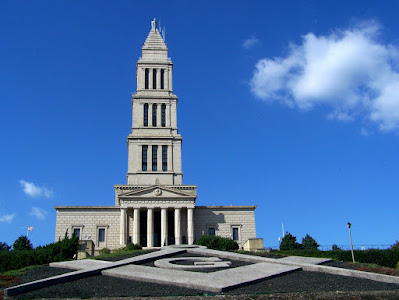
The George Washington Masonic National Memorial in Alexandria has been undergoing a major (and painstaking) exterior restoration project for the last eleven years. The monument to Brother George was built over a century ago and suffered from increasing water damage, limestone degradation, and even cracks from a 2011 earthquake. Work started on the iconic 9-story tower in 2014 and has at long last been completed.


An article in the local Zebra publication two weeks ago written and photographed by Brother Shawn Eyer detailed the work that was being done.
Cracks in the stone were sealed with epoxy. All of the original mortar was “raked out,” and each joint was repointed with a long-lasting mixture that allows moisture to escape rather than remain and go through freeze-thaw cycles. Weather-capping was installed. New LED lighting was installed to allow for the tower to be lit in many colors. Efflorescence—lime deposits often visible from the ground—was chipped away. In certain places, significant structural damage was repaired using steel rods. . .
For the last several years now, the work has neared completion with the scaffolding located behind the building, along the outer wall of the Memorial’s theater. Finally, the restoration of the temple was completed last month when workers lowered a newly-carved “Dutchman’s repair” into a niche where the 2011 earthquake had caused the coping to split. Now, that damage is completely invisible, and the integrity of the building is restored from top to bottom.
For the first time in a generation, it is possible to see the building in as stately a condition as that when it was first erected: a beautiful beacon of light with a positive and inspiring message.

 Thanks to Paul Keegan and his crew at Hibernia Masonry.

Monday, May 06, 2024

MAGI: Robert Cooper and Mark Tabbert Launch Masonic Book Review Podcast


by Christopher Hodapp

Masonic authors and historians Mark Tabbert and Scotland's Robert Cooper have recently embarked on a new joint podcast, a unique book review program called MAGI Reviews: The Masonic Authors' Guild International.  Mark and Robert started their podcast a couple of months ago, and they've done 16 episodes so far. 

Mark Tabbert

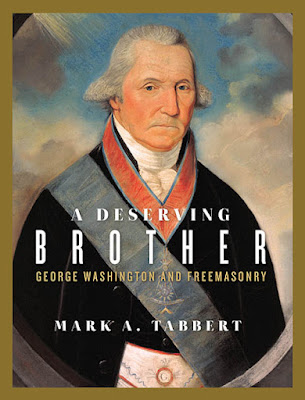
Both of these knowledgeable Brothers have held unique positions over the last couple of decades, and as Masonic authors and researchers, neither of them could be considered to be a slouch. Mark Tabbert is a past president of the Masonic Library & Museum Association, a former curator for the Scottish Rite NMJ's museum in Lexington, Massachusetts, and most recently, curator at the George Washington Masonic National Memorial's museum in Alexandria, Virginia. He's the author of American Freemasonry: Three Centuries of Building Communities and most recently, A Deserving Brother: George Washington and Freemasonry

Robert L.D. Cooper

Robert L.D. Cooper served for almost 30 years as the curator for the Grand Lodge of Scotland's Library & Museum in Edinburgh. He the author of The Red Triangle, an indispensable work about the history of anti-Masonic movements and persecutions; the outstanding Rosslyn Hoax, that examines the many legends and theories about the Knights Templar, Freemasonry, and the enigmatic Rosslyn Chapel in Scotland. Both of these brethren are members of the Society of Blue Friars, an honorary organization of  Masonic authors.

Because they are academic historians and not just a couple of aged, obsessive Masons with a warm glow in their hearts for dusty old Masonic books (not that there's anything wrong with that), they approach their reviews by discussing the pedagogical, academic value of the works themselves. Are they well-researched and well documented? Are they truthful? Are they backed up by useful, in-depth footnotes and references? Are their premises serious, looney, or just plain wishful thinking? Are they really thought-provoking, or are they so far off the rails that you'd be better off using them to prop up a rocky table leg? And what makes a more useful and more trustworthy Masonic book, from an academic point of view, anyway?

Consequently, there's been a good mix on the podcast so far – Masonic classics like Joseph Fort Newton's The Builders and David Stephenson's excellent Origins of Freemasonry: Scotland's Century; academic works like Mark C. Carnes’ Secret Ritual and Manhood in Victorian America and Steven C. Bullock's indispensable Revolutionary Brotherhood: Freemasonry and the Transformation of the American Social Order, 1730-1840. Over in the deep end of the pool are the more... let's call them speculative books, like Stephen Knight's paranoid fairy tale book The Brotherhood: Secret World of the Freemasons (the completely unsubstantiated book of nonsense that launched England into a three-decade anti-Masonic fervor) and David Ovason's inexplicably popular astrological Secret Architecture of our Nation’s Capital: The Masons and the Building of Washington, DC. 

So imagine my surprise when Mark and Robert featured my second book:  Season 1, Episode 16 reviewed Solomon's Builders: Freemasons, Founding Fathers and the Secrets of Washington, D.C., which was written some 14 years ago. After all this time, and despite the panicked circumstances under which it was written, I was pleasantly surprised that they felt it still was of value today.


Let me explain.

Back in the early 2000s when the world was young and dinosaurs ruled the Earth, the entire publishing industry was attempting to cash in on novelist Dan Brown's as yet-unreleased sequel to The DaVinci Code, rumored at that time to be entitled The Solomon Key (eventually The Lost Symbol). By 2003, Da Vinci Code was already the 6th most popular book in the history of the English language, and readers all over the world were breathlessly awaiting the next entry in his series of stories featuring Harvard University 'symbologist' (whatever that is), Robert Langdon. While speaking off the record at a small gathering of local citizens in his New Hampshire hometown, he let it slip that the title of his next book would likely be The Solomon Key and be about Freemasons in Washington D.C. That bit of seemingly innocuous news turned into an international headline, and the feeding frenzy began. 

Stacks of books about the Masons were hurled out by the mainstream press; History Channel shows began talking about the Masons; everyone from National Geographic to the stuffy US News & World Report published expensive, glossy, full-color specialty magazines about Freemasonry, the Knights Templar, old cathedrals, the Illuminati, Bohemian Grove, and anything else they could possibly heave into the mix that sounded ancient, mysterious, spooky, and secret society-ish. Then, Disney rushed the Masonic-themed movie National Treasure into production, and it was released in November 2004. National Treasure would never have been made if not for Dan Brown's tardiness in delivering his sequel manuscript; and my own Freemasons For Dummies would never have been published if National Treasure hadn't been the #1 box office hit of 2004. In fact, Bob Cooper's own book, Cracking the Freemasons Code, was released during this same period for much the same reason – to get a jump on what Masons everywhere feared might be bad fictional treatment by Brown's book.

So. In 2005 I was contacted by Ulysses Press, a small, independent publisher located in Berkeley, California, and asked to write a book that would attempt to second-guess Brown's still as-yet unknown story points, debunk any sort of Masonic claims that he might include in his sequel, and explain his as-yet unseen storyline—whatever that might be—from the standpoint of the Masonic fraternity. And I was given a whopping four months to deliver the manuscript (a month longer than Wiley gave me to write Freemasons For Dummies). 

It hit on the Masonic membership and activities of several of America's founding fathers, talked about possible Masonic influences on the Constitution, and explored the run-up to the Enlightenment period in England and how the Freemasons sprung from it. It detailed the Masonic cornerstone ceremonies for the White House, the U.S. Capitol building, the Washington Monument and more. Chapters debunked some of the most common fantasies about the Masons – Albert Pike, All-Seeing Eyes, the 'Masonic' symbols on the dollar bill and why they aren't actually 'Masonic', and, of course, the nonsense about the supposed 'Masonic' patterns in the streets of America's federal city. The back half of the book was a Masonic travel guide to Washington D.C., listing the many Masonic halls around the city, current and former grand lodge locations, Alexandria's George Washington Masonic National Memorial, the Scottish Rite SJ's House of the Temple, the city's original 'cornerstone', plus other noteworthy landmarks, buildings and monuments with both real and imaginary Masonic connections. 

Solomon's Builders still holds up pretty well 18 years after it was published, if I do say so myself.  When I wrote it, I tried to keep the specific Brown-related mentions to a minimum so it wouldn't become obsolete. I'm gratified that it still remains in print today, because so many other really excellent books that were released about the same time by respected Masonic authors have gone out of print and vanished into the anonymity of Half-Price Books metaphysical section. 

Masonic/Dan Brown mania had a big die-back after his The Lost Symbol  was finally published in 2009 – fortunately for us, the Masons actually turned out to be the good guys in the book, and not the evil, bald-headed, cat-stroking supervillains most of us feared. And the fraternity did have a momentary uptick in men joining lodges who were inspired either by Brown's novel or by one of the myriad Masonic books that came out at the time. But that faded after a couple of years.

Yet, Solomon's Builders remains a decent, handy Masonic guide to D.C. today. Albert Pike's statue in Judiciary Square did get yanked down in the fevered summer of George Floyd riot-related statue toppling. And the city of Alexandria and the parks department put some decent money into sprucing up the area around the first boundary marker for the District of Columbia that was installed and dedicated by Freemasons. And a few other changes have happened throughout the city. But most of the information is still valid today. So, many thanks to Mark and Bob for hitting it with a spotlight again. I'm honored just by the mere mention.

Sunday, November 05, 2023

George Washington Made A Mason 271 Years Ago Today


by Christopher Hodapp

A post on the George Washington Masonic National Memorial Facebook page reminds us that Sunday is the 271st anniversary of George Washington's initiation or "making" as a Freemason. 

George was made an Entered Apprentice Mason at the age of twenty in the Lodge at Fredericksburg, Virginia, on November 4, 1752. (There's some confusion over whether he was 20 or 21, because at this moment in time, the American colonies were just shifting over to using the Gregorian calendar.) He was passed to the Degree of Fellowcraft on March 3, 1753, and raised to the Sublime Degree of Master Mason on August 4, 1753. Soon after, Bro. Washington departed for the frontier on a surveying expedition. But he remained a member of Fredericksburg Lodge until his death on December 14, 1799.

The Bible upon which he took his Masonic obligations is still preserved and maintained by Fredericksburg Lodge 4 in Virginia. 

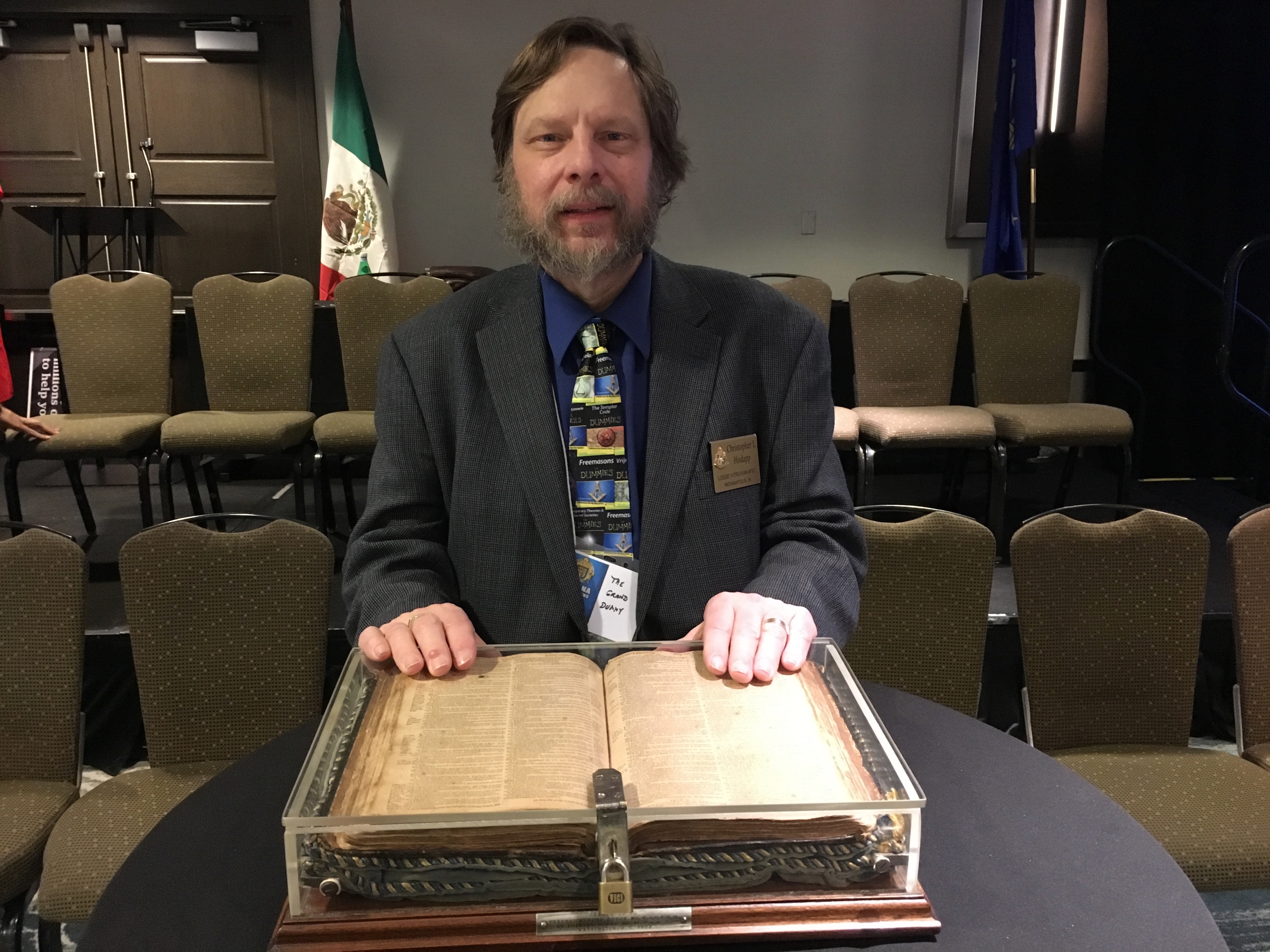
(Back in 2018, we were honored to have the Bible with us at the Masonic Library & Museum of Indiana for the 200th anniversary of the founding of the Grand Lodge of Indiana, and the Conference of Grand Masters in Indianapolis that same year. Fredericksburg keeps it locked in its traveling display case, presumably so it won't burst into flames when guys like me try to touch it.)


By the way, for those who fret about Masonic lodge dues these days being too cheap or too expensive, young George paid £2, 3 shillings, which would be approximately $488 today. Just a point of reference.

There have been stacks of books and articles written about George Washington and Freemasonry ever since his demise. Most have been well-intentioned, but so much has been wishful thinking, pure supposition, or downright fantasy. I touch on this in my own book, Solomon's Builders. But for the very last word in George Washington reference works concerning Freemasonry, let me recommend Mark Tabbert's recent work, A Deserving Brother, which documents every single Masonic meeting and event he provably attended, every known Masonic relic that he either owned or handled, and every known document he responded to regarding the fraternity. 

Monday, February 21, 2022

Book Review: 'A Deserving Brother: George Washington and Freemasonry' by Mark Tabbert


by Christopher Hodapp

When the George Washington National Masonic Memorial in Alexandria, Virginia was first proposed in 1910, it was designed as a magnificent monument to America’s most famous Mason, along with being a safe and secure repository for priceless Masonic objects owned by Virginia’s Alexandria-Washington Lodge 22 that were associated with Brother George. The lodge possessed an original, contemporary portrait of Washington showing him dressed in Masonic regalia. And they had a collection of irreplaceable items which had originally been owned by Washington or utilized by him for the cornerstone ceremony for the U.S. Capitol building in 1798. 


But a fire at the lodge in the late 1800s resulted in the loss of several their priceless objects. So the Memorial was proposed as a national Masonic project that would be supported by all regular, recognized grand lodges in the U.S. in order to more safely house and display these almost sacred items for the public and for Masons alike. Today, the Memorial houses one of the largest collections of Washington-associated memorabilia outside of his estate, Mount Vernon and the Smithsonian Museum.


Many years ago, Mark Tabbert told me of an ongoing project he was working on. He has been the head of collections at the Memorial for many years, and the physical resources at the Memorial are preserved for future historians and Masons. Like the fairytales of Parson Weems’ chop-down-the-cherry-tree “biography” of the general, president and founding father, Masonic tall tales about Washington began propagating with great abandon after his death, and continue through today. 

Despite the endless (and frequently bogus) claims some Masons have made over the years about Worshipful Brother George and his enthusiasm for the fraternity, the truth is that Washington really only provably attended a handful of lodge meetings in person throughout his entire lifetime. Tabbert has always insisted that it is vital to honestly understand the role Freemasonry legitimately played in Washington’s life (and conversely, the role he played for the fraternity) instead of just breezily and blindly accepting legends that were told, retold and embellished by well-intentioned brethren over the last two and a half centuries. 


For instance, although Washington was named as the Master of Alexandria Lodge when it was chartered, he never actually sat in that position, or even as a sideliner in that lodge, and the famous drawings and paintings of him dressed in a jewel and apron as the Worshipful Master and presiding over a meeting were simply artistic flights of fancy on the part of painters and sculptors, and nothing more.

The result of Mark’s ongoing labors over the last decade is an ambitious new book being released this week by the University of Virginia Press: A Deserving Brother: George Washington and Freemasonry. In it, Tabbert has researched quite literally every single reference, claim, rumor, letter, declaration, newspaper article or offhanded remark that ever connected George Washington to the Masonic fraternity. Every known bit of physical evidence associated with Washington and his Masonic membership is presented in the book in chronological order, while explaining, debunking or ignoring the unsubstantiated claims. Tabbert’s intention has been to correct the historical record and create the standard reference work for future researchers on the trail of Washington and the influence Freemasonry may or may not have had on his life and his character.

Freemasonry during America’s formative years was instrumental in reinforcing the notion of a non-secular, “civic religion” that was so vital to the creation and success of this new constitutional, democratic republic. Washington’s membership in the fraternity was influential in both directions. In practical terms, Masonry demonstrated mutual cooperation, respect, religious toleration, and social egalitarianism that informed Washington’s understanding of democracy. And his membership in the fraternity gave Freemasonry a status that few other organizations could achieve at the time. His Masonic membership and support drew more and more merchants, community and business leaders, and men of all political and religious persuasions to join its ranks.

A Deserving Brother straddles the line between being an historical narrative and an itemized, encyclopedic catalogue. An extensive introductory chapter by Washington historian Edward G. Lengel gives a general chronological sketch of George’s life and where it coincided with the Masonic fraternity. But the main body of the work is its meticulously researched catalogue. The book is divided into several major periods of Washington’s life: as a British subject; General and Commander in Chief; private citizen; President of the United States; and his retirement and death. Each chapter is introduced by a general outline of the time period covered. Following that, descriptions of each reference include photos, dates, locations, circumstances, and in the case of letters and other documents, transcriptions of the text itself. In an effort to be as complete as possible, Mark has included correspondence whenever someone would send Washington a note, a Masonic book or other gift related in any way to the fraternity. And to aid future researchers, each item’s provenance and current location today are provided.

Notably, Tabbert has been careful to include verified details of several important, oft-cited milestones concerning Washington and the Masons, including his first inauguration in New York City and the circumstances involving the famous St. John’s Lodge Bible upon which he took the oath of office; the Masonic cornerstone ceremony of the U.S. Capitol in 1793 and the surviving working tools and related objects used at that event; and details of Washington’s Masonic funeral service in December 1799. An epilogue goes on to cite references about Washington used both by Masons and anti-Masons in the 1800s, as well as celebrations held by Masons in 1899 on the 100th anniversary of his death, and in 1902 for the 150th anniversary of his raising as a Master Mason. The major books written about Washington’s Masonic experiences and involvement are described, as well as the formation of what would become the George Washington National Masonic Memorial Association. 


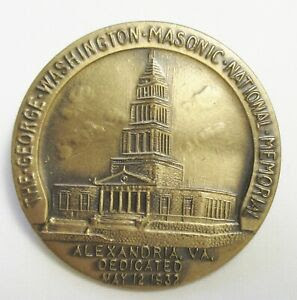
The Memorial itself was officially dedicated in 1932, some 22 years after it was first proposed, and Tabbert provides a synopsis of its mission and exhibits then and now, as well as an explanation of the changes that have occurred there since its opening.

In short, Mark Tabbert’s A Deserving Brother is without question the most extensive, detailed and truthful accounting of Washington and his Freemasonry as he lived it. As an historical research tool it is invaluable, and will unquestionably be the most important reference work on George Washington and the fraternity available for decades to come.

This book is being distributed by Macoy Publishing under a special partnership with the George Washington Masonic National Memorial Association. Priced at $34.95 for the 304-page hardback edition, CLICK HERE TO ORDER.

Thursday, May 27, 2021

History Channel: America's Book of Secrets


by Christopher Hodapp

So nobody tells me these things anymore. I didn't realize this was going to be aired this week until I got a flurry of "Hey, you were on TV" messages.

The History Channel (aka History®) has updated an older series entitled America's Book of Secrets with new episodes this season. Tuesday night, Season 4/Episode 3: The Freemason Factor aired and featured interviews with myself, Brothers Arturo De Hoyos, Akram Elias, Jeff Ballou, plus 
The Craft author John Dickie and others. We actually shot my stuff last October, but the show was delayed for several months due to the COVID shutdowns that prevented the production company from getting all the scenes they needed.

Close your mouth, stupid, before you swallow a fly.

The show airs on Tuesday nights, but it can be seen online at: https://play.history.com/shows/americas-book-of-secrets/season-4/episode-3

(Easter egg bonus for Indianapolis Masons: catch fleeting glimpses of the Scottish Rite Cathedral's stained glass of the letter G, and a glass scene of Solomon and Hiram from Calvin Prather Lodge.)

Thursday, November 26, 2020

George Washington's Thanksgiving Proclamation of 1789

by Christopher Hodapp


General Thanksgiving

By the PRESIDENT of the United States Of America 
A PROCLAMATION

WHEREAS it is the duty of all nations to acknowledge the providence of Almighty God, to obey His will, to be grateful for His benefits, and humbly to implore His protection and favour; and Whereas both Houses of Congress have, by their joint committee, requested me "to recommend to the people of the United States a DAY OF PUBLICK THANSGIVING and PRAYER, to be observed by acknowledging with grateful hearts the many and signal favors of Almighty God, especially by affording them an opportunity peaceably to establish a form of government for their safety and happiness:"

NOW THEREFORE, I do recommend and assign THURSDAY, the TWENTY-SIXTH DAY of NOVEMBER next, to be devoted by the people of these States to the service of that great and glorious Being who is the beneficent author of all the good that was, that is, or that will be; that we may then all unite in rendering unto Him our sincere and humble thanks for His kind care and protection of the people of this country previous to their becoming a nation; for the signal and manifold mercies and the favorable interpositions of His providence in the course and conclusion of the late war; for the great degree of tranquility, union, and plenty which we have since enjoyed;-- for the peaceable and rational manner in which we have been enable to establish Constitutions of government for our safety and happiness, and particularly the national one now lately instituted;-- for the civil and religious liberty with which we are blessed, and the means we have of acquiring and diffusing useful knowledge;-- and, in general, for all the great and various favours which He has been pleased to confer upon us.

And also, that we may then unite in moft humbly offering our prayers and supplications to the great Lord and Ruler of Nations and beseech Him to pardon our national and other transgressions;-- to enable us all, whether in publick or private stations, to perform our several and relative duties properly and punctually; to render our National Government a blessing to all the people by conftantly being a Government of wife, just, and constitutional laws, discreetly and faithfully executed and obeyed; to protect and guide all sovereigns and nations (especially such as have shewn kindness unto us); and to bless them with good governments, peace, and concord; to promote the knowledge and practice of true religion and virtue, and the increase of science among them and us; and, generally to grant unto all mankind such a degree of temporal prosperity as he alone knows to be best.

GIVEN under my hand, at the city of New-York, the third day of October, in the year of our Lord, one thousand seven hundred and eighty-nine.

(signed) G. Washington

The very first official presidential proclamation issued in the United States. Published in the The Massachusetts Centinel, Wednesday, October 14, 1789.

Thursday, April 23, 2020

Video: 'George Washington's Rules for Freemasons in Life and Lodge'


by Christopher Hodapp

Macoy Publishing has just posted a short video about a little book that Mark Tabbert put together with illustrator Ryan Flynn a few years ago. I called attention to it when it came out in 2017, and I am reprinting that post from October 21, 2017 below.
[Back in 2016], my friend Mark Tabbert sent me a manuscript to look over, and graciously asked me to write a foreword to it if I saw merit to it. I absolutely did. It was an unusual little book, and actually a by-product of his own much larger research project. In 2013, Mark embarked on a massive attempt to identify, organize, document, and interpret every incident, object, and contact George Washington personally had to do with Freemasonry. Just making the list to start with was daunting enough, and he's still not close to being finished with the final book he has long envisioned. Nevertheless, since Mark is the Director of Collections at the George Washington Masonic National Memorial in Alexandria, Virginia, his mission is guided by a sense of responsibility to Washington's Masonic legacy that surrounds him every day he drives up that long driveway on Shooter's Hill.


Anyway, back to Mark's research "by-product." One of the persistent things he kept encountering were references and quotes taken from a list of sayings often referred to as Washington's '110 Rules of Civility.' Over the years, people tended to be confused by that title, often believing George himself made them up, or maybe collected them over the years, scribbling them down as he heard them. But that wasn't how he came across them.
In the three centuries preceding this one, a common method of teaching penmanship to young students was by use of the copybook. This was a booklet filled with pages of blank lines, and at the top of each page was a saying, a proverb, or an aphorism, printed perfectly so that the student could follow the example and dutifully attempt to reproduce the precise handwriting presented. But those aphorisms had a more important effect over time. Those bits of wisdom, guidance, rules of proper behavior, and just plain common sense were handed down over the centuries, pretty uniformly, throughout much of Western society.

It was also the way that young George Washington learned his penmanship with a quill, and as an added bonus, how to treat people and be a civilized member of society. It is fair to say that the copybook and the repetitive writing of the sayings was a kind of basic training for living a decent life. By doing so, he also absorbed perfection of character and soul. Reading the Rules, it is striking that they concentrate, not on self-interest or personal happiness, but rather on the treatment and happiness of others. They call for the seemingly minor sacrifices that are required every day for the sake of living together in peace and harmony. The manners described in them go far beyond an obsession with when to tip one’s hat or bow when introduced, and are far more concerned with making other people feel welcome, or comfortable, or honored.

Or equal.

What makes all of this applicable to us as Masons and our lodges comes in something that Washington wrote in a letter in 1793, in which he said, "that the grand object of Freemasonry is to promote the happiness of the human race." That letter echoes a later quote from William Preston in 1796 that "happiness originates in the Lodge, and disperses its influence to the wide circle of the world."

And if it doesn't? I never say this, but I will this one single time. I hate to break it to you, but if it doesn't, you're doing it wrong.

Mark Tabbert has taken these 110 copybook aphorisms and done something unique with them. The result is his small book called George Washington's Rules for Freemasons in Life and Lodge.He's gathered Brother George's 110 Rules and rearranged them into different themes having to do with a Mason's behavior outside of, during, and after lodge (much as James Anderson did in 1723). In addition, Mark follows each Rule with a modern translation in plainer language for each one, much as the average grand lodge Monitor defines archaic language for modern Freemasons. (The original Rules come out of an early 17th century English translation of a French Jesuit book, so the language occasionally needed a gentle nudge of modernity.)

After the specifically Masonic-themed portion of the book, Mark also reprints the original 110 rules, unaltered, in order, so you can see the list of them as Washington wrote them down, for reference. The big bonus to the work is a meticulously detailed chronology of Washington's life and every instance of his contact with Masons, Masonic objects, or Masonic lodges. And finally, there is an extensive bibliography of trustworthy books regarding Washington and Freemasonry. For a book so deceptively small in size, it is densely packed with resources for your own future studies about our most famous American Brother.

At a paltry $10, you ought to pack one in your apron case and haul it out the next time you see a couple of brethren poking each other in the chest out in the parking lot after lodge. Better yet, order one for all of your lodge officers. Read a chapter out loud at your next meeting for a bit of education. Or send an anonymous copy to your grand master just as a reminder.

The copybooks of old largely disappeared in the mid-20th century, so these little proverbs haven’t been widely taught to school children for almost eight decades now. Within about 25 years of them vanishing from classrooms, Americans had already started to be a whole lot less civil, less respectful of each other. I suspect the social barbarism and grotesque treatment of our fellow citizens we are all living through these days is partially a result of the now total disappearance of these gentle, little reminders of truth and civility. They need to make a comeback, and fast.

Maybe as a tool to teach five year olds how to text on their kiddie cell phones, somebody could make an app and resurrect them again.

Mark Tabbert's book is available directly from Macoy Publishing HERE. It's currently unavailable from Amazon for no reason I can think of.

Tuesday, February 19, 2019

George Washington's Masonic Apron at Mount Vernon This Week


(This post was updated Friday, 2/22/19 at 2:15AM. After posting the original story, I went back and looked up more about the history of this apron and the controversies over it.)

Since 2011, the brethren of Mt. Nebo Lodge 91 in Shepherdstown, West Virginia have graciously permitted their 234-year old George Washington Masonic apron to be displayed to the general public during President's Week each February at Washington's Mount Vernon Estate in Virginia.

Young George Washington was initiated, passed and raised as a Freemason at the Lodge of Fredericksburg, Virginia between 1752-53. According to the story provided by the lodge, after the end of the American Revolutionary War, the Marquis de Lafayette allegedly presented his friend Washington this French-made silk Masonic apron while visiting Mount Vernon in 1784. The hand-embroidered apron features a square and compass, the crossed flags of France and the new United States, a memento mori, sprigs of acacia, and a tessellated cable-tow tied with three knots, referred to by French Masons as la houpe dentelee, which represents the mystic tie that binds all Masons in brotherhood.


(American Masons who visit lodges overseas will see this knotted rope symbolism tied with 'love knots' or 'infinity knots' commonly stretched all around lodge rooms, and it is strongly allied with the 'Chain of Union.' Brother Steve Burkle has written an excellent paper on this symbol and its relationship with the 'indented tessel' referred to in Preston-Webb ritual working. See it HERE.)

After Martha Washington’s death in 1802, this apron is believed to have been purchased for six dollars from her estate by Thomas Hammond, husband of George Washington’s niece, Mildred Washington. It was given to the Mt. Nebo Lodge in West Virginia prior to Hammond’s death in 1820.

The apron may be seen on display this week (February 15 - 24, 2019) at Mount Vernon's Donald W. Reynolds Museum and Education Center. Admission to the Museum is included with general admission to the estate.


The Watson-Cassoul Apron,
owned by Alexandria-Washington Lodge 22
This Saturday, February 23rd, the brethren of Mt. Nebo Lodge will hold a wreath-laying ceremony at Mount Vernon. The ceremony will begin at 1:30PM and will feature a prayer from their Masonic funeral service.


Of course, as with other relics alleged to have belonged to the nation's first President and most famous Freemason, the Mt. Nebo apron is not without its skeptics. It is remarkably similar to the the 'Watson-Cassoul Apron' that was presented to George Washington in 1782 by Elkanah Watson of Plymouth, Massachusetts and Monsieur Cassoul of Nantes, France.

Washington chose to wear the Watson-Cassoul Apron when he famously laid the cornerstone of the United States Capitol building in 1793. 
That famous apron is owned by Virginia's Alexandria-Washington Lodge No. 22, and the Mt. Nebo apron looks to be almost identical in design, although of slightly rougher quality and different details (the skull and bone instead of the 'All Seeing Eye' within the triangle at the center, and the acacia instead of the radiant beams, primarily). It is possible that Mt. Nebo's is a copy or variation of the Watson-Cassoul Apron, or perhaps it was a prior prototype.

Lafayette Apron, owned by
the Grand Lodge of Pennsylvania
A third Washington apron (and the best-known one) is known as the 'Lafayette Apron,' which was presented in 1784 by the Marquis de Lafayette, and is now in the Museum of the Grand Lodge of Pennsylvania in Philadelphia. Its design is quite different from the other two. The Lafayette Apron is said to have been sewn by the hands of Madame Lafayette herself, and so it carries a more romantic legendary status. Masons often mistake this apron for the one Washington wore at the Capitol cornerstone ceremony. And the Mt. Nebo story of their apron seems to combine the histories of the other two aprons. Nevertheless, it is possible that Lafayette did in fact present two aprons to his famous Masonic brother.

That said, the curators at Mount Vernon are obviously convinced enough by Mt. Nebo's provenance to confidently display it as authentic. And there's no reason to question that Washington really did have all three aprons presented to him in the early 1780s by his Brother Masons.

See the original story I posted in 2011 about the Mt. Nebo apron's first exhibition at Mt. Vernon: "Lost" Washington's Lafayette Apron To be Displayed at Mt. Vernon

Thursday, November 22, 2018

George Washington's Thanksgiving Proclamation of 1789

General Thanksgiving

By the PRESIDENT of the United States Of America
A PROCLAMATION

WHEREAS it is the duty of all nations to acknowledge the providence of Almighty God, to obey His will, to be grateful for His benefits, and humbly to implore His protection and favour; and Whereas both Houses of Congress have, by their joint committee, requested me "to recommend to the people of the United States a DAY OF PUBLICK THANSGIVING and PRAYER, to be observed by acknowledging with grateful hearts the many and signal favors of Almighty God, especially by affording them an opportunity peaceably to establish a form of government for their safety and happiness:"

NOW THEREFORE, I do recommend and assign THURSDAY, the TWENTY-SIXTH DAY of NOVEMBER next, to be devoted by the people of these States to the service of that great and glorious Being who is the beneficent author of all the good that was, that is, or that will be; that we may then all unite in rendering unto Him our sincere and humble thanks for His kind care and protection of the people of this country previous to their becoming a nation; for the signal and manifold mercies and the favorable interpositions of His providence in the course and conclusion of the late war; for the great degree of tranquility, union, and plenty which we have since enjoyed;-- for the peaceable and rational manner in which we have been enable to establish Constitutions of government for our safety and happiness, and particularly the national one now lately instituted;-- for the civil and religious liberty with which we are blessed, and the means we have of acquiring and diffusing useful knowledge;-- and, in general, for all the great and various favours which He has been pleased to confer upon us.

And also, that we may then unite in moft humbly offering our prayers and supplications to the great Lord and Ruler of Nations and beseech Him to pardon our national and other transgressions;-- to enable us all, whether in publick or private stations, to perform our several and relative duties properly and punctually; to render our National Government a blessing to all the people by conftantly being a Government of wife, just, and constitutional laws, discreetly and faithfully executed and obeyed; to protect and guide all sovereigns and nations (especially such as have shewn kindness unto us); and to bless them with good governments, peace, and concord; to promote the knowledge and practice of true religion and virtue, and the increase of science among them and us; and, generally to grant unto all mankind such a degree of temporal prosperity as he alone knows to be best.

GIVEN under my hand, at the city of New-York, the third day of October, in the year of our Lord, one thousand seven hundred and eighty-nine.

(signed) G. Washington

The first official presidential proclamation issued in the United States. Published in the The Massachusetts Centinel, Wednesday, October 14, 1789.

Sunday, November 04, 2018

Iconic Washington Painting Restored at the GW Memorial

George Washington as Master of His Lodge (1932) by Hattie Burdette
(Image before its restoration)
On Thursday this past week, the George Washington National Masonic Memorial in Alexandria proudly reinstalled a famous Masonic portrait of Washington, dressed in the regalia of Worshipful Master of Virginia's Alexandria-Washington Lodge 22. The Memorial recently undertook the task of having the original painting restored, and it now hangs near the Memorial's South Lodge Room.

It was just in time. 

This evening - Sunday, November 4th, 2018 - marks the 266th anniversary of the initiation of then 20 year-old George Washington into the Lodge at Fredericksburg, Virginia in 1752.


If this portrait looks familiar to many of you, it should. The portrait was commissioned in 1931 by Freemason and U.S. Congressman Sol Bloom for the George Washington Bicentennial Commission, and painted by artist Hattie Elizabeth Burdette (1875-1955). It depicts Washington presiding as Master of Alexandria-Washington Lodge No. 22, gavel in hand. If not the most famous image of Washington as a Freemason, it's arguably the most widely circulated one that is seen regularly in lodges all across the United States. Yet, it was commissioned by a Congressional committee and paid for by the government, not Masons. Imagine such a proposal today.

How is it that this particular painting of Brother George dressed as Worshipful Master wind up in so many American lodges? According to William D. Moore and John D. Hamilton's detailed essay, 'Washington As the Master of His Lodge: History and Symbolism of an American Icon',

New York Congressman Sol Bloom, director of [the Memorial] and a member of New York's Pacific Lodge No. 233, took pride in his agency's insistence on "realism." In consultation with F. Walter Mueller, a member of Century Lodge No. 100 in South Orange, New Jersey, Bloom reviewed many Masonic portraits of Washington before rejecting them all as inaccurate. He then hired Burdette to- create a portrait in which the figure was based upon Houdon's statue of Washington while the overall work incorporated the relics maintained by Alexandria-Washington Lodge No. 22... As well as appearing repeatedly both in the Masonic press and in publications of the Washington Bicentennial Commission, more than fifteen hundred photolithographic reproductions of Burdette's painting were distributed by congressmen to Masonic organizations throughout the United States.
Brother Sol Bloom
Brother Sol Bloom represented the 20th Congressional District (Manhattan's west side) in the House of  Representatives, serving fourteen terms from 1923 until his death in 1949. During the critical years leading up to and through the end of World War II, he was Chairman of the House Committee on Foreign Affairs, and he later went on to become one of the first signers of the United Nations charter. 

Prior to his congressional career, he had been both a newspaper and music publisher. He also understood showmanship. Early in life he was a theatrical and boxing manager, and he had been the creator of the Midway of the famous Chicago Columbian Exhibition in 1893.

In 1931, Bloom was named both chairman of the Congressional George Washington Bicentennial Commission and the director of the George Washington National Masonic Memorial's Bicentennial Committee, commemorating the 200th anniversary of George Washington's birth the following year. On that date, the new Masonic Memorial towering above Alexandria would be dedicated and opened to the public. Bloom requested eight Washington D.C. area artists to each create a poster which would be used to promote the official government-sponsored national celebration of Washington's birthday in 1932. Artist Hattie E. Burdette asked permission of Alexandria-Washington Lodge 22 to use their lodge room and Washington's Masonic gavel, sash, Past Master's jewel, his chair, and other items to depict in her painting. 


Teft Johnson, George's stand-in
Her model was Teft Johnson (photo), an actor who portrayed the role of Washington in several historical plays under the direction of famed Broadway producer David Belasco. Of all the posters submitted, Burdette's was selected by the Commission to advertise the Memorial's dedication.

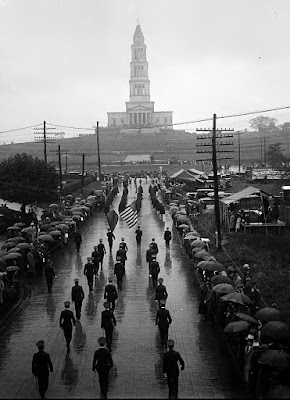
On November 29, 1931, Congress and the National Bicentennial Commission decided that second week of May in 1932 would be set aside as Masonic Week. Consequently, May 12th would be the official opening and dedication of the George Washington Masonic National Memorial

Invitations to this gala event were sent to thousands of American citizens and to regular Freemasons around the world. Although not a Mason himself, President Herbert Hoover and the First Lady were among the first to accept the invitation. Others included every member of Congress, the Justices of the Supreme Court and members of President Hoover’s cabinet, along with all 49 of the Grand Masters of the U.S. The mayor of Alexandria, the governor of Virginia, and many other government, military, religious and civic leaders joined the celebration. 

President and Mrs. Hoover leaving the Memorial on May 12th, 1932
As bad luck would have it, a torrential five-day downpour nearly ruined the ceremony - 50,000 attendees and onlookers had been expected and planned for, but the rain and flooding kept all but 1,500 from climbing the long driveway and attending at the Memorial itself. Bleachers outside sat wet and empty as reportedly hundreds of onlookers watched from the bottom of Shooters Hill safe and dry, huddled in railroad coaches at the Alexandria train station. Those who could manage to get inside the Memorial jammed into the 400 seat auditorium for the various speeches, far exceeding the Fire Marshal's directives.

On September 17, 1932 Teft Johnson again portrayed Washington for a reenactment of the President laying the cornerstone of the United States Capitol with full Masonic ceremony. The cornerstone ceremony reenactment was filmed by the Bicentennial Commission.

I am told with as much confidence as is possible that reproductions of Hattie Burdette's painting were circulated to every U.S. lodge possessing a charter in 1932, and that even today, every lodge in Virginia still has one hanging in its building. The original hung in the U.S. Capitol throughout 1932, and was then gifted to the George Washington National Masonic Memorial when the year was over.

And to come full circle, the historic Bible upon which young Brother George placed his hands that evening in Fredericksburg 266 years ago when he took his obligation as an Entered Apprentice is still preserved by Fredericksburg Lodge No. 4. The lodge has recently started a restoration fund to have the fragile book properly curated for future generations. We were honored to have it here in Indiana for our Grand Lodge Bicentennial and the Conference of Grand Masters this year.