"To preserve the reputation of the Fraternity unsullied must be your constant care."

BE A FREEMASON

Showing posts with label art. Show all posts

Wednesday, October 01, 2025

Grand Lodge of Texas 1945 Mural Created...At Last

Image: Sean Starr

by Christopher L. Hodapp

UPDATE: THIS STORY WAS UPDATED 10/2/2025 WITH A NEW COMPOSITE IMAGE PROVIDED BY THE ARTIST.

When the Grand Lodge of Texas built their magnificent art deco/Egyptian-revival grand lodge building in Waco in the 1940s, a mural was designed originally to be installed behind the auditorium's Grand East. It was never completed, for reasons lost in the mists of time. Cheapness, laziness, changes in taste, or never getting around to it. The point is, it was never put in place.


According to PGM and Grand Secretary Brad Billings, it was included in the building committee meeting talks up until 1945. An architectural model was created when the building was proposed by architect Raoul Jossett, and it was built almost exactly as the model specified. But the mural itself was never installed. A look at the immense size of the auditorium stage gives you some idea of just how huge this would have been.

"Speculation is cost or they likely couldn't find a local artist to make that size painting," says Brad.

Fast forward to this past year.

An artistic Texas Brother named Sean Starr got hold of the original proposed artwork and has painted a scaled-down version for the Grand Secretary's office in three 5-foot by 5-foot panels. (Composite image above provided by the artist.)

It appears to depict Hiram Abiff (or perhaps King Solomon?) flanked by art deco depictions of the Holy Sts John, combined with the circle and parallel lines of our symbolism.

GS Billings says the mural will be projected behind the Grand East at the next annual communication of Grand Lodge. He adds, "We plan to make prints to help offset the cost of the artist to make it! I’m happy to answer any questions or give a quote. Such a cool thing to be a part of!"

Tuesday, August 05, 2025

Albert Pike's Masonic Statue To Be Reinstalled in Washington D.C.


by Christopher Hodapp

The National Parks Service has announced it will restore and re-install the iconic bronze statue of Scottish Rite sage Albert Pike on its former plinth in Washington, DC's Judiciary Square. On June 19, 2020, the statue was toppled by rioters, covered in paint, doused with lighter fluid, and ignited, a victim of the national Confederate-related statue-toppling mania that went on in the wake of the death of George Floyd in Minneapolis.

According to a press release from the NPS issued yesterday,

Micro-abrasive cleaning of the Albert Pike statue to remove corrosion 
and paint in order to review the conditions of the bronze prior to repairs 
NPS photo
The restoration aligns with federal responsibilities under historic preservation law as well as recent executive orders to beautify the nation’s capital and re-instate pre-existing statues.

Originally authorized by Congress in 1898 and dedicated in 1901, the statue honors Pike’s leadership in Freemasonry, including his 32 years as Sovereign Grand Commander of the Ancient Rite of Scottish Freemasonry. The statue has been in secure storage since its removal and is currently undergoing restoration by the National Park Service’s Historic Preservation Training Center.

This action supports both the Executive Order on Making the District of Columbia Safe and Beautiful and the Executive Order on Restoring Truth and Sanity to American History, which direct federal agencies to protect public monuments and present a full and accurate picture of the American past.

Site preparation to repair the statue’s damaged masonry plinth will begin shortly, with crews repairing broken stone, mortar joints, and mounting elements. The NPS is targeting October 2025 for completing the reinstallment of the fully restored statue.
Upon the announcement, Washington D.C.'s longtime non-voting delegate to Congress, Eleanor Holmes Norton, announced her intention to introduce a new bill in Congress to prevent its reinstallation and to, instead, donate it to a museum, saying, "a statue honoring a racist and a traitor has no place on the streets of D.C."

Before its toppling, detractors had long objected to the statue on the grounds that Pike had owned several slaves when he lived in Arkansas, and served for just five months in the Confederate Army as a Brigadier General before resigning in disgust, making it the only statue of a "former Confederate soldier" in the District. There has also been a longstanding, unsubstantiated allegation that Pike had been a founder of the post-war Ku Klux Klan, claiming he had written their original rituals. And, oof course, there's a whole raft of conspiracy theories about Pike, topped by the absurd notion that he was a Luciferian whose rituals turned Freemasonry into Satanic ceremonies.

Pike was a complex, intellectual and deeply profound man in his day, and attempting to portray him as a "racist and a traitor" ignores just how complex he really was, reducing his lifetime to just two misleading adjectives. And wrapping up such a superficial judgement with lies and conspiracy theories is a deliberate attempt to rewrite history to win likes and clicks.

(See Scottish Rite SJ Grand Archivist Arturo DeHoyos' statement from 2020 about Pike's real writings and activities HERE.)

Pike's statue had first been erected by the Scottish Rite SJ across from the location of their original 'House of the Temple' headquarters. For thirty years, protesters and the press characterized Pike's sculpture as a "Confederate monument," despite the fact that it was never anything of the kind. His statue was not erected by pro-Confederate veterans groups, or by alleged Ku Klux Klan members (it predated the 1920s resurgence of the KKK by many years). The statue was originally erected on a tiny sliver of land between two diverging diagonal streets. The streets and the statue were moved slightly when a new highway on-ramp was built there in the 1950s. The 11-foot tall bronze sculpture by Italian artist Gaetano Trentanove was erected in 1901 and donated to the city by the Scottish Rite Southern Jurisdiction to commemorate their own 100th anniversary. 

Out of their first 90 years, Albert Pike had served as the AASR-SJ's Sovereign Grand Commander for 32 of them—over a third of the Supreme Council's entire lifespan at that time. The original House of the Temple held their headquarters, their auditorium for putting on degrees, their vast and growing library, and Albert Pike lived and died there. So did his TWO successors. That made this particular corner historically significant.


The sculpture did NOT depict Pike as a Confederate soldier, nor did it commemorate or celebrate the five months in which he served as a general in the Confederate army. It was a Masonic representation of Pike's lifetime accomplishments as an author, philosopher, orator, lawyer, historian, polyglot, and a soldier (not only in his brief stint in the Confederate army, but also in the Mexican-American War). He wasn't atop a horse; he had no sword dangling from his belt; there was no declaration of heroship, and no phony bromide about 'healing a divided nation' that are the hallmarks of Civil War statues. Pike stood there with a book in his hand and the inscription Vixit Laborum Ejus Super Stites Sunt Fructus. "He has lived. The fruits of his labors live after him." Yet few - if any - who tore it down had any interest in actually looking up what the fruits of his labors really were.

There were no references to the Confederacy, only that Pike had been a "soldier" and the banner in the hand of the Grecian figure is not a Confederate flag or symbol, but a Scottish Rite one featuring the double-headed eagle. It was purely a Masonic statue and an homage to his life's many accomplishments. Nevertheless, it was felled by the mob and hauled away to an unspecified location by the District's Parks Department.


This morning, an NPR reporter sent me an email asking for a comment about the statue's restoration. Unfortunately, I returned her call too late for her deadline. The last thing any Freemason wants is for this whole controversy to bubble up again and used to fling mud on the fraternity. I've never been of the opinion that Pike needed to be beatified by Masons, and he didn't either, if his own writings were any indication. He once wrote: “When I am dead, I wish my monument to be builded only in the hearts and memories of my Brethren of the Ancient and Accepted Scottish Rite, and my name to be remembered by them in every country, no matter what language men may speak there, where the light of the Ancient and Accepted Scottish Rite shall shine, and its oracles of Truth and Wisdom be reverently listened to.”

Besides, Washington Masonic sites get enough vandalism from the lunatic crowd without giving them another one. But I despise it when the hysterics go out of their way to spread lies about the fraternity, especially when the truth is easily discovered.

For more than you'll ever want to know about Pike and the statue, see Albert Pike, Statues, History and Hysteria from back in 2017. In the 1980s and 90s, it became something of a crusade for perennial presidential candidate and famed nutcase Lyndon LaRouche to demand its removal.

Every time this particular subject arises, I always add the same post script. In February 1993, the Philalethes magazine published a piece about the Pike statue controversy that was raging back then. It was written by the Reverend Howard L. Woods, a Christian minister who served for ten years as the Grand Master of the Most Worshipful Prince Hall Grand Lodge of Arkansas F&AM. In 1991, he had been invited as the Lecturer for the Philalethes Society, the first Prince Hall Mason ever asked to do so, and still many years before Prince Hall recognition became widespread. GM Woods wrote before more recent scholarship has brought to light more of Pike's writings and verification that Pike did indeed provide his revised Scottish Rite rituals to help the Prince Hall aligned Scottish Rite.*(see note)

The Reverend Grand Master Woods' perspective in 1993 deserves to be repeated now, both for our own members and the general public. It still rings true 32 years later.
The Albert Pike Statue: Let It Stand
There is no love lost between Prince Hall Masons and the memory of the late Albert Pike, Masonic Historian, writer, alleged ritualist for the Ku Klux Klan, but, if Freemasonry is to remain the bulwark of free-thinking people, then, "Let the statue remain!"
Like the natures he wrote about, Albert Pike showed the light and dark sides of his own soul, when with one breath he spoke of his willingness to give up his Freemasonry rather than recognize the Negro as a 'Masonic Brother' and with another breath, declared that every man should be free, for a free man is an asset, while a slave is a liability. Mankind is that way, and as long as the statue stands, America and Freemasonry will survive.
Let the statue be torn down and America and Freemasonry will be in jeopardy, for one would have to wonder, "What would be next?" As a Prince Hall Mason, an African American and supposedly free-thinker, I can see a higher power than the mortal mind of Albert Pike guiding his pen as he wrote such beautiful words of life without an occasional helping hand from someone "bigger than you or I."
Let the statue stand, even if it is proven that Albert Pike did write ritual for the Ku Klux Klan; more ignoble deeds have been done by others without sacrifice of their historic heroism.
Let the statue stand as a reminder that the good and evil of men are in equilibrium within us, and we all should strive for perfection now and in the future, not in the past. Let the statue stand!
 --Rev. Howard L. Woods, Grand Master, Prince Hall Masons of Arkansas.

*NOTE: Between 1887 and 1891, Albert Pike happily shared personal, autographed copies of his Scottish Rite Masonic degree rituals with his counterpart, Thornton A. Jackson, in the parallel Scottish Rite Southern Jurisdiction for black Prince Hall Masons, in order to assist their fledgling organization. Pike's correspondence has not survived, but in writings of the period, Jackson described Pike as his friend. Later comparisons of their two sets of rituals confirmed that the Prince Hall AASR-SJ today remain very close to those Pike wrote in the years before 1887.

Post-riot photos by Brother Efrian Olujimi Dalle

Monday, February 10, 2025

Masonic and Odd Fellows Folk Art at Cincinnati's Taft Museum


by Christopher Hodapp

From now until May 11th, 2025, downtown Cincinnati's Taft Museum of Art is displaying an exhibit of fraternal folk art featuring some 80 pieces from the Freemasons and the Odd Fellows.

From the museum's website description:
Mystery & Benevolence: Masonic and Odd Fellows Folk Art

Through compelling and cryptic works of art, Mystery & Benevolence brings to light the histories, symbolism, and beliefs of the Freemasons and the Independent Order of the Odd Fellows (IOOF)—two fraternal organizations with deep roots in American history.


For decades, members across the country have come together to socialize, help others, and improve themselves and their communities. The exhibition features more than eighty works of art, including items once owned by the Daughters of Rebekah—the first lodge to include women—and the Grand United Order of Odd Fellows, founded as the African American counterpart to the IOOF. Sculptures, textiles, regalia, prints, and works of decorative art explore the main principles of the organizations: fellowship, charity, labor, passage, and wisdom. Elaborately stitched costumes, gilded regalia and jewelry, and richly embellished ceremonial objects provide a glimpse into the enigmatic world of these secret societies.


Mystery and Benevolence is organized by the American Folk Art Museum, New York, NY, from the Kendra and Allan Daniel Collection and toured by International Arts & Artists, Washington, DC.

The Taft Museum is open Wednesdays through Mondays from 10AM to 5PM. Admission is free for Taft members, guests of members with guest pass, military, and youth (17 and under); $15 for adults; $12 for seniors. Includes admission to special exhibitions and the museum’s collection galleries. Sundays and Mondays are free of charge.

The Taft Museum of Art is located at 316 Pike Street, at the east end of Fourth Street, across from historic Lytle Park in downtown Cincinnati.

Sunday, June 23, 2024

Smoky Mountains Masonic Marker Near Maggie Valley Vandalized


by Christopher Hodapp

The Great Smoky Mountains Masonic Marker at Black Camp Gap in North Carolina was recently vandalized, according to an article on the WLOS-TV13 website


The Marker, located along the Blue Ridge Parkway, is a stone monument that was constructed in the 1930s by area Freemasons, and it contains stones from all 50 states, many of which are inscribed with their origins. 

Attendees at the annual Great Smoky Mountains York Rite Festival held in Maggie Valley each July make a pilgrimage to the Marker. It was dedicated July 11, 1938 and contains a time capsule. 


The Marker sits at the top of a hill and can be reached via a series of stone steps that are engraved with the names of various lodges and grand lodges that contributed to its construction. Photos in the article show damage was done to those stairway stones, along with several more on the Marker itself:

Blue Ridge Parkway representatives say it appears that someone took a hammer and chipped the steps away at the Masonic marker near Maggie Valley, all the way up to the main marker. "It appears to be some fairly recent vandalism," said Blue Ridge Parkway spokesperson Leesa Brandon.

Brandon says that only last week did they hear of the damage at the Masonic marker off of the Heintooga Road section of the Parkway.

"Unfortunately, instances of graffiti and vandalism on the Parkway are all too common," said Brandon. "But we're sorry obviously to see this particular instance at this historic marker that's been here since the late 1930s."

The monument includes rocks from most states — from places such as Plymouth Rock and the Alamo. Some of the stones have even come from the Rock of Gibraltar and Antarctica.

"A biker told me about it," said Mark Balree, who is visiting from Wilmington. "I'm going to go see it."

He finds the monument intriguing and is saddened to hear of the vandalism.

"Our law enforcement rangers have been on site and have collected some of the information," said Brandon. But, with no surveillance cameras on site, the investigation will be difficult.

"It's very hard to know or say exactly what happened without any witnesses," she said.

Brandon said this marker has a significant meaning to the Freemasons. "We've started some discussions with some of the local caretakers of that site about next steps," she said. The repairs, however, will be more difficult than replacing graffitied or stolen overlook signs.

"This is not going to be that kind of repair," Brandon said. "It will require a lot of special care and attention."

Future security measures are up for discussion, such as a security camera and more patrols.

"I think all of those conversations are on the table," she said.

The Blue Ridge Parkway says anyone with information should contact authorities at 1-800-727-5928.


The Marker was the brainchild of T. Troy Wyche in the early 1930s. A stone bearing his name was damaged, as was a triangular stone commemorating its dedication in 1938. It was created to demonstrate the cooperation among Masons all over the world.

The National Park Service explanation of the Marker
(Photo: Chris Hodapp)

According to the National Parks Service sign, the Marker is made up of 687 stones that came from the various states and 41 other nations, from every continent, including Antarctica. They include stones from Plymouth Rock, the Rock of Gibraltar, the Alamo, and the White House.

Over the years, a metal fence was installed around the Marker in an attempt to prevent just this sort of vandalism, and a wooden shelter was built over it to guard against damage from the natural elements.

Friday, February 02, 2024

Grand Orient of Italy Wins Court Battle Against Italian Senate Over Mussolini's Confiscation of Their HQ


Photo: Wikipedia Commons

by Christopher Hodapp

The Grande Oriente d'Italia (Grand Orient of Italy) has prevailed in an Italian Supreme Court ruling against the government that restores ownership of their former headquarters. The historic Palazzo Giustiniani was illegally seized in 1925 by dictator Benito Mussolini's Fascist government ,and was never returned to the Masons after the end of World War II. Since that time, the magnificent 16th century palazzo with its beautiful interior frescos has housed the offices of the Senate of the Republic, and is the residence of the President of the Senate.

The landmark decision was handed down on January 26th, and recognizes the fact that the fascist state confiscated the Masons' historic property without any due process, recompense or restitution whatsoever. The verdict comes just one year short of the 100-year anniversary of the building's seizure.

From the close of World War I until the Allied victories against the Axis dictatorships that ended World War II, Freemasonry in Hitler's Germany, Mussolini's Italy, and Franco's Spain was suppressed and declared to be a so-called "secret society." Countless European Masons were persecuted, arrested, and even executed for no other crime than being a Freemason. The Palazzo Giustiniani was seized from the Grand Orient Masons by the Mussolini regime for use by the Italian Senate, and Freemasonry in Italy was banned outright by 1926. After war broke out across Europe, Masonic halls all over Axis-occupied territories were confiscated, along with regalia, furniture, artwork, and especially grand lodge membership files. Masonic buildings were frequently turned into anti-Masonic propaganda displays and museums, luridly staged with the creepiest of props (skeletons were a big hit with the public) to perpetuate the unfounded allegations that the fraternity practiced Satanic worship, blasphemies, plotted revolutions, and other creepy, nefarious intrigues.
NOTE: To clarify: the Grand Orient of Italy is the largest obedience in that country, and it is the body that the overwhelming majority of U.S. grand lodges recognize. The Grand Lodge of Italy is the second largest group, a mixed body that admits both men and women, and is not deemed regular by the overwhelming majority of the Masonic world. But in a rarity, the United Grand Lodge of England—from whom many U.S. grand lodges seek clarity and guidance—recognizes the much smaller and newer Regular Grand Lodge of Italy. The U.S. did not uniformly follow UGLE's action, and continues not to do so.
After the war ended, and Freemasonry returned, the Grand Orient was permitted to move its headquarters back into the palazzo, but it continued to principally be occupied by the Senate offices. By 1981, the Masons again moved out – voluntarily this time – into a smaller building.

From my albeit imperfect understanding of the whole situation, it certainly sounds like the Grand Orient Masons are now the Senate's new absentee landlords.

From a letter circulated this week by the Grande Oriente d'Italia's Grand Master Stefano Bisi:


"Fascist paramilitary squads violently occupied the building on 5 November 1925, as the Court itself recalled. And immediately afterwards the fascist state acquired the building, through a settlement agreement, against which appeals were already presented in various judicial offices at the time, asserting its right of pre-emption on an asset of artistic value, without however first declaring the nullity of the contract stipulated by the GOI in 1911 for the purchase of the building itself.
"This was a condition, the Court said, prejudicial for the state to be able to exercise its right of pre- emption and acquire the property. Consequently, the regime illegally took possession of the property in violation of the 1909 law on artistic assets.
On these legal bases, the United Sections of the Supreme Court of Cassation sent the case back to the Lazio Regional Administrative Court, remitting to it the assessment regarding the legitimacy of the acquisition procedure of Palazzo Giustiniani.
The Grand Orient expressed satisfaction with the court's decision and confirmed that the judicial initiative is aimed exclusively at restoring the truth of the facts to history in the full conviction that it represents the foundation of the essence of the democratic state to which the Grand Orient of Italy is proud to belong.
A victory for the Grand Master Stefano Bisi, his council and the staff of lawyers of the GOI. A very important step forward in the controversy which adds to other historic goals scored in these last years by the Italian Masonic institution.
Located close to Rome's Pantheon, the beginnings of this Roman palace were originally built as a religious residence in the mid-1500s on the Via della Dogana Vecchia. But in 1590, it was acquired by a Genoese prince named Giuseppe Giustiniani. Over time, Giustiniani's descendants bought up surrounding buildings, eventually connecting them together until it comprised the entire city block. 

Great big palazzos can look mighty empty unless they get filled up with statuary, paintings, murals and other tchotchkes, which is just what the Giustiniani's set about doing. The artwork collection was reputed to be comprised of more than 1,600 pieces, including paintings by some of the greatest artists of the Renaissance period, and even 1st century AD statuary excavated from the remains of Emperor Nero's infamous Baths

Many additions and modifications were done to the palace over the centuries. Most of the ancient statuary and the most valuable art pieces were sold off over the 1700 and 1800s, and by 1826, the last of the Giustiniani family died out. The building was then acquired by the Grazoli family, and for a while it was rented out as the diplomatic residence of the Tzarist Russian Ambassador to Italy.

The massive palazzo was finally leased to the Freemasons of the Grand Orient of Italy beginning in 1898 for 11,000 lire a year. Three years after that, the Grand Orient purchased the historic building outright for use as its headquarters, and converted several of the largest rooms into magnificent lodge meeting halls.

The ceiling of one gallery is decorated with images of King Solomon.

The same gallery today, stripped of its Masonic furnishings


Solomon looking over the plans for the Temple, in the background.

"Solomon's Judgement," the famous instance of two women claiming to be mothers of
the same newborn child. Solomon calls their bluff, and threatens to cut the child in half,
causing the liar to confess her fraudulent claim.

The opportunity to acquire the building outright was spearheaded in 1901 by the Grand Master (and Mayor of Rome at the time, by the way) Ernesto Nathan – the 7-story, 405-room palace was sold to the Grand Orient for 1,055,000 lireAccounting for inflation since 1901 and the conversion rate between the Italian Lira and the U.S. Dollar, that original 1,055,000 lire purchase price calculates out to about US$11 billion today. 

That's with a B. Give or take. 

The Senate set aside space in the Palazzo for the Masons' return after WWII, but about 40 years later even that reduced area became too much room for the GOI to deal with. In 1981, the notorious P2 (Propaganda Due) scandal became an international crime headline-grabber. The complex plot involved a former Grand Orient Masonic lodge being operated without a charter by its expelled Worshipful Master, Licio Gelli, with a thousand secret members as a front for organized crime, government corruption, killings, terrorist attacks, bombings, and even the theft of a substantial sum of cash from the Vatican's own bank accounts. Even today, the P2 lodge is often described as having been a "shadow government," made up of evildoing Masons in high-ranking military and government positions. 

Even though the P2 lodge was operating illegally and the Grand Orient expelled and denounced all those involved, the European press rarely took care to explain the reality of the situation or make clear that thousands of rank and file Masons had nothing to do with Gelli's crimes. To this day, Freemasons all across Europe are frequently outed by the press and denounced as criminals primarily because the P2 scandal was so notorious. The reputation of the fraternity worldwide was sullied by the press coverage of the whole affair, even though the actual participants had nothing to do with Freemasonry.

In 1985 the Grand Orient moved its headquarters down the road into a much more modest (but still not-exactly scruffy) home –  the Villa Medici del Vascello in Rome (photo below), purchased at that time from Princess Elvina Pallavicini. 

Current home of the Grand Oriente d'Italia, in the former Villa Medici del Vascello.
Photo from the GOI website.

A departure agreement made in 1991 with the Senate was supposed to provide a large area at the Palazzo for an Italian Museum of Freemasonry – which never materialized. According to a 1985 article in La Repubblica, four floors of the Palazzo remained partially decorated with imagery of the Masonic fraternity.
NOTE: My own mastery of Italian is limited to "Ciao!" and "Pronto!", asking waiters for my dinner check to be handed over to the wealthier-looking guy at the next table, and shouting down the hall for an extra roll of carta igienica. Consequently, my deciphering details from Italian articles can't be trusted. But below is my probably-terrible English translation – aided by Google Translate:
"[T]he Sancta Sanctorum remains, that is, the main temple of the Grand Orient and five other smaller temples. It is here that at least once a week, at the behest of the grand master, Armando Corona, what the Freemasons call their "ritual work" takes place. Here is the "hall of [winding] steps", here are the Workshops, "sacred spaces above and outside the world", with the entrance located to the west, the blue-vaulted roof dotted with constellations with the signs of the zenith and of the nadir, and the black and white checkered floor to recall that of Solomon's Temple.
"The Grand Master's throne is surmounted by a canopy of blue fabric with gold fringes. On the eastern wall stand the initials of the phrase: "To the glory of the great architect of the universe". The statues of Hercules, Venus and Minerva next to the three flame lamps and the three love knots symbolize strength, beauty and wisdom. Wisdom, for the Grand Master Armando Corona, was to give victory to the Senate, which for years and years had been claiming the four floors of Palazzo Giustiniani occupied by the Grand Orient.
"However, I set one condition," says Corona. "Given that our name derives from the Giustiniani Palace, it is right and indispensable that in this palace the Grand Orient preserves at least one "ubi consistam" – some rooms – in order to symbolically justify its denomination". According to the compromise, three floors for a total of approximately three thousand square meters will be sold to the Senate and - in exchange for a symbolic rent with no deadlines - the first floor will instead be kept for the Grand Orient, where Corona intends to set up a permanent exhibition of the history of Freemasonry and in which the main temple will be maintained for its esoteric rites..."
It's true that governments generally have more money than either Elon Musk or God (in that order), but something tells me that the Italian Senate has no intention of offering to buy their longtime digs back from the Masons for US$11 billion.

From Il Tempo: "Giustiniani Palace. A glimmer of light for the Freemasonry museum/Il Tempo" reported by Riccardo Mazzoni:
After a century of battles, the Freemasons managed to reopen the case of Palazzo Giustiniani, the historic seat of the Grand Orient of Italy expropriated by the fascist regime. The Supreme Court of Cassation has in fact annulled the ruling of the Council of State which had established the jurisdiction of the ordinary judge on the issue, and the TAR will therefore have to judge. 
The Grand Orient of Italy had denounced the lack of the preliminary condition of the legitimate exercise of the power of the Italian State, i.e. the failure to declare the nullity of the deed of sale drawn up way back in 1911 in favor of Urbs (real estate company of the Grand Orient of Italy), with the consequence that, since the ownership deed in the company remained in force, the pre-emption decree issued by the government could not constitute a transfer deed in favor of the latter, an argument fully accepted by the Supreme Court.
The Grand Orient of Italy reiterated that the judicial initiative is aimed exclusively at restoring the truth of the facts to history, "in the full conviction that historical truth represents the foundation of the essence of the democratic state".
"The united sections of the Court of Cassation, Grand Master Stefano agreed with us" Bisi told Tempo. "We denounced and argued that the fascist regime could not legitimately exercise the right of pre-emption on the Palazzo Giustiniani because the purchase deed had not been declared null and void in our favor. Now I hope that the President of the Senate Ignazio La Russa will summon us in order to find an agreement to hand over at least those 140 square meters to make the museum of Italian Freemasonry, as foreseen by the agreement signed in 1991 by President Giovanni Spadolini and the Grand Orient of Italy."
The judicial process was restarted by the will of the current council at the end of July 2020: thanks to painstaking work done in the archives of the Grand Orient of Italy, fundamental documents were recovered thanks to which an appeal was presented to the TAR of Lazio on 29 July 2020 against the Senate "for the investigation and declaration of the abusive occupation of Palazzo Giustiniani, the historic seat of Freemasonry which was acquired by force of public property, with a sham transaction which forced the Grand Orient to recognize the legitimacy of the expropriation". But for this renunciation the fascist state promised compensation, and this was the basis that opened the way to the appeal. The one faced by the Freemasons of Palazzo Giustiniani was an authentic judicial ordeal, starting from the sentence of '53 of the Court of Appeal of Rome which declared the action for annulment due to the defect of consent causing violence to be extinguished "by statute of limitations", because the action "should have been carried out within five years of the events", i.e. in the period in which fascism exercised its maximum violence. A paradoxical motivation, therefore.
The Lazio Regional Administrative Court's ruling in December 2021, confirmed by the Council of State, then constituted yet another mockery, sending the dispute back to the jurisdiction of the ordinary judge. Now the Court of Cassation has brought justice, and the hope is that the final word will be put to an end to an affair which certainly does no credit to the republican state, which for decades has in fact legitimized an abuse of power perpetrated by the fascist regime with violence. Alongside judicial truth, therefore, there is also a political and institutional question of great importance: the repudiation of a false right acquired through a crime against humanity, which was in effect the persecution of the Freemasons culminating in the merciless hunt on the night of San Bartolomeo. "It cannot be tolerated," Bisi stated on several occasions, "that an undue claim by a State like Italy, which is the homeland of Democracy, Justice and Freedom, could be based on this crime." 

Saturday, August 12, 2023

Freemason and Odd Fellows Exhibit at Historic Arkansas Museum in Little Rock


by Christopher Hodapp


A new exhibition on Freemasonry and the Odd Fellows opened this evening at the Historic Arkansas Museum in Little Rock: "Mystery and Benevolence: Masonic and Odd Fellows Folk Art from the Kendra and Allan Daniel Gift to the American Folk Art Museum."

The exhibit is on loan from the American Folk Art Museum in New York.


Mystical, evocative, and sometimes simply strange, the art of fraternal practice is rich in symbols that are oddly familiar yet strikingly uncommon. Through arcane and alluring artifacts, Mystery and Benevolence brings to light the histories of the Freemasons and the Independent Order of the Odd Fellows, two fraternal secret societies with deep roots in American history. The over eighty carvings, textiles, sculptures, and adornments that constitute this exhibition were used from the late eighteenth through mid-twentieth centuries, and retain their clandestine allure to this day.

The Historic Arkansas Museum is located at 1100 North Street, Little Rock, Arkansas. Hours are Tuesday – Saturday 9:00 AM - 5:00 PM; Sunday 1:00 PM - 5:00 PM. For admission and more information, visit their website at www.arkansasheritage.com

Tuesday, July 25, 2023

Masonic Mural Defaced in Naperville, Illinois


by Christopher Hodapp

I'd far rather be writing much more uplifting stories about the fraternity these days, but there's been another case of presumably anti-Masonic vandalism reported today.

About a decade ago, the town of Naperville, Illinois began aggressively commissioning the creation of public art, sponsored by local merchants. The result, known as Century Walk, is a massive, ongoing outdoor art project through downtown, with more than 50 murals and sculptures. Naperville is about a 45 minute drive west of downtown Chicago, and the town's "Century Walk" and the Riverwalk along the DuPage River has become a popular day-tripper spot.

The local Masonic lodge, Euclid Lodge 65, got into the act by sponsoring a Masonic mural on the blank wall of a dry cleaners across the street from their meeting hall. Artist Marianne Lisson Kuhn created a painting that celebrated the heritage of Freemasonry and the lodge, featuring George Washington and town founder, Joseph Naper. It is titled, "Faith, Hope and Charity." 


The completion of the mural was celebrated back in 2011 with a big ceremony. But the former dry cleaners building where the Faith Hope and Charity mural had originally been installed was torn down several years ago. The artwork was ultimately moved to a new location at 227 S. Main Street.

Now it's been deliberately vandalized and defaced. Monday night just before midnight, the mural was substantially smeared in red and black spray paint. 

The Chicago Tribune reports this afternoon that a Mr. Carlos Marcos, 43, of West Chicago was arrested today and charged with criminal defacement to property. No motive was mentioned, but the Masonic artwork was the only art piece on Century Walk that was damaged — the Masons have already contacted the artist about its repair and restoration.

Post script message: In all my postings about these increasing cases of vandalism and outright attacks on Masonic halls and Masons themselves, I neglected to mention that one of our three major landmark Masonic buildings in Indianapolis had a door bashed in by rocks about a month ago.

Saturday, June 17, 2023

Pennsylvania Masonic Art Exhibition 2023 Call for Entries


by Christopher Hodapp

Calling all Masonic artists! The Masonic Library & Museum of Pennsylvania is holding an open art competition and Grand Exhibition this year, with the theme "Embodying Masonic Values." The call for entries is now open.

All artwork entries must display a visual interpretation of some aspect of Freemasonry in Pennsylvania, whether it be philosophical, historical, scientific, social, fraternal, charitable, architectural, etc. Selected artwork will be exhibited in the Masonic Temple in Philadelphia.

Eligibility
Any amateur or professional artist or college art student may enter, but all will be judged as equals for competition purposes. Artists must be at least 18 years of age. All submissions must be original; they may have been created within the past two years and may have been previously exhibited. No work previously produced on a commission will be accepted. All submissions must be available for purchase.

Categories
Oil, Three-dimensional, Drawing and Print-making, Water-Based Medium, Digital Imagery

Awards
$200 Prize per winner, per category
$500 Grand Master’s Prize
$1,000 Best in Show Prize

Entrance Fee
First entry: $25; Second and Third Entry: $10 (Limit of 3 entries per artist)

Judges will be: Brother Travis Simpkins, Artist; John McDaniel, Artist; and Elaine Erne, Artist/Teacher

Auction
If the artists in the Grand Exhibition choose to participate, their entered works may be auctioned off at the Exhibition Gala, with 80% of the auction value going to them and 20% to The Masonic Library and Museum of Pennsylvania. The artist may set a reserve price, as well as a direct purchase price for the original work to be revealed AFTER the auction.

Entry deadline: Thursday, Aug. 10, by midnight, E.D.T. Submissions must be made through www.callforentry.org

Judges' selections will be announced: Friday, Aug. 25

Opening Reception: The Grand Exhibition Gala will be held at the Masonic Temple in Philadelphia on Friday, Oct. 6, featuring a cocktail and hors d’oeuvres reception, live music, announcement of winners and a silent auction of selected artwork.

Exhibition: The Grand Exhibition will be open to the public to view starting on Tuesday, Oct. 10, 9 a.m. – 5 p.m., Tuesdays – Saturdays, until Nov. 11.

Venue: Masonic Temple, One N. Broad St., Philadelphia, PA 19107-2598

For more information, see the website HERE 


Thursday, September 29, 2022

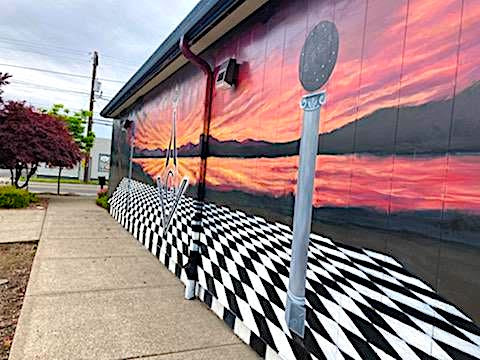
Oregon Lodge Has New Mural

by Christopher Hodapp

The Freemasons of Washington Lodge 46 in Portland, Oregon dedicated a stunning outdoor mural at the Washington Masonic Center on September 14th during their Past Masters Dinner. 


Mural design and artwork was done over the summer by artist Joe Riso. In a recent post by Senior Warden Dave Munson, he said, "It looks nice and doesn’t 'shout' but draws positive attention to who we are."


The city of Portland is planted thick with all sorts of murals painted on community buildings, and they're often mentioned on travel websites and in tourism articles. But I'll freely admit I'm pretty partial to this one.

Monday, August 08, 2022

Only 3 Days Left to Enter Pennsylvania's Grand Lodge Art Exhibition!

by Christopher Hodapp


Masonic artist Ryan J. Flynn

by Christopher Hodapp

Calling all Masonic artists! Deadline is this Thursday!

The Masonic Library and Museum of Pennsylvania is sponsoring the Grand Exhibition Art Competition: Embodying Masonic Values.

According to the Call For Entries posted in May, all artwork entries must display a visual interpretation of some aspect of Freemasonry in Pennsylvania, whether it be philosophical, historical, scientific, social, fraternal, charitable, architectural, etc. Selected artwork will be exhibited in the Masonic Temple in Philadelphia.

This competition is open to any artist over 18 years of age, and membership in the Masonic fraternity is not required. Deadline for submissions is Thursday, August 11, 2022.

Criteria
All artwork entries must display a visual interpretation of some aspect of Freemasonry in Pennsylvania, whether it be philosophical, historical, scientific, social, fraternal, charitable, architectural, etc. Selected artwork will be exhibited in the Masonic Temple in Philadelphia.

Eligibility
Any amateur or professional artist or college art student may enter, but all will be judged as equals for competition purposes. Artists must be at least 18 years of age. All submissions must be original; they may have been created within the past two years and may have been previously exhibited. No work previously produced on a commission will be accepted. All submissions must be available for purchase.

Categories
Oil, Three-dimensional, Drawing and Print-making, Water-Based Medium, Digital Imagery

Awards

$200 Prize per winner, per category
$500 Grand Master’s Prize
$1,000 Best in Show Prize

Entrance Fee
First entry: $25
Second and Third Entry: $10
(Limit of 3 entries per artist)

Auction
If the artists in the Grand Exhibition choose to participate, their entered works may be auctioned off at the Exhibition Gala, with 80% of the auction value going to them and 20% to The Masonic Library and Museum of Pennsylvania. The artist may set a reserve price, as well as a direct purchase price for the original work to be revealed AFTER the auction.

Jurors
Brother Travis Simpkins, Artist
John McDaniel, Artist
Elaine Erne, Artist/Teacher

Entry Deadline
Thursday, August 11, 2022 by midnight, E.D.T. Submissions must be made online through Call For Entries

Opening Reception
The Grand Exhibition Gala will be held at the Masonic Temple in Philadelphia on Friday, October 7th, featuring a cocktail and hors d’oeuvres reception, live music, announcement of winners and a silent auction of selected artwork.

Public Exhibition
The Grand Exhibition will be open to the public for viewing starting on Tuesday, October 11, 9 a.m. – 5 p.m., Tuesdays – Saturdays, until November 12th. The exhibit will be at the Masonic Temple, One N. Broad Street, Philadelphia, PA 19107-2598.


For more information CLICK HERE.