"To preserve the reputation of the Fraternity unsullied must be your constant care."

BE A FREEMASON

Showing posts with label philosophy. Show all posts

Wednesday, November 11, 2020

Masonic Author W. Kirk McNulty Passes

W. Kirk MacNulty portrait by Travis Simpkin


by Christopher Hodapp

My Brethren, the roll of the workmen has been called, and one Master Mason has not answered to his name. Brother Shawn Eyer reported on his Facebook page that esteemed Masonic author William Kirk MacNulty has laid down his working tools at the age of 88.

WB MacNulty was the author of three deeply thoughtful and philosophical books about Masonic symbolism: The Way of the Craftsman (1988), Freemasonry: A Journey Through Ritual and Symbol (1991), and Freemasonry: Symbols, Secrets, Significance (2006). MacNulty’s writing focuses on the impact of Masonic history, philosophy and symbolism on the psychological and spiritual development of the individual. For many Masons, his books introduced them to a whole new understanding of our esoteric symbolism and philosophy, and he urged all Masons to seek out and find our personal interpretations.

He was three times Master of Lodge of Living Stones, was a member of the Lodge of the Nine Muses No. 1776 in D.C. and of Alexandria-Washington Lodge No. 22 in Virginia. He also was a member of Quatuor Coronati Lodge. In recognition of his contributions to Masonic literature, he was named as Friar No. 94 in the Society of Blue Friars in 2005.

From the Craftsmen Online Facebook page:
W. Kirk MacNulty was born in California in 1932. He studied at Stanford University and the University of Tennessee, and had a career in the United States Marine Corps and in corporate information technology.

His interest and involvement in Freemasonry spans more than fifty-five years. He received the degrees of Masonry in 1961 at Carson Valley Lodge No. 33 of Gardnerville, Nevada. He later affiliated with lodges in Hawaii, Tennessee, England, and Virginia. He was Worshipful Master of the Lodge of Living Stones No. 4957 in Leeds, England, in 1979, 1980, and 1991. He is the Charter Master (1997) of the Lodge of the Nine Muses No. 1776, a Traditional Observance Lodge in the District of Columbia.

His literary efforts have earned outstanding recognition. In 2008, he was received as a member of London's prestigious Quatuor Coronati Lodge No. 2076, the world's premier lodge of research. In 2016, he was recognized as a Fellow of the Philalethes Society for his many contributions to the literature of Freemasonry.

He was born in Long Beach, California. His father was an Officer in the Marine Corps, and Kirk traveled to many places during his childhood. When his father retired, his parents settled in San Mateo, California; and he attended San Mateo High School, and graduated from Stanford University. Kirk became an Officer in the Marine Corps where he served for several years. Upon leaving the Marine Corps he became a Freemason in 1961 while living in Gardnerville, Nevada. It was a small country town, with a Masonic Lodge and a dedicated group of members. As he went through the ritual of the Third Degree, he had some profound insights about his own life, the meaning of life, and the meaning of Freemasonry. That started him on a quest to learn more, to know more, and to communicate to others a real and deeper meaning of Masonry than many of its members are aware. Then, while living in London for 18 years, he had the opportunity to get to know Lord Northampton, John Hamill, and other luminaries of the United Grand Lodge of England, and they encouraged him in my Masonic writing.

In addition, he has run, and participated in, Masonic Study groups both in the US and the UK, using the kinds of concepts described in his latest book: Contemplating Craft Freemasonry, in the process gaining enormous insight into his own life, as well as a deeper understanding of the nature of the Craft.
Several years ago, Kirk presented one of his talks as part of the M.A.T.S.O.L. (Masonry at the Speed of Light) online lecture series, which was the brainchild of Indiana Mason Al McClelland long before we all became self-trained experts in Zoom presentations:


"The Philosophical Background of Masonic Symbolism" - W. Kirk McNulty

As of Tuesday evening, I have not seen any notices about funeral services.

He has laid down the working tools of the Craft and with them he has left that mortal part for which he no longer has use. His column is broken, and his Brethren mourn.

Requiescat in pace.

Sunday, April 19, 2020

2020 Prestonian Lecture Now in Print

by Christopher Hodapp


The selection of the annual Prestonian Lecturer by the United Grand Lodge of England has been a tradition now for almost a hundred years. The yearbook of the UGLE describes the establishment by Preston himself:


‘During his lifetime William Preston developed an elaborate system of Masonic instruction which was practiced in association with the Lodge of Antiquity of which he was at one time Master. At his death in 1818, Preston bequeathed to Grand Lodge the sum of £300 for the perpetuation of his system of instruction… Lectures in accordance with this system were delivered from 1820 until 1862, when the Lectureship was permitted to lapse.
In 1924 the Prestonian Lectureship was revived with a modification to the original Scheme, the lecturer now submitting a Masonic subject of his own selection, and with the exception of the war years, 1940-1946, regular appointments have been made annually since 1924 to the present day.’
Since 1924 the naming of the lecturer each year has been an important addition to Masonic education everywhere, and the lecturer has traditionally traveled throughout the United Kingdom, and often all over the world, to make his winning presentation in person. Only the hardships of World War II have managed to interrupt the Prestonian Lecturers from their roving mission of enlightenment since its re-establishment in 1924.

And now this year comes along.

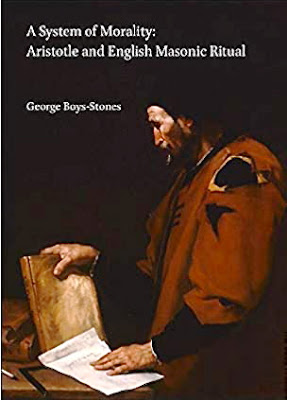
The Prestonian Lecturer for 2020 is George Boys-Stones, and it's the unfortunate bum luck of the moment that his travels have been curtailed worldwide by the COVID-19 Wuhan virus pandemic shutdown. Brother Boys-Stones' lecture is entitled, 'A System of Morality: Aristotle and English Masonic Ritual,' and he was scheduled to travel to the United States later this year as part of his international speaking tour.

Fortunately, the printed version of the 2020 Prestonian Lecture was published earlier this month, and now is available for purchase via Amazon in both paperback and Kindle versions.

From the Amazon description:
English Freemasonry defines itself as a “system of morality,” but what does that phrase mean? This new study traces it back to the work of William Preston (1742-1818), who argued that Freemasonry teaches a philosophical approach to virtue. According to Preston, the rituals of Freemasonry are designed to lead the initiate through the ethical thought of Aristotle. His view proved popular, and was decisive in shaping the ritual approved for use by the United Grand Lodge of England shortly after its formation in 1813. Almost all English lodges, and many others throughout the world, still use a ritual derived from this one, and, perhaps without realizing it, continue to pay silent testimony to Preston and to Aristotle in their work.
Brother Boys-Stones is a Past Assistant Grand Director of Ceremonies for the UGLE. When he wasn't hanging around with Freemasons, he was a professor of Classics at Durham University for twenty years from 1999 to 2019. This past year, he jumped ship for the Americas and is now a member of the faculty at the University of Toronto. He is the managing editor of Phronesis, a journal of ancient philosophy, and he is a prolific author on the topics of Greek and Roman philosophy. Phronesis publishes works about philosophy, metaphysics, epistemology, logic and the philosophy of science and medicine, from their ancient origins down to the end of the sixth century A.D.


Last year, he published Platonist Philosophy 80 BC to AD 250: An Introduction and Collection of Sources in Translation which provided new English translations of some of the most important Platonic writings of the ancient world. He has an enormous body of work in print on these subjects. For a list of many more books George Boys-Stones has written, you can see them on his Goodreads page HERE.


Given Brother George's field of study, I suspect he's taking the philosophical approach to the global shutdown that's keeping him from touring now. Hopefully, the pandemic will turn out to be less dangerous than was initially projected and everyone can back to real life again. For myself, I look forward to seeing and hearing Brother George speak in person sooner than later. In the meantime, enjoy his books.

Tuesday, January 14, 2020

The Stonecutter


One thing always leads to another, and connections are funny things. While I was back in Indianapolis over the weekend I came across this unusual artifact we uncovered from a long-forgotten storage locker in the downtown Temple. I've never seen a sculpture quite like it, and it has the look of something from the 1930s or so. Then my friend David Hosler posted this old Chinese folk tale today on Facebook that I first read many, many years ago and had forgotten about. It was popularized in the disarmingly philosophical little volume, The Tao of Pooh by Benjamin Hoff, which used the classic children's stories of Winnie the Pooh to introduce the basic fundamentals of Taoism.


Thanks for the reminder, Dave.


The Stonecutter

There was once a stonecutter who was dissatisfied with himself and with his position in life.

One day he passed a wealthy merchant’s house. Through the open gateway, he saw many fine possessions and important visitors. “How powerful that merchant must be!” thought the stonecutter. He became very envious and wished that he could be like the merchant.

To his great surprise, he suddenly became the merchant, enjoying more luxuries and power than he had ever imagined, but envied and detested by those less wealthy than himself. Soon a high official passed by, carried in a sedan chair, accompanied by attendants and escorted by soldiers beating gongs. Everyone, no matter how wealthy, had to bow low before the procession. “How powerful that official is!” he thought. “I wish that I could be a high official!”

Then he became the high official, carried everywhere in his embroidered sedan chair, feared and hated by the people all around. It was a hot summer day, so the official felt very uncomfortable in the sticky sedan chair. He looked up at the sun. It shone proudly in the sky, unaffected by his presence. “How powerful the sun is!” he thought. “I wish that I could be the sun!”

Then he became the sun, shining fiercely down on everyone, scorching the fields, cursed by the farmers and laborers. But a huge black cloud moved between him and the earth, so that his light could no longer shine on everything below. “How powerful that storm cloud is!” he thought. “I wish that I could be a cloud!”

Then he became the cloud, flooding the fields and villages, shouted at by everyone. But soon he found that he was being pushed away by some great force, and realized that it was the wind. “How powerful it is!” he thought. “I wish that I could be the wind!”

Then he became the wind, blowing tiles off the roofs of houses, uprooting trees, feared and hated by all below him. But after a while, he ran up against something that would not move, no matter how forcefully he blew against it – a huge, towering rock. “How powerful that rock is!” he thought. “I wish that I could be a rock!”

Then he became the rock, more powerful than anything else on earth. But as he stood there, he heard the sound of a stonecutter's hammer pounding a chisel into the hard surface, and felt himself being changed. “What could be more powerful than I, the rock?” he thought.