
"To preserve the reputation of the Fraternity unsullied must be your constant care."

BE A FREEMASON

Showing posts with label virtues. Show all posts

Saturday, November 11, 2023

Ancient & Accepted Rite for England and Wales Drops Trinitarian Christian Requirement


by Christopher Hodapp

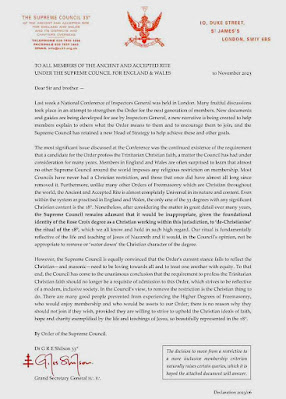
The Supreme Council 33° of the Ancient and Accepted Rite for England and Wales (what American Masons know as the Scottish Rite) announced a significant policy change in its jurisdiction this week. Following a National Conference of Inspectors General, a letter was issued Friday stating that they are removing their longstanding requirement for petitioners to specifically declare a belief in Trinitarian Christianity.

This is an important change in this jurisdiction's membership prerequisites. Prior to this, the requirements for Masons seeking membership in the Ancient and Accepted Rite for England and Wales were as follows: 

"All candidates for membership of the Ancient and Accepted Rite under the jurisdiction of the Supreme Council for England and Wales must profess the Trinitarian Christian faith and have been Master masons for at least one year in UGLE, or have joined a lodge under UGLE from a recognized Grand Lodge."

Friday's announcement reads, in part:

Members in England and Wales are often surprised to learn that almost no other Supreme Council around the world imposes any religious restriction on membership. Most Councils have never had a Christian restriction, and those that once did have almost all long since removed it. Furthermore, unlike many other Orders of Freemasonry which are Christian throughout the world, the Ancient and Accepted Rite is almost completely Universal in its nature and content. Even within the system as practiced in England and Wales, the only one of the 33 degrees with any significant Christian content is the 18°.

Nonetheless, after considering the matter in great detail over many years, the Supreme Council remains adamant that it would be inappropriate, given the foundational identity of the Rose Croix degree as a Christian working within this jurisdiction, to 'de-Christianize’ the ritual of the 18°, which we all know and hold in such high regard. Our ritual is fundamentally reflective of the life and teaching of Jesus of Nazareth and it would, in the Council's opinion, not be appropriate to remove or 'water down' the Christian character of the degree.

However, the Supreme Council is equally convinced that the Order's current stance fails to reflect the Christian—and Masonic—need to be loving towards all and to treat one another with equity. To that end. the Council has come to the unanimous conclusion that the requirement to profess the Trinitarian Christian faith should no longer be a requisite of admission to this Order, which strives to be reflective of a modem, inclusive society. In the Council's view, to remove the restriction is the Christian thing to do. There are many good people prevented from experiencing the Higher Degrees of Freemasonry, who would enjoy membership and who would be assets to our Order; there is no reason why they should not join if they wish, provided they are willing to strive to uphold the Christian ideals of faith, 
hope and charity exemplified by the life and teachings of Jesus, so beautifully represented in the 18°.


As alluded to in the letter, the traditional Rose Croix 18° as it is worked in the majority of Scottish Rite jurisdictions today is founded upon Christian imagery and symbolism — events in the life of Christ are used as an allegory for its lessons of monotheistic universality and the importance of Faith, Hope, and Charity. 

In many Scottish Rite systems around the world, the 18th is the culmination of the first half of the Rite's degrees, and it can take many years to attain that level outside of the U.S. It's not uncommon for many Scottish Rite members in certain jurisdictions to never rise above the 18th — their degrees are taken one at a time, in order, often months (or even years) apart. This dramatically differs from the U.S. where a candidate generally becomes a full 32° Scottish Rite Mason in a single day or weekend. 

Albert Pike's post-Civil War revision of the 18° for the Southern Jurisdiction of the Scottish Rite in the U.S. kept the original structure and allegory of the Rose Croix degree that had originally come to America from France through Etienne Morin as part of the hauts grades making up the Rite of Perfection. (Refer to the Francken Manuscript for this early version.) While it tells the story of the life, death, and resurrection of Jesus Christ, Pike removed the original degree's obligation to live a specifically Christian life and accept all of the tenets of Christianity. He felt such an obligation violated the most basic Masonic principles of universality and tolerance. So he kept the story, but reworked the obligation of the degree.

The Northern Masonic Jurisdiction of the Scottish Rite in the U.S. took a bit longer to remove the specifically Christian obligation from the 18°. In the degree, Jesus of Nazareth is the Exemplar, and any monotheistic believer can confidently take the obligation. 

The NMJ's website explains their own current version of the 18° (as revised in 1941 and later, in 1964) this way:

In 1941, Sovereign Grand Commander Melvin M. Johnson appealed to revise the 18° so it could be better suited for men of all faiths. He said: "This is the heart of what the Rite seeks to inculcate in its degree of Rose Croix, this common faith. (That good will overcome evil) When the battle is won, Freemasonry’s greatest secret – secret only, because the world will not learn it – will be secret no longer for then humanity will find peace in brotherhood."

[snip] 


[T]he Knight of the Rose Croix of H.R.D.M (Heredom), relays the life and death of Jesus. The allegory is based on the New Law he declared at the Last Supper: the law of love, which all men everywhere may understand and practice. His teachings exemplify the universal principles of life and encourage candidates to be virtuous, endeavor to eliminate vice, and practice tolerance and love. Upon the doctrine of Universality, the 18° should be interpreted by each Brother according to his own faith.

While Craft Lodge Freemasonry has been historically non-sectarian in its membership requirements since at least 1717, there are several Masonic-related appendant organizations that a Freemason can join that do have a specifically Trinitarian Christian requirement. These include the Knights Templar, the Masonic version of the Rosicrucians (SRICF), the Red Cross of Constantine, the White Shrine of Jerusalem, and more. The Supreme Council 33° for England and Wales has been unusual by having such a requirement, since no other Scottish Rite jurisdiction does.

Just as a bit of background, in May 1801, the first Supreme Council 33° for the Ancient Accepted Scottish Rite was opened in Charleston, South Carolina, and eventually became known as the Southern Jurisdiction of the USA. It was followed by France (1804), Spain (1811) and the Northern Masonic Jurisdiction of the USA (1813). Ireland (1826) was the sixth, England and Wales (1845) — receiving its Patent from the Northern Masonic Jurisdiction — was the eleventh, and Scotland (1846) the twelfth. There are now independent Supreme Councils in over 60 countries.

Saturday, December 01, 2018

The Ideals of a Freemason


I encountered one of the most moving descriptions of the ideals of a Freemason today on the Grand Lodge of Alberta's website, originally written in 1888 by M.W. Bro. Otto Klotz and published in the Canadian Craftsman magazine:

"If you see a man who quietly and modestly moves in the sphere of his life; who, without blemish, fulfils his duty as a man, a subject, a husband and a father; who is pious without hypocrisy, benevolent without ostentation, and aids his fellow man without self-interest; whose heart beats warm for friendship, whose serene mind is open for licensed pleasures, who in vicissitudes does not despair, nor in fortune will be presumptuous, and who will be resolute in the hour of danger;
"The man who is free from superstition and free from infidelity; who in nature sees the finger of the Eternal Master; who feels and adores the higher destination of man; to whom faith, hope and charity are not mere words without any meaning; to whom property, nay even life, is not too dear for the protection of innocence and virtue, and for the defence of truth;
"The man who towards himself is a severe judge, but who is tolerant with the debilities of his neighbor; who endeavors to oppose errors without arrogance, and to promote intelligence without impatience; who properly understands how to estimate and employ his means; who honors virtue though it may be in the most humble garment, and who does not favor vice though it be clad in purple; and who administers justice to merit whether dwelling in palaces or cottages.
"The man who, without courting applause, is loved by all noble-minded men, respected by his superiors and revered by his subordinates; the man who never proclaims what he has done, can do, or will do, but where need is will lay hold with dispassionate courage, circumspect resolution, indefatigable exertion and a rare power of mind, and who will not cease until he has accomplished his work, and then, without pretension, will retire into the multitude because he did the good act, not for himself, but for the cause of good!"
(Source: The Canadian Craftsman, March 15, 1868. M.W. Bro. Otto Klotz
If you ever meet such men, you will have seen see the personification of brotherly love, relief and truth — and you will have found the ideal of a Freemason. 

Can you envision yourself striving to be such a man?


UPDATED 12/4/2018:

This is why Freemasonry is a lifelong course of study and discovery. After I posted this earlier yesterday, several Canadian brethren informed me that the above is actually a small excerpt of a much longer Charge given at the conclusion of officer installation ceremonies in many Canadian jurisdictions. 

The entire Address to the Brethren, of which Otto Klotz' portion above is a part, can be found HERE, and I heartily recommend it to your attention. I can't help but think it would be a fine unofficial addition to any installation ceremony anywhere, but then, I'm a Masonic heretic. Klotz' description of the 'Ideals of a Mason' is all the more impressive when you realize that the author was a German whose second language was English.

In addition, the story behind the entire Charge and its origins is described in a paper written in 1998 by Mark S. Dwor can be read HERE on the incredible Grand Lodge of British Columbia and Yukon website.