"To preserve the reputation of the Fraternity unsullied must be your constant care."

BE A FREEMASON

Monday, February 21, 2022

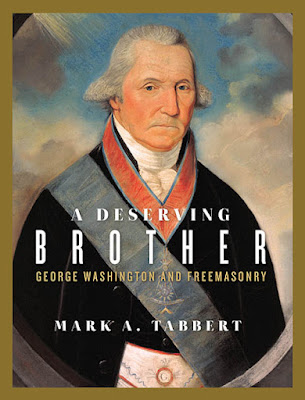
Book Review: 'A Deserving Brother: George Washington and Freemasonry' by Mark Tabbert


by Christopher Hodapp

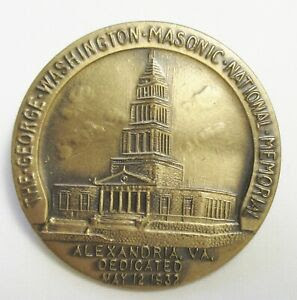
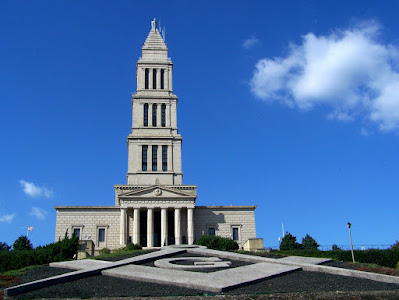
When the George Washington National Masonic Memorial in Alexandria, Virginia was first proposed in 1910, it was designed as a magnificent monument to America’s most famous Mason, along with being a safe and secure repository for priceless Masonic objects owned by Virginia’s Alexandria-Washington Lodge 22 that were associated with Brother George. The lodge possessed an original, contemporary portrait of Washington showing him dressed in Masonic regalia. And they had a collection of irreplaceable items which had originally been owned by Washington or utilized by him for the cornerstone ceremony for the U.S. Capitol building in 1798. 

But a fire at the lodge in the late 1800s resulted in the loss of several their priceless objects. So the Memorial was proposed as a national Masonic project that would be supported by all regular, recognized grand lodges in the U.S. in order to more safely house and display these almost sacred items for the public and for Masons alike. Today, the Memorial houses one of the largest collections of Washington-associated memorabilia outside of his estate, Mount Vernon and the Smithsonian Museum.


Many years ago, Mark Tabbert told me of an ongoing project he was working on. He has been the head of collections at the Memorial for many years, and the physical resources at the Memorial are preserved for future historians and Masons. Like the fairytales of Parson Weems’ chop-down-the-cherry-tree “biography” of the general, president and founding father, Masonic tall tales about Washington began propagating with great abandon after his death, and continue through today. 

Despite the endless (and frequently bogus) claims some Masons have made over the years about Worshipful Brother George and his enthusiasm for the fraternity, the truth is that Washington really only provably attended a handful of lodge meetings in person throughout his entire lifetime. Tabbert has always insisted that it is vital to honestly understand the role Freemasonry legitimately played in Washington’s life (and conversely, the role he played for the fraternity) instead of just breezily and blindly accepting legends that were told, retold and embellished by well-intentioned brethren over the last two and a half centuries. 


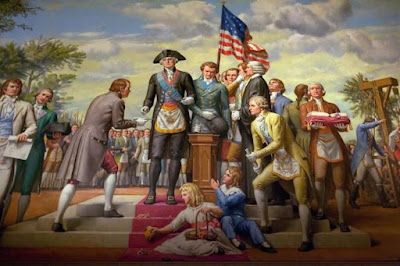
For instance, although Washington was named as the Master of Alexandria Lodge when it was chartered, he never actually sat in that position, or even as a sideliner in that lodge, and the famous drawings and paintings of him dressed in a jewel and apron as the Worshipful Master and presiding over a meeting were simply artistic flights of fancy on the part of painters and sculptors, and nothing more.

The result of Mark’s ongoing labors over the last decade is an ambitious new book being released this week by the University of Virginia Press: A Deserving Brother: George Washington and Freemasonry. In it, Tabbert has researched quite literally every single reference, claim, rumor, letter, declaration, newspaper article or offhanded remark that ever connected George Washington to the Masonic fraternity. Every known bit of physical evidence associated with Washington and his Masonic membership is presented in the book in chronological order, while explaining, debunking or ignoring the unsubstantiated claims. Tabbert’s intention has been to correct the historical record and create the standard reference work for future researchers on the trail of Washington and the influence Freemasonry may or may not have had on his life and his character.

Freemasonry during America’s formative years was instrumental in reinforcing the notion of a non-secular, “civic religion” that was so vital to the creation and success of this new constitutional, democratic republic. Washington’s membership in the fraternity was influential in both directions. In practical terms, Masonry demonstrated mutual cooperation, respect, religious toleration, and social egalitarianism that informed Washington’s understanding of democracy. And his membership in the fraternity gave Freemasonry a status that few other organizations could achieve at the time. His Masonic membership and support drew more and more merchants, community and business leaders, and men of all political and religious persuasions to join its ranks.

A Deserving Brother straddles the line between being an historical narrative and an itemized, encyclopedic catalogue. An extensive introductory chapter by Washington historian Edward G. Lengel gives a general chronological sketch of George’s life and where it coincided with the Masonic fraternity. But the main body of the work is its meticulously researched catalogue. The book is divided into several major periods of Washington’s life: as a British subject; General and Commander in Chief; private citizen; President of the United States; and his retirement and death. Each chapter is introduced by a general outline of the time period covered. Following that, descriptions of each reference include photos, dates, locations, circumstances, and in the case of letters and other documents, transcriptions of the text itself. In an effort to be as complete as possible, Mark has included correspondence whenever someone would send Washington a note, a Masonic book or other gift related in any way to the fraternity. And to aid future researchers, each item’s provenance and current location today are provided.

Notably, Tabbert has been careful to include verified details of several important, oft-cited milestones concerning Washington and the Masons, including his first inauguration in New York City and the circumstances involving the famous St. John’s Lodge Bible upon which he took the oath of office; the Masonic cornerstone ceremony of the U.S. Capitol in 1793 and the surviving working tools and related objects used at that event; and details of Washington’s Masonic funeral service in December 1799. An epilogue goes on to cite references about Washington used both by Masons and anti-Masons in the 1800s, as well as celebrations held by Masons in 1899 on the 100th anniversary of his death, and in 1902 for the 150th anniversary of his raising as a Master Mason. The major books written about Washington’s Masonic experiences and involvement are described, as well as the formation of what would become the George Washington National Masonic Memorial Association. 
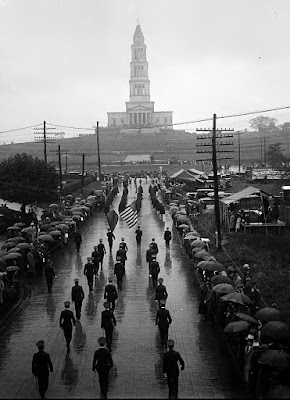


The Memorial itself was officially dedicated in 1932, some 22 years after it was first proposed, and Tabbert provides a synopsis of its mission and exhibits then and now, as well as an explanation of the changes that have occurred there since its opening.

In short, Mark Tabbert’s A Deserving Brother is without question the most extensive, detailed and truthful accounting of Washington and his Freemasonry as he lived it. As an historical research tool it is invaluable, and will unquestionably be the most important reference work on George Washington and the fraternity available for decades to come.

This book is being distributed by Macoy Publishing under a special partnership with the George Washington Masonic National Memorial Association. Priced at $34.95 for the 304-page hardback edition, CLICK HERE TO ORDER.

Sunday, February 20, 2022

R.I.P. Paul Newhall


by Christopher Hodapp

NOTE: THIS STORY HAS BEEN UPDATED WITH FUNERAL INFORMATION BELOW

News has come that my friend and Brother Paul Newhall passed away in the early hours of Saturday. Paul's wife Georgia posted a message on her Facebook page yesterday with the news. And the Allied Masonic Degrees posted a special announcement yesterday morning.


I can’t recall actually meeting Paul and Georgia for the first time because they just always seemed to have been there. I encountered the Newhalls regularly when I started attending Masonic Week, back near the end of the old Hotel Washington days in the early 2000’s. Even then, Paul was one of those rare Brothers who was always the answer to seemingly every question that came up about the event: Got any problem? Ask Paul. He always knew how to shrewdly negotiate contracts, juggle complex logistical arrangements, plan meals, organize meal tickets and credentials, diplomatically settle battles, smooth ruffled feathers (and egos), and even assist short-handed hotel banquet chefs in madly dishing up plates in the kitchen while dressed in his tuxedo. All the while, he was simultaneously serving as an officer in multiple Masonic organizations. Everyone, everywhere, always seemed to want just a little bit of Paul’s attention. And everyone who asked for it, no matter how great or trivial the request, always got it.

When a bunch of us upstarts formed the Masonic Society in 2010 and we wanted to hold our dinner, annual meeting and elections at the host hotel that next February, Paul came to the rescue right from the very start. He managed to work us into a highly coveted time slot on Friday night with our own dining room, and for many years, a big suite in which we hosted a hospitality room.

As the years passed, Paul suffered a variety of health problems. Periodically, he would duck out of the Masonic Week activities in order to go track down a kidney dialysis center to treat his diabetes. In 2013, Paul's kidneys began to fail and he required a transplant to survive. And so, Georgia became his donor. Several years later, doctors were forced to amputate his foot. And yet, through those physical trials and tribulations, Paul remained cheerful, caring, and eternally optimistic. 

 
I have always taken to heart the concept that Masonry should be governed by those “who can best work or best agree,” as our ritual enjoins. In the two decades I have known Paul, he was always just such a man, even when he and Georgia were burdened personally by challenges that would have felled almost anyone else. Paul was dedicated, driven, organized, indefatigable, and responsible to a fault. And above all, honorable. Such people may seem to be in short supply these days, but they still exist, and I have to admit I've encountered more of them within our fraternity than anywhere else. My world has been a better place because Paul and Georgia have been in it. So it is with deepest sadness I offer my most heartfelt condolences to Paul's entire family. 

His column is broken and his brethren mourn.

Requiescat in pace.

UPDATED 2/23/2022 2:00AM
FUNERAL INFORMATION

The viewing and visitation for Paul Newhall will be held this Friday, February 25, 2022 from 4:30 to 6:30 p.m. at:

Adams-Green Funeral Home and Crematory
721 Elden Street
Herndon, VA

The funeral, including Masonic Services, will begin at 6:30 p.m. Internment will take place in the spring in Chestnut Grove Cemetery, Herndon. Flowers will be received by Adams-Green. In lieu of flowers, memorial donations in his memory may be directed to the National Kidney Foundation at www.kidney.org

His complete official obituary can be seen HERE.

Wednesday, February 16, 2022

Adam Kendall Named 111th Blue Friar


by Christopher Hodapp


I was unable to attend AMD Masonic Week this year because of some personal family issues. That's a shame, because by all accounts, I've heard it was one of the best and most memorable Masonic Weeks in recent history.

The 78th Consistory of the Society of Blue Friars was convened Friday, February 11th at the Hyatt Regency in Crystal City, Virginia as part of Masonic WeekThe Society of Blue Friars was founded in 1932 for the express purpose of recognizing outstanding Masonic authors throughout the world. 

This year's newest member of the Society is Friar No. 111, Adam G. Kendall of California. Adam is the former editor of the Scottish Rite Research Society's quarterly publication, The Plumbline, and served for many years as the curator of the Grand Lodge of California's Henry Wilson Coil Library and Museum in San Francisco. He’s just recently been named as editor of the SRRS annual collection of papers, Heredom.

Adam's presentation was “The Scandals and Secret Rites of Benjamin Hyam,” which can be found in Quatuor Coronati Lodge's recent Freemasonry on the Frontier anthology.


The Society convenes each year during Masonic Week in the Washington, D.C. vicinity to induct a new Friar, and its gatherings are open to all Master Masons. Authors like Arthur E. Waite, Harold V.B. Voorhis, Dwight L. Smith, Allen Roberts, Thomas Jackson, Yasha Beresiner, Alain Bernheim, Robert G. Davis, Alton Roundtree, Michael R. Poll, Robert D. B. Cooper, Josef Wäges and Piers Vaughan are just a few prior Blue Friar honorees. In a rare moment of weakness, they even let a Dummy in.

I wasn't the only one kept away from the event this year. Sadly, Arturo De Hoyos' father passed away at the beginning of the week, and so he was unable to preside as Grand Abbot of the Society of Blue Friars this year. And so it fell to Deputy Grand Abbott Mark A. Tabbert to do the honors this year and announce this our newest inductee.

Tuesday, February 15, 2022

Illinois Attacks on Masonic Halls Part of Growing Anti-Masonic Vandalism


by Christopher Hodapp

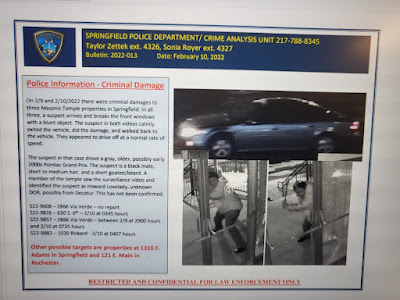
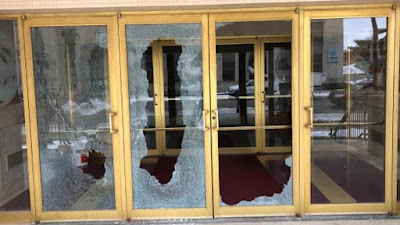
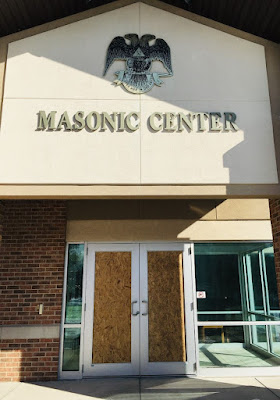
Police in Springfield, Illinois are asking the public for leads and information in connection with recent multiple attacks on Illinois Masonic properties. (Click the image above to enlarge.) The Grand Lodge of Illinois office, the Springfield Masonic Center and the Ansar Shriners all had their glass entry doors smashed last week, and similar damage occurred at the Masonic temple in Decatur, Illinois last year.

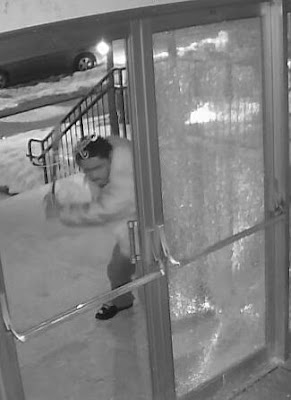
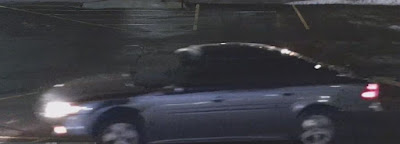
Police are seeking a person of interest in the attacks who was seen on security camera footage from the Shrine. A member at the temple identified the suspect as Howard Lovelady, who is possibly from Decatur, Illinois. The suspect is a black male, short to medium length hair, with a a goatee/beard. He was driving a 2000's silver or gray Pontiac Grand Prix. 

There seems to have been an increase in deliberate vandalism against Masonic sites as of late. 

Meanwhile, a notorious, headline-seeking preacher in Tennessee named Pastor Gary Locke regularly urges his audiences to "destroy everything Masonic," and has unfortunately gotten increased airplay online in the last few weeks. Most recently, Locke held a highly publicized book burning event in Florida, consigning Harry Potter and Twilight books to the flames (along with, by the way, Fahrenheit 451, with absolutely no sense of irony whatsoever). Declaring Freemasonry to be Satanic ("Paging Mister Taxil. Mister Leo Taxil, please pick up a white courtesy phone."), his anti-Masonic rant from that event has been endlessly forwarded around Tweetbook, Snaptwit and Facespace.  Any attempt to block his more incendiary anti-Masonic diatribes from social media simply becomes more fodder to be shoveled by Locke to his followers as "proof" that us cloven-hooved Satanic Masons have superpowers that must be vanquished. 

Unfortunately, too many Masons online have failed to remember the very first charge given to the new Entered Apprentice in most jurisdictions:

"In your outward demeanor, be particularly careful to avoid censure or reproach. Let no interest, favor or prejudice, bias your integrity, or influence you to be guilty of a dishonorable action. . . [N]either are you to suffer your zeal for the institution to lead you into argument with those who, through ignorance, may ridicule it."

Anti-social media brings out the very worst in everyone it seems, and there are entirely too many Masons who are hurling insults and decidedly un-Masonic language at Locke and his followers. That type of public language and online behavior is exactly why grand lodges around the world have been adopting codes of online conduct for their members.

Indianapolis Prince Hall Temple Receives Indiana Landmarks/Lilly Foundation Grant


by Christopher Hodapp


Indianapolis' Prince Hall Masonic Temple at 22nd and Central Avenue is receiving a $9,000 preservation grant from Indiana Landmarks Foundation and the Lilly Foundation towards the replacement of their aged roof. The story on WRTV-6 concentrates solely on the building's more recent past as home of Central Lodge No. 1 of the Most Worshipful Prince Hall Grand Lodge F&AM of Indiana. It completely ignores the building's storied origin in 1915 when it was designed as a team effort by the three top, competing architectural firms in the city. Oriental Lodge No. 500 of the Grand Lodge F&AM of Indiana at that time was the largest suburban lodge in the city. Among its members were the principals of those three architectural design companies.

Oriental Lodge had originally been chartered in 1875, and it was a prestigious lodge. In 1904, the Vice-President of the United States under Teddy Roosevelt, Charles W. Fairbanks, became a member (making them one of the only Masonic president/vice-president teams in US history). By 1912, the lodge had 600 members, and just seven years later, it had swollen to 900. By its 50th anniversary in 1925, the lodge had 1,100 on its rolls, and 22nd and Central Avenue was a very hot neighborhood. Odd to think of it today as a 'suburb.'


In 1983, Oriental Lodge merged with Evergreen Lodge on the city's west side, and moved out of their temple. It was sold to Central Lodge No. 1 (oldest African-American Prince Hall-derived lodge in Indiana) and a temple association of several other Prince Hall lodges and appendant groups. Before this time, Prince Hall lodges in the city had been renting space in the downtown YWCA on Indiana Avenue. 

Out of the 14 purpose-built neighborhood Masonic buildings in the city limits of Indianapolis, outside of downtown's Mile Square, that were standing a century ago, the Temple of Central Lodge No. 1 today is the only Masonic building left that has been continuously built, owned, and operated by Freemasons. This magnificent temple in 1983 became the first Prince Hall building in Indianapolis that had been specifically designed as a Masonic space since their grand lodge's formation back in 1856.

(See my story from 2016: A Tale of a Temple.)

In addition to Central Lodge 1, the following Prince Hall Masonic organizations all meet in that same temple: Waterford 13, Trinity 18, Sumner A. Furniss 61 lodges; Constantine Consistory 25 Scottish Rite; Union 1 Order of the Eastern Star Chapter; Sumner A. Furniss Assembly 32 of the Order of the Golden Circle; the York Rite bodies of Cyrus Chapter 1 Royal Arch Masons, John C. Dawson 22 Council of Royal and Select Masters, and Gethsemane Commandery 37 Knights Templar.

Friday, February 11, 2022

Masonic Sites in Illinois Vandalized

Damage at the Grand Lodge of Illinois in Springfield

by Christopher Hodapp

NOTE: This story has been updated on Friday, February 11 at 5:45AM to include photos and more information about attacks on Masonic sites across Illinois.

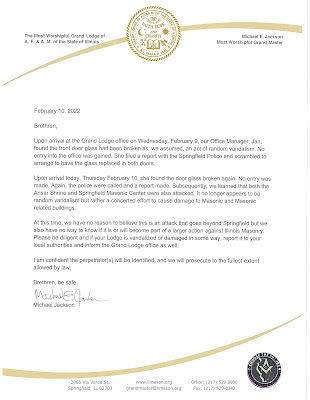
Several Masonic locations in Illinois have been struck with deliberate acts of vandalism in the last few weeks. According to a letter circulated by MW Michael E. Jackson, Grand Master of Illinois, the Grand Lodge office in Springfield had its glass door smashed on Wednesday, and after being replaced, it was shattered again on Thursday. 


Across town, the Springfield Masonic Center and the Ansar Shrine were also vandalized. 

There were no break-ins, and nothing appears to have been stolen. 

From GM Jackson's letter:

"At this time, we have no reason to believe this is an attack that goes beyond Springfield but we also have no way to know if it is or will become part of a larger action against Illinois Masonry. Please be diligent and if your Lodge is vandalized or damaged in some way, report it to your local authorities and inform the Grand lodge as well."

Click the image above to enlarge.

Security camera images from the Shrine were circulated today on the newschannel20.com website showing the attacker and what may be his car. Anyone with information concerning these attacks or this person in the photos are urged to contact the Springfield Police Department at 217-788-8427.


Last month, the Decatur, Illinois Masonic Temple suffered eight different attacks that did an estimated $20,000 in damage to their facility. Decatur police arrested - and released - a suspect in that case. Lodge members there believe all of these attacks may have been committed by the same person. 

Meanwhile, suspicious packages were found at Masonic temples in Champaign and Chatham, Illinois a few months ago. One of the packages contained a note accusing Masons of trying to destroy the world.

Acts of vandalism against Masonic buildings have been escalating around the country, along with the circulation of anti-Masonic literature. To the southeast of the Illinois border, southern Indiana Masonic halls have been reporting about thick packets of anti-Masonic material taped to lodge doors or left in their mailboxes.

Photos provided by Ansar Shrine Center

Thursday, February 10, 2022

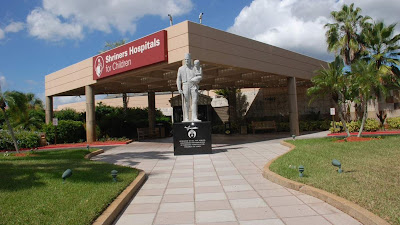
Shriners Closing Tampa Hospital - Transitioning to Outpatient Services


by Christopher Hodapp

Shriners Children officially announced the closing of the Shriners Hospital in Tampa, Florida last week. Shriners has operated its Tampa hospital on the campus of the University of South Florida since opening in 1985, and in fact, the headquarters of both Shriners International (the fraternal origination) and its non-profit, recently-renamed medical philanthropy, Shriners Children, are located in Tampa. Unfortunately, stories in the Tampa Bay News caused lots of heated accusations in its wake from the rank and file Nobles on social media.


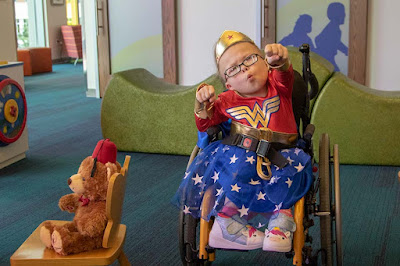
Since first opening, the Tampa hospital has treated more than 50,000 children. The original 60-bed, acute care, inpatient hospital at that location was already transformed into an outpatient clinic back in 2019, with fewer than 100 employees. The facility has been treating children with scoliosis, muscular dystrophy and brittle bone disease (osteogenesis imperfecta). It also provides radiology and pediatric rehabilitation services, along with braces, artificial limbs and corrective orthopedic shoe inserts. But in the almost 40 years that the Tampa location has been open, the medical universe has undergone enormous evolution. 

A wide variety of forces contributed to that change, including: a shrinking domestic birth rate; the major reduction of birth defects in recent decades; advances in technology and care procedures that no longer demand expensive, overnight (or longer) stays; and the dramatic increase in the cost of staffing and maintaining a full-service, full-size hospital with little-used facilities. And don't forget the massive intrusion of government in the wake of the Affordable Care Act that redefined what a "hospital" can and cannot do without running afoul of Medicaid and various insurance regulations. Before 2011, Shriners prided itself in providing care to children at no cost, often saying, "Our hospitals have everything other hospitals have, except a billing office." The ACA changed all of that and ultimately forced them to accept insurance payments and the regulatory nightmares that went with it. However, they still treat uninsured patients free of charge.


In April, Shriners will announce a new partnership with local providers in the Tampa area that will permit their pediatric and orthopedic specialists to treat more patients at more locations, and perform many in-home services. Tampa is not alone. It is actually one of five locations in the Shriners system transforming from hospitals into out-patient service providers. Complex cases requiring surgeries and longer-term, inpatient treatment will be transported to the Shriners acute-care hospitals in Shreveport, Louisiana or Greenville, South Carolina. In addition to orthopedic cases, Shriners continue to provide world-renowned care for children with severe burns, clubbed feet and other debilitating injuries throughout their 23 North American locations.

The Shrine opened its first children's hospital a century ago in 1922, and has served more than 1.5 million patients since then. Shriners Hospitals for Children are supported by individual donations from the public, but primarily by the members of Shriners International, a Masonic fraternity open to men with nearly 200 chapters in the U.S. and other countries. Most Americans are unaware that in order to be a Shriner, a man must first become a Freemason and join a local Masonic lodge.

Tuesday, February 08, 2022

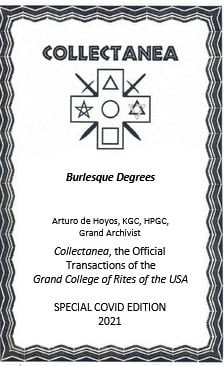
Grand College of Rites Offers Bonus Book: 'Burlesque Degrees'


by Christopher Hodapp
The Grand College of Rites of the United States of America is a regular Masonic body that is dedicated to preserving the history and rituals of defunct and inactive Masonic orders. Formally organized in 1932, the Grand College of Rites publishes an annual volume known as Collectanea which contains reprinted rituals of various officially extinct organizations deposited within its archives. The College and its members agree that these rituals are published and copyrighted strictly for the purpose of research and preservation, and are not to be worked or performed. Over the last couple of years, for example, Collectanea has been featuring the degrees of the Cerneau Rite system, which caused more than its share of excitement in the 1800s when it began to spread throughout the northeastern states. (Still to this day, the Tyler's Oath administered to visitors in Pennsylvania specifically requires sojourning Masons to swear they are not members of a Cerneau lodge and have not had the degrees of the Cerneau Rite conferred on them! Talk about holding a grudge.)

But the book that came this week is actually something quite special, and not the usual sort of obscure esoteric rituals the College has traditionally published in the past. Because of the COVID-19 pandemic precautions in the DC area last year, the 2021 Masonic Week was canceled. In light of this, Most Illustrious Duane L. Vaught, KGC, the current Grand Chancellor of the College, was struck by the notion of offering a special bonus book to the members that features some lighter-hearted levity than the usual offering of serious degrees.

And so, this volume of "Burlesque Degrees" is being provided as a Bonus Book to all 2020 and 2021 dues-paying members as a way of saying thank you for their continuing support of the mission of the College throughout the COVID-19 pandemic. 


During the Golden Age of Fraternalism, quite literally hundreds of fraternal groups proliferated. Most tried to be solemn in nature, with degrees to impart wise and serious truths. But others were created as unofficial 'side degrees' to provide an entertaining night for members, or as one pamphlet put it, "a comic ceremony designed to cure the blues and fill the treasury." 

The fraternal groups included in this collection are truly obscure and deliberately comic: The Haymakers, the Munchers of Hard Tack, the Sublime Order of Arabian Knights, Uncle Sam's Eagles, the Up-To-Date Order of Goosie Girls, the Grand and Noble Order of Button Busters, and more.


These types of side degrees sometimes became quite elaborate and required special props as part of the gags involved. DeMoulin Brothers in Greenville, Illinois published an enormous catalog of goofy (and occasionally dangerous) props for side degrees, and became known as "the goat factory" because of the wide variety of various mechanical bucking goats they manufactured. The C.E. Ward Company in New London, Ohio also published a catalog strictly for "burlesque goods," and several pages of their offerings are included at the end of this volume.

Annual dues in the GCR is a paltry $20. If you are a current dues-paying member who was NOT paid up in 2020 or 2021 - you can contact the Grand Registrar at grand.registrar@grandcollegeofrites.org for purchase information for this bonus book.

Meanwhile, the regular 2021 edition of Collectanea will conclude the series of the Cerneau Rite (30° - 32°) is at the printers now and will ship very soon.

Any Master Mason holding membership and in good standing in a regular symbolic lodge recognized by a majority of grand lodges of Freemasonry in the United States may petition for membership as a Fellow in the Grand College of Rites. (click here for a petition)

Friday, January 28, 2022

Pre-Order From Masonic Book Club: Samuel Pritchard's Masonry Dissect'd


by Christopher Hodapp

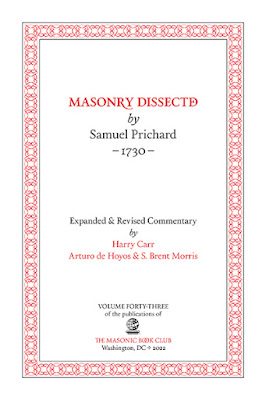
The newly revived Masonic Book Club has just announced the pre-publication ordering window for their second volume: a new edition of Samuel Pritchard's 1730 ritual exposure, Masonry Dissected

The pre-publication order window will be open from January 27, 2022, until February 28, 2022, at 11:59

The 'old' Masonic Book Club first published this book in 1977 with wonderful commentary by Masonic scholar Harry Carr, Past Master and Secretary of Quatuor Coronati Research Lodge No. 2076 in London.This 144-page reprint of that 1977 edition features Carr’s classic commentary, revised and updated by Ill. Arturo de Hoyos, 33°, G.C., and S. Brent Morris, 33°, G.C.

Pritchard's book included the first known publication of the details of the Master Mason degree, which had only been incorporated into the premiere Grand Lodge of England's ritual in 1726, just nine years after the 1717 formation of their grand lodge.

During the years before 1726, English ritual consisted of only the Entered Apprentice and Fellow Craft degrees. While Pritchard's book was doubtless seen as a dastardly act and a betrayal of Masonic secrecy and honor at the time, it does provide historians a written record of the Masonic degrees as they existed in those formative years. It was also extremely popular at the time, presumably for both a curious public, and for Masons trying to learn to memorize their ritual.

From the MBC's description:
"When the Grand Lodge of England was formed in 1717, there were only two degrees: Entered Apprentice and Fellow Craft. A “master mason” either held the contract at a job site (think “general contractor”) or was the elected presiding officer of a lodge. The first conferral of the Third or Master Mason Degree in a Masonic lodge occurred in March 1726 in Lodge Dumbarton Kilwinning No. 18. The degree apparently was conferred in May 1725 at a social club of Masons in London, the Philo Musicæ et Architecturæ Societas. There is no hint of what the ceremony may have been—not in the Old Charges, manuscript rituals, or publications. Nothing!
"Then on October 20, 1730, Samuel Prichard published Masonry Dissected with full details of the ritual for what he claimed was the Master Mason Degree. A second edition came out on October 21, and a third edition on October 31, all three published by Wilford in London. A presumably pirated edition dated “MD.CC.XXX” (1730) and printed by Thomas Nichols “without Temple Bar” (London) probably had made its appearance by the end of October 1730. Other presumably pirated versions were printed in Read’s Weekly Journal or British Gazetteer, on October 24, 1730; Northampton Mercury, in two parts on October 28, 1730, and on November 2, 1730; and the second half in The Original Mercury, York Journal: or, Weekly Courant, on November 2, 1730 (the reprint of the first half has not been located).
"Thus, there were three separate editions by Wilford for Prichard, a pirated edition by Nichols, and a newspaper version, all printed in London, plus a two-part pirated newspaper version printed in the Midlands, and another pirated newspaper version printed in the North of England, all within fourteen days. This was a popular book!

Here are the specifics from Brent Morris:


The pre-publication order window will be open from January 27, 2022, until February 28, 2022, at 11:59  
 
The special MBC pre-publication price is $30. Regular retail price will be $40. 
 
This time during the pre-publication sale period, we also will be offering a "First Day of Issue" signed edition for $45. These copies will not be available later for retail. 
 
We only will accept pre-publication purchases placed using the MBC order form. Pre-publication orders are not available through the Scottish Rite Store.

The printing industry currently is experiencing massive supply chain disruptions. We cannot place the order for Masonry Dissected until pre-publication purchasing is completed and reviewed. We hope to place the order by March 3, 2022. Our printer estimates "approximately 78–83 business days" to manufacture the books. We expect the books to be mailed about June 15–22, 2022, and will keep you informed of progress and changes. Thank you for your understanding during these unusual times.

**Due to GDPR and other complications, we only can accept credit card charges from and ship to the USA, US territories, Canada, and Mexico.

** However, Lewis Masonic in the United Kingdom is accepting a limited number of pre-publication orders (signed & unsigned editions) for the rest of the world. For details, please click the "Order Masonry Dissected" button below and answer "All Other Countries" to the first question.

If you have any questions, please visit the "FAQs" section on our MBC web page or email us at mbc@scottishrite.org.
There are no dues for the new Masonic Book Club. Books are announced for pre-publication orders and payments are only collected as books are ready to be manufactured. All transactions are handled exclusively online. Without a rigid calendar driving publications, new books can come out as quickly as nine months or as late as eighteen months, as resources permit. Book prices range in the $30 vicinity for pre-publication orders, or $40 retail if you miss the pre-pub ordering window. Volumes will no longer be numbered as in the old Club, but if the hardback edition sells out, the MBC will make a paperback print-on-demand edition available of the books. 

If there are sufficient pre-publication sales, MBC members will be notified after the pre-publication window closes at 11:59 pm ET on Monday, February 28, 2022. The books will be printed, and will ship around June 15–22, 2022.

If there are insufficient sales, members will be notified; and refunds will be credited about March 21, 2022.

To the relief of the MBC's older original members, the new Club actually communicates with its members twice a year with an electronic newsletter to keep everyone in the loop about upcoming volumes in the works and their production status. Despite his recent retirement from his longtime job of editing the AASR-SJ's Scottish Rite Journal, S. Brent Morris 33° continues to manage the MBC, and this endeavor has truly been a labor of love for him. 


The mission statement of the resurrected Masonic Book Club is to publish classic Masonic works with the goal of increasing Masonic knowledge and to become a profit center for the House of the Temple Foundation. More information can be found at the MBC's website HERE. If you are interested in this or subsequent volumes, you need to sign up on the website. If you have any questions or suggestions, please address them to mbc@scottishrite.org.

Thursday, January 27, 2022

GM of Georgia Issues Edict Banning Widows Sons Motorcycle Riders


by Christopher Hodapp

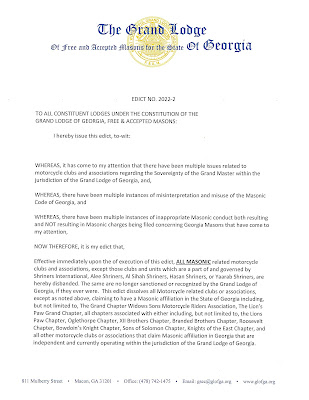
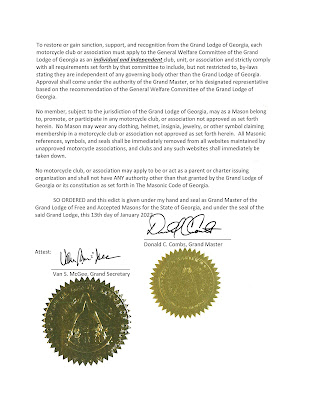
The Grand Master of the Grand Lodge of Georgia F&AM, Donald C. Combs, has just issued an edict in his state (No. 2022-2) forbidding the Freemasons in his jurisdiction from belonging to the Widows Sons International Masonic motorcycle riders association. Georgia Masons who do not comply by dropping their WS membership risk expulsion from the fraternity. Further, the edict orders ALL Masonic-related motorcycle clubs and associations in Georgia to disband, with the exception of motorcycle clubs affiliated with the Shrine. (Click images below to enlarge.)


This is not the first time this has happened in the U.S.

Back in 1998, a group of Masons who shared a love of motorcycles organized the first chapter of the Widow’s Sons Masonic motorcycle riders club, led by Brother Carl Davenport out of Chicago, Illinois. Open to all Master Masons, the goal of the Widows Sons was (and is) to promote motorcycle riding among Masons, and to promote Masonic membership among the general public. They regularly support and contribute to Masonic programs that help widows and orphans of Brother Masons. But almost from the outset, there was a cohort of Masons who strongly objected to the public image of the Widow’s Sons, and criticized the group’s first logo design, patches and leather vests as looking entirely too much like an unsavory outlaw motorcycle gang. 


Original logo for the Widows Sons included a sultry, red leather-clad 'Widow.'
(Image from Hiram's Knights website)

Their early vests often featured a Masonic square and compass, and a common objection was that Masonic symbols would be seen in bars on brethren who may not be able to subdue their passions. It was especially objected to in states where a grand lodge forbade Masons from serving and consuming alcohol at lodge functions. And their earliest logo featured a sultry 'widow' dressed in red leathers looking entirely too MILF-like. By the early 2000s, several grand masters around the U.S. issued decisions and edicts against the group, and in more than a few cases, ordered the groups to completely shut down, threatening expulsion for Masons who defied these orders. Other states forbade the wearing of Widows Sons signature leather vests in Craft lodge meetings.

(See Grand Master of Texas Edict: Widow's Sons Motorcycle Group from 2011; I don’t believe that anything has changed in Texas since then concerning Masonic biker groups.)

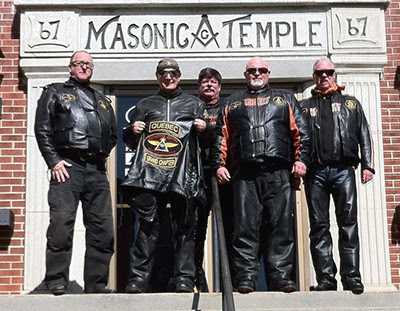
Photo: widowssonsinternational.com

Unfortunately, Masonic motorcycle associations have always - and continue to attract - extra scrutiny from critics and more than a few grand masters. Motorcycle-riding GMs in general have no issues with them, but plenty of other GMs find them problematic, asserting that motorcycle clubs of any kind attract an unsavory sort of man and are antithetical to the upstanding image that Freemasons have historically cultivated. There are also allegations that the state grand chapters of the Widows Sons set themselves up as a conflict of interest with grand lodges.

Over the last couple of hundred years or so, enthusiastic Masons have often sought to form special interest clubs or groups with like-minded brethren based on their professions, hobbies, or obsessions. There are Masonic veterans’ groups (National Sojourners), fishing clubs, gun clubs (like Hiram's Rangers Western action shooters club), stamp-collecting groups (Masonic Philatelic Club), RV owners (National Camping Travelers ), Masonic luncheon groups (like High Twelve International), and lots more. The most obvious manifestation of this phenomenon can be seen in the Shrine. Upon joining a local Shriners temple, new members are often encouraged to join and participate in a specific affinity group like the clowns, Masonic or Shriner degree teams, little car drivers, classic car enthusiasts, model railroad clubs, boat owners, private plane pilots (the “Flying Fezes”), and often one of the most popular, motorcycle riders. 

Other states have managed over the years to hammer out agreements between their grand lodges and the Widows Sons, so hopefully this will be a brief incident.

UPDATED 1/27/2022 9:00PM

A closer reading of the edict gives a better sense of what it is attempting to address. From his edict I took away that the GL of GA must officially recognize or authorize any group calling itself ‘Masonic,’ and that the entire collection of clubs being disbanded or forbidden never bothered to officially get those approvals. I believe he’s saying, ‘Clean up your act, decide if you want to be Masonic, and apply for approval with the proper committee. Let’s do this right instead of ignoring the GA code and procedures.’


Tuesday, January 25, 2022

NBC/Peacock Announces Cancellation of Dan Brown's 'The Lost Symbol'


by Christopher Hodapp


NBC's Peacock streaming network has announced that there will only be the single season of Dan Brown's The Lost Symbol that has already aired. The 10-episode series aired between September and November 2021, and there are no plans for future episodes.

Based on Brown's 2009 blockbuster Masonic-themed novel, The Lost Symbol starred Ashley Zukerman as symbologist Robert Langdon, along with Valorie Curry (“Blair Witch”), Sumalee Montano (“10 Cloverfield Lane”), Rick Gonzalez (“Arrow”), Beau Knapp (“Seven Seconds”), and actor and comedian Eddie Izzard as Peter Solomon.

According to the announcement in Variety on Monday
, "Peacock and producers believed that the series adaptation of the book told the complete story of the source material." 
The completed series will continue to be offered to subscribers on the Peacock streaming platform.

The creative team for the series made an early decision to modify much of the Masonic content of Brown's original novel and invent a super-secret level of Freemasons within the fraternity (called 'Leviathan') in order to free the show from having to stick to known facts, symbolism and practices of Masonry. And I was told a major consideration of the producers was their legal departments' advice to not show the square and compass in order to avoid any possibility of being sued for copyright or trademark infringement by the fraternity. (I'm only reporting it.) 

Apparently the Peacock advertising department never got that memo...


The so-called "Leviathan cross" depicted in the show is actually the alchemical symbol for sulphur (also for volcanic brimstone), and series creators invented the fictional group as a special collection of powerful, select, brainy, unseen Masonic masters who protect the really secret secrets to life, the universe and everything.


The Scottish Rite Southern Jurisdiction created an eleven-part YouTube series that acts as a Masonic viewers' guide to the Lost Symbol program. Hosted by Brother Maynard Edwards, ° KCCH, the multi-part program, Symbols & Secrets, explores and explains the symbols, terminology and accuracy of The Lost Symbol. As the program explains, this is NOT a Masonic symbol. 


Friday, January 07, 2022

Zanesville, Ohio Masonic Temple Destroyed By Fire

(Photo: Times-Republic)


by Christopher Hodapp

The historic Masonic Temple in downtown Zanesville, Ohio was gutted by fire last night, and numerous nearby buildings and businesses were ordered to be evacuated (including the Muskingum County Jail's 100 prisoners). 

Fortunately, there were no injuries or fatalities reported. 

According to stories in the Zanesville Times-Republic, no statement has been made concerning the source of the blaze, whether it was accidental, faulty wiring, or deliberately set. With the rising number of Masonic lodges being the target of arsonists all over the world, that's a vital bit of business to discover.

Photo: Kelly Sims

Firefighters were called at about 11:00 PM, but the fast-burning flames spread quickly. Although the brick and limestone exterior survived the devastating blaze, the interior floors were almost completely destroyed.

The Temple was opened in 1901 and has been the longtime home of Lodge of Amity No. 5, along with York Rite groups and other appendant organizations. But the Temple was also an important place to the wider community. Between 50 and 60 artists have rented studio space in the Temple for many years. Other renters included a law firm, property management agencies, and a bail bonds agency. Its 7-story height made it the tallest building in the town.

(Photo: Times-Republic)

Because the entire structure was completely gutted, it now poses an immediate danger to people and nearby business if it collapses. Zanesville fire department officials have ordered the Temple to be demolished - possibly as early as this weekend.

On Saturday, the first ever Zanesville Arts Walk was to have taken place, with much activity around the Temple artists' studios. 

Amity Lodge No. 5 is one of the first five Ohio lodges that formed the Grand Lodge of Ohio in 1806. The lodge sold the Temple building several years ago, but continued to lease their lodge rooms from the new owners. Bill Hosler reports that the lodge had officer's jewels made by Paul Revere on display, as well as the military sword belonging to Rufus Putnam of American Union Lodge No. 1. No word as yet as to the fate of those items.

Saturday, January 01, 2022

Fire at Grand Lodge of Ireland in Dublin


by Christopher Hodapp

NOTE: This story has been updated to include a statement from the Grand Lodge of Ireland.


The Irish Times and other sources are reporting that a fire broke out at the historic Dublin headquarters of the Grand Lodge of Ireland this evening (New Years Eve) at about 5:30 PM local time on New Years Eve. The building was supposed to be empty at that time, and fire officials suspect arson. 

Witnesses said that a man in his 30s was seen climbing through a broken window into the building and setting fire to a Christmas tree that was displayed in the building's library. The fire brigade arrived at 5:40 and quickly extinguished the blaze.


A bizarre anti-vaccination message was also painted on the sidewalk outside.


The graffiti is understood to be reference to mRNA, the technology used in some Covid-19 vaccines.

The Grand Lodge of Freemasons of Ireland grand secretary Philip Daleydescribed the attack as “very serious” and “completely out of the blue”.

However, he said there had been previous demonstrations outside the hall and other Masoni halls in Ireland by anti-vaccination campaigners.

“The view is that we created the virus and we are part of the new world order and we have to be stopped. It’s ridiculous stuff,” he said.

An unidentified man was hospitalized with spinal injuries after falling at the scene. No one is saying yet whether this person is under suspicion for the blaze, or merely an innocent bystander.


The magnificent Freemasons Hall on Molesworth Street in Dublin has been the home of the Grand Lodge since 1860. While the fire was mostly contained to one room, the library is the perhaps the worst of all possible places to be damaged. 

UPDATE: January 4, 2022, 3:40PM

The following statement was issued this morning by the Grand Secretary for the Grand lodge of Ireland:

Dear Brethren,
Thank you for the many emails, texts, and calls offering support and assistance following the arson attack at Freemasons’ Hall. It is impossible, at this time, to reply individually due to the large volume, however we really appreciate your support.

The insurance assessors have been working over the weekend to assess the damage, but it will take some time to complete this. Our first objective is to get Freemasons’ Hall open and operational. It is hoped that electricity and gas will be restored within the next 24 hours and the clean-up has commenced.

Although the damage is extensive, it is repairable, and work will commence over the coming weeks. The books and the paintings in the café / library have suffered smoke damage and a plan is in place to protect them prior to restoration.

I would ask for your patience in dealing with administrative matters at this time. It may take a little longer to get a reply as our computers and telephone services have not yet been restored.

Sincerely & fraternally,

Philip A.J. Daley
Grand Secretary

 Meanwhile, two photos of some of the interior damage to the library and cafe have been circulated on Facebook without attribution. If anyone knows who took these images, let me know and I'll add their credit.