"To preserve the reputation of the Fraternity unsullied must be your constant care."

BE A FREEMASON

Showing posts with label George Washington Masonic Memorial. Show all posts

Tuesday, February 24, 2026

Masonic Gavel Used By George Washington For Capitol Cornerstone At Tonight's State of the Union Address

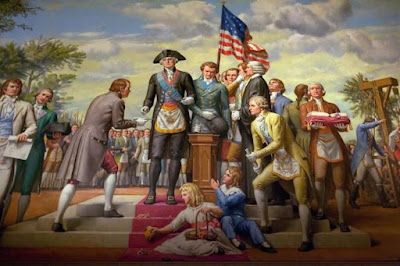
Allyn Cox 1955 mural at the George Washington Masonic National Memorial

by Christopher Hodapp

President Donald Trump's State of the Union message is taking place tonight, and there will be an important Masonic artifact there for this special occasion. 


The famous gavel used by George Washington at the Masonic cornerstone ceremony for the new U.S. Capitol building in 1793 will be displayed on the Speaker's podium in the House of Representatives tonight during the joint session of Congress.


Speaker Mike Johnson requested the gavel be present at the State of the Union address for the first time in history. The gavel is owned by Potomac Lodge No. 5 in Washington, DC.

The ceremony has been depicted several times by artists. The image at the top of this article was painted by Allyn Cox as a massive mural at the George Washington Masonic National Monument in Alexandria, Virginia. Installed in 1955, the mural underwent careful restoration in 2017. Cox also painted another version of the ceremony that is in the Cox Corridor of the U.S. Capitol.


Today, the U.S. Capitol Historical Society proudly announced that Speaker Mike Johnson will become the first House Speaker in history to display George Washington’s Gavel during the State of the Union Address to Congress. The historic Gavel was first used in 1793 to lay the cornerstone of the United States Capitol building: “The People’s House” and the physical manifestation of our democracy. Since that ceremony, the Gavel has been in the care of Potomac Lodge No. 5, the oldest Masonic Lodge in Washington, D.C. The U.S. Capitol Historical Society worked diligently with the Lodge and Speaker’s Office to enable the Gavel to rest on the rostrum during this year’s Address—marking the 250th anniversary of America’s founding.

“The U.S. Capitol Historical Society would like to thank Speaker Johnson and Potomac Lodge No. 5 for working with us to ensure the display of a historic treasure for this year’s historic Address,” said Roswell Encina, President & CEO of the U.S. Capitol Historical Society. “Complementing the State of the Union with George Washington’s Gavel beautifully reflects the importance of preserving and sharing the Capitol’s history; helping Americans connect with the people, places, and traditions that continue to shape our nation. A significant part of the Society’s mission is to bring Congress to the People. During America250, it is especially satisfying to have helped bring the People to Congress.”

In 1793, U.S. President and Master Mason, George Washington, laid the cornerstone of the United States Capitol Building. At the time, a growing schism between “Federalists” and “Republicans” threatened the American experiment in its infancy. Washington therefore lent his prestige to such events as the laying of the Capitol cornerstone to give credence to the new U.S. Government: established in 1789 after our Constitution was ratified.
Allyn Cox painting of the Masonic cornerstone ceremony in the Cox Corridor
of the U.S. Capitol.
 
On the morning of September 18, 1793, Washington and a procession of artillery and Masonic lodges crossed the Potomac River to the new Federal City. They did so, a newspaper reported, “with music playing, drums beating, colors flying, and spectators rejoicing.” At the Capitol site, Washington stepped into a dug trench, laid a silver plate onto the ground, and set the cornerstone atop it. He was accompanied by brethren who conducted a Masonic ritual with corn (a symbol of nourishment), wine (a symbol of refreshment), and oil (a symbol of joy). Witnesses then chanted and celebrated until night.

After the ceremony, Washington bestowed the Gavel to Valentine Reintzel, the head of Potomac Lodge No. 5, who assisted that day and cared for the artifact until his death. In the two centuries since, Potomac Lodge No. 5 has been the Gavel’s custodian, loaning it to other cornerstone ceremonies, including the Washington Monument, National Cathedral, and Smithsonian Institution.

<snip>

As Washington himself told Congress in his first State of the Union Address:

“Knowledge is in every Country the surest basis of public happiness…To the security of a free Constitution it contributes in various ways: By convincing those, who are entrusted with the public administration, that every valuable end of Government is best answered by the enlightened confidence of the people: And by teaching the people themselves…to discriminate the spirit of liberty from that of licentiousness, cherishing the first, avoiding the last, and uniting a speedy, but temperate vigilence against encroachments, with an inviolable respect to the laws.”

In addition to the gavel, another artifact from that same ceremony is owned by Virginia's Alexandria-Washington Lodge 22: a large silver trowel used to symbolically spread the cement of Brotherly Love.


Wednesday, August 20, 2025

G. Washington Masonic Natl Memorial Wraps Up Major Exterior Restoration


by Christopher Hodapp

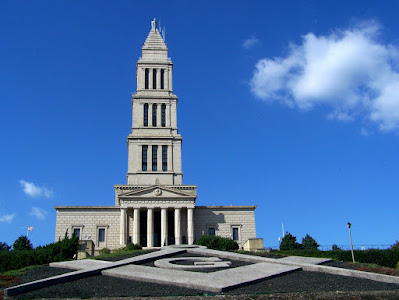
The George Washington Masonic National Memorial in Alexandria has been undergoing a major (and painstaking) exterior restoration project for the last eleven years. The monument to Brother George was built over a century ago and suffered from increasing water damage, limestone degradation, and even cracks from a 2011 earthquake. Work started on the iconic 9-story tower in 2014 and has at long last been completed.


An article in the local Zebra publication two weeks ago written and photographed by Brother Shawn Eyer detailed the work that was being done.
Cracks in the stone were sealed with epoxy. All of the original mortar was “raked out,” and each joint was repointed with a long-lasting mixture that allows moisture to escape rather than remain and go through freeze-thaw cycles. Weather-capping was installed. New LED lighting was installed to allow for the tower to be lit in many colors. Efflorescence—lime deposits often visible from the ground—was chipped away. In certain places, significant structural damage was repaired using steel rods. . .
For the last several years now, the work has neared completion with the scaffolding located behind the building, along the outer wall of the Memorial’s theater. Finally, the restoration of the temple was completed last month when workers lowered a newly-carved “Dutchman’s repair” into a niche where the 2011 earthquake had caused the coping to split. Now, that damage is completely invisible, and the integrity of the building is restored from top to bottom.
For the first time in a generation, it is possible to see the building in as stately a condition as that when it was first erected: a beautiful beacon of light with a positive and inspiring message.

 Thanks to Paul Keegan and his crew at Hibernia Masonry.

Saturday, November 02, 2024

George Washington Masonic Natl Memorial Dragged Into Politics


by Christopher Hodapp

(Updated Saturday, 10:20am,Nov. 2, 2024)

The trouble with owning a publicly visible building is that, occasionally, it's image pops up in the damndest places. 

It seems the local Democratic Party in Alexandria used an image of the George Washington Masonic National Memorial building up on Shuter's Hill, overlooking the city, lit up in blue, and implying it was done in support of their 'team color.' "Alexandria is the heart of Virginia. And it beats blue." screams the headline. Cute. Except that the Memorial was NEVER lit up in ANY color for ANY political party or cause.

By Friday morning, the Memorial had issued a 'cease and desist' letter to the Alexandria Democrats and posted a FAQ regarding its use for endorsing political candidates and causes. (See below.)

What's sad to me was that it never seemed to occur to the local political operatives that "the Freemasons" might be upset by its use. They appear to simply be unaware (or possibly uncaring) of our strict stance on political and religious tolerance and non-partisanship as an organization. We don't take sides as an organization, at the grand lodge OR local lodge level. But we've obviously dropped so far off of the cultural radar that their committee (or advertising agency) didn't consider our reaction might be highly negative to its use in such a manner. 

Let's not get partisan here, because, while this particular misrepresentation of Masonic philosophy was posted by the Democratic Party, the tragic truth is that, ANY political party, individual candidate, or advertising agency squint these days might have just as easily grabbed a shot of the Memorial's various lighting schemes over the years and used it for their own similar political message.


1. Has the George Washington Masonic National Memorial Association endorsed any political candidates?

No, the George Washington Masonic National Memorial Association (GWMNMA) has not endorsed any political candidate or party, nor does it participate in any partisan political activity. Our organization remains strictly nonpartisan in accordance with the values of Freemasonry and our status as a private 501(c)(3) nonprofit organization. Since 1723, Freemasonry has consistently stated its opposition to participating in partisan political causes, and this principle is a fundamental concept of Masonic recognition and regularity.
2. Why was the George Washington Masonic National Memorial featured in a recent political flyer?

The image of our Memorial was used without permission on a political campaign flyer circulated by the Alexandria Democratic Committee and the Democratic Party of Virginia. The flyer, which was not created nor authorized by our organization, implied our endorsement of eleven specific candidates. Upon learning of this unauthorized use, we have taken immediate action to request a retraction and ensure it does not happen again.
3. Why was the George Washington Masonic National Memorial’s tower lit in blue?

The Memorial has been lit in blue most recently in honor of a remembrance ceremony for Officer Daniel J. Canniff (ret.) of the Alexandria Police Department, who passed away October 3. The lighting coincided with a celebration of his life that took place October 15. Previously, it was lit blue for Hannukah, and for the 2023 Cornerstone Centennial. Under no circumstances is the Memorial’s lighting ever a partisan political message.
4. What actions has the GWMNMA taken to address this issue?

To protect the integrity of the GWMNMA’s nonpartisan standing, we have issued a cease and desist letter to the Alexandria Democratic Committee, requesting that they immediately stop using our building’s image and issue a public statement clarifying that our organization does not endorse any candidate or party. We are committed to upholding our principles of impartiality and transparency in this matter.
5. Is the GWMNMA affiliated with or supportive of any political organization?

No, the GWMNMA is not affiliated with any political organization and does not endorse any political platform, candidate, or party. Freemasonry as a whole has a longstanding tradition of political neutrality, and we adhere strictly to this policy, which dates back to the 1720s. Our mission is to honor the legacy of George Washington and to educate the public on Freemasonry’s history, principles, and values, free of partisan divisions.
6. What does the GWMNMA’s nonpartisan policy entail?

The GWMNMA’s nonpartisan policy means we refrain from all political endorsements, contributions, and activities that could imply support for or opposition to any political party or candidate. This policy aligns with the broader Masonic tradition of abstaining from partisan political involvement and is a critical component of our identity as a respected national museum and educational organization.
7. How does this issue affect the GWMNMA’s supporters and members?

The GWMNMA values its members and supporters across the political spectrum, and our commitment to nonpartisanship helps ensure that our organization remains a welcoming and inclusive space for all. For this reason, we have taken action to protect our reputation and to reaffirm our neutrality.
8. What should I do if I have further questions or concerns?

We encourage those with additional questions or concerns to reach out to our team directly. Please contact Shawn Eyer, Managing Director of Communications and Education via email at seyer@gwmemorial.org or by phone at 703-400-4950. We appreciate your continued support and understanding as we work to uphold the values and integrity of the George Washington Masonic National Memorial Association.

Thursday, July 25, 2024

Virginia's Grand Senior Warden Matthew Szramoski Named As G. Washington Masonic Memorial's New Executive Director


by Christopher Hodapp

The George Washington Masonic National Memorial Association in Alexandria, Virginia has just announced the appointment this week of Matthew Szramoski as its new Executive Director, effective immediately. He replaces Karl V. Hopkins who was appointed following the retirement last August of longtime Executive Director George Seghers.

Brother Szramoski was most recently the Director of Development for the Supreme Council of the Ancient and Accepted Scottish Rite Southern Jurisdiction in Washington, D.C. Before that, he was Youth Programs Manager for the National Rifle Association.

In the Masonic world, he is the current Grand Senior Warden of the Grand Lodge AF&AM of Virginia and is Past Master of three Virginia lodges: Yorktown 205, John Blair 187, and Mount Vernon 219. In the York Rite, he is a Past Commander of Old Dominion Commandery 11, a Past High Priest of Uroy Harris Chapter 83 of Royal Arch Masons. He holds the Knight York Cross of Honor, a member of the Knight Masons, and a 33° Scottish Rite Mason (SJ).

Sunday, November 05, 2023

George Washington Made A Mason 271 Years Ago Today


by Christopher Hodapp

A post on the George Washington Masonic National Memorial Facebook page reminds us that Sunday is the 271st anniversary of George Washington's initiation or "making" as a Freemason. 

George was made an Entered Apprentice Mason at the age of twenty in the Lodge at Fredericksburg, Virginia, on November 4, 1752. (There's some confusion over whether he was 20 or 21, because at this moment in time, the American colonies were just shifting over to using the Gregorian calendar.) He was passed to the Degree of Fellowcraft on March 3, 1753, and raised to the Sublime Degree of Master Mason on August 4, 1753. Soon after, Bro. Washington departed for the frontier on a surveying expedition. But he remained a member of Fredericksburg Lodge until his death on December 14, 1799.

The Bible upon which he took his Masonic obligations is still preserved and maintained by Fredericksburg Lodge 4 in Virginia. 

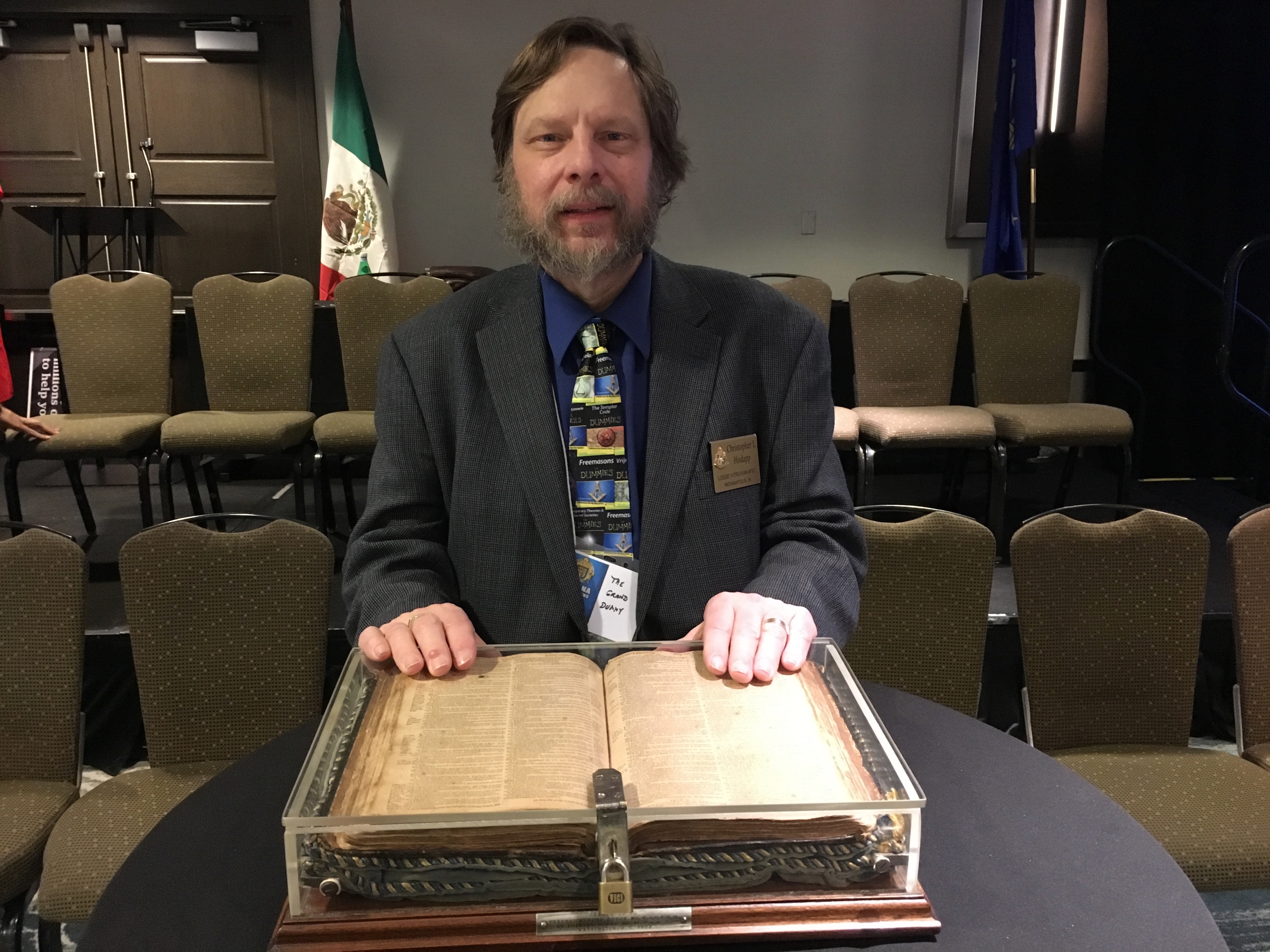
(Back in 2018, we were honored to have the Bible with us at the Masonic Library & Museum of Indiana for the 200th anniversary of the founding of the Grand Lodge of Indiana, and the Conference of Grand Masters in Indianapolis that same year. Fredericksburg keeps it locked in its traveling display case, presumably so it won't burst into flames when guys like me try to touch it.)


By the way, for those who fret about Masonic lodge dues these days being too cheap or too expensive, young George paid £2, 3 shillings, which would be approximately $488 today. Just a point of reference.

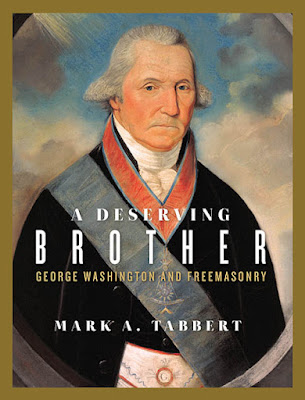
There have been stacks of books and articles written about George Washington and Freemasonry ever since his demise. Most have been well-intentioned, but so much has been wishful thinking, pure supposition, or downright fantasy. I touch on this in my own book, Solomon's Builders. But for the very last word in George Washington reference works concerning Freemasonry, let me recommend Mark Tabbert's recent work, A Deserving Brother, which documents every single Masonic meeting and event he provably attended, every known Masonic relic that he either owned or handled, and every known document he responded to regarding the fraternity. 

Friday, June 02, 2023

Universal Brotherhood Day in D.C. Celebrates 300th Anniversary of Anderson's 'Constitutions'


by Christopher Hodapp

This year marks the 300th anniversary of the publication of James Anderson's Constitutions of the Freemasons in 1723, the foundational document of the fraternity. On June 23-24 (St. John's Day), the 2023 Universal Brotherhood Celebration will take place in the Washington, D.C. area at the George Washington National Masonic Memorial. The event will be hosted by the Grand Lodge of the District of Columbia's historic Naval Lodge No. 4, with the participation of the Pro Grand Master of the United Grand Lodge of England and visiting Grand Masters of several U.S. Masonic jurisdictions.

Friday, June 23rd
  • Congressional Breakfast at the U.S. Capitol with Masonic members of Congress
  • Universal Lodge Meeting in the Andrew Jackson Lodge Room at the GWNM Memorial in Alexandria, Virginia
  • Festive Board at the Memorial - $50/person

Saturday, June 24th
  • Lectures at the Mount Vernon Estate on Anderson's Constitutions by various presenters on the impact of the 1723 Constitutions on the United Kingdom, Continental Europe, South America, and the United States.
  • Wreath laying at George Washington's tomb
  • Universal Brotherhood Banquet at Washington's J.W. Marriott Hotel - $110/person
For more information and to register, visit the Eventbrite website HERE.

Monday, February 21, 2022

Book Review: 'A Deserving Brother: George Washington and Freemasonry' by Mark Tabbert


by Christopher Hodapp

When the George Washington National Masonic Memorial in Alexandria, Virginia was first proposed in 1910, it was designed as a magnificent monument to America’s most famous Mason, along with being a safe and secure repository for priceless Masonic objects owned by Virginia’s Alexandria-Washington Lodge 22 that were associated with Brother George. The lodge possessed an original, contemporary portrait of Washington showing him dressed in Masonic regalia. And they had a collection of irreplaceable items which had originally been owned by Washington or utilized by him for the cornerstone ceremony for the U.S. Capitol building in 1798. 


But a fire at the lodge in the late 1800s resulted in the loss of several their priceless objects. So the Memorial was proposed as a national Masonic project that would be supported by all regular, recognized grand lodges in the U.S. in order to more safely house and display these almost sacred items for the public and for Masons alike. Today, the Memorial houses one of the largest collections of Washington-associated memorabilia outside of his estate, Mount Vernon and the Smithsonian Museum.


Many years ago, Mark Tabbert told me of an ongoing project he was working on. He has been the head of collections at the Memorial for many years, and the physical resources at the Memorial are preserved for future historians and Masons. Like the fairytales of Parson Weems’ chop-down-the-cherry-tree “biography” of the general, president and founding father, Masonic tall tales about Washington began propagating with great abandon after his death, and continue through today. 

Despite the endless (and frequently bogus) claims some Masons have made over the years about Worshipful Brother George and his enthusiasm for the fraternity, the truth is that Washington really only provably attended a handful of lodge meetings in person throughout his entire lifetime. Tabbert has always insisted that it is vital to honestly understand the role Freemasonry legitimately played in Washington’s life (and conversely, the role he played for the fraternity) instead of just breezily and blindly accepting legends that were told, retold and embellished by well-intentioned brethren over the last two and a half centuries. 


For instance, although Washington was named as the Master of Alexandria Lodge when it was chartered, he never actually sat in that position, or even as a sideliner in that lodge, and the famous drawings and paintings of him dressed in a jewel and apron as the Worshipful Master and presiding over a meeting were simply artistic flights of fancy on the part of painters and sculptors, and nothing more.

The result of Mark’s ongoing labors over the last decade is an ambitious new book being released this week by the University of Virginia Press: A Deserving Brother: George Washington and Freemasonry. In it, Tabbert has researched quite literally every single reference, claim, rumor, letter, declaration, newspaper article or offhanded remark that ever connected George Washington to the Masonic fraternity. Every known bit of physical evidence associated with Washington and his Masonic membership is presented in the book in chronological order, while explaining, debunking or ignoring the unsubstantiated claims. Tabbert’s intention has been to correct the historical record and create the standard reference work for future researchers on the trail of Washington and the influence Freemasonry may or may not have had on his life and his character.

Freemasonry during America’s formative years was instrumental in reinforcing the notion of a non-secular, “civic religion” that was so vital to the creation and success of this new constitutional, democratic republic. Washington’s membership in the fraternity was influential in both directions. In practical terms, Masonry demonstrated mutual cooperation, respect, religious toleration, and social egalitarianism that informed Washington’s understanding of democracy. And his membership in the fraternity gave Freemasonry a status that few other organizations could achieve at the time. His Masonic membership and support drew more and more merchants, community and business leaders, and men of all political and religious persuasions to join its ranks.

A Deserving Brother straddles the line between being an historical narrative and an itemized, encyclopedic catalogue. An extensive introductory chapter by Washington historian Edward G. Lengel gives a general chronological sketch of George’s life and where it coincided with the Masonic fraternity. But the main body of the work is its meticulously researched catalogue. The book is divided into several major periods of Washington’s life: as a British subject; General and Commander in Chief; private citizen; President of the United States; and his retirement and death. Each chapter is introduced by a general outline of the time period covered. Following that, descriptions of each reference include photos, dates, locations, circumstances, and in the case of letters and other documents, transcriptions of the text itself. In an effort to be as complete as possible, Mark has included correspondence whenever someone would send Washington a note, a Masonic book or other gift related in any way to the fraternity. And to aid future researchers, each item’s provenance and current location today are provided.

Notably, Tabbert has been careful to include verified details of several important, oft-cited milestones concerning Washington and the Masons, including his first inauguration in New York City and the circumstances involving the famous St. John’s Lodge Bible upon which he took the oath of office; the Masonic cornerstone ceremony of the U.S. Capitol in 1793 and the surviving working tools and related objects used at that event; and details of Washington’s Masonic funeral service in December 1799. An epilogue goes on to cite references about Washington used both by Masons and anti-Masons in the 1800s, as well as celebrations held by Masons in 1899 on the 100th anniversary of his death, and in 1902 for the 150th anniversary of his raising as a Master Mason. The major books written about Washington’s Masonic experiences and involvement are described, as well as the formation of what would become the George Washington National Masonic Memorial Association. 


The Memorial itself was officially dedicated in 1932, some 22 years after it was first proposed, and Tabbert provides a synopsis of its mission and exhibits then and now, as well as an explanation of the changes that have occurred there since its opening.

In short, Mark Tabbert’s A Deserving Brother is without question the most extensive, detailed and truthful accounting of Washington and his Freemasonry as he lived it. As an historical research tool it is invaluable, and will unquestionably be the most important reference work on George Washington and the fraternity available for decades to come.

This book is being distributed by Macoy Publishing under a special partnership with the George Washington Masonic National Memorial Association. Priced at $34.95 for the 304-page hardback edition, CLICK HERE TO ORDER.

Friday, September 04, 2020

George Washington Memorial's Masonic Digital Archive Is a Research Treasure


by Christopher Hodapp

For many years, Mark Tabbert at the George Washington Masonic National Memorial in Alexandria, Virginia has been actively seeking support for and promoting a digital collection made up of the proceedings of all U.S. grand lodges and appendant grand bodies. 

This ongoing project is being done through the Memorial's Louis A. Watres Library, named after the Association’s second president who oversaw the Memorial’s construction. Opened in 1952, the Library contains a substantial collection of approximately 7,000 volumes, including Masonic literature and U.S. Grand Lodges’ and other major Masonic organizations’ annual Proceedings.


The scope of the Masonic Digital Archives project is enormous - consider that a grand lodge like my own has been publishing these reports annually for over two hundred years, generally at the rate of a couple of hundred pages each year. Then multiply that by 51 Grand Lodges, plus Grand Royal Arch Chapters, Grand Cryptic Councils, and Grand Knights Templar Commanderies.

The Memorial Association is digitizing each governing body’s complete annual proceedings collections for a flat rate of $1000 as a service to the Craft. That price is non-adjustable, regardless of the number of books or pages digitized. After that, a $200 annual subscription fee maintains and updates the online collection on the Memorial's LUNA database platform. LUNA presents each book in pdf form and is fully searchable, making the hunting of names, places, topics, dates and more fast and simple. 

The Memorial's digitization project has primarily used the much faster and less expensive 'destructive' method of scanning, meaning that bound books must be sacrificed in order to speed the scanning process. For that reason, the Watres Library has requested two full sets of proceedings from each grand body so that the Memorial still has one complete and undamaged, bound set of volumes on its shelves to augment the online digital scanned versions. They have gotten underway with scanning the duplicate volumes they already have.

To see the proceedings currently online from 21 states and grand bodies, visit the Masonic Digital Archives HERE. 


Mark just sent me an update this week advising that, as of August 2020, the Memorial staff has digitized all of their duplicate proceedings collections, alphabetically from Alabama to New Hampshire so far. They expect to complete the full project through Wyoming before 2022. 

So here's the catch.

If you are a grand officer of a Masonic Grand Lodge or Grand York Rite Body of a state alphabetically between Alabama and New Hampshire, Mark can tell you what proceedings years have been digitized and which are still needed. If you confirm your jurisdiction's $1000 commitment to the project and the annual $200 subscription fee, the available digitized proceedings of your grand body will appear in the LUNA catalog within five working days.

If you are grand officer of a Masonic Grand Lodge or Grand York Rite Body of a state alphabetically between New Jersey and Wyoming, the Library has not yet organized your proceedings and is unable to give you a detailed inventory just yet. However, with your confirmed commitment to the project, Mark will pull your state’s proceedings and provide an inventory of what they have. Once a complete proceedings set is in hand from you and the $1000 is received, digitizing and posting on-line into LUNA will take approximately 30 working days or less.

This massive undertaking is an incredible research resource for historians and researchers, be they Masonic, academic, or genealogical. If your Grand Lodge hasn't stepped up and contributed to this project, the scanning and annual hosting fees are more than fair. Indiana scanned our proceedings many years ago, and to have them in digitized form has been a godsend - I couldn't have written my book Heritage Endures without it. And each year our jurisprudence committee and others regularly dive into our online proceedings hunting minute and otherwise hard-to-find information. Plus, organizing these collections onto an easy to use and access database is not a simple project for your grand lodge to take on - the Memorial is doing all the hard work.

If you have any questions about participating the Masonic Digital Archives Project or about LUNA, contact Mark Tabbert, Director of Museum and Library Collections.

The Louis A. Watres Library is available to the public and researchers by appointment only. Appointments must be made a least 24 hours prior. 

Friday, July 10, 2020

The Celestial Lodge: Alaska PGM John 'Bo' Cline Passes


by Christopher Hodapp

UPDATE: THIS STORY HAS BEEN UPDATED 7/11/20.

My longtime friend and Masonic Brother John 'Bo' Cline, passed away from acute leukemia on Wednesday. My deepest condolences to his dear wife Beth, to Josh, Megan, and all of their family.


It has been my privilege to know both Bo and Beth since I was invited to speak at Alaska's annual communication on Kodiak Island back in 2009, when he was elected as Grand Master. Bo's honors and accomplishments are far too numerous to recount here. In addition to serving as Alaska's Grand Master, he has served as a board member of the George Washington Masonic National Memorial, a member of the Board of Directors of the Masonic Restoration Foundation, and he was the third President of the Masonic Society between 2012-14. 

I just read that Bo was due to receive his honors as a 25-year member of our fraternity this month from his mother lodge, Alaska's Matanuska Lodge No. 7. 

Bo passed away on the 25th anniversary of the date of his being raised as a Master Mason.


Bo was such an incredibly multi-talented, multi-faceted man. On his Facebook page this week, Beth's brother, Jim Dodds, wrote this about Bo:
As with anyone it's hard to sum up in so many words a man's life.
With Bo it's exceedingly difficult because Bo lived an exceptional life.
He was an avid outdoorsman, brilliant engineer/scientist/mathematician, world traveler, and incredibly talented craftsman. Woodworking and brewing were his crafting passions.
To me though he was a mentor, friend, and even though he was married to my sister he seemed like a true blood brother.
He was 15 years older than me but I didn't feel that age difference.
He taught me about fishing and camping and working on the farm.
Indeed. Bo Cline was all that, and more. He was a mentor to all who knew him, and a natural leader who inspired everyone whose lives he touched. 


The COVID virus shutdowns have made all of our usual customs surrounding death and grief even more more heartbreaking than they would normally be under the best of  circumstances. Beth has requested that his Masonic Service be held later on when it is safer to gather together.

In Shakespeare's Hamlet, the prince is describing to his friend Horatio a vision of his father's ghost, 'in my mind's eye.' 
"He was a man, take him for all in all, I shall not look upon his like again."
I feel much the same way about Bo's passing. Men and Masons like Bo Cline pass this way but once. Would that there were thousands more like him.

His column is broken, and his Brethren mourn.

Requiescat in pace.


NOTE: The Masonic Restoration Foundation has announced that they will hold on online remembrance for Bo Cline on Sunday, July 12th at 8:00 PM Eastern Time (4:00 PM Alaska time), and it is open to anyone via Zoom. 

Click HERE to register. 

After registering, you will receive an email with information about joining the meeting.

Thursday, November 29, 2018

Freemasonry in the Age of Woke


There's a disappointingly superficial piece on the Washington Post website today by feature writer Sadie Dingfelder about the George Washington National Masonic Memorial in Alexandria, Virginia. As I read it, I was immediately struck by a picture it paints of a growing number of Americans these days and how Freemasonry is seen by them. 

Here are some excerpts from Dingfelder's article, 'Unlock the secrets of the Freemasons - or at least gawk at their strange costumes':
“Is it usually pretty quiet here?” I asked the person checking me in, who later turned out to be my tour guide.

“It can get pretty busy in the summer,” he replied. In warm months, busloads of Masons visit the memorial, he said.

“I must admit, I don’t know much about Freemasons,” I said, which prompted my guide to launch into a short history of the group.

“It’s basically a fraternal organization,” he concluded. “They do a lot of service and charity work.”

“Oh, so it’s like the Rotary Club, but with costumes and secret handshakes,” I said...

[snip]

The memorial also houses a museum of Masonic history, and we’d just arrived on a floor devoted to that when a muffled voice emanated from my guide’s walkie-talkie. He rushed off to fetch a late-arriving tourist, leaving me alone in a room full of creepy mannequins attired in the costumes of various Freemason subgroups and affiliated societies, including Shriners’ fezzes, Arabic-looking turbans, militaristic uniforms and one costume with a jeweled breastplate, an imitation of vestments worn by ancient Israelite priests.

I found this to be a fascinating glimpse into a less-woke era, but I was disappointed that I couldn’t find any explanatory text about why these groups of (I imagine) white men wore Middle Eastern-ish garb, and whether similar costumes are still used today.
Some of the Freemason costumes on display struck this reviewer as Orientalist,
militaristic or just plain strange.
Scattered around the mannequins were displays of random club ephemera — plus a few inexplicable objects, including a jaunty bobblehead doll of the controversial Christian figure Jacques de Molay, a monk who fought in the Crusades and was later sentenced to death. De Molay’s medieval order, the Knights Templar, inspired the modern-day Knights Templar — a Christian-focused subgroup of Freemasons, my guide explained after returning with a mysterious man in a trench coat...
[snip]
If I’m right, he’s an increasingly rare breed. Freemason membership has been in decline since the 1960s, according to a chart on display in the museum’s basement. “Civic life declined as people spent more time alone in front of a television or computer screen,” the accompanying text explains. Fair enough, but I’m betting that the Masons’ fraught racial history and continued exclusion of women have also contributed to their diminishing relevance.

I mention this because the Masonic memorial may be on its way to becoming just that: a memorial to a bygone organization, where powerful men once gathered to socialize, plan charitable work and wear Orientalist costumes. Perhaps a lot of this is best left in the past, but it seems to me — a person who spends way too much time alone, in front of a computer — that there’s something here worth bringing into the future.

The benefit of resources like LinkedIn is that you can go and find out about the background of people whom you otherwise don't know at all, and Sadie's profile yields a few items worth noting. She's not a teenager or a college student — she graduated in 2001, so she's in her mid- or even late-30s. Sadie's a graduate of Smith College (a private liberal arts college for women only in their undergrad program), and she's been working as a writer for the Post in the Washington D.C. area in various capacities for ten years. She lives and works in the very city that a lot of Masons (and even non-Masons) regard as one heavily influenced by Freemasons from the past, and (if you believe in such things) filled with Masonic symbolism even in the street map. TV producers of programs about Freemasonry are obsessed with the idea. So it surprised me a bit to see just how little knowledge or awareness of Freemasonry she seemed to have when she walked into the Memorial — and apparently, how little she had actually learned by the time she left. After touring the place, she declared that Freemasonry is little more than a bygone organization.

This isn't a hit on Ms. Dingfelder, not at all. It's a comment on how diminished we have become in the collective American psyche. I thought we had reached rock bottom in that regard back before novelist Dan Brown put Freemasonry back on the map in the early 2000s. Since those dark days, cable television has had loads of programs about Masonry. Stacks of factual, intelligent, and truthful books (including mine and Brent Morris') got poured onto the market. Freemasonry worked its way into pop culture references like movies, music and TV shows. I had thought we had even turned a tiny corner and tipped the scales slightly back into our favor, at least as far as a basic awareness of Freemasonry was concerned.

Indeed, the Scottish Rite NMJ did a survey two years ago and discovered that a full 81% of respondents had at least heard of Freemasonry, even if they didn't know what it was. But as I think back over the last five or six years now, and reflect on my own contacts with the public about it, I fear more people are even less aware of what Freemasonry actually is than in the 1990s. In that same survey, less than 30% actually knew what the values of Freemasonry were. And the most common question I get asked by non-Masons under 35 these days once I get my basic elevator speech out of the way is, "But just what is it that you guys DO? What's the point?"

That shouldn't be a shock, since we are about one generation removed from the 1990s. The adults in 1990 were having children at that moment in time, and we are now encountering those former infants as adults today. Already by 1990, Freemasonry had been waning, along with a raft of other social changes taking place then. By 1990, the fraternity was already down in membership by more than 30% from its 1958 height. It was blatant that the Baby Boomers had steered clear of Freemasonry, just as they had so many other so-called "Establishment" ideals of their parents. Organized religious attendance was decreasing. Divorce rates had skyrocketed. Childbirths were down substantially, and most concerning, single parent households (usually single moms) were taking a major upswing. It was into this period that today's current Millennial adults now in their late-20s and 30s were born.


According to the Pew Research Center, fewer than half (46%) of American kids under 18 years of age are living in a home in 2018 with two married heterosexual parents in their first marriage - what is quaintly called a traditional family household. This is a huge change from 1960, when 73% of children fit this description, and 1980 when 61% did. At less than 50% today, it's certainly a dwindling tradition.

One of the most enormous shifts in family structure is this one: 34% of American children today are living with an unmarried parent—up from just 9% in 1960, and 19% in 1980. In most cases, these unmarried parents are single, without a live-in partner of any kind to help raise and educate the children. And by far, the largest number are single mothers.

When I wrote Freemasons For Dummies in 2004, there was still a reasonable chance that enough grandfathers had been Freemasons in sufficient numbers that their grandchildren had at least encountered the fraternity in their lives. But that percentage has done nothing but drop since then.

Fewer children today have full-time fathers than ever before in recorded history, and even fewer of them have a grandfather to pass along older traditions like Freemasonry and numerous other important values. 

(Interestingly, 5% of children are not living with either parent at all. In most of these cases, they are living with a grandparent—a phenomenon that has become much more prevalent since the recent economic recession.)

When you take into consideration all of this stew of statistics, it's clear that Freemasonry as a subject for observation by children has a pretty paltry chance of being passed along to the current and future generations by many fathers, grandfathers, siblings, uncles or other influential men in their lives. 

In other words, there's no statistically significant reason why Sadie Dingfelder would have encountered Freemasons in her family. She doesn't mention any sort of family connection to the fraternity, so the only way she knows anything at all about us is from what she picked up by cultural references she has encountered as a teenager and adult. Like going to the Memorial, poking around on the Internet, or catching a rerun on A&E or the History Channel. I suspect she may not have a single family member, friend or acquaintance who is a Mason, or was in recent memory.

Mull that over. And if she has children of her own today, what chance will they have as adults to inherit any sort of collective, cultural knowledge of Masonry in another 20 years?

Note her comments about Masonry being from a "less-woke era" (a colossally imbecilic adjective if ever there was one) and her pronouncement that our "fraught racial history and continued exclusion of women have also contributed to their diminishing relevance." Whether you believe that or not, that is one narrative being circulated about us today in this hyper-heightened period of describing every single subject on the face of the Earth in terms of gender, race, offense, privilege  and oppression. Young people are being taught a dramatically different (and arguably damaging) version of Western and American history now than older generations, and the values, traditions and institutions of the Founders and prior important historical figures are being derided or ignored altogether. The images of George Washington and Ben Franklin as Freemasons don't carry the sort of influence and impact they had even 20 years ago – some today would even argue that they are a negative.  And let's not even venture into the demographics regarding religious beliefs among Americans in 2018, or how religious Americans are almost uniformly portrayed in a negative light by the pop culture. 

None of this is an indictment of anyone, because there's no single villain we can isolate and counter, argue with, or shoot out behind the barn. These are simply the current circumstances we find ourselves struggling in. That's what we're facing going forward as we try to craft messages for the profane world, design our museums, and sit for interviews with the press. Once again, the culture has shifted under our feet, and this time, we find ourselves potentially tap-dancing on a minefield.

As bleak as all of this may seem, at its core, Freemasonry is and will remain important and relevant and needed as time marches on, but it's up to each of us to do our part to ensure its future by not hiding what's left of our light under a bushel and permitting ourselves to be ignored to death. Remember that even Sadie recognizes this, and concluded her essay with this thought: "Perhaps a lot of this is best left in the past, but it seems to me — a person who spends way too much time alone, in front of a computer — that there’s something here worth bringing into the future."

There is indeed.
Sunday, November 04, 2018

Iconic Washington Painting Restored at the GW Memorial

George Washington as Master of His Lodge (1932) by Hattie Burdette
(Image before its restoration)
On Thursday this past week, the George Washington National Masonic Memorial in Alexandria proudly reinstalled a famous Masonic portrait of Washington, dressed in the regalia of Worshipful Master of Virginia's Alexandria-Washington Lodge 22. The Memorial recently undertook the task of having the original painting restored, and it now hangs near the Memorial's South Lodge Room.

It was just in time. 

This evening - Sunday, November 4th, 2018 - marks the 266th anniversary of the initiation of then 20 year-old George Washington into the Lodge at Fredericksburg, Virginia in 1752.


If this portrait looks familiar to many of you, it should. The portrait was commissioned in 1931 by Freemason and U.S. Congressman Sol Bloom for the George Washington Bicentennial Commission, and painted by artist Hattie Elizabeth Burdette (1875-1955). It depicts Washington presiding as Master of Alexandria-Washington Lodge No. 22, gavel in hand. If not the most famous image of Washington as a Freemason, it's arguably the most widely circulated one that is seen regularly in lodges all across the United States. Yet, it was commissioned by a Congressional committee and paid for by the government, not Masons. Imagine such a proposal today.

How is it that this particular painting of Brother George dressed as Worshipful Master wind up in so many American lodges? According to William D. Moore and John D. Hamilton's detailed essay, 'Washington As the Master of His Lodge: History and Symbolism of an American Icon',

New York Congressman Sol Bloom, director of [the Memorial] and a member of New York's Pacific Lodge No. 233, took pride in his agency's insistence on "realism." In consultation with F. Walter Mueller, a member of Century Lodge No. 100 in South Orange, New Jersey, Bloom reviewed many Masonic portraits of Washington before rejecting them all as inaccurate. He then hired Burdette to- create a portrait in which the figure was based upon Houdon's statue of Washington while the overall work incorporated the relics maintained by Alexandria-Washington Lodge No. 22... As well as appearing repeatedly both in the Masonic press and in publications of the Washington Bicentennial Commission, more than fifteen hundred photolithographic reproductions of Burdette's painting were distributed by congressmen to Masonic organizations throughout the United States.
Brother Sol Bloom
Brother Sol Bloom represented the 20th Congressional District (Manhattan's west side) in the House of  Representatives, serving fourteen terms from 1923 until his death in 1949. During the critical years leading up to and through the end of World War II, he was Chairman of the House Committee on Foreign Affairs, and he later went on to become one of the first signers of the United Nations charter. 

Prior to his congressional career, he had been both a newspaper and music publisher. He also understood showmanship. Early in life he was a theatrical and boxing manager, and he had been the creator of the Midway of the famous Chicago Columbian Exhibition in 1893.

In 1931, Bloom was named both chairman of the Congressional George Washington Bicentennial Commission and the director of the George Washington National Masonic Memorial's Bicentennial Committee, commemorating the 200th anniversary of George Washington's birth the following year. On that date, the new Masonic Memorial towering above Alexandria would be dedicated and opened to the public. Bloom requested eight Washington D.C. area artists to each create a poster which would be used to promote the official government-sponsored national celebration of Washington's birthday in 1932. Artist Hattie E. Burdette asked permission of Alexandria-Washington Lodge 22 to use their lodge room and Washington's Masonic gavel, sash, Past Master's jewel, his chair, and other items to depict in her painting. 


Teft Johnson, George's stand-in
Her model was Teft Johnson (photo), an actor who portrayed the role of Washington in several historical plays under the direction of famed Broadway producer David Belasco. Of all the posters submitted, Burdette's was selected by the Commission to advertise the Memorial's dedication.

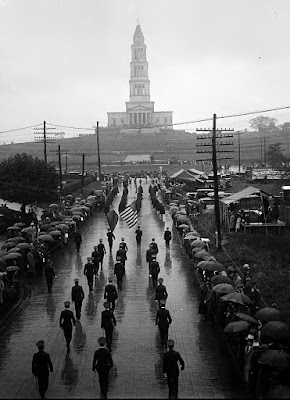
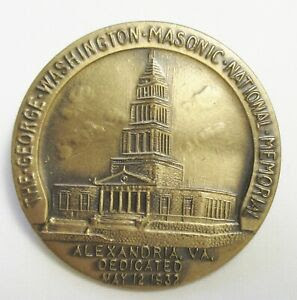
On November 29, 1931, Congress and the National Bicentennial Commission decided that second week of May in 1932 would be set aside as Masonic Week. Consequently, May 12th would be the official opening and dedication of the George Washington Masonic National Memorial. 

Invitations to this gala event were sent to thousands of American citizens and to regular Freemasons around the world. Although not a Mason himself, President Herbert Hoover and the First Lady were among the first to accept the invitation. Others included every member of Congress, the Justices of the Supreme Court and members of President Hoover’s cabinet, along with all 49 of the Grand Masters of the U.S. The mayor of Alexandria, the governor of Virginia, and many other government, military, religious and civic leaders joined the celebration. 

President and Mrs. Hoover leaving the Memorial on May 12th, 1932
As bad luck would have it, a torrential five-day downpour nearly ruined the ceremony - 50,000 attendees and onlookers had been expected and planned for, but the rain and flooding kept all but 1,500 from climbing the long driveway and attending at the Memorial itself. Bleachers outside sat wet and empty as reportedly hundreds of onlookers watched from the bottom of Shooters Hill safe and dry, huddled in railroad coaches at the Alexandria train station. Those who could manage to get inside the Memorial jammed into the 400 seat auditorium for the various speeches, far exceeding the Fire Marshal's directives.

On September 17, 1932 Teft Johnson again portrayed Washington for a reenactment of the President laying the cornerstone of the United States Capitol with full Masonic ceremony. The cornerstone ceremony reenactment was filmed by the Bicentennial Commission.

I am told with as much confidence as is possible that reproductions of Hattie Burdette's painting were circulated to every U.S. lodge possessing a charter in 1932, and that even today, every lodge in Virginia still has one hanging in its building. The original hung in the U.S. Capitol throughout 1932, and was then gifted to the George Washington National Masonic Memorial when the year was over.

And to come full circle, the historic Bible upon which young Brother George placed his hands that evening in Fredericksburg 266 years ago when he took his obligation as an Entered Apprentice is still preserved by Fredericksburg Lodge No. 4. The lodge has recently started a restoration fund to have the fragile book properly curated for future generations. We were honored to have it here in Indiana for our Grand Lodge Bicentennial and the Conference of Grand Masters this year.