"To preserve the reputation of the Fraternity unsullied must be your constant care."

BE A FREEMASON

Showing posts with label affinity lodge. Show all posts

Friday, April 17, 2026

California Opens Starfleet Lodge U.D.


by Christopher Hodapp

The Grand Lodge of California has officially established Freemasonry’s first Star Trek-themed affinity lodge. Starfleet Lodge U.D. was consecrated on Sunday in the Pleasanton Masonic Hall. Grand Master Garrett S. Chan was on hand for the occasion. (Photos from Jonathan Hirshon’s Facebook page) 


Their location makes sense as Pleasanton is neighboring city of San Francisco, where, according to the canon of the Star Trek universe, is the location of Starfleet headquarters and the Earth location of the United Federation of Planets. Or will be in the 23rd century. No word yet on whether they can be numbered 1701 once they satisfy the requirements of being under dispensation.


WB Adam Hanin is the lodge’s founding Worshipful Master, WB Nicholas Hayworth, Senior Warden, WB Dinesh Chhabra, Junior Warden, and WB Gary Sparks, Senior Deacon. Yes, the Tyler is armed with a very sharp Bat'leth to repel boarders.

Dilithium crystal-powered gavel


Festive Board on Deck 5

As they say in Scotland, "The lodge is closed, and the bar is open!"
But where is the Saurian brandy?

Food replicator needs reprogramming: no green beans in sight.
And that spaghetti on a paper plate is "best served cold."


In recent years California has been encouraging the establishment of affinity lodges, made up of members with a special interest in common. As many as twenty years ago, my friend WB Jeffrey Naylor strongly advocated for affinity lodges based on shared outside interests of groups of Masons. He encouraged embracing ideas like a “Lionel Lodge” for train enthusiasts, arguing that common passions could attract quality men to Freemasonry without conflicting with its principles. 

Many jurisdictions have hundreds of lodges, creating opportunities for unique, non-cookie-cutter experiences rather than identical ones. In England, the United Grand Lodge of England (UGLE) has long supported this approach with numerous affinity lodges for hobbies and occupations—such as fishermen, gamers, F1 racing fans, actors, musicians, and rugby players—alongside their Universities Scheme to attract students and faculty. A new science fiction and fantasy-themed lodge in the UK recently drew over 130 attendees at its consecration. One member noted that these lodges simply combine two passions, strengthening both the lodge and the fraternity, while maintaining standard ritual and meetings.

Sadly, affinity lodges have still not became widespread in the United States, which is a missed opportunity. My own jurisdiction of Indiana has seen a few special-purpose lodges over the years, including ones for handicapped candidates (Bartimaeus Lodge), a blood drive (Transylvania Lodge), historic preservation (Schofield Lodge No. 1818), and medical professionals (St. Lukes Lodge No. 761), plus historic foreign-language lodges in German back in the 19th century. There is, however, increasing interest in contemplative, philosophical, and esoteric-minded lodges. With so many possibilities within our basic framework, there is ample room to experiment while honoring Masonic landmarks and thinking creatively to attract (and retain) new members and revitalize the fraternity.

Sunday, July 10, 2022

Affinity Lodges: UGLE Charters Science Fiction & Fantasy Lodge 10016


by Christopher Hodapp

On Saturday, July 9th, the United Grand Lodge of England announced the official consecration of their newest Masonic lodge: Science Fiction and Fantasy Lodge No. 10016.  The lodge meets in the Rugley Masonic Centre on Pottal Pool Road in Peckridge.


(If you squint carefully at the photo, you'll see a pair of lightsabers, and a Klingon bat'leth held by their Tyler, as you would expect, forming a square and quadrant and resembling a Past Master's jewel.)

https://redd.it/vw0k0b

Many of our grand lodge jurisdictions have hundreds of lodges, and there's a strong argument to be made against identical, cookie-cutter lodges. Twenty years ago, my friend WB Jeffrey Naylor (founding Master of Indiana's Lodge Vitruvian 767 and fellow Knight of the North) was strongly advocating unique Masonic lodges, based on outside interests of groups of Masons. 

Jeff wrote, 

"If you can get enough Master Masons who like to dress up like train engineers and who want to start Lionel Lodge No. 769, or whatever the number is now, let the cheer go up and celebrate the chartering of a new lodge. These guys have something in common, they want to pull together and appeal to a particular group of men whose interests are not antithetical to the fraternity and who might just bring quality men into Freemasonry. Don't fight it, embrace it, promote it." 

It's been twenty years now since Jeff wrote that, and our English brethren have been doing this sort of thing for quite some time.

The UGLE has not been squeamish about the establishment of all sorts of affinity lodges, made of members who enjoy certain hobbies or who share the same occupations. There are lodges for fishermen, gamers, F1 auto racing fans, actors and musicians, various sports like rugby, and many more. That's in addition to their ongoing Universities Scheme, which encourages the establishment of lodges near colleges and universities, designed to attract administrators, faculty and staff, as well as students.

While some purists may argue that a science fiction and fantasy-themed lodge is somehow degrading, embarrassing, or in some way makes Masonry seem like a frivolous pursuit, quite the contrary. It can be argued that it helps tap into a portion of men who might otherwise have never even given a moment of thought to the notion of petitioning a lodge. And it helps to fight against the perception that Masonry is nothing but a haven for cranky old men with squealing hearing aids, and lonely, basement-dwelling incels. 

"There are many special interests lodges in the UK, an F1 Lodge, a rugby lodge, etc. For the members it is a way to marry two of their greatest passions which can only serve to strengthen the Lodge and the fraternity in general. We had over 130 in attendance at our consecration, with a growing list of joining members as well as eager visitors. With the exception of a few specific implements in the Lodge, as seen in the photos, the ritual and the Lodges meeting will be conducted the same as any other. Where we hope to truly set ourselves apart will be at the festive boards as well as our social events."

Sadly, the affinity lodge concept never really became a big hit in the United States. That's a shame, because with scores or hundreds of lodges in a jurisdiction, that means there are myriad laboratories in which to experiment, as long as the landmarks are followed. There is much to be said for thinking outside the box when it comes to exploring the notion of chartering a new lodge (or in trying to rejuvenate an existing one).

While not exactly affinity lodges, in my own jurisdiction of Indiana we have had a number of unique, special purpose lodges: 
  • Bartimaeus Lodge U.D. ("under dispensation") was organized in the 1960s specifically to help lodges in the state to confer the degrees of Masonry on handicapped and disabled candidates. 
  • Transylvania Lodge U.D. was formed to meet once a year (on or around Halloween) in order to operate a blood drive. Its Master, Bob Hilgediek, was an extraordinarily tall man with a gaunt face and was affectionately as 'Drac' – he presided over their annual meetings dressed in an appropriate long black cloak. A blood donation truck was parked in the lot outside and remained open throughout the day. Sadly, the lodge died when Bob passed away in 2001.
  • Schofield Lodge 1818 U.D. was created specifically to support the ongoing restoration and operation of the historic Schofield House in Madison, Indiana – the site of the first official meeting of the Grand Lodge of Indiana.
  • St. Luke Lodge 761 in Franklin, Indiana (location of our Masonic retirement home, known today as Compass Park) originally started as an occupational affinity lodge for doctors and others in the medical professions. 
Throughout our history, we have also had a handful of lodges that did their Masonic work in German. An enormous number of Indiana's early settlers emigrated from the German states in Europe, and these German lodges were quite popular in their day. New York had several lodges in New York City that performed their meetings and ceremonies in Italian. I'm sure other states had their own foreign language lodges that were established during the various regional periods of mass immigration. I understand there are several lodges in and around Washington DC that still do their work in French. 

(Honestly, with the huge influx of Hispanic immigrants to the U.S. over the last 40+ years, I'm astonished that almost no one has attempted to organize Spanish language lodges across the country. That seems like a terrible oversight and a foolish one, to ignore this rapidly growing demographic – especially since Masonry currently thrives in Mexico, Cuba, and Central and South America these days.)

But in addition to hobbies, pastimes and professions, there has been a slow growth of a different type of affinity lodge in the U.S. I'm speaking of the rise in lodges made up of Masons who are looking for a more contemplative, philosophical, esoteric-minded lodge experience. 

That's for another post. More along this line of thinking in an upcoming post later on this week.


Meanwhile, congratulations to the founding members of Science Fiction and Fantasy Lodge No. 10016. May you truly live long and prosper.

Thursday, January 27, 2022

GM of Georgia Issues Edict Banning Widows Sons Motorcycle Riders


by Christopher Hodapp

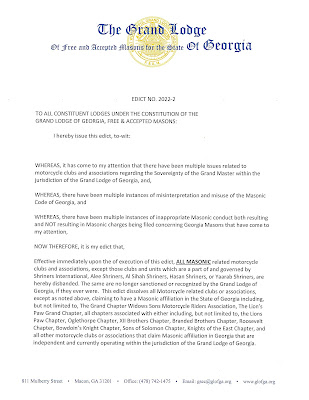
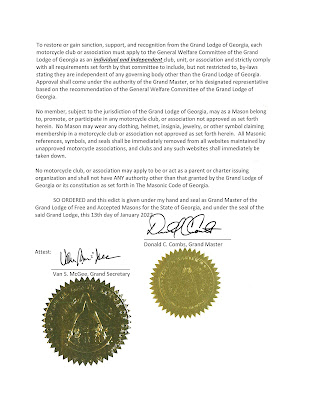
The Grand Master of the Grand Lodge of Georgia F&AM, Donald C. Combs, has just issued an edict in his state (No. 2022-2) forbidding the Freemasons in his jurisdiction from belonging to the Widows Sons International Masonic motorcycle riders association. Georgia Masons who do not comply by dropping their WS membership risk expulsion from the fraternity. Further, the edict orders ALL Masonic-related motorcycle clubs and associations in Georgia to disband, with the exception of motorcycle clubs affiliated with the Shrine. (Click images below to enlarge.)


This is not the first time this has happened in the U.S.

Back in 1998, a group of Masons who shared a love of motorcycles organized the first chapter of the Widow’s Sons Masonic motorcycle riders club, led by Brother Carl Davenport out of Chicago, Illinois. Open to all Master Masons, the goal of the Widows Sons was (and is) to promote motorcycle riding among Masons, and to promote Masonic membership among the general public. They regularly support and contribute to Masonic programs that help widows and orphans of Brother Masons. But almost from the outset, there was a cohort of Masons who strongly objected to the public image of the Widow’s Sons, and criticized the group’s first logo design, patches and leather vests as looking entirely too much like an unsavory outlaw motorcycle gang. 


Original logo for the Widows Sons included a sultry, red leather-clad 'Widow.'
(Image from Hiram's Knights website)

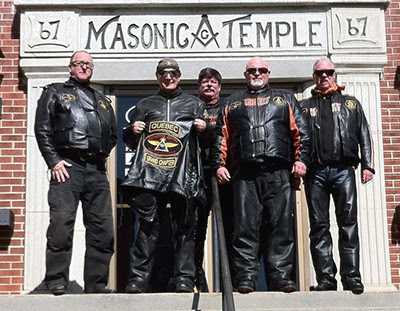
Their early vests often featured a Masonic square and compass, and a common objection was that Masonic symbols would be seen in bars on brethren who may not be able to subdue their passions. It was especially objected to in states where a grand lodge forbade Masons from serving and consuming alcohol at lodge functions. And their earliest logo featured a sultry 'widow' dressed in red leathers looking entirely too MILF-like. By the early 2000s, several grand masters around the U.S. issued decisions and edicts against the group, and in more than a few cases, ordered the groups to completely shut down, threatening expulsion for Masons who defied these orders. Other states forbade the wearing of Widows Sons signature leather vests in Craft lodge meetings.

(See Grand Master of Texas Edict: Widow's Sons Motorcycle Group from 2011; I don’t believe that anything has changed in Texas since then concerning Masonic biker groups.)

Photo: widowssonsinternational.com

Unfortunately, Masonic motorcycle associations have always - and continue to attract - extra scrutiny from critics and more than a few grand masters. Motorcycle-riding GMs in general have no issues with them, but plenty of other GMs find them problematic, asserting that motorcycle clubs of any kind attract an unsavory sort of man and are antithetical to the upstanding image that Freemasons have historically cultivated. There are also allegations that the state grand chapters of the Widows Sons set themselves up as a conflict of interest with grand lodges.

Over the last couple of hundred years or so, enthusiastic Masons have often sought to form special interest clubs or groups with like-minded brethren based on their professions, hobbies, or obsessions. There are Masonic veterans’ groups (National Sojourners), fishing clubs, gun clubs (like Hiram's Rangers Western action shooters club), stamp-collecting groups (Masonic Philatelic Club), RV owners (National Camping Travelers ), Masonic luncheon groups (like High Twelve International), and lots more. The most obvious manifestation of this phenomenon can be seen in the Shrine. Upon joining a local Shriners temple, new members are often encouraged to join and participate in a specific affinity group like the clowns, Masonic or Shriner degree teams, little car drivers, classic car enthusiasts, model railroad clubs, boat owners, private plane pilots (the “Flying Fezes”), and often one of the most popular, motorcycle riders. 

Other states have managed over the years to hammer out agreements between their grand lodges and the Widows Sons, so hopefully this will be a brief incident.

UPDATED 1/27/2022 9:00PM

A closer reading of the edict gives a better sense of what it is attempting to address. From his edict I took away that the GL of GA must officially recognize or authorize any group calling itself ‘Masonic,’ and that the entire collection of clubs being disbanded or forbidden never bothered to officially get those approvals. I believe he’s saying, ‘Clean up your act, decide if you want to be Masonic, and apply for approval with the proper committee. Let’s do this right instead of ignoring the GA code and procedures.’

Sunday, June 09, 2019

'Hiram's Rangers' Masonic Western Action Shooters


After twenty years of thinking I had my finger on the pulse and my ear to the ground (a startlingly vulnerable position to find oneself, to be sure), I just discovered a new group that's gotten sizable enough nationwide to be newsworthy. I never cease to be amazed at the boundless diversity of interests within this fraternity that manages to find enough kindred spirits to band together into a new and inventive Masonic group. 


Meet Hiram's Rangers. As described on one Facebook page, Hiram's Rangers is a Masonic club comprised of brothers who have a passion for 'The Old Bang 'N' Clang,' Western Action Shooters. To receive the degree you must be a Western action shooter, be clad in 19th century clothing, and preferably be attending an event associated with western action shooting. Much like numerous other smaller associative or informal Masonic groups, once you become a Ranger, you are empowered to transmit the degree to others who meet the requirements – sort of like the Turtles, or the Grand College of Memes. And, I'd be remiss if I didn't mention The Invisible Lodge for Master Mason magicians, or the National Camping Travelers for Masonic RVers.

Freemasonry attracts more than its share of brethren with an active interest in history, and within that group there are numerous Masons who engage in historical reenacting. There's the Sword of Bunker Hill, tied to the Revolutionary War period. There's the National Order of the Beaver degree (or "Buck Skinners' Degree”) for Masons who participate in historical Rendezvous as fur traders. The medieval Knight Templar group Levant Preceptory in Indiana grew in part from a Mason who heavily participated in the Society for Creative Anachronism. And there are countless others all over the country with various regional levels of awareness.


So if you're an active Western shooter and a Mason, ask around. Something tells me this will grow quickly.

(H/T MW Kenneth Roy, Jr.)