"To preserve the reputation of the Fraternity unsullied must be your constant care."

BE A FREEMASON

Showing posts with label Masonic book. Show all posts

Monday, March 16, 2026

'Solomon's Builders' Now Available As Audio Book


by Christopher Hodapp


To my surprise, my 2006 book, Solomon's Builders: Freemasons, Founding Fathers, and the Secrets of Washington D.C., has just been released as an unabridged audio book and is now available from Amazon/Audible for $18.18. Unfortunately for fans of audio books, there are many photos and illustrations in the print edition, so your enjoyment of Solomon's Builders may be less than ideal, unless you use it as a companion to the dead tree version. That's not me trying the old Chico Marx sales tactic, "One's no good - you gotta have the whole set." I'm just saying it's tough to contemplate the street plans of Washington DC or Sandusky, Ohio without actually seeing them.

Be aware that Solomon's Builders was written before novelist Dan Brown's hotly awaited Da Vinci Code sequel, The Lost Symbol, was released. Still, I actually enjoyed writing it more than any other book I've done. At the time, Dan Brown mania was in full force, and second-guessing his anticipated 'Masons in Washington DC' storyline was a cottage industry. 

Shortly after Freemasons For Dummies was released in 2005, I received an obscene phone call from an editor at Ulysses Press who made me an offer few new authors can refuse: they wanted to pay me to write anything I wanted, as long as they could promote it as an unauthorized tie-in to Brown's sequel. I spent 10 days in Washington interviewing, researching, taking photos, and even getting threatened with arrest by the CIA in Reston. (Yes, really.) And, unlike the Dummies books with Wiley, Ulysses gave me little in the way of a deadline.

Brown's Masonic-themed The Lost Symbol finally came out in 2009, almost 9 years after his blockbuster DaVinci Code was released, and much of the speculation about his plot points that I made in my book turned out to be wrong. Brown – or his publisher – had leaked early on that his upcoming book was to be called The Solomon Key, hence my own title, which I ultimately liked, whether it tied in or notBut I wrote it in such a way that it was more of an overview of the Masonic backgrounds of the Founding Fathers and a Masonic guidebook to the city than the sort of "I'll bet he writes this" ripoff that so clogged up bookstore shelves at the time (usually with the word 'Code' in the title). Consequently, most of the book's content has withstood the lapse of time, and remains useful and informative. 

BTW, as was done with Freemasons For Dummies several years ago, the publisher never asked me to narrate the recording - it's read by someone named Charles Constant, who does a fine job. I just wish an invitation had been extended to me, since I am an experienced voice-over artist who's recorded many commercials over the decades. I've encountered many Masons who have been disappointed when the recording wasn't me, but that's show-biz. 


Just to clarify something else: Ulysses Press' owner called me the day the news services breathlessly reported that Brown had finally turned in his sequel's manuscript in 2009 and that they finally had a publication date. The owner wanted ANOTHER tie-in book written within six weeks after I actually read The Lost Symbol to update my previous guesses and explain the actual Masonic references Brown DID include in his new novel. That new book was released in January 2010 as Deciphering the Lost Symbol, and is still floating around out there. 

Thursday, September 25, 2025

Today Only! Sale on 'Freemasons For Dummies' Kindle Just $2.99


by Christopher Hodapp

UPDATE 9/29/2025 AT 8:00PM
SALE IS OVER WITH AND THE KINDLE IS BACK UP TO IT'S NORMAL $17.99 PRICE.

I just received a last-minute message from my editor at Wiley that Amazon is offering a flash sale RIGHT NOW on the Kindle version of Freemasons For Dummies for an unbelievable $2.99! 

That's a markdown from the usual Kindle price of $17.99 and it's available today only, Thursday, September 25th! 

Strange and myriad are the ways of Amazon. No, I don't know when they'll shut it down, so you need to act fast. He who hesitates pays full retail! And this flash sale applies ONLY to the Kindle edition of the book, and NOT the paperback dead-tree version.

CLICK HERE to be whisked off to the Amazon page.


Sunday, June 02, 2024

175th Anniversary Edition of Macoy's Classic Monitor


by Christopher Hodapp

Hard to believe, but Macoy Publishing and Masonic Supply is entering its 175th anniversary of serving the Craft. That's pretty amazing for any company, but especially one that has such a narrow niche of customers. To celebrate, their first project is a reprint of a Masonic classic: the 175th Anniversary Edition of (Robert) Macoy's Masonic Monitor. 

This edition has been thoroughly edited and formatted by Kansas Past Grand Master and author Michael Halleran, and its more than 300 illustrations have been painstakingly cleaned up. The hardback covers are being individually gold stamped in-house at Macoy using the same hand-carved wooden dies that were created for the original 1867 edition. 

The company has literally hundreds of these illustration dies created for their oldest books that were painstakingly carved by craftsmen in the 1800s using the tiniest of precision carving blades and magnifying glasses at a time long before the introduction of electricity. Macoy's also refurbished a mid-1800s letter press in order to print limited edition bookmark cards for this special book, using its own custom-carved wooden die.


In the video above, Macoy owner Steve McCall explains the difference between a Masonic monitor versus a ritual, and a brief history of the development of monitors that led to Robert Macoy's version in the 1850s. And if you've never known how a hardback book gets manufactured with a complex, artistic gold-stamped cover, Steve explains it. 


Macoy's has made a limited edition of just 750 copies of this book, and some 400 have already been sold. So act now! At just $29.95 (cheap!) they'll go fast! 

To order, CLICK HERE.

Monday, May 06, 2024

Act Fast! Beat Another Price Increase on Freemasons For Dummies!


by Christopher Hodapp

Heads up, bargain hunters! He who hesitates is poor.

About three weeks ago, I popped open a new case of Freemasons For Dummies 3rd edition paperbacks and discovered to my great shock that Wiley Publishing has suddenly raised the cover price again, from $24.99 to $27.99. That's an $8 increase in just two years.

No, I'm not a bit happy about it. 

But if you want to get in on a last-minute price break for just a single copy or two, Amazon is currently still selling Freemasons For Dummies 3rd edition for just $19.99 apiece, and still lists the book's full cover retail price at the old rate of $24.99. And if you're an Amazon Prime member, you get free shipping, too. 

(Unfortunately, Barnes & Noble's online store has already figured out the price increase, so you'll pay full boat through them.)

I know that lodges and grand lodges often order a large number of the books as gifts for new members. Ordering directly through Wiley Publishing will give you a substantial discount if you buy certain quantities – call their customer service line at (800) 225-5945‬ and ask about bulk order pricing. (They'll ask you for the ISBN Number: 978-1-119-84342-9Just beware of ever-increasing shipping prices.

Please understand that I had nothing to do with the increases, wasn't even informed about it, and I certainly don't receive a bigger royalty check from it. I don't know how long the old price will hang around on Amazon before they discover Wiley's new higher price, but take advantage of it while the gettin's good.

Tuesday, February 13, 2024

Masonic Week 2024: John Bizzack Named 112th Blue Friar


by Christopher Hodapp

WB John W. Bizzack, Past Master of Kentucky's historic Lexington Lodge No. 1 and one of the driving forces behind the Rubicon Masonic Society, was named as the 112th member of the Society of Blue Friars at Masonic Week in Arlington, Virginia last Friday.

The Blue Friars were founded in 1932 for the express purpose of recognizing outstanding Masonic authors throughout the world. It is arguably the smallest of Masonic organizations, and possibly the oddest, since it has no ritual and few rules. Traditionally, the Society convenes a Consistory each year during Masonic Week in the Washington, D.C. vicinity to induct a new Friar, and its gatherings are open to all Master Masons. Each year's Consistory is a highlight of Masonic Week, and a new friar may be announced at the discretion of the Grand Abbott.

Friar Bizzack is the author of numerous books, including 
Island Freemasonry, an examination of the influential role that Masonic lodges played in civilizing the frontier during America's early westward expansion, and how modern observant-styled lodges can play much the same part today by holding members to higher standards and educating new generations in civility, self-improvement, self-governance and tolerance. A thread that winds throughout all of John's works is that in fewness there is strength. A smaller fraternity will ultimately be a better one, and the huge membership numbers of the past ultimately damaged Masonry's core mission in North America. 

Some of Friar Bizzack's other works include Taking Issue, Sins of Our Masonic Fathers, and Bending Granite

Normally, the new friar is expected to present an original research paper at the Consistory. Unfortunately, John was unable to attend due to upcoming surgery, but his paper on the subject of measuring the success of Freemasonry was read by Friar Adam Kendall.

Grand Abbott Arturo DeHoyos has named Philalethes Magazine editor Shawn Eyer as the new Deputy Grand Abbott for the Blue Friars, since former Deputy Abbott Mark Tabbert moved away from the Washington D.C. area last year and took up residence in Iowa. Mark has returned to his midwestern roots, and living a more leisurely life out here in the states that begin with 'I', where the greatest dilemmas we face are over what to wear to the weekly Corn God sacrifices...

NOTE: This story originally credited Shawn Eyer as reading Friar Bizzack's paper. In fact, it was Friar Adam Kendall who did the honors. Apologies for the error.

Monday, October 30, 2023

NEW BOOK: 'Freemasonry From the 1st to the 33rd Degree' (1875) translated by Kamel Oussayef


by Christopher Hodapp

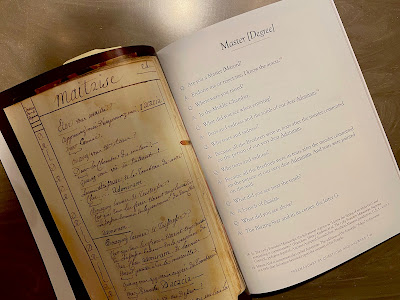
Illus. Kamel Oussayef 33° has just released a new book through the Scottish Rite Northern Masonic Jurisdiction as part of an ongoing program of rediscovering a treasure trove of 18th and 19th century French Masonic manuscripts. Entitled Freemasonry From the 1st to the 33rd Degree: the Complete Ritual of the Sovereign Grand Inspector General of the 33rd and Last Degree of the Ancient Accepted Scottish Rite, it is an English translation of an original document in French, written down in 1875 by an unknown Mason during an international Scottish Rite Congress held at Lausanne, Switzerland. 

They loved book titles in the 19th century that were so long they ended in a different zip code.

While Albert Pike was presenting his newly-revised degrees in the Southern Jurisdiction's Supreme Council in the U.S., this document is a record of the Scottish Rite rituals being worked contemporaneously in Switzerland.

Illus. Brother Kamel has been volunteering for almost 20 years at the Scottish Rite (NMJ) Museum & Library working on this series of very special translation and publication projects. The archives of the museum contain a priceless collection of rare, handwritten French manuscripts that have languished in the vaults for a century or more without ever having been translated into English. His previous books include: Freemasonry By Questions and Answers; Saint Edoüard: A 1748 Masonic Scottish Lodge During the French EnlightenmentThe Spirit of Freemasonryand The Book of Wisdom - all of which have been published in beautiful side-by-side translation editions by the Scottish Rite Northern Masonic Jurisdiction


Like his other books, The Complete Ritual  is presented in a photographic facsimile manner, with a color photo of each original manuscript page on the left side, and the English translation on the right. 


The degree rituals themselves are summarized, and there are no real "dramatic vignettes" as in the American Northern and Southern jurisdictions. They describe the transmission of signs and passwords, designs for aprons, sashes or other regalia for each degree, and perhaps a historical or philosophical explanation, as presented in the original document. 

The degrees include the Entered Apprentice, Fellow Craft and Master Mason as part of the overall Scottish Rite system. The Rite has always been a self-contained system of its own, but in most jurisdictions, they agree not to work their first, second, and third degrees in order to coexist with an established grand lodge's sovereignty. Some countries don't follow this model, and there are many jurisdictions in the world in which the complete Scottish Rite degree system is their grand lodge. In more than a few places, this led to schisms that remain to this day of sovereign grand lodges competing with a parallel Scottish Rite Supreme Council/grand lodge.

There is also an outstanding historical introduction by Illus. Jacques G. Ruelland, Scottish Rite Deputy for the Province of Quebec, Canada that provides much background information about the Lausanne Congress, the circumstance in which this manuscript had been written. He provides a detailed social, political and Masonic background for this important period that has been rarely examined here in the U.S.

The Lausanne Congress of 1875 was important, in part, because pro-secularism French Masons in the Grand Orient de France were attempting to convince French-speaking Masonic bodies to remove all references to God, a "supreme being," or the "Grand Architect of the Universe" from their degree systems and as a requirement for petitioners. 

France's secular Grand Orient craft lodge degrees consisted of (and still do) the Scottish Rite's first three degree rituals, and they were (unsuccessfully) attempting to strong-arm the Swiss into purging God from all of their rituals at this time. Doing so is an awkward situation since many of the Scottish Rite degrees are centered around the Biblical story of building or re-building Solomon's Temple (and are also very similar to what we call in America the York Rite degrees). It's tough to remove references to God successfully from Masonry's Biblical symbolism, especially if you're trying to leave out the Universe's Great Architect from the story of building sacred temples in the hearts of men, patterned after the holiest place on Earth and erected to God by Solomon. Apparently the Swiss thought so too, and didn't follow the Grand Orient's recommendations.

Research has shown that the earliest haute grades ("high degrees") of what we call Scottish Rite Freemasonry had been created or influenced by late-1700s Jacobites - pro-Catholic Scottish and English exiles living in France who had supported the Stuart line of kings back in their homelands. Their Catholic beliefs clashed with the secular forces of the French Revolution period that sought to remove the Church's influence from all government, education, and social aspects of life – even Freemasonry. But even though French movements for "complete freedom of thought" continued to grow in popularity, the French Masonic bodies retained the belief in God as a requirement after the Revolution. That clash of ideologies eventually led to the Grand Orient de France removing the requirement of its members of believing in a Deity in 1877 (two years after the Lausanne Congress), which created a schism in worldwide Freemasonry that exists to this day, and which is why the smaller but widely-recognized Grande Loge Nationale Française is considered the only regular grand lodge in that country by the vast majority of the Masonic world. 

In 2020, Illus. Kamel Oussayef 33° became the 110th author to be admitted into the Society of Blue Friars, a very special organization formed in 1932 to specifically honor Masonic authors.

Friar Oussayef was born in Sétif, Algeria and attended school in France, where he lived for many years. He holds an MA from the Fletcher School of Law and Diplomacy at Tufts University and an MS from the School of Public Communications at Boston University.

Kamel is a Past Master of William Parkman Lodge and Converse Lodge in Massachusetts (
Masons in that state do not number their lodges). He has been awarded the prestigious Henry Price and Joseph Warren medals for distinguished service to Freemasonry in Massachusetts. In the AASR, he is an Assistant Master of Ceremonies with the Massachusetts Consistory of the Valley of Boston.

Freemasonry From the 1st to the 33rd Degree: the Complete Ritual of the Sovereign Grand Inspector General of the 33rd and Last Degree of the Ancient Accepted Scottish Rite is available as an oversize 272-page paperback from the Scottish Rite Northern Masonic jurisdiction's website for $72.80, or as a Kindle edition for $9.99 for cheapskates, skinflints, and starving Masons... (I can't stand e-books myself, but it still does present each full-color manuscript page, followed by the English translation on alternating pages, which makes it a little more cumbersome to read than the dead tree edition.)

Sunday, July 16, 2023

Amity's 'The Acacia Book 2023' Is Available for Individual Orders


by Christopher Hodapp

The VERY BRIEF bulk ordering window for Amity's updated 2023 international listing of regular, recognized Masonic grand lodges and lodges ended on Saturday. They first started taking orders back on June 15th and the deadline for bulk orders ended on July 15th. But you can still order single copies at the regular price of $27 apiece.

If you're a Mason and you don't know what I'm talking about, Amity's Acacia book is a comprehensive listing that's custom printed (on demand), specifically for your jurisdiction. It replaces the now defunct Pantagraph List of Lodges (Masonic) that ceased production a couple of years ago. (Pantagraph published their annual book for 115 years, but closed in 2021.)

Amity's version of the listing has made vast improvements and uses their updated database of grand lodges around the world. If you're a grand lodge's grand secretary, a local lodge secretary, a member of your GL's foreign fraternal relations committee, or just a well-traveled Mason who wants a quick reference book to find a regular lodge meeting wherever you go, this is the guide you can't do without. And because of the way they tailor each copy to your own specific jurisdiction, you won't find yourself trying to visit a lodge that's unrecognized by your grand lodge.

Amity is also a phone app that allows you to enter your grand lodge information and instantly find recognized lodges anywhere you travel.

CLICK HERE TO ORDER (You'll need to log in or open a new account.)

Here are the details from their latest mailing:

2023 Pricing

You may order books after the bulk order has closed. The standard price for the 2023 edition remains $27.00 USD per book (no change from last year), and includes related costs such as taxes and basic shipping.

New in 2023

Your feedback continues to help improve the Acacia Book. Based on your suggestions we've made a wide variety of improvements, including:
    • Expanded Support for Accents and non-Roman Characters
    • Automated Lodge Updates (for Some Member Management Systems)
    • More Masonic Education Throughout
And, of course, that's on top of the other groundbreaking features of the Acacia Book:
  • The Whole World: Amity is still the only system that accurately documents all of the world's regular Grand Lodges.
  • Custom for You: Every Grand Lodge gets its own version, with its own seal on the cover and a curated list of recognized Grand Lodges inside.
  • Translated Names: All Grand Lodge Names are listed in the Grand Lodge's native tongue, and translated into English.

Sunday, March 13, 2022

And you thought all we do in Indiana is sacrifice burnt offerings to the Corn God


by Christopher Hodapp

Nothing momentous with this post. Just memorializing a lunchtime gathering last week of a Dummy, a visiting Idiot, and our Hoosier pals. 

I'm 63 years old. I have to post these things in lieu of having an actual memory.

Left to right: 
Just remember: there is no cabal.

Monday, February 21, 2022

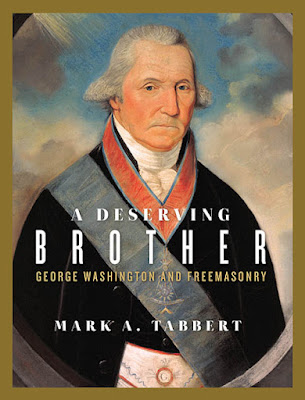
Book Review: 'A Deserving Brother: George Washington and Freemasonry' by Mark Tabbert


by Christopher Hodapp

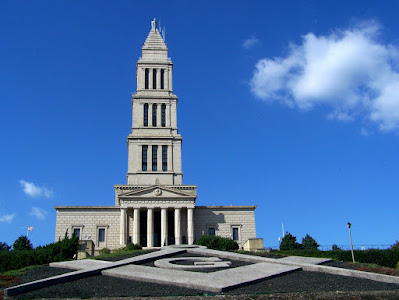
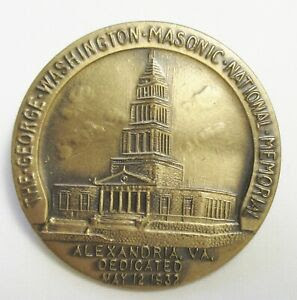
When the George Washington National Masonic Memorial in Alexandria, Virginia was first proposed in 1910, it was designed as a magnificent monument to America’s most famous Mason, along with being a safe and secure repository for priceless Masonic objects owned by Virginia’s Alexandria-Washington Lodge 22 that were associated with Brother George. The lodge possessed an original, contemporary portrait of Washington showing him dressed in Masonic regalia. And they had a collection of irreplaceable items which had originally been owned by Washington or utilized by him for the cornerstone ceremony for the U.S. Capitol building in 1798. 


But a fire at the lodge in the late 1800s resulted in the loss of several their priceless objects. So the Memorial was proposed as a national Masonic project that would be supported by all regular, recognized grand lodges in the U.S. in order to more safely house and display these almost sacred items for the public and for Masons alike. Today, the Memorial houses one of the largest collections of Washington-associated memorabilia outside of his estate, Mount Vernon and the Smithsonian Museum.


Many years ago, Mark Tabbert told me of an ongoing project he was working on. He has been the head of collections at the Memorial for many years, and the physical resources at the Memorial are preserved for future historians and Masons. Like the fairytales of Parson Weems’ chop-down-the-cherry-tree “biography” of the general, president and founding father, Masonic tall tales about Washington began propagating with great abandon after his death, and continue through today. 

Despite the endless (and frequently bogus) claims some Masons have made over the years about Worshipful Brother George and his enthusiasm for the fraternity, the truth is that Washington really only provably attended a handful of lodge meetings in person throughout his entire lifetime. Tabbert has always insisted that it is vital to honestly understand the role Freemasonry legitimately played in Washington’s life (and conversely, the role he played for the fraternity) instead of just breezily and blindly accepting legends that were told, retold and embellished by well-intentioned brethren over the last two and a half centuries. 


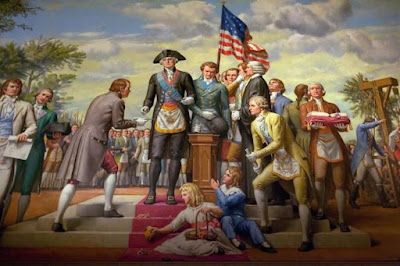
For instance, although Washington was named as the Master of Alexandria Lodge when it was chartered, he never actually sat in that position, or even as a sideliner in that lodge, and the famous drawings and paintings of him dressed in a jewel and apron as the Worshipful Master and presiding over a meeting were simply artistic flights of fancy on the part of painters and sculptors, and nothing more.

The result of Mark’s ongoing labors over the last decade is an ambitious new book being released this week by the University of Virginia Press: A Deserving Brother: George Washington and Freemasonry. In it, Tabbert has researched quite literally every single reference, claim, rumor, letter, declaration, newspaper article or offhanded remark that ever connected George Washington to the Masonic fraternity. Every known bit of physical evidence associated with Washington and his Masonic membership is presented in the book in chronological order, while explaining, debunking or ignoring the unsubstantiated claims. Tabbert’s intention has been to correct the historical record and create the standard reference work for future researchers on the trail of Washington and the influence Freemasonry may or may not have had on his life and his character.

Freemasonry during America’s formative years was instrumental in reinforcing the notion of a non-secular, “civic religion” that was so vital to the creation and success of this new constitutional, democratic republic. Washington’s membership in the fraternity was influential in both directions. In practical terms, Masonry demonstrated mutual cooperation, respect, religious toleration, and social egalitarianism that informed Washington’s understanding of democracy. And his membership in the fraternity gave Freemasonry a status that few other organizations could achieve at the time. His Masonic membership and support drew more and more merchants, community and business leaders, and men of all political and religious persuasions to join its ranks.

A Deserving Brother straddles the line between being an historical narrative and an itemized, encyclopedic catalogue. An extensive introductory chapter by Washington historian Edward G. Lengel gives a general chronological sketch of George’s life and where it coincided with the Masonic fraternity. But the main body of the work is its meticulously researched catalogue. The book is divided into several major periods of Washington’s life: as a British subject; General and Commander in Chief; private citizen; President of the United States; and his retirement and death. Each chapter is introduced by a general outline of the time period covered. Following that, descriptions of each reference include photos, dates, locations, circumstances, and in the case of letters and other documents, transcriptions of the text itself. In an effort to be as complete as possible, Mark has included correspondence whenever someone would send Washington a note, a Masonic book or other gift related in any way to the fraternity. And to aid future researchers, each item’s provenance and current location today are provided.

Notably, Tabbert has been careful to include verified details of several important, oft-cited milestones concerning Washington and the Masons, including his first inauguration in New York City and the circumstances involving the famous St. John’s Lodge Bible upon which he took the oath of office; the Masonic cornerstone ceremony of the U.S. Capitol in 1793 and the surviving working tools and related objects used at that event; and details of Washington’s Masonic funeral service in December 1799. An epilogue goes on to cite references about Washington used both by Masons and anti-Masons in the 1800s, as well as celebrations held by Masons in 1899 on the 100th anniversary of his death, and in 1902 for the 150th anniversary of his raising as a Master Mason. The major books written about Washington’s Masonic experiences and involvement are described, as well as the formation of what would become the George Washington National Masonic Memorial Association. 


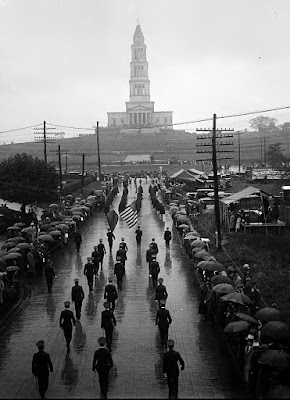
The Memorial itself was officially dedicated in 1932, some 22 years after it was first proposed, and Tabbert provides a synopsis of its mission and exhibits then and now, as well as an explanation of the changes that have occurred there since its opening.

In short, Mark Tabbert’s A Deserving Brother is without question the most extensive, detailed and truthful accounting of Washington and his Freemasonry as he lived it. As an historical research tool it is invaluable, and will unquestionably be the most important reference work on George Washington and the fraternity available for decades to come.

This book is being distributed by Macoy Publishing under a special partnership with the George Washington Masonic National Memorial Association. Priced at $34.95 for the 304-page hardback edition, CLICK HERE TO ORDER.

Tuesday, February 08, 2022

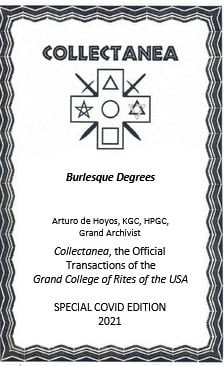
Grand College of Rites Offers Bonus Book: 'Burlesque Degrees'


by Christopher Hodapp
The Grand College of Rites of the United States of America is a regular Masonic body that is dedicated to preserving the history and rituals of defunct and inactive Masonic orders. Formally organized in 1932, the Grand College of Rites publishes an annual volume known as Collectanea which contains reprinted rituals of various officially extinct organizations deposited within its archives. The College and its members agree that these rituals are published and copyrighted strictly for the purpose of research and preservation, and are not to be worked or performed. Over the last couple of years, for example, Collectanea has been featuring the degrees of the Cerneau Rite system, which caused more than its share of excitement in the 1800s when it began to spread throughout the northeastern states. (Still to this day, the Tyler's Oath administered to visitors in Pennsylvania specifically requires sojourning Masons to swear they are not members of a Cerneau lodge and have not had the degrees of the Cerneau Rite conferred on them! Talk about holding a grudge.)

But the book that came this week is actually something quite special, and not the usual sort of obscure esoteric rituals the College has traditionally published in the past. Because of the COVID-19 pandemic precautions in the DC area last year, the 2021 Masonic Week was canceled. In light of this, Most Illustrious Duane L. Vaught, KGC, the current Grand Chancellor of the College, was struck by the notion of offering a special bonus book to the members that features some lighter-hearted levity than the usual offering of serious degrees.

And so, this volume of "Burlesque Degrees" is being provided as a Bonus Book to all 2020 and 2021 dues-paying members as a way of saying thank you for their continuing support of the mission of the College throughout the COVID-19 pandemic. 


During the Golden Age of Fraternalism, quite literally hundreds of fraternal groups proliferated. Most tried to be solemn in nature, with degrees to impart wise and serious truths. But others were created as unofficial 'side degrees' to provide an entertaining night for members, or as one pamphlet put it, "a comic ceremony designed to cure the blues and fill the treasury." 

The fraternal groups included in this collection are truly obscure and deliberately comic: The Haymakers, the Munchers of Hard Tack, the Sublime Order of Arabian Knights, Uncle Sam's Eagles, the Up-To-Date Order of Goosie Girls, the Grand and Noble Order of Button Busters, and more.


These types of side degrees sometimes became quite elaborate and required special props as part of the gags involved. DeMoulin Brothers in Greenville, Illinois published an enormous catalog of goofy (and occasionally dangerous) props for side degrees, and became known as "the goat factory" because of the wide variety of various mechanical bucking goats they manufactured. The C.E. Ward Company in New London, Ohio also published a catalog strictly for "burlesque goods," and several pages of their offerings are included at the end of this volume.

Annual dues in the GCR is a paltry $20. If you are a current dues-paying member who was NOT paid up in 2020 or 2021 - you can contact the Grand Registrar at grand.registrar@grandcollegeofrites.org for purchase information for this bonus book.

Meanwhile, the regular 2021 edition of Collectanea will conclude the series of the Cerneau Rite (30° - 32°) is at the printers now and will ship very soon.

Any Master Mason holding membership and in good standing in a regular symbolic lodge recognized by a majority of grand lodges of Freemasonry in the United States may petition for membership as a Fellow in the Grand College of Rites. (click here for a petition)

Friday, January 28, 2022

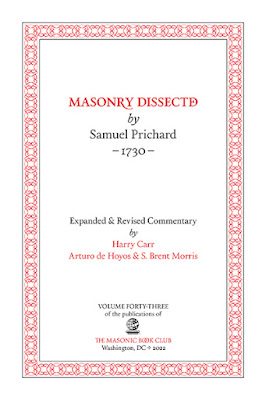
Pre-Order From Masonic Book Club: Samuel Pritchard's Masonry Dissect'd


by Christopher Hodapp

The newly revived Masonic Book Club has just announced the pre-publication ordering window for their second volume: a new edition of Samuel Pritchard's 1730 ritual exposure, Masonry Dissected

The pre-publication order window will be open from January 27, 2022, until February 28, 2022, at 11:59

The 'old' Masonic Book Club first published this book in 1977 with wonderful commentary by Masonic scholar Harry Carr, Past Master and Secretary of Quatuor Coronati Research Lodge No. 2076 in London.This 144-page reprint of that 1977 edition features Carr’s classic commentary, revised and updated by Ill. Arturo de Hoyos, 33°, G.C., and S. Brent Morris, 33°, G.C.

Pritchard's book included the first known publication of the details of the Master Mason degree, which had only been incorporated into the premiere Grand Lodge of England's ritual in 1726, just nine years after the 1717 formation of their grand lodge.

During the years before 1726, English ritual consisted of only the Entered Apprentice and Fellow Craft degrees. While Pritchard's book was doubtless seen as a dastardly act and a betrayal of Masonic secrecy and honor at the time, it does provide historians a written record of the Masonic degrees as they existed in those formative years. It was also extremely popular at the time, presumably for both a curious public, and for Masons trying to learn to memorize their ritual.

From the MBC's description:
"When the Grand Lodge of England was formed in 1717, there were only two degrees: Entered Apprentice and Fellow Craft. A “master mason” either held the contract at a job site (think “general contractor”) or was the elected presiding officer of a lodge. The first conferral of the Third or Master Mason Degree in a Masonic lodge occurred in March 1726 in Lodge Dumbarton Kilwinning No. 18. The degree apparently was conferred in May 1725 at a social club of Masons in London, the Philo Musicæ et Architecturæ Societas. There is no hint of what the ceremony may have been—not in the Old Charges, manuscript rituals, or publications. Nothing!
"Then on October 20, 1730, Samuel Prichard published Masonry Dissected with full details of the ritual for what he claimed was the Master Mason Degree. A second edition came out on October 21, and a third edition on October 31, all three published by Wilford in London. A presumably pirated edition dated “MD.CC.XXX” (1730) and printed by Thomas Nichols “without Temple Bar” (London) probably had made its appearance by the end of October 1730. Other presumably pirated versions were printed in Read’s Weekly Journal or British Gazetteer, on October 24, 1730; Northampton Mercury, in two parts on October 28, 1730, and on November 2, 1730; and the second half in The Original Mercury, York Journal: or, Weekly Courant, on November 2, 1730 (the reprint of the first half has not been located).
"Thus, there were three separate editions by Wilford for Prichard, a pirated edition by Nichols, and a newspaper version, all printed in London, plus a two-part pirated newspaper version printed in the Midlands, and another pirated newspaper version printed in the North of England, all within fourteen days. This was a popular book!

Here are the specifics from Brent Morris:


The pre-publication order window will be open from January 27, 2022, until February 28, 2022, at 11:59  
 
The special MBC pre-publication price is $30. Regular retail price will be $40. 
 
This time during the pre-publication sale period, we also will be offering a "First Day of Issue" signed edition for $45. These copies will not be available later for retail. 
 
We only will accept pre-publication purchases placed using the MBC order form. Pre-publication orders are not available through the Scottish Rite Store.

The printing industry currently is experiencing massive supply chain disruptions. We cannot place the order for Masonry Dissected until pre-publication purchasing is completed and reviewed. We hope to place the order by March 3, 2022. Our printer estimates "approximately 78–83 business days" to manufacture the books. We expect the books to be mailed about June 15–22, 2022, and will keep you informed of progress and changes. Thank you for your understanding during these unusual times.

**Due to GDPR and other complications, we only can accept credit card charges from and ship to the USA, US territories, Canada, and Mexico.

** However, Lewis Masonic in the United Kingdom is accepting a limited number of pre-publication orders (signed & unsigned editions) for the rest of the world. For details, please click the "Order Masonry Dissected" button below and answer "All Other Countries" to the first question.

If you have any questions, please visit the "FAQs" section on our MBC web page or email us at mbc@scottishrite.org.
There are no dues for the new Masonic Book Club. Books are announced for pre-publication orders and payments are only collected as books are ready to be manufactured. All transactions are handled exclusively online. Without a rigid calendar driving publications, new books can come out as quickly as nine months or as late as eighteen months, as resources permit. Book prices range in the $30 vicinity for pre-publication orders, or $40 retail if you miss the pre-pub ordering window. Volumes will no longer be numbered as in the old Club, but if the hardback edition sells out, the MBC will make a paperback print-on-demand edition available of the books. 

If there are sufficient pre-publication sales, MBC members will be notified after the pre-publication window closes at 11:59 pm ET on Monday, February 28, 2022. The books will be printed, and will ship around June 15–22, 2022.

If there are insufficient sales, members will be notified; and refunds will be credited about March 21, 2022.

To the relief of the MBC's older original members, the new Club actually communicates with its members twice a year with an electronic newsletter to keep everyone in the loop about upcoming volumes in the works and their production status. Despite his recent retirement from his longtime job of editing the AASR-SJ's Scottish Rite Journal, S. Brent Morris 33° continues to manage the MBC, and this endeavor has truly been a labor of love for him. 


The mission statement of the resurrected Masonic Book Club is to publish classic Masonic works with the goal of increasing Masonic knowledge and to become a profit center for the House of the Temple Foundation. More information can be found at the MBC's website HERE. If you are interested in this or subsequent volumes, you need to sign up on the website. If you have any questions or suggestions, please address them to mbc@scottishrite.org.

Sunday, November 21, 2021

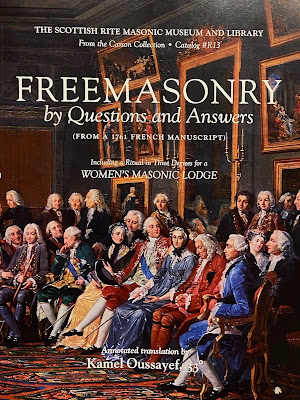
New Book: 'Freemasonry By Questions and Answers' by Kamel Oussayef

by Christopher Hodapp

Illus. Kamel Oussayef 33° has been volunteering for almost 20 years at the Scottish Rite (NMJ) Museum & Library working on a series of very special projects. The archives of the Museum contain a priceless collection of handwritten 18th and 19th century French manuscripts that have languished in the vaults for a century or more without ever having been translated into English. His previous books include: Saint Edoüard: A 1748 Masonic Scottish Lodge During the French EnlightenmentThe Spirit of Freemasonry; and The Book of Wisdom - all of which have been published in beautiful editions by the Scottish Rite Northern Masonic Jurisdiction

His new book is the latest in that series. Freemasonry By Questions and Answers is a translation of a 1761 French manuscript made up of a series of notebooks, plus several additional documents up through 1806. If you have any interest in the development of Masonic ritual — both in the Craft lodge and in what became the Scottish Rite — this book is remarkable. French and so-called continental Freemasonry veered off into both major and minor differences from the Preston-Webb rituals we work in the U.S. or the Emulation rituals in Britain. Also, bear in mind that a year after the first notebook in the collection was written down, Etienne (Stephan) Morin carried a patent to the Caribbean and the Americas to establish a Supreme Council of the Rectified Scottish Rite. The degrees in the notebooks reflect the words and rubric of the Rectified Rite at that time. There are also notes concerning English and Scottish rituals demonstrated to the French brethren from visitors across the Channel. There is even a suggested series of toasts for table lodge/festive boards included. If you are a U.S. jurisdiction that uses a particular odd-sounding "table lodge" format that includes the line "To erect Temples to Virtue, and to dig dungeons for vices," that wording doesn't exist in Preston-Webb. It originally came from French ritual in this formative period.

Many of the early French Masonic lodges were extensions of salons of the period, where influential and learned men and women would gather to discuss philosophy, the arts, social and political issues and other topics of the day. Consequently, a special treasure in this manuscript is the inclusion of the Q/A lectures from a French female "lodge of adoption." That term comes from the male lodges that would sponsor or "adopt" a lodge for women, with substantially different rituals and wording. And as a final bonus item, a letter is included from 1806 that explains how and why Napoleon Bonaparte became "protector of Freemasonry" without ever actually joining himself, why he encouraged his sister Caroline, his brothers, and his military officers to become Masons, and how he encouraged his wife, the Empress Josephine, to become Venerable Maîtresse of a female Masonic lodge that attracted influential women to join with her. In addition to the translations, the entire manuscript is heavily annotated to provide insights about the Masons involved, noteworthy historical contexts, ritualistic variations, and more.


Like his other books, Freemasonry By Questions and Answers is presented in a photographic facsimile manner, with a color photo of each manuscript page on the left side, and the English translation on the right. 

Studying the changes in Masonic ritual from one country to another in the first century of grand lodge speculative Masonry is fascinating. It should be noted that French writing in the 18th century is not the same French you might have taken classes in or what you find in "French phrases for tourists" guidebooks. It's more complex, and occasionally obscure. Having these French Masonic records and notebooks translated into English opens them up to wider study by more scholars. 

By the way, Kamel's books make excellent companions to a rare, out of print work published back in 1971 by Quatuor Coronati Lodge of Research No. 2076 in London. Track down The Early French Exposures, edited by the legendary Masonic author, Harry Carr.

In 2020, Illus. Kamel Oussayef 33° became the 110th author to be admitted into the Society of Blue Friars, a very special group of Masonic writers. Friar Oussayef was born in Sétif, Algeria and attended school in France, where he lived for many years. He holds an MA from the Fletcher School of Law and Diplomacy at Tufts University and an MS from the School of Public Communications at Boston University.

Kamel is a Past Master of William Parkman Lodge and Converse Lodge. He has been awarded the prestigious Henry Price and Joseph Warren medals for distinguished service to Freemasonry in Massachusetts. In the AASR, he is an Assistant Master of Ceremonies with the Massachusetts Consistory of the Valley of Boston.

At the moment, Freemasonry By Questions and Answers is only available as a Kindle download for $9.99 from Amazon.com. The Scottish Rite NMJ Supreme Council website is in the process of being updated following their change in leadership a couple of months ago. Once the print version of book is added to the NMJ's online Marketplace, be aware that a limited number of the hard copy, paperback are being printed in its first run. It is expected to be in the $50 price range. If that initial printing is popular enough to sell out, an additional print run will be considered. I'll update this post when that comes available.

UPDATE 12/13/2021
Paperback edition now available.
The oversized paperback edition of the book is now available from the Scottish Rite NMJ Marketplace website for $52. CLICK HERE TO ORDER