"To preserve the reputation of the Fraternity unsullied must be your constant care."

BE A FREEMASON

Saturday, March 12, 2022

As the Sword Turns: Called Conclave Removes Templar Grand Master Michael B. Johnson


by Christopher Hodapp

“You stubborn and hardheaded people! 
You are always fighting against the Holy Spirit,
just as your ancestors did” 
(Acts 7:51; CEV)

An historic gathering took place today, and I don't mean in a happy, smiley-face historic way. Michael B. Johnson, Most Eminent Grand Master of the Grand Encampment of Knights Templar of the United States, has been removed from office at a Called Special Conclave held in Fort Wayne, Indiana. 

Johnson has been replaced as Grand Master by David Kussman, and will retain the title of Past Deputy Grand Master. Some 291 Templars in attendance cast their votes, and the decision to remove Johnson was overwhelming: 219 in favor of his removal, 57 against, with 15 spoiled ballots.

I've long felt that the members of the Knights Templars who actively seek high office positions carry swords to stab each other in the back with. Go get yourself a big cup of coffee, because this tale is long and winding, along with being a tedious Masonic equivalent of an "inside baseball" discussion.

Michael B. Johnson has been removed as Grand Master of the Grand Encampment.


Called Special Conclaves are extremely rare. In fact, several Templar Knights who have searched the archives of the Grand Encampment have said there is no record of a single Special Conclave ever being called throughout the 20th century.

Michael Johnson's time in office has been turbulent. Upon his election last August, Johnson issued an official decision which immediately overturned a resolution passed at the Grand Encampment's 2021 Triennial Conclave in Minneapolis. That resolution passed by a super-majority and had been intended to put an end to the long-running battles over the Grand Priory of America (GPA) of the Chevaliers Bienfaisants de la Cité Sainte (CBCS), otherwise known in English as the Knights Beneficent of the Holy City. 

That overwhelmingly lopsided August vote had reversed Grand Encampment decisions made back in 2010, which had branded the GPA a "clandestine Templar organization." Then-Grand Master William H. Koon had controversially demanded the resignation of all Templar Sir Knights belonging to the GPA, and then, using a French charter of dubious parentage, the Grand Encampment established its own Grand Priory of the Scottish Reformed and Rectified Rite of the United States of America. In the wake of those actions, longstanding Templar Knights who remained as GPA/CBCS members were suspended or expelled from the Grand Encampment, and a flurry of lawsuits - both institutional and personal - erupted over the years.

(NOTE: The Grand Encampment's declaration of the GPA to be clandestine and the subsequent establishment of its own CBCS body took place during the years of Grand Master William H. Koon. In the spirit of full disclosure, I became a member of the Grand Encampment's new CBCS Grand Priory in 2011, as did the now-deposed Grand Master Michael Johnson.)

In the midst of arguments, suspensions, expulsions, lawsuits and lots of broken friendships, the Grand Encampment's Grand Priory of the Scottish Reformed and Rectified Rite of the United States of America CBCS body was dissolved in January 2013 by Grand Master David Dixon Goodwin, but the decisions declaring the GPA clandestine and forbidding Templar membership in it remained. And so, the resolution to end the feud by compromise eleven years after all this began passed by an overwhelming 77% of the vote at the 2021 Triennial. 

Just about now is when your eyes will really begin to glaze over.

GM Michael Johnson issued his decision to ignore the vote and return the status of the GPA to being a clandestine Templar order in a matter of days after taking office.


SIDEBAR: Who the heck is the Grand Priory of America?

The GPA was established in the US back in 1934 with a charter from the Grand Prieuré Indépendant d'Helvetie (Great Priory of Switzerland) CBCS, the Swiss organization that has long been considered to be the definitive fountainhead of the the Chevaliers Bienfaisants de la Cité Sainte, or Knights Beneficent of the Holy City. Outside of the U.S. The CBCS is a system of the Rite Ecossais Rectifie (Scottish Rectified Rite), and considered to be the oldest continuously operating Christian chivalric Masonic Order in the world, tracing its roots back to Baron Karl Gotthelf von Hund's "Rite of Strict Observance" in Germany in the 1750s. By widespread agreement, even though it possesses its own degree rituals for the Entered Apprentice, Fellow Craft and Master Mason degrees, like the Scottish Rite systems in the U.S. and most of Europe, it acknowledges that those degrees are the sole domain of Masonic grand lodges.

The Grand Priory of America CBCS was established in Raleigh, North Carolina by Dr. William Moseley Brown and J. Raymond Shute II, the founding brethren of what became Masonic Week in Washington DC each year. The GPA was established as an invitation-only group, but it quickly became little more than a private supper club for Grand Encampment Past Grand Masters and a few celebrity Masons, because, as one wag famously put it, "there's too much riff-raff in the 33rds." Its constitution limited membership to just 81 in the U.S., dividing the country into three prefectures with 27 members each.

 
In 1927, the Grand Encampment of Knights Templar of the United States granted recognition to the Swiss Grand Prieuré Indépendant d'Helvetie as a Templar body. When the Grand Prieuré Indépendant d'Helvetie issued a charter to the Raleigh group to form the Great Priory of America in 1934, that placed it in direct conflict with the notion that all Masonic Knights Templar in the U.S. work under the authority of the Grand Encampment. In fact, the 1934 charter itself is worded, "Grand Prieuré Indépendant d'Helvetie de Province ORDRE TEMPLIERE." The way the jurisdictional problem got solved was that the Great Priory's leadership assured the Grand Encampment that it was nothing but a social club, conferred no Templar orders on its members, and did not exchange official representatives with other Great Priories. With that understanding, CBCS became a regular participant in the annual "Masonic Week" festivities in Washington D.C. (later Alexandria, VA) held every February. Instead of its deeply spiritual and esoteric degrees being conferred upon seekers of Masonic wisdom, it became little more than a title to be passed to the luminaries of American Masonry. But by 1994, several officers of the GPA began attending international Knight Templar gatherings representing themselves as a Templar group. It was at this point the Grand Encampment stepped in. And then the fight started... 

 For more about this topic, see this post from back in 2010.


The drama thickened in September when GM Johnson took the surprising step of removing the duly elected Deputy Grand Master, David J. Kussman, from office for "malfeasance and disloyalty." 

Then-Grand Generalisimo David Kussman had been appointed last year by then-Grand Master Jeffrey Nelson to chair a committee to investigate the whole GPA imbroglio and find a way to end the feud and reinstate its suspended members. As chairman of the committee, Kussman and his group worked out a truce between the GPA and the Grand Encampment, which became the basis of the resolution that passed at the 2021 Triennial. In Johnson's order removing Kussman from the grand officer's line, his chairing of that committee and the subsequent resulting vote led to Johnson's declaration in other venues that he was "disloyal." (No charges were ever brought against Kussman, and no trial was ever conducted. He remained a member in good standing.)

By late September, a website had been set up to facilitate the organization of a Called Special Conclave to address the actions of GM Mike Johnson. The "Call To Conclave" laid out the Constitutional method and requirements to call for an extraordinary meeting for the purpose of reviewing- and perhaps reversing - the actions of a grand master. According to the Constitution, representatives from at least nine different statewide Grand Commanderies are required to make a quorum in order to trigger a called meeting. That minimum was quickly reached.

In October, a letter was sent to KT officers across the Grand Encampment's voting delegates, written by Sir Knight Thomas Tsirimokos, Chairman of the Grand Encampment Jurisprudence Committee. Tsirimokos weighed in on the appropriateness of the GM's actions and what he saw as constitutional reasons why a called conclave didn't have the power to reverse or amend the decisions of a sitting Grand Master. Other members of that committee saw it differently, as a letter from David Kussman made clear (see it HERE). 

In an additional attempt to dissuade those calling for a conclave, the Grand Encampment opined that those nine Grand Commanderies should be required to foot the bill for calling the meeting, including all hotel and dining expenses. In a counter to that, the Conclave was attached to the already scheduled East Central Department Conference at the Grand Wayne Convention Center in Fort Wayne, so additional expenses would be minimal.

Further agitating members, the monthly Knight Templar Magazine became a source of contention. The front page of the September 2021 issue showed GM Johnson perched on a horse and dressed in his Templar finery. Not especially surprising, since in real life he is a Wyoming rancher, and many Masonic Templar commanderies historically had mounted drill teams until the middle of the 20th century. But the headline at the bottom of the cover was both a disturbing and shocking message from the brand new leader of a purportedly Christian-based Masonic organization: 


"I never forget loyalty, nor do I forget betrayal."

In the February 2022 issue of the Knight Templar Magazine, GM Johnson penned a message ostensibly about "Cancel Culture" in society, and attempting to link that topic to the motives of the Called Conclave:

"There are brothers who do not agree with the Constitution of the Grand Encampment or the powers of the grand master. The Grand Encampment Constitution is clear that only at a stated conclave can decisions be reviewed. Sections of the Constitution may be added or deleted by the voting delegates of the Triennial Conclave. Some of the “Canceled Culture” think they can be loud enough or disruptive enough at other Grand Encampment meetings to get their way on certain matters concerning our Constitution or decisions of the grand master. The Knights Templar are Christian sol- diers who are bound by the obligation they took upon the Holy Bible to defend our Lord and Savior Jesus Christ and to be governed by our Constitution. Our Constitution states that you must be a Christian to become a Templar, and it is the duty of every Knight Templar to uphold our Constitution."

For some time, Sir Knight Benjamin Williams of Colorado had been the associate editor of the KT magazine, assisting longtime editor John Palmer. The masthead of the last few issues shows that Ben has recently been removed from that position. Williams had been an excellent choice to assist on the magazine, as he was responsible for the beautifully designed Rocky Mountain Mason magazine several years ago, and is a talented Masonic author and blogcaster. SK Ben is also an attorney and was on the committee headed by Kussman working on the GPA compromise. 

Since GM Johnson issued his decision rescinding the action of the Grand Encampment, Ben has reported on the developments and presented his legal opinions online of the KT Constitution regarding the powers of the Grand Master vs. those of the voting members of the Grand Encampment. His most recent podcast was posted March 2nd and summarizes the run-up to the Conclave taking place today in Fort Wayne.

Listen HERE: RMM-062: Special Conclave of the Grand Encampment

Further documentation for the Called Conclave can be found HERE.

The "Call To Conclave" resolution set out the order of business to be taken up at today's meeting. 


According to the Constitution, "An elected officer of the Grand Encampment may be removed from Office by a two-thirds vote of the members present and voting at a Conclave of the Grand Encampment. This section is enforceable upon adoption." (Emphasis mine.)

The voting members of the Grand Encampment have now exercised that option. And there's probably some irony in the fact that the Conclave was held in the "Mad" Anthony Wayne Room of the Ft. Wayne Convention Center.

I am starting to feel like Harland and Wolff sitting back in Belfast reading the morning reports of the Titanic sinking.

NOTE: An earlier version of this story mistakenly named John Cooper as the author of the dissenting letter, and referred to PGM Jeffrey Nelson incorrectly as John Nelson. I regret the errors. This revision also added the actual vote counts for removing former Grand Master Johnson.

Wednesday, March 02, 2022

Masons Everywhere Want to Help Ukrainian Brethren


by Christopher Hodapp

Ukrainians woke up last week and found themselves suddenly in the middle of a full-scale invasion against one of the largest military forces in the world. People are fleeing their homes, taking up arms against the invaders, and placing their lives on the line to protect their sovereignty, their homes, and their freedom. Consequently, Masons from around the world have wished to offer their sympathy, prayers and more tangible support like money, medicine and food, especially to Masonic brethren there.

Many Masons may have done some Internet research and discovered that the Grand Lodge of Ukraine (Великої Ложі України) is widely recognized as regular and is in amity with most of the regular grand lodges around the world, including the United Grand Lodge of England (UGLE), the National Grand Lodge of France (GNLF), and forty U.S. grand lodges. Ironically, the Grand Lodge of Russia even got around to recognizing the Grand Lodge of Ukraine four years ago, in 2018. So it's absolutely a lousy (and arguably tasteless) thing to enter something as meaningless as Masonic recognition rules into a discussion of helping fellow human beings in a war. 

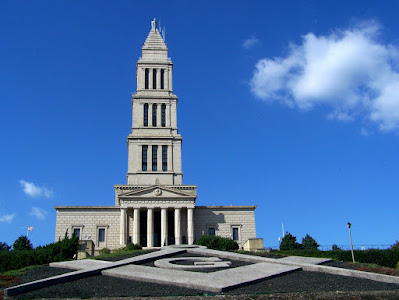
Now there are a growing number of grand masters and individual Masons around the world issuing official letters of support for Ukraine and denouncing Russia for its hostile military actions. Masons everywhere are wondering how to help. Individual brethren have suggested GoFundMe campaigns to collect money in order to send to the GL of Ukraine. At the beginning of the week, even the George Washington National Masonic Memorial was bathed in blue and yellow light, the colors of the Ukrainian flag.


(Photo: James Cullum from ALXNow website)


It’s frustrating to have to give a bureaucratic explanation to a question about extending aid and charity to Masons in any war-torn nation. However, our members need to remember that all communications at a grand lodge level must be conducted properly by going through our own Grand Lodge Secretaries, and not directly from our members. In fact, the Grand Secretary of the GL of Ukraine has already politely said in a form letter response being circulated online that he and their grand lodge have been overwhelmed by the volume of communications from Masons around the world, and he is unable to reply to them personally. I suspect they've been deluged with messages.


(Just so you know, there was no bank account info attached to the letter, despite him referencing it. Honestly, I suspect the Russians would love to have their bank account information, so it's just as well he didn't include it.)

The Grand Lodge of New York is asking for donations to their Brotherhood Fund, earmarked for Ukraine:


Dear Brethren and Friends,

We at the Grand Lodge of New York are trying to do our part towards answering the call of the distressed in providing a source of much needed help to those adversely affected by these unprovoked acts of violence and war against the good citizens of the Ukraine. These unprecedented assaults and aggression are especially traumatic and harrowing to the population of children and the elderly residing in both the cities and countryside of the Ukraine.

Your Grand Master, Most Worshipful Richard J. Kessler, and the Grand Lodge of New York, in a strong showing of solidarity with our fellow brethren of the Grand Lodge of the Ukraine, we look to the members of our noble Craft to demonstrate their heartfelt compassion and empathy for our fellow human beings during this their hour of darkness. Together, we will emerge from this tragic and dispirited experience united with a renewed zeal of bringing back peace, harmony and brotherhood throughout the world. The essence of True Masonic Brotherhood will be a beacon of hope for all to see and emulate.

In the name of this charitable and humanitarian effort in support of our brothers and their families in the Ukraine, we are grateful to receive your contributions, both large and small, as checks payable to the Masonic Brotherhood Fund earmarked for the Grand Lodge Emergency Relief Fund. Please mail your checks directly to the Masonic Brotherhood Fund, 71 West 23rd Street, New York, NY 10010-4149. Rest assured that every penny received will be distributed to those in need and absolutely no monies will be deferred to cover expenses and related costs incurred by the Grand Lodge.

CLICK HERE TO PAY ONLINE 

In anticipation of your most generous support, please accept the warmest fraternal thanks on behalf of the Grand Master, the officers and members of the Grand Lodge for your kind-spirited gift to the Grand Lodge Emergency Relief Fund. The noted humanitarian and physician, Dr. Albert Schweitzer said it best, “There is no higher religion than human service. To work for the common good is the greatest creed.” In memory of the many victims who are injured, maimed or have perished during this calamity, and in cohesion with their families and fellow countrymen, we gratefully bear witness to your genuine and unselfish expression of charity.

In closing, I would like to share a short but true story that is most apropos today as it was when originally told in 1941. During the height of World War II, the Pro Grand Master of Finland, R:.W:.Brother Marcus Tollet, spoke of a little boy at a local seaport in Finland who looking at the various sailing ships noticed one flying a strange flag on its masthead, asked his father, “What flag is that?” He knew the flags of the Scandinavian countries and of all the countries that border on the Baltic, but this was a different flag; and his father replied, “It is the Freemason’s Flag – It is the Stars and Stripes of the American Flag”.

Thank you once again for your thoughtfulness and generosity for our fellow human beings during these trying times.

Fraternally,

Richard T. Schulz
Grand Secretary

Grand Lodge of F & AM Of the State of New York
Masonic Hall - 17th Floor
71 West 23rd Street
New York, NY 10010-4149 U.S.A.


Meanwhile, the Grand Lodge of Missouri this afternoon issued the following statement to its members:


The Grand Lodge office recieved an email request from the Grand Lodge of the Ukraine this morning.

The Grand Lodge of Missouri considers requests from other jurisdictions for emergency aid and assistance, however, those requests must be recognized by the Masonic Service Association (MSA), that is a part of the Confrence of Grand Masters of North America.

This request has been forwarded to the MSA for their consideration. Understandiably, with the volitity of the situation in the Ukraine, and the posability for fraud, the validity of the request has not yet been established.

THEREFORE, it is the order of the Grand Master that NO Missouri Lodges contribute any lodge funds to this, or any similar request(s), at this time.

If you or your lodge has recieved a similar request for assistance, please forward a copy of this request to the Grand Lodge of Missouri grlodge@momason.org so it may be forwarded to the MSA for their verification.

Once the request for assistance has been verified by the Masonic Service Association, another notice will be sent out through the Missouri portal, permiting donations to the MAS for donation to Ukaine.


As of Wednesday afternoon, the Masonic Service Association has NOT issued a Masonic Disaster Relief notice. This is likely because the GL of Ukraine has not formally or informally requested it. (I think we can all probably understand that they are a bit preoccupied right at the moment.)


U.S. Brethren are cautioned NOT to attempt to set up their own independent fundraising plans in the name of their individual lodge or grand lodge, or even just identifying oneself as acting on behalf of other Masons – that is the prerogative of your grand lodge and the MSA. 


Further, the message from the Grand Secretary of Ukraine cites their most pressing need right now to be, not money, but a place to stay outside of the country as Ukrainian refugees continue to pour out across borders, followed by food and medicine.


This story will be updated if there are any substantive changes.


A word about recognition of the Grand Lodge of Ukraine


Masonic diplomacy and governance can be a tricky thing to understand, especially for newer Masons. Many Masons online have expressed dismay when they discover the GL of Ukraine isn't recognized by their own grand lodge. Indeed, in my own situation, the Grand Lodge F&AM of Indiana is one of eleven U.S. grand lodges that does not recognize the Grand Lodge of Ukraine at this time. The reason is simple, and there’s no underlying animosity for it. The Grand Lodge of Ukraine never formally applied to us in Indiana for recognition after it was regularly constituted in September 2005. We were initially informed of their founding by their Grand Secretary at that time, but the Grand Lodge of Indiana has a longstanding waiting period at least five years following the formation of a brand new grand lodge before taking up the matter of its recognition. Waiting periods are designed to make sure a newborn GL isn't contested by others already in amity with us, as well as to let enough time lapse in case of bitterness or ego inflation, since so many spurious GLs come into being under hotheaded situations.


Further, established Masonic protocol expects that the newer grand lodge must formally request recognition of the older established one. But the GL of Ukraine never followed through with us, and we could not unilaterally extend recognition to them without their formal request to do so. It’s unfortunate, as our assembled grand lodge would have doubtless extended mutual recognition to them any time after 2010, had they asked. 


This is partially why the MSA was created in the first place. In the advent of a catastrophe, MSA acts as a single voice of North American Freemasons, instead of 51 (or 100) grand lodges and more than a million of us who all think we need to chime in on every given topic these days. If the MSA is contacted by the GL of Ukraine and its board of governors decide to act on their request for donations, those of us in the eleven GLs who don't recognize Ukraine's grand lodge are still able to contribute legitimately as Masons, and in a much greater collective capacity than any GoFundMe page you or I could ever set up.


Sunday, February 27, 2022

Grand Lodge of Massachusetts Co-Sponsoring Revolutionary War Lecture Series


by Christopher Hodapp

As the U.S. inches its way to the 250th anniversary of America’s declaration of independence in 2026, the Grand Lodge of Massachusetts has announced its participation in a series of lectures and presentations on the pre-revolutionary war years. Entitled Boston’s Revolutionary Martyrs, the speaker series is a joint effort between the Framingham History Center, Revolution 250, the Dr. Joseph Warren Foundation, the Massachusetts Society of the Sons of the Revolution, and the Massachusetts Freemasons. It will feature scholars, historians and authors. 

According to a story in the MetroWest Daily News, the first presentation in the series will be held this Friday through Sunday and will highlight the events that led to the 'Boston Massacre' and its aftermath. This weekend commemorates the 250th anniversary of Dr. Joseph Warren’s first 'Boston Massacre Oration' in 1772.

Crispus Attucks is generally regarded as the first person killed on the night of March 5th, 1770 in what was quickly dubbed the 'Boston Massacre' by the pro-independence press. Six British soldiers and their commanding officer were surrounded and attacked by an angry mob of 400 Bostonians. When one soldier was struck with a club and knocked to the ground, the soldiers opened fire on the crowd, killing five men and wounding six. Revolutionary Mason Paul Revere quickly put together what became the most famous depiction of the event, an engraving that depicted the steely-eyed soldiers firing into the helpless crowd.

Attucks was of African-American and Native-American descent, and is generally regarded as the first American martyr of pre-revolutionary America. But many details of the Boston Massacre remain mysterious today. Questions that loom large include “Was the Boston Massacre the first fatal violence of the Revolution?" "How do leaders like Dr. Joseph Warren who have been whitewashed from history keep the memory of the Massacre alive?" and "How did this initial massacre shape the ideology of the Martyrdom in American liberty?” The inaugural series of lectures answers these and other questions.

The Grand Lodge Massachusetts is marking its 289th anniversary this year. It is the oldest Masonic grand lodge in the Western Hemisphere and the third-oldest in the world. It was chartered in 1733, following the establishment of the Grand Lodge of England in 1717, and Ireland in 1725. Many of the participants in the runup to the American Revolution were Freemasons in Boston, at the English-chartered St. John’s Lodge (the first chartered Masonic lodge in the American colonies, established by the "Moderns" Grand Lodge of England), and the independently established Lodge of St. Andrew (which eventually secured a charter from the Grand Lodge of Scotland, and ultimately became a part of the "Ancients" Grand Lodge in North America). 

Each event will display artifacts, documents and period pieces that have never been available for public viewing, such as the lost archives of Warren’s medical diary, the only painting of Warren (by John Copley of the Museum of Fine Arts in Boston) and more. 

Presentations include:
  • “Trial by Massacre” by Dr. Robert J. Allison (Charlestown only)
  • “The Ongoing Search for Crispus Attucks” by J.L. Bell (Framingham, New England Historic Genealogical Society, Dedham)
  • “The Martyr & the Massacre: The Story of Dr. Joseph Warren” by Christian Di Spigna
  • “Women Witnessing a Massacre” by Katie Turner Getty (Framingham, New England Historic Genealogical Society, Charlestown, Dedham)
  • “The Boston Massacre and its place on the Road to American Independence” by Jonathan Lane (New Bedford only)
The lectures will be held at five locations between Friday, March 4 and Sunday, March 6 to commemorate the 250th anniversary of Dr. Joseph Warren’s first Boston Massacre Oration in 1772, including:
The events are open to the public. Join the presenters as they discuss and explore how that “Bloody Massacre perpetrated in King Street…” became an indelible part of our national memory. Tickets are $15 and may be purchased using the links embedded in the schedule above. The New Bedford event is free of charge.


Thursday, February 24, 2022

Despite an Arrest, Lodge Vandalism Continues


by Christopher Hodapp

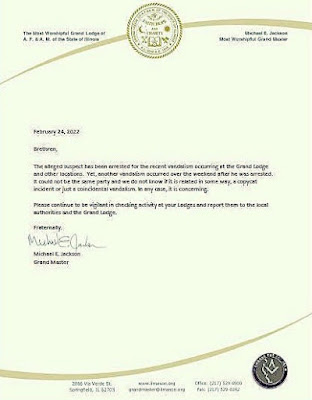
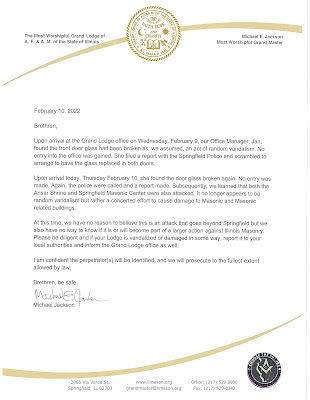
MW Michael E. Jackson, Grand Master of Illinois, has issued a new letter concerning several cases of vandalism at lodges in his state two weeks ago. (Click image to enlarge.) Despite an arrest in at least one incident, the activity apparently continues. 

February 24, 2022

 Brethren,

The alleged suspect has been arrested for the recent vandalism occurring at the Grand Lodge and other locations. Yet, another vandalism occurred over the weekend after he was arrested. It could not be the same party and we do not know if it is related in some way, a copycat incident or just a coincidental vandalism. In any case, it is concerning.

Please continue to be vigilant in checking activity at your Lodges and report them to the local authorities and the Grand Lodge.

 Fraternally.

Michael E. Jackson

Monday, February 21, 2022

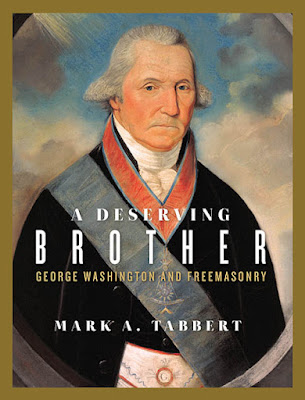
Book Review: 'A Deserving Brother: George Washington and Freemasonry' by Mark Tabbert


by Christopher Hodapp

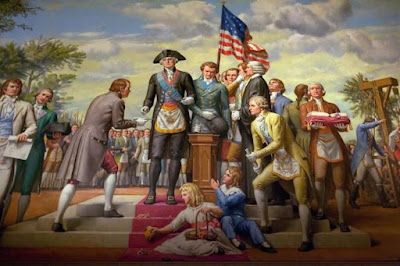
When the George Washington National Masonic Memorial in Alexandria, Virginia was first proposed in 1910, it was designed as a magnificent monument to America’s most famous Mason, along with being a safe and secure repository for priceless Masonic objects owned by Virginia’s Alexandria-Washington Lodge 22 that were associated with Brother George. The lodge possessed an original, contemporary portrait of Washington showing him dressed in Masonic regalia. And they had a collection of irreplaceable items which had originally been owned by Washington or utilized by him for the cornerstone ceremony for the U.S. Capitol building in 1798. 


But a fire at the lodge in the late 1800s resulted in the loss of several their priceless objects. So the Memorial was proposed as a national Masonic project that would be supported by all regular, recognized grand lodges in the U.S. in order to more safely house and display these almost sacred items for the public and for Masons alike. Today, the Memorial houses one of the largest collections of Washington-associated memorabilia outside of his estate, Mount Vernon and the Smithsonian Museum.


Many years ago, Mark Tabbert told me of an ongoing project he was working on. He has been the head of collections at the Memorial for many years, and the physical resources at the Memorial are preserved for future historians and Masons. Like the fairytales of Parson Weems’ chop-down-the-cherry-tree “biography” of the general, president and founding father, Masonic tall tales about Washington began propagating with great abandon after his death, and continue through today. 

Despite the endless (and frequently bogus) claims some Masons have made over the years about Worshipful Brother George and his enthusiasm for the fraternity, the truth is that Washington really only provably attended a handful of lodge meetings in person throughout his entire lifetime. Tabbert has always insisted that it is vital to honestly understand the role Freemasonry legitimately played in Washington’s life (and conversely, the role he played for the fraternity) instead of just breezily and blindly accepting legends that were told, retold and embellished by well-intentioned brethren over the last two and a half centuries. 


For instance, although Washington was named as the Master of Alexandria Lodge when it was chartered, he never actually sat in that position, or even as a sideliner in that lodge, and the famous drawings and paintings of him dressed in a jewel and apron as the Worshipful Master and presiding over a meeting were simply artistic flights of fancy on the part of painters and sculptors, and nothing more.

The result of Mark’s ongoing labors over the last decade is an ambitious new book being released this week by the University of Virginia Press: A Deserving Brother: George Washington and Freemasonry. In it, Tabbert has researched quite literally every single reference, claim, rumor, letter, declaration, newspaper article or offhanded remark that ever connected George Washington to the Masonic fraternity. Every known bit of physical evidence associated with Washington and his Masonic membership is presented in the book in chronological order, while explaining, debunking or ignoring the unsubstantiated claims. Tabbert’s intention has been to correct the historical record and create the standard reference work for future researchers on the trail of Washington and the influence Freemasonry may or may not have had on his life and his character.

Freemasonry during America’s formative years was instrumental in reinforcing the notion of a non-secular, “civic religion” that was so vital to the creation and success of this new constitutional, democratic republic. Washington’s membership in the fraternity was influential in both directions. In practical terms, Masonry demonstrated mutual cooperation, respect, religious toleration, and social egalitarianism that informed Washington’s understanding of democracy. And his membership in the fraternity gave Freemasonry a status that few other organizations could achieve at the time. His Masonic membership and support drew more and more merchants, community and business leaders, and men of all political and religious persuasions to join its ranks.

A Deserving Brother straddles the line between being an historical narrative and an itemized, encyclopedic catalogue. An extensive introductory chapter by Washington historian Edward G. Lengel gives a general chronological sketch of George’s life and where it coincided with the Masonic fraternity. But the main body of the work is its meticulously researched catalogue. The book is divided into several major periods of Washington’s life: as a British subject; General and Commander in Chief; private citizen; President of the United States; and his retirement and death. Each chapter is introduced by a general outline of the time period covered. Following that, descriptions of each reference include photos, dates, locations, circumstances, and in the case of letters and other documents, transcriptions of the text itself. In an effort to be as complete as possible, Mark has included correspondence whenever someone would send Washington a note, a Masonic book or other gift related in any way to the fraternity. And to aid future researchers, each item’s provenance and current location today are provided.

Notably, Tabbert has been careful to include verified details of several important, oft-cited milestones concerning Washington and the Masons, including his first inauguration in New York City and the circumstances involving the famous St. John’s Lodge Bible upon which he took the oath of office; the Masonic cornerstone ceremony of the U.S. Capitol in 1793 and the surviving working tools and related objects used at that event; and details of Washington’s Masonic funeral service in December 1799. An epilogue goes on to cite references about Washington used both by Masons and anti-Masons in the 1800s, as well as celebrations held by Masons in 1899 on the 100th anniversary of his death, and in 1902 for the 150th anniversary of his raising as a Master Mason. The major books written about Washington’s Masonic experiences and involvement are described, as well as the formation of what would become the George Washington National Masonic Memorial Association. 


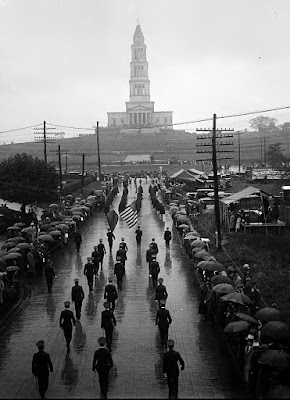
The Memorial itself was officially dedicated in 1932, some 22 years after it was first proposed, and Tabbert provides a synopsis of its mission and exhibits then and now, as well as an explanation of the changes that have occurred there since its opening.

In short, Mark Tabbert’s A Deserving Brother is without question the most extensive, detailed and truthful accounting of Washington and his Freemasonry as he lived it. As an historical research tool it is invaluable, and will unquestionably be the most important reference work on George Washington and the fraternity available for decades to come.

This book is being distributed by Macoy Publishing under a special partnership with the George Washington Masonic National Memorial Association. Priced at $34.95 for the 304-page hardback edition, CLICK HERE TO ORDER.

Sunday, February 20, 2022

R.I.P. Paul Newhall


by Christopher Hodapp

NOTE: THIS STORY HAS BEEN UPDATED WITH FUNERAL INFORMATION BELOW

News has come that my friend and Brother Paul Newhall passed away in the early hours of Saturday. Paul's wife Georgia posted a message on her Facebook page yesterday with the news. And the Allied Masonic Degrees posted a special announcement yesterday morning.


I can’t recall actually meeting Paul and Georgia for the first time because they just always seemed to have been there. I encountered the Newhalls regularly when I started attending Masonic Week, back near the end of the old Hotel Washington days in the early 2000’s. Even then, Paul was one of those rare Brothers who was always the answer to seemingly every question that came up about the event: Got any problem? Ask Paul. He always knew how to shrewdly negotiate contracts, juggle complex logistical arrangements, plan meals, organize meal tickets and credentials, diplomatically settle battles, smooth ruffled feathers (and egos), and even assist short-handed hotel banquet chefs in madly dishing up plates in the kitchen while dressed in his tuxedo. All the while, he was simultaneously serving as an officer in multiple Masonic organizations. Everyone, everywhere, always seemed to want just a little bit of Paul’s attention. And everyone who asked for it, no matter how great or trivial the request, always got it.

When a bunch of us upstarts formed the Masonic Society in 2010 and we wanted to hold our dinner, annual meeting and elections at the host hotel that next February, Paul came to the rescue right from the very start. He managed to work us into a highly coveted time slot on Friday night with our own dining room, and for many years, a big suite in which we hosted a hospitality room.

As the years passed, Paul suffered a variety of health problems. Periodically, he would duck out of the Masonic Week activities in order to go track down a kidney dialysis center to treat his diabetes. In 2013, Paul's kidneys began to fail and he required a transplant to survive. And so, Georgia became his donor. Several years later, doctors were forced to amputate his foot. And yet, through those physical trials and tribulations, Paul remained cheerful, caring, and eternally optimistic. 

 
I have always taken to heart the concept that Masonry should be governed by those “who can best work or best agree,” as our ritual enjoins. In the two decades I have known Paul, he was always just such a man, even when he and Georgia were burdened personally by challenges that would have felled almost anyone else. Paul was dedicated, driven, organized, indefatigable, and responsible to a fault. And above all, honorable. Such people may seem to be in short supply these days, but they still exist, and I have to admit I've encountered more of them within our fraternity than anywhere else. My world has been a better place because Paul and Georgia have been in it. So it is with deepest sadness I offer my most heartfelt condolences to Paul's entire family. 

His column is broken and his brethren mourn.

Requiescat in pace.

UPDATED 2/23/2022 2:00AM
FUNERAL INFORMATION

The viewing and visitation for Paul Newhall will be held this Friday, February 25, 2022 from 4:30 to 6:30 p.m. at:

Adams-Green Funeral Home and Crematory
721 Elden Street
Herndon, VA

The funeral, including Masonic Services, will begin at 6:30 p.m. Internment will take place in the spring in Chestnut Grove Cemetery, Herndon. Flowers will be received by Adams-Green. In lieu of flowers, memorial donations in his memory may be directed to the National Kidney Foundation at www.kidney.org

His complete official obituary can be seen HERE.

Wednesday, February 16, 2022

Adam Kendall Named 111th Blue Friar


by Christopher Hodapp


I was unable to attend AMD Masonic Week this year because of some personal family issues. That's a shame, because by all accounts, I've heard it was one of the best and most memorable Masonic Weeks in recent history.

The 78th Consistory of the Society of Blue Friars was convened Friday, February 11th at the Hyatt Regency in Crystal City, Virginia as part of Masonic WeekThe Society of Blue Friars was founded in 1932 for the express purpose of recognizing outstanding Masonic authors throughout the world. 

This year's newest member of the Society is Friar No. 111, Adam G. Kendall of California. Adam is the former editor of the Scottish Rite Research Society's quarterly publication, The Plumbline, and served for many years as the curator of the Grand Lodge of California's Henry Wilson Coil Library and Museum in San Francisco. He’s just recently been named as editor of the SRRS annual collection of papers, Heredom.

Adam's presentation was “The Scandals and Secret Rites of Benjamin Hyam,” which can be found in Quatuor Coronati Lodge's recent Freemasonry on the Frontier anthology.


The Society convenes each year during Masonic Week in the Washington, D.C. vicinity to induct a new Friar, and its gatherings are open to all Master Masons. Authors like Arthur E. Waite, Harold V.B. Voorhis, Dwight L. Smith, Allen Roberts, Thomas Jackson, Yasha Beresiner, Alain Bernheim, Robert G. Davis, Alton Roundtree, Michael R. Poll, Robert D. B. Cooper, Josef Wäges and Piers Vaughan are just a few prior Blue Friar honorees. In a rare moment of weakness, they even let a Dummy in.

I wasn't the only one kept away from the event this year. Sadly, Arturo De Hoyos' father passed away at the beginning of the week, and so he was unable to preside as Grand Abbot of the Society of Blue Friars this year. And so it fell to Deputy Grand Abbott Mark A. Tabbert to do the honors this year and announce this our newest inductee.

Tuesday, February 15, 2022

Illinois Attacks on Masonic Halls Part of Growing Anti-Masonic Vandalism


by Christopher Hodapp

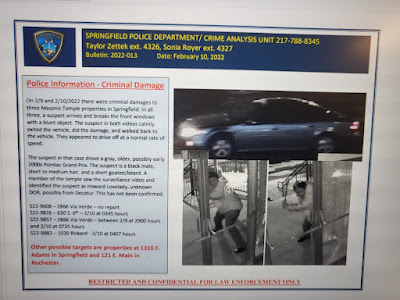
Police in Springfield, Illinois are asking the public for leads and information in connection with recent multiple attacks on Illinois Masonic properties. (Click the image above to enlarge.) The Grand Lodge of Illinois office, the Springfield Masonic Center and the Ansar Shriners all had their glass entry doors smashed last week, and similar damage occurred at the Masonic temple in Decatur, Illinois last year.

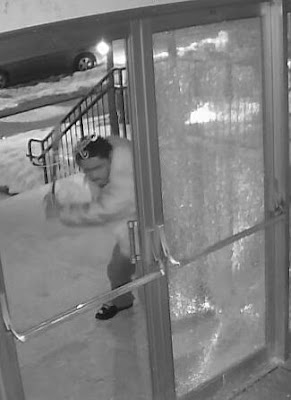
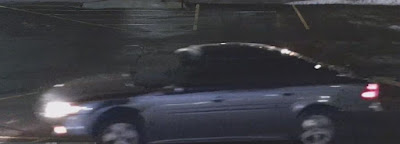
Police are seeking a person of interest in the attacks who was seen on security camera footage from the Shrine. A member at the temple identified the suspect as Howard Lovelady, who is possibly from Decatur, Illinois. The suspect is a black male, short to medium length hair, with a a goatee/beard. He was driving a 2000's silver or gray Pontiac Grand Prix. 

There seems to have been an increase in deliberate vandalism against Masonic sites as of late. 

Meanwhile, a notorious, headline-seeking preacher in Tennessee named Pastor Gary Locke regularly urges his audiences to "destroy everything Masonic," and has unfortunately gotten increased airplay online in the last few weeks. Most recently, Locke held a highly publicized book burning event in Florida, consigning Harry Potter and Twilight books to the flames (along with, by the way, Fahrenheit 451, with absolutely no sense of irony whatsoever). Declaring Freemasonry to be Satanic ("Paging Mister Taxil. Mister Leo Taxil, please pick up a white courtesy phone."), his anti-Masonic rant from that event has been endlessly forwarded around Tweetbook, Snaptwit and Facespace.  Any attempt to block his more incendiary anti-Masonic diatribes from social media simply becomes more fodder to be shoveled by Locke to his followers as "proof" that us cloven-hooved Satanic Masons have superpowers that must be vanquished. 

Unfortunately, too many Masons online have failed to remember the very first charge given to the new Entered Apprentice in most jurisdictions:

"In your outward demeanor, be particularly careful to avoid censure or reproach. Let no interest, favor or prejudice, bias your integrity, or influence you to be guilty of a dishonorable action. . . [N]either are you to suffer your zeal for the institution to lead you into argument with those who, through ignorance, may ridicule it."

Anti-social media brings out the very worst in everyone it seems, and there are entirely too many Masons who are hurling insults and decidedly un-Masonic language at Locke and his followers. That type of public language and online behavior is exactly why grand lodges around the world have been adopting codes of online conduct for their members.

Indianapolis Prince Hall Temple Receives Indiana Landmarks/Lilly Foundation Grant


by Christopher Hodapp


Indianapolis' Prince Hall Masonic Temple at 22nd and Central Avenue is receiving a $9,000 preservation grant from Indiana Landmarks Foundation and the Lilly Foundation towards the replacement of their aged roof. The story on WRTV-6 concentrates solely on the building's more recent past as home of Central Lodge No. 1 of the Most Worshipful Prince Hall Grand Lodge F&AM of Indiana. It completely ignores the building's storied origin in 1915 when it was designed as a team effort by the three top, competing architectural firms in the city. Oriental Lodge No. 500 of the Grand Lodge F&AM of Indiana at that time was the largest suburban lodge in the city. Among its members were the principals of those three architectural design companies.

Oriental Lodge had originally been chartered in 1875, and it was a prestigious lodge. In 1904, the Vice-President of the United States under Teddy Roosevelt, Charles W. Fairbanks, became a member (making them one of the only Masonic president/vice-president teams in US history). By 1912, the lodge had 600 members, and just seven years later, it had swollen to 900. By its 50th anniversary in 1925, the lodge had 1,100 on its rolls, and 22nd and Central Avenue was a very hot neighborhood. Odd to think of it today as a 'suburb.'


In 1983, Oriental Lodge merged with Evergreen Lodge on the city's west side, and moved out of their temple. It was sold to Central Lodge No. 1 (oldest African-American Prince Hall-derived lodge in Indiana) and a temple association of several other Prince Hall lodges and appendant groups. Before this time, Prince Hall lodges in the city had been renting space in the downtown YWCA on Indiana Avenue. 

Out of the 14 purpose-built neighborhood Masonic buildings in the city limits of Indianapolis, outside of downtown's Mile Square, that were standing a century ago, the Temple of Central Lodge No. 1 today is the only Masonic building left that has been continuously built, owned, and operated by Freemasons. This magnificent temple in 1983 became the first Prince Hall building in Indianapolis that had been specifically designed as a Masonic space since their grand lodge's formation back in 1856.

(See my story from 2016: A Tale of a Temple.)

In addition to Central Lodge 1, the following Prince Hall Masonic organizations all meet in that same temple: Waterford 13, Trinity 18, Sumner A. Furniss 61 lodges; Constantine Consistory 25 Scottish Rite; Union 1 Order of the Eastern Star Chapter; Sumner A. Furniss Assembly 32 of the Order of the Golden Circle; the York Rite bodies of Cyrus Chapter 1 Royal Arch Masons, John C. Dawson 22 Council of Royal and Select Masters, and Gethsemane Commandery 37 Knights Templar.

Friday, February 11, 2022

Masonic Sites in Illinois Vandalized

Damage at the Grand Lodge of Illinois in Springfield

by Christopher Hodapp

NOTE: This story has been updated on Friday, February 11 at 5:45AM to include photos and more information about attacks on Masonic sites across Illinois.

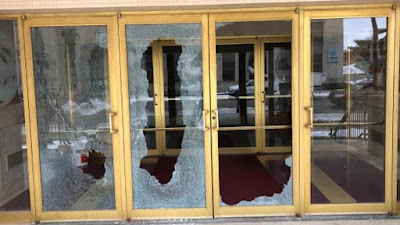
Several Masonic locations in Illinois have been struck with deliberate acts of vandalism in the last few weeks. According to a letter circulated by MW Michael E. Jackson, Grand Master of Illinois, the Grand Lodge office in Springfield had its glass door smashed on Wednesday, and after being replaced, it was shattered again on Thursday. 


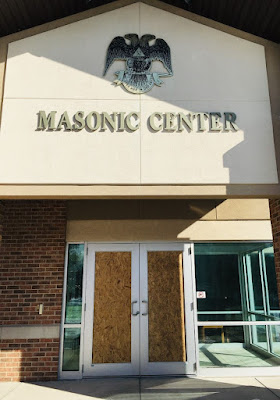
Across town, the Springfield Masonic Center and the Ansar Shrine were also vandalized. 

There were no break-ins, and nothing appears to have been stolen. 

From GM Jackson's letter:

"At this time, we have no reason to believe this is an attack that goes beyond Springfield but we also have no way to know if it is or will become part of a larger action against Illinois Masonry. Please be diligent and if your Lodge is vandalized or damaged in some way, report it to your local authorities and inform the Grand lodge as well."

Click the image above to enlarge.

Security camera images from the Shrine were circulated today on the newschannel20.com website showing the attacker and what may be his car. Anyone with information concerning these attacks or this person in the photos are urged to contact the Springfield Police Department at 217-788-8427.


Last month, the Decatur, Illinois Masonic Temple suffered eight different attacks that did an estimated $20,000 in damage to their facility. Decatur police arrested - and released - a suspect in that case. Lodge members there believe all of these attacks may have been committed by the same person. 

Meanwhile, suspicious packages were found at Masonic temples in Champaign and Chatham, Illinois a few months ago. One of the packages contained a note accusing Masons of trying to destroy the world.

Acts of vandalism against Masonic buildings have been escalating around the country, along with the circulation of anti-Masonic literature. To the southeast of the Illinois border, southern Indiana Masonic halls have been reporting about thick packets of anti-Masonic material taped to lodge doors or left in their mailboxes.

Photos provided by Ansar Shrine Center

Thursday, February 10, 2022

Shriners Closing Tampa Hospital - Transitioning to Outpatient Services


by Christopher Hodapp

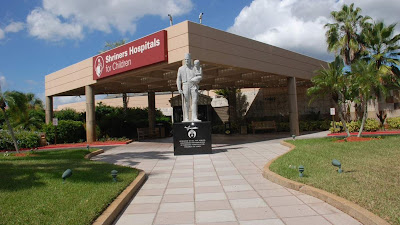
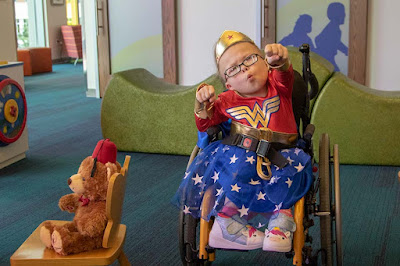
Shriners Children officially announced the closing of the Shriners Hospital in Tampa, Florida last week. Shriners has operated its Tampa hospital on the campus of the University of South Florida since opening in 1985, and in fact, the headquarters of both Shriners International (the fraternal origination) and its non-profit, recently-renamed medical philanthropy, Shriners Children, are located in Tampa. Unfortunately, stories in the Tampa Bay News caused lots of heated accusations in its wake from the rank and file Nobles on social media.


Since first opening, the Tampa hospital has treated more than 50,000 children. The original 60-bed, acute care, inpatient hospital at that location was already transformed into an outpatient clinic back in 2019, with fewer than 100 employees. The facility has been treating children with scoliosis, muscular dystrophy and brittle bone disease (osteogenesis imperfecta). It also provides radiology and pediatric rehabilitation services, along with braces, artificial limbs and corrective orthopedic shoe inserts. But in the almost 40 years that the Tampa location has been open, the medical universe has undergone enormous evolution. 

A wide variety of forces contributed to that change, including: a shrinking domestic birth rate; the major reduction of birth defects in recent decades; advances in technology and care procedures that no longer demand expensive, overnight (or longer) stays; and the dramatic increase in the cost of staffing and maintaining a full-service, full-size hospital with little-used facilities. And don't forget the massive intrusion of government in the wake of the Affordable Care Act that redefined what a "hospital" can and cannot do without running afoul of Medicaid and various insurance regulations. Before 2011, Shriners prided itself in providing care to children at no cost, often saying, "Our hospitals have everything other hospitals have, except a billing office." The ACA changed all of that and ultimately forced them to accept insurance payments and the regulatory nightmares that went with it. However, they still treat uninsured patients free of charge.


In April, Shriners will announce a new partnership with local providers in the Tampa area that will permit their pediatric and orthopedic specialists to treat more patients at more locations, and perform many in-home services. Tampa is not alone. It is actually one of five locations in the Shriners system transforming from hospitals into out-patient service providers. Complex cases requiring surgeries and longer-term, inpatient treatment will be transported to the Shriners acute-care hospitals in Shreveport, Louisiana or Greenville, South Carolina. In addition to orthopedic cases, Shriners continue to provide world-renowned care for children with severe burns, clubbed feet and other debilitating injuries throughout their 23 North American locations.

The Shrine opened its first children's hospital a century ago in 1922, and has served more than 1.5 million patients since then. Shriners Hospitals for Children are supported by individual donations from the public, but primarily by the members of Shriners International, a Masonic fraternity open to men with nearly 200 chapters in the U.S. and other countries. Most Americans are unaware that in order to be a Shriner, a man must first become a Freemason and join a local Masonic lodge.

Tuesday, February 08, 2022

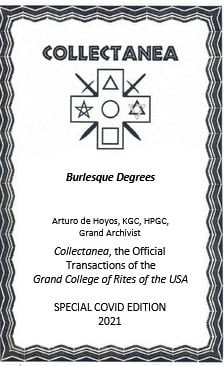
Grand College of Rites Offers Bonus Book: 'Burlesque Degrees'


by Christopher Hodapp
The Grand College of Rites of the United States of America is a regular Masonic body that is dedicated to preserving the history and rituals of defunct and inactive Masonic orders. Formally organized in 1932, the Grand College of Rites publishes an annual volume known as Collectanea which contains reprinted rituals of various officially extinct organizations deposited within its archives. The College and its members agree that these rituals are published and copyrighted strictly for the purpose of research and preservation, and are not to be worked or performed. Over the last couple of years, for example, Collectanea has been featuring the degrees of the Cerneau Rite system, which caused more than its share of excitement in the 1800s when it began to spread throughout the northeastern states. (Still to this day, the Tyler's Oath administered to visitors in Pennsylvania specifically requires sojourning Masons to swear they are not members of a Cerneau lodge and have not had the degrees of the Cerneau Rite conferred on them! Talk about holding a grudge.)

But the book that came this week is actually something quite special, and not the usual sort of obscure esoteric rituals the College has traditionally published in the past. Because of the COVID-19 pandemic precautions in the DC area last year, the 2021 Masonic Week was canceled. In light of this, Most Illustrious Duane L. Vaught, KGC, the current Grand Chancellor of the College, was struck by the notion of offering a special bonus book to the members that features some lighter-hearted levity than the usual offering of serious degrees.

And so, this volume of "Burlesque Degrees" is being provided as a Bonus Book to all 2020 and 2021 dues-paying members as a way of saying thank you for their continuing support of the mission of the College throughout the COVID-19 pandemic. 


During the Golden Age of Fraternalism, quite literally hundreds of fraternal groups proliferated. Most tried to be solemn in nature, with degrees to impart wise and serious truths. But others were created as unofficial 'side degrees' to provide an entertaining night for members, or as one pamphlet put it, "a comic ceremony designed to cure the blues and fill the treasury." 

The fraternal groups included in this collection are truly obscure and deliberately comic: The Haymakers, the Munchers of Hard Tack, the Sublime Order of Arabian Knights, Uncle Sam's Eagles, the Up-To-Date Order of Goosie Girls, the Grand and Noble Order of Button Busters, and more.


These types of side degrees sometimes became quite elaborate and required special props as part of the gags involved. DeMoulin Brothers in Greenville, Illinois published an enormous catalog of goofy (and occasionally dangerous) props for side degrees, and became known as "the goat factory" because of the wide variety of various mechanical bucking goats they manufactured. The C.E. Ward Company in New London, Ohio also published a catalog strictly for "burlesque goods," and several pages of their offerings are included at the end of this volume.

Annual dues in the GCR is a paltry $20. If you are a current dues-paying member who was NOT paid up in 2020 or 2021 - you can contact the Grand Registrar at grand.registrar@grandcollegeofrites.org for purchase information for this bonus book.

Meanwhile, the regular 2021 edition of Collectanea will conclude the series of the Cerneau Rite (30° - 32°) is at the printers now and will ship very soon.

Any Master Mason holding membership and in good standing in a regular symbolic lodge recognized by a majority of grand lodges of Freemasonry in the United States may petition for membership as a Fellow in the Grand College of Rites. (click here for a petition)