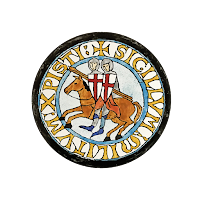
What's up with this fascination with skulls, you may ask? The medieval Knights Templar actually adopted the skull and crossed leg bones as an occasional symbol during their time in the Holy Land to frighten and intimidate the Infidels in battle. Some have claimed that the image was also used as the flag for Templar ships, and after their suppression in 1307, it was eventually co-opted by pirates.
Today, as more and more Masons are taking an interest in the esoteric side of our rituals and symbolism, they've become quite familiar with the memento mori and its ancient warning to remember that life is fleeting, and that a man should live every day as though it might be his last.
If you come from a Christian background and a denomination that marks Ash Wednesday by making a cross on the forehead using black ash, the words that accompany this ritual are "Remember that you are dust, and unto dust, you shall return." If you travel throughout Europe, there are many catacombs, and even chapels, with skulls and bones of the dead used for walls, arches and general cheery decor. They are a constant reminder of mortality, and as Horace reminds us, "Pale death knocks with the same tempo upon the huts of the poor and the towers of Kings."
Reminders of Death as a constant companion weren't particularly seen as creepy in earlier centuries, in part because death was so prevalent in everyday life. In large families, the death of one or more children before reaching adulthood was all too common, and life expectancy for adults was much shorter than today. Communicable diseases commonly wiped out whole families, villages and towns all across the globe. Wars with tens of thousands of casualties on all sides devastated entire nations, and during World War I, it was nearly impossible to find a family anywhere in Europe who hadn't lost a father, son or brother in that conflict.
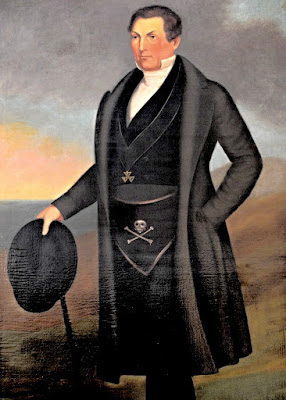
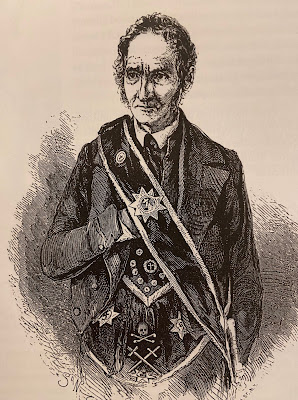
The historical, triangular 'skull and crossbones' apron was part of the Masonic Knights Templar regalia from the 1770s until the 1860s within the tyled confines of a Commandery meeting or degree – it's described as part of the uniform used in meetings in Thomas Smith Webb's Freemason's Monitor in 1808.
Because all of the York Rite degrees were originally designed to be conferred in a Masonic lodge, the Templar apron was considered an extension of the use of a Masonic apron required for all work and meetings. By the 1830s, the black military-like uniform we're all familiar with was already taking form, but there were a lot of local variation in them from state to state and commandery to commandery.
An attempt was made in 1859 by the Grand Encampment to demand national uniform conformity, which included a black uniform with a white surcoat or tunic, and essentially banned the skull apron (interestingly for ALL Templars, EXCEPT Washington Commandery No. 1). Think about that realistically — keep a white uniform clean while riding around on horseback. Consider that Templary was already the most expensive of all Masonic orders to participate in because of the uniform, swords, ostritch-feathered chapeau, PLUS special Templar riding accessories like decorative stirrup covers and protective cuffs if you planned to ride in a parade team. The demand for this new standard uniform by the Grand Encampment wasn't scorned or loudly protested against — local commanderies simply ignored it.
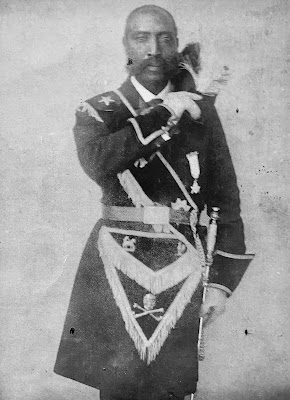
It wasn't just the U.S. Grand Encampment Templars that stuck with the skull apron. Even the Prince Hall Commanderies held on to them throughout the 19th century.
Nevertheless, after the 1860s and the end of the Civil War, the use of the skull apron in meetings as part of the KT's uniform started to fall by the wayside. Among many there was a growing concern that its symbolism might be misunderstood by the public (especially since more and more Templars were having newfangled photographic portraits made of themselves dressed in full regalia, and non-Masons could suddenly see the skull and bones apron without sneaking into a meeting). That misunderstanding would only increase in the 20th century, when skulls and crossbones became identified with poison chemical labels, pirates, horror movies and the "death's head" cap badge on Nazi SS uniforms.
In any case 75.96% of the Sir Knights at the Triennial this week approved the apron's use. While it's approved by Grand Encampment, this must be adopted and approved in your state by your Grand Commandery first, if it is not in your uniform regulations. Remember that the "historical" skull apron is for asylum use only, while the "contemporary" apron is approved for public or private use. The preference is to wear an apron over the class A uniform coat — it is NOT considered as a replacement for the uniform (in case you thought you could get out of buying a full uniform and just showing up in street clothes and the apron).
And if you're looking for a new one, Masonic Revival offers a skull apron: https://masonicrevival.com/collections/aprons/products/knightstemplar-apron
If anyone can provide a link to a supplier of the new contemporary public apron, please pass it along and I'll update this entry.
'Attestation of faith' on petitions fails
The second piece of legislation that attracted lots of attention was a proposed requirement to be placed on future Templar petitions stating that the petitioner affirms his Christian faith in writing. Unlike most other appendant organizations associated with Freemasonry, the Knights Templar requires that a petitioner must be a professed Christian, and that demand causes some heartburn with Masons who aren't Christians, or who believe that this somehow violates the spirit of Freemasonry and the Ancient Charges.
Nevertheless, the Masonic Knights Templar order has had belief in Christianity as a requirement since the 1760s when it first appeared. Such a prerequisite is without question "exclusionary," but nowhere is it promised that absolutely everyone has an absolute right to experience absolutely every single degree in absolutely every Masonic-related organization, absolutely. The Order itself is based upon the medieval Templars who held a unique position that straddled both the ecclesiastical and the temporal spheres as "warrior monks." Removing the Christian elements from the Templar ritual would leave nothing but an empty husk.
Over the decades, some local Commanderies and even state Grand Commanderies have tried to hedge on the Christian membership requirement. Some jurisdictions phrase their petitions with squishier language, requiring no more than a belief in a "higher power," while others merely ask that a petitioner be willing to "defend the Christian religion." That's a loophole big enough to drive a Sherman tank through. But the Statutes of the Grand Encampment are quite specific. Section 177(b) requires that a petitioner for the Orders must be a "firm believer in the Christian religion."
However, the amendment that was up for a vote this week went beyond merely asking a petitioner if he is a firm believer in Christianity. The proposed Attestation of Faith required the petitioner to declare himself to be a Christian specifically "as defined in the four Gospels (Matthew 16:16, John 3:15-17, Acts 4:10-12, and Romans 9-10)"
Click the image below to enlarge it and read the entire proposed statement in its entirety.
While most of the Knights in attendance at the Triennial felt the statement was well-founded and good-intentioned, the attestation itself was clumsily written, resulting in confusion and contention. While all Templars are supposed to be Christians, the enormous range of Christian denominations have variations in teachings concerning the role of the Holy Spirit. As a result, debates over the Resolution's wording quickly went into the weeds over definitions and details of Christ's crucifixion, resurrection from the dead, time spent with the Apostles including the Last Supper, and his ascension.
An attempt was made to amend the Resolution in order to simplify the statement. That amendment to the Resolution was submitted in writing in advance of the Triennial, and it was found to be in proper form by the Jurisprudence Committee. The amendment essentially struck out the entire text of the proposed Attestation to read simply:
"I profess the Christian Faith: that through the Birth, Life, Death, Resurrection, and Ascension of Jesus, believers are saved and redeemed."
According to attendees, this amended version received a simple majority (53.31%) of yes votes, but did not meet the two-thirds super majority required for an amendment to the statutes. It's possible that if the original resolution had simply been this wording in the first place, it would have passed.
Resolutions restore amity with Great Priory of America of the CBCS
If you know nothing of what this whole imbroglio was about, and you have no idea who or what the CBCS is, don't feel somehow that your Masonic knowledge is lacking. This situation is as about as deep into the waist-high weeds of Masonic appendant bodies as it gets.The third noteworthy bit of legislation was Resolution 2021-23, rescinding 2012-01 and Duane Vaught Decision No. 5 which had previously declared the Great Priory of America (GPA) of the Chevaliers Bienfaisants de la Cité Sainte (CBCS) to be an unrecognized Masonic Templar Order. Because of that situation, members of the Grand Encampment who held membership in the Great Priory of America were deemed to be in violation of their knightly vows. This Resolution rescinding that status passed with more than 77% of yes votes.
Further, a second proposed Resolution (2021-26) which called for the automatic expulsion of any member of the GEKT who sought or held membership in the GPA, was voted down by the delegates.
This hopefully brings an end to more than a decade of hostility, broken friendships, and scuttled Masonic careers.
The long, twisting, epic saga of the Grand Encampment of Knights Templar and attempts beginning back in 2011 to establish a new CBCS Rectified Rite priory in the US turned into an all-out war of words and lawsuits between the GEKT and the existing CBCS Great Priory of America. Sadly, this mess wound up dividing some of the most respected leaders in North American Freemasonry into two warring factions. And then the lawyers got involved.
Much of that battle played out right here on my blog, I'm sorry to say. Rather than re-describe, re-hash and re-litigate this episode, I will point to this post from December 2010 for background on what set this whole drama in motion:
Grand Priory of the Scottish Reformed & Rectified Rite of the United States of America
Over the next two or three years I wrote more posts about the situation (if you really have a burning desire to wade into it, use the search menu on this blog and look for articles with CBCS, Rectified Rite, or Grand Priory in them).
In full disclosure, I freely admitted at the time that I was part of the group in favor of establishing the new CBCS priory under the authority of the Grand Encampment. The GPA was established in the U.S. in 1934 and quickly turned into little more than a supper club for a tiny, select group of Masons ("Because", as one wag joked to me, "the 33rds were letting in too much riff-raff"). Their membership never exceeded about four dozen at any one time. Yet, they controlled any working of the Rectified Rite degrees in the U.S., as a result. This post is not the place to drift into a windy explanation of Martinism and the different degree systems that grew out of its three variants in the 18th and 19th centuries. But many of us at the time felt that this beautiful, philosophical and deeply complex degree system was being held hostage by a group that had no desire or intention of actually working those rituals themselves.
So, in 2012 the Grand Encampment of Knights Templar obtained a charter in France from a CBCS body there, and they sought to expand the CBCS in the U.S. to a wider Masonic membership. And that, as they say in stories about ugly divorces, is when the fight started.
Much time has passed, leadership of both the Grand Encampment and the Great Priory of America has changed, and emotions and passions have hopefully cooled. Clearly, the general membership of the Grand Encampment decided this year that they've had enough of being involved in this conflict.
As a very dear friend often says, "So it goes."
All of that having been said, the reasons for attempting to bring the CBCS degrees to a wider group of U.S. Masons still remain valid, and certainly not for some absurd notion of "let other VIP Masons in to your exclusive club." The growing interest in esoteric orders within Masonry should not be blunted and locked away out of some twisted sense that it's only for the cool kids.
Honors and Awards
• SK Brandon Mullins of Michigan was inducted as the first member of a new order of Masonic knights Templar scholars, the Order of Clairvaux. Admission to this prestigious institution is restricted to just one Sir Knight each Triennium. SK Mullins presented his paper about the use of skull imagery in Templary – a timely topic, given the apron legislation this year.
• SK W. Bruce Pruitt, the senior Past Grand Commander of California, was elected a Most Eminent Honorary Past Master of the Grand Encampment and elevated to Grand Cross Templar.
• SK Art F. Hebbeler III, Grand Prelate of the Grand Encampment, received the Knight Grand Cross.
• SK Dicky W. Johnson (Tennessee) was made a Honorary Past Grand Prelate of the Grand Encampment of Knights Templar of the USA.
(Please alert me if I missed anyone.)
And finally...
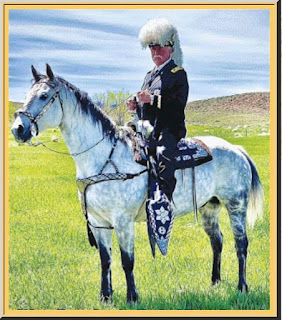
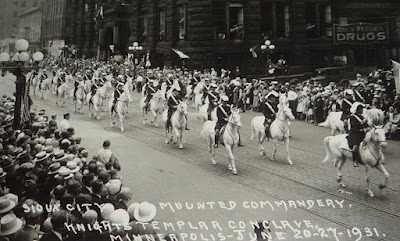
Congratulations to all Grand Encampment officers, and especially to MEGM Michael Johnson, whom I've known for many years. Mike is from Crowheart, Wyoming where he and his wife Judy own a cattle ranch, and he served as Grand Master in 2015-16. Mike became a cowboy fresh out of high school, and the Grand Encampment's webpage features an image of him in his Templar uniform while riding horseback. It's been a very long time since most of us have seen a Grand Master of Knights Templar on horseback, but Templar horse teams were commonplace in the 19th and early 20th centuries.
Sadly, in this Age of Snark we're all living through, right after this image was posted on Facebook, a tiny squall went up over it.
Out of touch!
Elite!
Backward!
The expense!