"To preserve the reputation of the Fraternity unsullied must be your constant care."

BE A FREEMASON

Wednesday, February 26, 2020

Another One Lost: Troy, Ohio Temple Sold


And another one gone, and another one gone, and another one bites the dust...

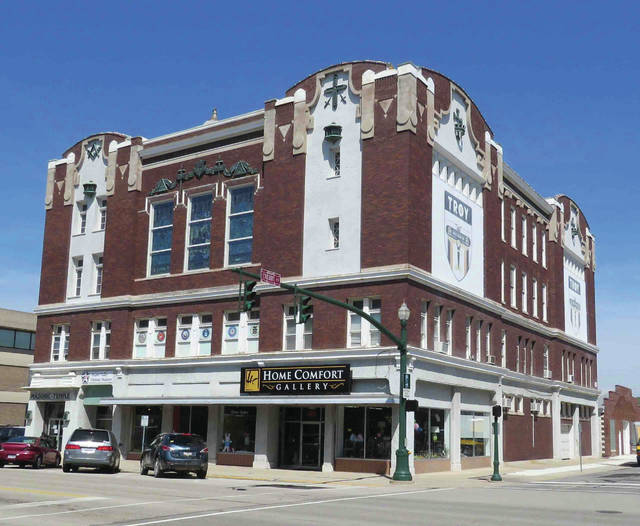
The unique 1907 Masonic Temple of Franklin Lodge No. 14 in Troy, Ohio has just been sold to unspecified buyers for $670,000.

From a story by Aimee Hancock on the Troy Daily News website on February 24th:

The historic building was constructed in 1907 by the Troy Franklin Lodge. According to Purke, early indications are that the Masonic Temple building, which is listed on the National Registry of Historic Buildings, will be saved and repurposed, though specific plans for the building have not been announced at this time.

The building has been the meeting place for the Masonic lodge members for generations and features two [sic] signature, one-of-a-kind stained glass windows on the third floor, a marble staircase, and an interior that dates back to the early 1900s.

According to Bruce Ball, Franklin Lodge 14 member, the Masons have met at the Troy Masonic Temple since its opening in 1908. Ball said while no new location has yet been identified, Franklin Lodge 14 intends to stay in the Troy area.

“Our roots are here in Troy,” he said. “A lot of the founding fathers of Troy were founding fathers of our lodge. The majority of our members are from Troy and we want to stay part of the community; like any other fraternal organization, we like to help the community and do anything we can with what we’ve got.”
The second floor of the Masonic Temple has been the home of the Miami Valley Veterans Museum since 2010 when the Masons offered the Miami Valley Veterans Museum a location to house their museum.


So the lodge selling its temple also means that the local veterans' museum is being given the boot, as well.


When the Temple was built on Troy's Main Street, it was deliberately situated as close as possible to the center of the community. Even today it dominates the skyline of Troy as you enter the roundabout in the middle of town, just as it did in 1907.


It sits just steps from the impressive county courthouse, and photos from its earlier years show that its facade has been slightly altered over time.


But time has not dimmed its irreplaceable stained glass windows that will never be equaled. They were installed at great expense and with loving care by their forefathers who hoped their grandsons would do even better and bigger things.


Franklin Lodge hasn't announced where it will meet from now on, but if hundreds of other lodges following this same path are any example, one can pretty confidently surmise it won't be in the heart of their town in a home befitting the oldest and greatest fraternal organization in the world, in a new temple inspired by the finest architectural and stonemason's arts.

And please spare me the "a lodge is not a building" excuses. A Masonic temple is a reflection of the Masons inside, nothing more or less. And it's about time we recognize that the most thoroughly abused and deliberately misunderstood phrase in all of Masonry is that "it is the interior, not the exterior of a man, that Masonry regards..." The Masons who built these places were the leading members of their communities. No mayor or businessman or architect or doctor or machine shop foreman in 2020 wants to discover that the greatest secret of Masonry is that their lodge wants to argue over who broke the flapper valve on the toilet they refuse to repair two months in a row. And unless we start acting again like we are worthy of attracting our community leaders to join and participate in Masonic lodges in the 21st century, this fraternity will continue to slip through our fingers until we are nothing but a nostalgic footnote to history.


Tuesday, February 25, 2020

Congressman Jeff Van Drew Hails His Lodge


New Jersey Congressman and Brother Jeff Van Drew speaking on the floor of the U.S. House of Representatives about his home lodge, Cannon Lodge No. 104 on February 11, 2020. The clip aired on c-SPAN. 

Cannon Lodge is in South Seaview, New Jersey.

In the U.S., our politicians, civil servants and civic leaders can proudly proclaim their Masonic membership on national television. We need to remember that periodically when a story appears like yesterday's about the state prosecutor in Croatia being forced to resign solely because he was a Freemason.

Monday, February 24, 2020

Croatia's State Prosecutor Forced To Resign Over Masonic Membership


(NOTE: This story has been updated on 2/25/2020 at 3:18PM EST.)

The chief state prosecutor for the nation of Croatia has just been forced to resign his office solely for being a Freemason.


An Associated Press story on February 20th reports that Croatia's State’s Attorney, Dražen Jelenić, came under fire after he publicly acknowledged his membership in a Masonic lodge.

From the AP story:


Jelenic initially refused to resign, saying that being a member of the fraternal organization did not affect his independence. However, the prime minister and other Croatian officials insisted he leave his post as the country’s top prosecutor.

Prime Minister Andrej Plenkovic said at a Cabinet meeting Thursday that membership in an organization or order like a Masonic lodge could undermine public trust in “the integrity of people running the highest institutions.”

“I would like to stress that this does not mean the state attorney has acted against the law or did not perform his duty objectively and independently,“ Plenkovic said. “This duty does not leave any room for doubt in independence or objectivity.”

Jelenic became state’s attorney in 2018. Plenkovic said the government had no prior knowledge of his Masonry affiliation.

A slightly more detailed English-language story appeared on the Balkan Insight website last Thursday:

“This membership is lawful [but it] burdened the performance of my duty as Chief State Prosecutor,” Jelenic said on Wednesday, when he confirmed his resignation.
The weekly Nacional reported on his membership on Tuesday. While explaining it earlier to local media, Jenelic denied belonging to a secret or semi-secret organisation, and said it was just a civic association registered in accordance with the law, so there was no conflict of interest.
Jelenic told the media that he was invited to join a freemasonry association in March 2018, a month before being named to his post as chief prosecutor.
The association was registered as a non-profit dedicated to “promoting masonic worldviews, above all general morality, culture and love for one’s fellow man and charity”, according to the Croatian Registry of Associations.
However, Croatian officials are obliged to declare their membership of associations or organisations to the Commission for the Resolution of Conflicts of Interest, which Jelenic failed to do.
The resignation followed only days after media reported that several journalists from the tabloid Dnevno.hrand its sister print weekly, 7Dnevno, had been arrested for allegedly trying to blackmail an ophthalmologist over his links to the same masonic association.
Nikica Gabric claimed the journalists had tried to blackmail him into buying 27,000 euros worth of advertising space in the weekly in exchange for not publishing pictures of him attending masonic ceremonies. Jelenic had become involved in the affair, after accusing Gabric of trying to influence the investigation into the Dnevno.hr journalists. On Wednesday, Jelenic clarified his statement, saying Gabric had clearly been the victim of attempted blackmail.
President Zoran Milanovic made it clear he supported the prosecutor’s departure. He said that everyone who was a member of a masonic association and was doing a public job or was a public official, notably in law enforcement, was unnecessarily bringing into question their objectivity and loyalty.
Jelenic was appointed to his post in April 2018. He earlier served as president of the State Judicial Council, and as a municipal prosecutor and county prosecutor.

In additional articles I have found so far, Parliament Speaker Gordan Jandroković declared that Jelenić's Masonic membership constituted a case of what he called "dual loyalty," which is frequently cited by anti-Masons as an excuse for persecuting members of law enforcement, the judiciary or in government positions over their Masonic membership. These are the sort of accusations that were common in the late 1990s and early 2000's during the English witch hunts against Masons by their Home Secretary, Jack Straw.

A story on the N1 website gave more details about the blackmail end of the story and what is already being called the "Masonic Affair":

The unusual scandal began unravelling last week, when a prominent Croatian eye doctor, Nikica Gabric, reported to the police that journalists of the popular tabloid website Dnevno.hr and its weekly print issue 7Dnevno were threatening to publish photographs showing Gabric attending masonic ceremonies.

Gabric claimed that, in exchange for not publishing the photographs, the journalists wanted him to buy 200,000 kuna (€27,000) worth of advertising space in the 7Dnevno weekly. The police investigation was opened, resulting in arrests of Dnevno.hr’s editor-in-chief, his deputy, and the website’s owner. According to Gabric, the arrested editor-in-chief’s deputy is also a member of the same masonic lodge.
The first Masonic lodge in Croatia and the Balkans was established in 1764 by Croatian Count Ivan Drašković VIII. The first Grand Lodge of Croatia was established in 1778, but the fraternity was shut down in 1795 across Croatia, Austria and Hungary after Illuminati-inspired (or connected) conspirators with Masonic membership hatched a failed revolutionary plot in the region. Masonic lodges would reopen again, only to be shut down throughout much of the 19th century at various times as fears of 'Illuminism' continued.

After the collapse of the Austro-Hungarian Empire in World War I, Croatia was handed over to the Kingdom of Serbia, and eventually folded into Yugoslavia. Freemasonry was reestablished under the Grand Lodge of Serbia and flourished from 1919 until the pro-Nazi fascists came to power in Croatia in 1940. Jews, Serbs and Freemasons were persecuted, arrested and murdered, and many were removed to the Nazi-inspired Jasenovac extermination camp in Slavonia. Jasenovac became one of the largest concentration camps in Europe and was nicknamed the 'Auschwitz of the Balkans.'
After Yugoslavia's collapse in 1941, the new government of the Independent State of Croatia also completely banned Freemasonry, and it remained illegal after the end of World War II for another 51 years.

After the breakup of Yugoslavia in the 1990s and the re-formation of the nation of Croatia, the Grand Lodge of Austria formed a 'provisional lodge' in Vienna with the task of raising and educating a whole new generation of Masons who would eventually be able to revive the Grand Lodge of Croatia. In 1994, the Grand Lodge of Ancient Free and Accepted Masons of Croatia was successfully registered as a civil society with the Croatian Ministry of Public Administration.

An English-language website for Freemasonry in Croatia today can be found at http://www.freemasonry-croatia.org/indexen.htm


UPDATED 2/25/2020

From my admittedly imperfect, drive-by understanding of the story, this appears to be a political battle with looming elections, and this demand for his resignation was his party's leadership squeezing him out, NOT some official government policy. If I'm reading this correctly, it's mostly about political optics in a contested parliament election cycle. That's not to blunt Croatia's long history of outlawing Freemasonry at several points over the last three centuries. But Croatia is a member of the European Union, and when Italy and England both enacted actual laws banning the participation of Freemasons in government, law enforcement or judiciary positions back in the late 1990s and early 2000s, such laws were deemed to be illegal discrimination by the EU Court of Human Rights. It's unlikely that an EU nation today would attempt to actually codify and enforce such official policies these days. But one never knows anymore.

Some commentators on Masonic boards in the U.S. have taken to opining that Jelenić may be a member of an irregular, unrecognized grand lodge in Croatia. In addition to the regular Grand Lodge of Ancient Free and Accepted Masons of Croatia, there are Droit-Humain, Memphis-Misraim and Grand Orient bodies at work in the country today. It is important to note that anti-Masonry sees no difference between regular or irregular Freemasons. Our internal distinctions are meaningless to the outside world when embarking on anti-Masonic crusades, witch hunts and persecution.
Saturday, February 22, 2020

New Book by Austrian Priest Urges Reconciliation Between Catholicism and Masonry


The argument within the Roman Catholic Church over whether current Canon Law forbids Masonic membership continues apace. 
Entering into the fray, a new book has just been published in Austria, the Loge und Altar: Über die Aussöhnung von Katholischer Kirche und regulärer Freimaurerei (Lodge and Altar: On the Reconciliation of the Catholic Church and Regular Freemasonry) written by Father Michael Heinrich Weninger, a member of the Pontifical Council for Interreligious Dialogue. He announced the book last week at a press conference in Vienna, and was accompanied by Grand Master Georg Semler of the Grand Lodge of Austria AF&AM on the dais. 

Weninger's book is based on his 2019 doctoral dissertation Über die Aussöhnung von Katholischer Kirche und regulärer Freimaurerei (On the Reconciliation of the Catholic Church and Regular Freemasonry) completed at the Pontifical Gregorian University. He was ordained as a priest in 2011.

Almost instantaneously after the book's announcement last week, the 'Catholic Militant' wing of the Internet erupted with indignation and demands for Weninger's immediate excommunication. Catholic hardliners have long declared that Freemasonry promotes 'indifferentism,' Deism and naturalism, which makes it heretical and in direct opposition to Church teachings and doctrine.


The reason why this is not just some minor or academic issue these days is because that two recent surveys of U.S. Freemasons have shown that about 20% of current American Masons declare that they are Roman Catholics. That means there may be about 235,000 Catholic Freemasons in the U.S. in 2020. And it's entirely possible that a similar percentage holds true throughout the rest of the Masonic world.

Father Michael Weninger
Back in 2014, Fr. Weninger celebrated a mass at the consecration of a new English Mark Master's lodge, St. Margaret’s Lodge No 1954, in the Austrian town of Swettl. He was named on a public website as the Chaplain during officer installations of three lodges, and he's been attacked in the hardline Catholic anti-Masonic press ever since. For decades, there have been countless conspiracy theories touted that "the Freemasons" are attempting to dismantle and destroy the Catholic Church from within the Vatican, and hardliners regularly insist that the administrative bureaucracy of the Vatican (the Roman Curia) is packed with secret Masonic clergy hellbent on heretical subversion. Or something.

I'm unsure where Fr. Weninger gets his figures, but he estimates there could be as many as two million Catholic Freemasons in the world. There's no real way of knowing, since Freemasons don't ask their members what their religious denomination happen to be. The surveys I cited above were conducted over the Internet and were voluntary, self-reporting ones. But in predominantly Catholic countries where Freemasonry is popular, such as the Philippines, I have seen estimates of their Catholic Masonic membership as high as 80%.

In his new book (currently only available in a German language edition), 
Weninger makes a strong argument that Catholics are not forbidden to become Freemasons, and that the Church needs to adjust its rules to account for the vast differences between regular, recognized Freemasonry, versus the very different irregular, unrecognized version practiced by some 'continental' Masons - most notably, the Grand Orient de France and its descendants. The GOdF permits atheists to join their lodges, and has historically (and quite publicly) fought against Catholic influence in France for at least 140 years or more—arguably longer. The GOdF and some of its high profile members over the years have, in some ways, been the among the loudest political antagonists of the Church in Europe since the 1780s. Fr. Weninger wants the Church to finally admit that the Anglo-American style of regular Freemasonry is no enemy of the Church and that their rules need to account for the differences.

This argument has been tried several times over the last six decades and longer, but the official position of the Church remains confusing to Catholic Masons, parish priests and bishops, and even cardinals. On the one hand, Freemasonry is not specifically forbidden by name or even mentioned in current Canon Law of the Catholic Church, which is Fr. Weninger's principal point. On the other hand, an official declaration of the Congregation for the Doctrine of the Faith (CDF) in 1983, written by then-Cardinal and Prefect Joseph Ratzinger (later Pope Benedict XVI), declared that Canon Law DOES forbid Masonic membership, even if it isn't mentioned by name:

"[T]he Church’s negative judgment in regard to Masonic association remains unchanged since their principles have always been considered irreconcilable with the doctrine of the Church and therefore membership in them remains forbidden. The faithful who enrol in Masonic associations are in a state of grave sin and may not receive Holy Communion.
"It is not within the competence of local ecclesiastical authorities to give a judgment on the nature of Masonic associations which would imply a derogation from what has been decided above..."

The CDF acts as sort of a Supreme Court tribunal when it comes to rendering official Vatican positions on the subject of Canon Law, and is a hybrid of both religious and legal experts. When you lock any two lawyers in a room and ask them to debate a legal question, you'll get eight opinions — three of them passionate — and lots of qualifiers. But when it's about Canon Law, you also have to hurl in a gaggle of popes, theologians, bishops and cardinals, ambitious officials hunting local and Vatican appointments or advancement, and lots of armchair experts, along with about 1,900 years' worth of precedents, edicts, and opinions. 

And that's why the Freemason question remains so hotly debated whenever the topic arises among Church insiders and the modern hardline movement of so-called 'Catholic militants.' Cardinal Ratzinger's 1983 declaration concerning Freemasonry still being forbidden for Catholics to join was an official legal position affirmed by the Congregation for the Doctrine of the Faith in 1983.  Yet, Freemasonry is NOT forbidden in Canon Law itself, because what is described in general terms in the law itself does not resemble the regular, recognized Freemasonry practiced by millions of men the world over. 

To cite a deliberately incendiary simile, it's analogous to saying, "I don't find abortion mentioned in the U.S. Constitution." It's not, but the Supreme Court rendered a controversial a decision on the matter and issued a majority opinion as to why they found it constitutional. That opinion remains the law until another decision comes down the road and either changes it or reaffirms it. Which means that states and municipalities seeking to overturn or alter the Supreme Court decision attempt to pass new laws that might be found compelling enough to a future court to change its collective mind.

The Roman Catholic Church has had a variety of justifications for opposing Freemasonry over the last 280 years or so, some doctrinal, some ideological, some political, some delusional, and even once or twice, just cases of vengeance. Catholics who join the fraternity who subsequently choose to remain Masons in defiance of Church policy do so for very important reasons: they actually see for themselves that Freemasonry does NOT conflict with the Church; that Masonry inspires them to strengthen their faith, not weaken it; that lodges advocate for their members to participate in their own churches and live by the precepts of their faith; and Freemasonry is not 'relativistic' or 'indifferent' concerning all religious faiths in any way, other than seeking a way to prevent religious arguments within the confines of the lodge by simply agreeing to use general terms for God that men of differing faiths will not find offensive or argumentative. In other words, the Freemasonry they see and live with daily has nothing to do with the way the Church formerly characterized it in Canon Law. So, every few years a couple of Masons and a couple of clerics get together and delude themselves into believing they can convince the Vatican to stop niggling at this same sore tooth, which never happens.


Works by notorious hoaxer Leo Taxil perpetuated the
myth of Satanic elements and worship in Freemasonry
Unfortunately, the most commonly recurring accusation in the Church's official and unofficial position against Freemasonry since the 1730s has been that it is 'heretical.' Masons have always known this to be completely untrue and a spurious slander. Worse, by the 1800s there were increasing attempts by Catholic leaders and authors to brand Freemasonry as 'Satanic' in nature (Leo Taxil's famous hoaxes being the most notorious), and that thread has persisted for more than two centuries. Again, actual Masons know this to be an absurd contention, especially for the largest religious denomination in the world to promulgate. 


Jack Chick's tracts reinforced the lie that heretical
elements and Satan worship are hidden from 'low-ranking' Masons
and revealed only in "the highest degrees."
Catholic Masons especially are galled by the notion that they are just too stupid, too 'low-ranking,' or too easily duped to comprehend that Freemasonry has somehow hidden this and hoodwinked them into 'worshiping Satan.' Because, you know, it's a big secret—EVERYBODY knows it. Everybody, that is, except for actual Freemasons.

As early as the 1890s when the Church organized an Anti-Masonic Congress at Trent and the Universal Anti-Masonic Union,  it was a delegation of German prelates who were the only attendees who scoffed at the wild accusations of Devil-worship, heresy and worse. Over the last 60 years, German, Austrian, Scandinavian, Mexican and South American clergy and bishops have made numerous argumentsto try to convince the CDF (and the succession of popes) that there is a vast difference between regular and irregular Masonry and our position about religion among our members. But when cornered on the subject, anti-Masonic Vatican officials who are often charged with deciding complex 'angels on pinheads' types of theological and doctrinal questions suddenly declare Freemasonry to be too complicated and confusing for them to see any differences between grand lodges and appendant groups. So they usually fall back on the 'heresy' argument as their most unbroachable accusation.

Freemasonry deserves at least as much latitude within the policies of the Catholic Church as other religious denominations or service organizations do—namely, respect for its devotion to its mission of a worldwide brotherhood of toleration, mutual respect, charity, and support for its members that seeks to unite men who would have otherwise remained at a perpetual distance because of arguments about divisive matters like religion. Masonry is a attempt to tear down barriers, not erect them. Ascribing some sort of nefarious, evil motive to the millions of regular, recognized Freemasons or subtext to the institution itself is a judgement based on either ignorance or deliberate deceitfulness. Far too many men of impeccable character for more than three centuries have embraced Freemasonry, while being models of faithfully religious belief and practice. And a great many of them have been Catholics on the quiet. If the surveys are correct, one fifth of our U.S. members are currently Catholics. Make of that what you will.

Father Winenger told reporters during his press conference that he has given a copy of his new book to Pope Francis and to influential members of the Curia. Far be it from me to tell him his quest is quixotic at best, and I admire his courage. Other priests who have revealed their Masonic membership or sympathies over the years have not fared well in the tribunals of the CDF when it got that far.


While waiting for an English version of his book that might never come, I highly recommend Fabio Venzi's excellent The Last Heresy: The Catholic Church and Freemasonry, published in 2019. It's some of the most recent scholarship, includes much material that hasn't been assembled in one place before, and written by a distinguished Italian Mason in English.


Wednesday, February 19, 2020

Including the Masons


It's gratifying to know that Shriner Masons count when touting diversity and inclusiveness in Derby City.

Spotted by attendees at the Conference of Grand Masters at the Louisville airport this week was this signage celebrating the city's 'inclusiveness' as its biggest strength. That's a parade unit from Kosair Shrine on the left of the poster.


It does a community good to remind them every once in a while just how important Freemasons are to our civic life and have been for a long time. It used to be that "everybody knew" who and what the local Masons did in their area, who they were, and why it was worthwhile to actually join a lodge and take an active role in keeping up the good work. As our membership shrinks and fewer extended family relatives or neighbors have that tradition to pass on, too many of our fellow citizens don't know anymore. 

Today, Kosair Charities is the largest charity for children in the history of the region known as Kentuckiana. Louisville's Masons who make up the Shriners, via Kosair Charities, have been improving children's lives in Kentucky and Southern Indiana ever since 1923 when they opened the Kosair Crippled Children Hospital, which later consolidated into Louisville's Children's Hospital in 1982 (since renamed Norton Children's Hospital). 


After the consolidation, Kosair began providing grants to support pediatric programs such as The Kosair Charities Pediatric Convalescent Center at the Home of the Innocents. 


Kosair Charities provides individual help to children outside hospitals through the Kosair Kids program, which arranges for medical referrals, financial assistance and transportation. The former Kosair Crippled Children Hospital property is now the campus for the Sam Swope Kosair Charities Center, and in 2013, they opened the Kids Center for Pediatric Therapy and Bluegrass Center for Autism. Today, through an extensive grant program, Kosair Charities is able to support numerous agencies around the state that provide crucial medical care to children. 

An old friend has always told me "All Freemasonry is local," and our neighbors need occasional reminding that we're still alive and we still want good men to join us. 

Including them.


Tip o' the fez to Mark Tabbert.

Tuesday, February 18, 2020

New 'Be A Freemason' Website Rolled Out


Over the last two years, the Scottish Rite Northern Masonic Jurisdiction's comprehensive "Not Just A Man. A Mason." advertising campaign for Craft Freemasonry has been enthusiastically adopted all across the U.S. and elsewhere by grateful grand lodges and individual lodges alike. Not content to rest on their laurels, the campaign has just rolled out an entire website dedicated to explaining just who and what Freemasons are, what we stand for, and how to join in your state or community. 

Interested in becoming a Freemason?


It was just debuted at the annual Conference of Grand Masters of Masons in North America (COGMNA) held in Louisville this week.


The new website www.beafreemason.org is co-sponsored by the Northern and Southern Jurisdictions of the Scottish Rite, as well as Shriners International, and it builds off of the Not Just A Man, A Mason campaign. The new site is tasteful, well written, well conceived, and beautifully executed. It is deliberately generic enough so that any grand lodge jurisdiction, local lodge, or even appendant body can confidently direct the public to it to effectively explain and promote the fraternity, and provide a way to seek more information about joining a lodge


Quite literally any Masonic organization can link directly to it, and it is an entirely standalone website designed not to conflict with any jurisdiction's existing internet or advertising material. It includes a form that will forward new member inquiries to each U.S. grand lodge jurisdiction based on the potential applicant's home address.  

Like the entire Not Just A Man campaign, this is a huge boon to the entire fraternity and is provided by the Scottish Rite NMJ free of charge. I can't stress what an excellent tool and gift they have provided to us all.

Just remember: a campaign like this – at best – can only nudge a man to give the fraternity a look, and possibly take the step of petitioning. Grand lodges can send those men to our lodges, and when the stars are aligned, they can occasionally send them in large numbers. It is, however, only the local lodges and the Masons in them who do or do not live up to our own past reputation and expectations. When new members fail to return, that's on you and I because we failed to do our part to truly make them Masons and to help them become part of our worldwide Brotherhood.

Because we're all in this together, Brethren.


For more about customizing or using the other material in the campaign, visit the Not Just A Man website HERE.


Sunday, February 16, 2020

Angel Millar's 'Three Stages of Initiatic Spirituality' Now Available


Students seeking to explore the esoteric symbolism, concepts and philosophy of initiatic traditions like Freemasonry, Order of the Golden Dawn, Rosicrucianism and countless others, take note. Brother Angel Millar has just announced the release of his new book, Three Stages of Initiatic Spirituality: Craftsman, Warrior, Magician from Inner Traditions Publishing. 

Angel Millar is a New York Mason and a popular lecturer on Freemasonry, initiation and esotericism, as well as an artist and student of martial arts. He is the author of several books, including Freemasonry: Foundation of the Western Esoteric Tradition and The Crescent and the Compass: Islam, Freemasonry, Esotericism and Revolution in the Modern Age


Now in his newest book he discusses the craftsman, warrior, and magician archetypes that echo the traditional three-part division of societies. He explores how these three classic initiatic archetypes represent the three successive stages of spiritual growth in an individual’s life. He investigates their symbolism, rituals, and metaphysical aspects and shares meditations, practices, and transformational techniques for each archetype.

For an excerpt of the new book, the Introduction can be read HERE.


Knights of Columbus Ditch Degrees and 'Secrecy' for Public Ceremony

"The BIG problem with our fraternity is our secrecy. And our rituals. Too long, too complicated.  If we speed it up, say we combine all three rituals, and do it in a single afternoon as a PUBLIC ceremony so their families could see that we're not creepy. — THAT'S what YOUNG men REALLY want!"
Some version of these very words at some point have dribbled out of the mouths of more than one Masonic leader in the U.S. and elsewhere over the last 25 years or so. Face it - that's how American Masons got One Day Classes starting in the 1980s. Minus the "let's do it in public" part. Regardless, even One Day Masons still at least get to witness our three Craft degree rituals essentially as they have been done for centuries. They are an intrinsic part of the entire initiatic experience that progresses in knowledge and responsibility by steps. 

Non-Masons have a total misunderstanding of what Masonic "secrecy" is all about and how and why it exists. Over the years, quite literally hundreds of other organizations have attempted to model themselves after the Masonic template by initiating members into their various fraternities and advancing them in knowledge and understanding. The "secrecy" in "secret societies" usually has nothing to do with nefarious activity, except in the most criminal or deliberately spooky clubs.

Imagine this statement being given by a Grand Master at your Annual Communication:


"The future of our Order depends upon growth, and we need a way to join that is inviting and accessible. The new combined ceremony removes the barriers of secrecy and commitment of time that inhibited many from joining our ranks. It also eliminates redundancies and presents the lessons of charity, unity and fraternity in a more clear and convincing way."
Except that it wasn't a Masonic leader. It appears in the latest issue of Knightline, an internal magazine for the Catholic fraternal order of the Knights of Columbus. After more than 130 years, the Knights have just decided to ditch their foundational three-degree initiatic system, blindfolding of candidates, and the whole "secrecy" business in favor of - you guessed it - one day classes. Or more correctly, 30-minute classes.

With a single "streamlined" half-hour ceremony replacing their three initiatic degrees. 

Held in public with families and friends. 

At least one wag online has already dubbed it "Knight Lite."

Never mind that they have had our bad example of a quarter century of Masons who have gone through one day events and uniformly stated out loud that they felt sorely cheated by the whole experience. Why am I imagining a group of 70-year olds telling a room full of 80-year olds "what young men want" without bothering to actually find out? Probably because I've seen it more than a few times with our own organization.

I've been following this story now for two weeks, and the most bewildering aspect is that, unlike every other voluntary associative fraternal organization in the U.S., the Knights of Columbus have defied the 'Bowling Alone' demographics and DOUBLED in size since 1960 to almost 2 million today. Which makes this even more inexplicable. 

The Knights of Columbus is a voluntary men's fraternal group for Catholics, and was founded in 1885 by Father Michael McGivney, a young priest serving at St. Mary Church in New Haven, Connecticut. This was during the Golden Age of Fraternalism when membership in so-called "secret societies" was in full flower and explosive expansion. Like so many other fraternal groups, the KofC patterned itself after Freemasonry's basic structure, with three principal degree ceremonies (eventually joined by a fourth degree that was optional, similar to the Knights Templar in Masonry, complete with their own patriotic drill teams featuring similar uniforms, swords, and plumed chapeaux).


One of the reasons for their formation was that so many other fraternal groups at that time would not admit Catholics as members – or the Church would not permit parishioners to join them, as with Masonry. Late 19th century America was overwhelmingly Protestant, and Catholicism was considered a religious minority that was paired with a huge influx of Irish, Italian and Eastern European immigration. Distrust of Catholic foreigners waxed and waned throughout the 19th century - the anti-Catholic, nationalist 'Know Nothings' were a noisy force before the Civil War. The same sentiments would boil for another sixty years and eventually bubble over into the re-formation of the Ku Klux Klan into the 1920s. In fact, the KofC's fourth degree was added in the early 1900s to specifically counteract anti-Catholic accusations and smears of their purported anti-American fealty to Rome (along with a desire to compete in parade drill teams with the Masonic Knights Templar). When Al Smith ran for President in 1928 as the first Catholic candidate for that office, all of those old "foreign agent for Rome" propaganda smears got dragged out again, and Catholics were quite right to not shrug off a few insults.

All four KofC degrees have historically been conferred in secret, with men only, and each teaches a different lesson or virtue - charity, unity, fraternity and patriotism. In time, they also created an insurance benefit program (like the Woodmen of America), their own women's auxiliary, and youth groups for boys and girls. Today they have over two million members worldwide. And unlike Freemasonry, their membership since the 1960s has only INCREASED, while other older groups like ours have plunged in size. But that's a bit of a misleading figure, because their members are not participating or coming back. Yes they pay dues, but they don't participate.

Now their leadership thinks they have the solution. From a story in American Magazine circulated by the Catholic News Service:

[S]tarting this year, the Knights have adopted a new ceremony. Called the Exemplification of Charity, Unity and Fraternity, it combines the initiation for the first three degrees into a single ceremony that will be open to family, friends and fellow parishioners.

"There is nothing we do that is secret or needs to be secret," Supreme Knight Carl Anderson told the Tennessee Register, newspaper of the Diocese of Nashville. "We decided this is a way to let other parishioners know, family members know, what the Knights of Columbus is all about. We think that's a good thing."

[snip]

At the Knights' Supreme Convention last summer, a resolution from the Illinois delegation calling for combining the first-, second- and third-degree ceremonies into one and removing the condition of secrecy was approved. Anderson directed a review of the ceremonies "with an eye toward staying true to our roots while at the same time presenting our principles of charity, unity and fraternity in a more clear and convincing way."

Anderson unveiled the new ceremony in November at the midyear meeting for the order's state deputies, who are the highest official in each jurisdiction. He said the ceremony "stays true to our traditions while addressing the needs of our times."

The fourth-degree ceremony will remain unchanged and will continue to be open to members only.

"Secrecy has to be understood in the context of the 19th century," Anderson said. "There was incredible bigotry against Catholics," with the anti-Catholic No [sic] Nothings in control politically in New England at the time, and the Ku Klux Klan later became a powerful political force across the country, he said. "There was some appeal to secrecy." Also at the time, the idea of progressing through the degrees as a journey toward Knighthood was popular.

But today, those features have proved to be an impediment to men joining, particularly young men, Anderson said.

The new single ceremony takes about 30 minutes, Anderson said.

By opening the ceremony to the public, "families and friends can see what we're all about and hopefully decide I or my brother or my husband should join," Anderson said.


[snip]

"It's an exciting development for the Knights of Columbus," said Michael McCusker, the state deputy of Tennessee. "How many times do we go home from degrees with our hearts on fire and we had a desperate need to share it with our families, but we couldn't? To me that's akin to putting your light under a bushel."

"What I also like is it removes the struggle of getting a man to go through all three separate degrees," said McCusker, a member of Council 9317 at St. Francis of Assisi Church in Cordova, in suburban Memphis, Tennessee. "I like that they go, they and their families see what they're involved in, and the minute they leave, they're full members of the Knights of Columbus."

The latest issue of Knightline also contains a detailed article about this new streamlined degree conferral ceremony, along with several statements from Supreme Knight Carl Anderson, the national head of the Order:


“Just as our forefathers rallied to meet the challenges of their day, we must inspire the men of our day. We must reach out to meet these men where they are. And when we do, we must show them that they are called to be men of Charity, Unity and Fraternity. Because of this we are acting to make our Order more inviting and more accessible.”

[snip]

“In recent decades, we have found it harder to bring men, especially young fathers, into the Order. When we ask them why, they tell us three ceremonies are too time-consuming and too difficult to attend. They tell us that secrecy is unnecessary.

“Many local councils lack ceremonial teams or the manpower to organize degrees. This means many candidates wait far too long to fully join our ranks. Some give up. Too many never take their Second and Third Degrees. Last year, only little more than half of the men who took their First Degree also took their Third Degree.

“Our most recent supreme convention adopted a resolution from Illinois to consider combining our current First, Second and Third Degree ceremonies into one and removing the condition of secrecy. ... We undertook an inclusive process with supreme directors, state officers and ceremonialists with many decades of experience in the exemplification of our degrees... Our new ceremony can be held in a council chamber or in the parish with families and friends seated in the pews. They will see firsthand, the organization that their husbands, fathers, brothers, sons and friends are joining — the principles and values they are committing to and why it matters.”

So it's all the same justifications:  fewer qualified ritualists in the Order means fewer councils are able to confer their own degrees, and fewer active members means fewer personal mentors to welcome and instruct candidates. They have also ditched their longstanding personal petitioning and investigation requirements for new members, now permitting applicants to sign up and join conditionally entirely online without any personal contact whatsoever. That means more men sign up to carry a dues card who never even bother to show up to their own council's meetings, or so much as meet with fellow members. 


Last year the Knights of Columbus threw their old chapeaux and tuxedos overboard for their
Fourth Degree drill teams in favor of a watered down blazer and beret,
under the justification that the old uniform was anachronistic
and "too expensive for young men."

All of this was the very opposite of why the KofC was formed in the first place. So the KofC has surrendered and joined society's mediocre march to more isolation and anonymity, lowered standards of behavior and conduct, and fewer expectations of personal growth and achievement.

One wonders what the KofC's Father Michael McGivney would think about all of this today.

On a related note, I'm currently reading Yuval Levin's book, A Time To Build, in which he discusses the former vital importance of trust in institutions and the critical roles they played in the U.S. until the last fifty years. Institutions like the Freemasons and the Knights of Columbus used to be formative, arguably even transformative. That is to say, participation in such institutions used to mold our character and personality, expect and erect standards of behavior and morality, and enforce their own systems of collective ethics on their members. In short, making good men better ones. In that way, American society developed a collective, inborn level of standards and fairness that permitted our unique democratic society to grow and prosper and function pretty smoothly. Joining a group like the Masons was intended to be formative.  

No more. Today, joining a group has become performative. In the rush to snag warm bodies in off the street, our fraternal groups are becoming just one more place to display our already preconceived notions of behavior and status. Members are transforming their institutions, instead of the other way around. 

What the fraternal groups used to teach to their members is far less important now than public positions held, vainglorious titles collected, shiny medals plastered across every lapel, and stacks of spiffy membership certificates nailed over the desk. Increasingly, more groups are being driven from within to be more publicly demonstrative of various favored cultural or political agendas. (The KofC, for instance, has made one of its primary public missions to demonstrate against pro-abortion laws.) Longstanding rules of membership and conduct that stood for centuries are now cast aside to demonstrate inclusiveness, woke-ishness, and intersectional sensitivity. Hairsplitting over whether a "transitioning transgender" is a man or not is now common conversation. Expectations of things like marital fidelity have been pitched overboard so some up-and-coming grand officer won't be embarrassed that he lives with his girlfriend who hasn't divorced her current husband "yet." Requirements of even a nominal belief in God have been contorted and stretched to their farthest possible limits because "an otherwise good guy won't join if we make him believe in God anymore!"  And so on.

The Knights of Columbus aren't just offering their new 3-in-1 public ceremony as an option. As the Knightline articles point out, they are to eventually replace their old initiatic rituals entirely. "A final date for complete termination of the old ceremonies will be determined by the Knights of Columbus Board of Directors." It would be curious to look in 50 years from now and see if this creates a "traditional observance" movement within the KofC to preserve and revive their original rituals. After all, young Catholic conservatives managed to re-introduce the Latin Mass after decades of the vernacular mass had been forced upon them by Vatican II in the 1960s. Why? They felt cheated by losing the centuries-long connection to their foundation.

As for those old, previously-taken pledges of secrecy in their old degrees? The national organization declares, "Promises made in previous ceremonies should be honored."

And who says chivalry is dead?


POST-SCRIPT:

A friend asked me why this should upset so many Masons in online discussion groups and Facebook over the last few days. Here's why. 

Doubtless there will be a little clot of Masonic GMs who think this is a fine idea and believe "Our biggest problem is secrecy and time-wasting. What an answer!" The KofC was ALWAYS a weak, patched up fraternal cousin of Freemasonry so the Church could say "We have those, too." So this isn't a major concern outside of their group. But they've already seen the destructive result of online memberships for non-participants - they don't participate. All they are doing is further watering down the one-on-one friendship, mentorship and companionship aspects of any fraternal group. And this only reinforces that isolation.

It's a boney finger and an empty sleeve to Masonic leaders who harbor these same broken ideas in their own heads.