"To preserve the reputation of the Fraternity unsullied must be your constant care."

BE A FREEMASON

Tuesday, February 11, 2020

Memphis Masonic Temple For Sale


The Masonic white elephant hunters are at it again.

The Daily Memphian in Memphis, Tennessee reports this morning that their downtown DeSoto Masonic Temple is officially up for sale for $2.5 million (the story is hidden behind a paywall), and has been for about a month and a half. 


From what I'm able to discover, the DeSoto Temple has a large lodge room and ceremonial rooms for the York Rite bodies, including a Commandery Asylum. It is the home of Memphis Lodge 118 and DeSoto Lodge 299. 


According to the estimate in the article, if the Masons of Memphis decided to recreate this beautiful temple today they'd spend between $11-16 million. That's how much the brethren in 1914 thought of their fraternity when  they erected it with great pomp and fanfare. Try suggesting that kind of investment in a Masonic lodge building to a couple of hundred city brethren in 2020.


Order of the White Elephant
Most of the old bromides and excuses from the white elephant hunters are intact: too big, too old, no parking, creaky elevator, so bargain price. Six floors, 56,000 square feet. 'Why, it'd be nigh unto a miracle if us poor, beleaguered developers and real estate agents don't make the Masons pay US just to take it off their hands, by gum.'

And yet, someone WILL buy it - undoubtedly for even less than it's listed for - and a developer or individual investor WILL manage to have the money that the fraternity never can seem to find these days just to protect and maintain our most impressive and important temples. Interesting when you consider that in 1914 when it was built, the fraternity was not even close to being at its most populous. There were just about as many Masons in the U.S. in 1914 as there are right now.

Masons began widespread stampedes to the suburbs or the edges of their towns starting about 70 years ago, and we've never regained our stature, our visibility, or our attraction ever since. Our national decline coincided with our retreat to faceless halls in generic suburban office buildings of the 60s and 70s, and anonymous,pre-fab pole barns in bean fields ordered up from the Internet. Communities all over America are arguably returning to their city centers with greater vibrancy than any time since the 1920s today, yet Masons just keep shoving their significant, landmark temples out the airlock.

Australian Mason Peter Thornton once reflected that Charles XII of Sweden in 1709, Napoleon in 1812 and Hitler in 1941 all attempted to take Moscow in the wintertime and failed. Regardless of it being a terrible and costly blunder each time, he reflected that nine out of ten Freemasons would still vote to attack Moscow in winter.


Memphis is fortunate in that it also has its historic 1909 Scottish Rite Valley building just a few blocks away, so the Masons there aren't completely abandoning their downtown. The city is enjoying a boom in its urban center, and no wonder, as it sits right on the Mississippi River. More and more cities at this moment in time are seeing rapid expansion of high-priced apartments and condos filling up with young singles and families. Now is the very worst moment in history to abandon these city centers that are brimming with men who we should be introducing to Freemasonry. 


While I'm on the subject, the beautiful 1909 Masonic Temple in Pomona, California is also up for sale for $3 million.


It's starting to look like Elephant Walk around this fraternity.


Sunday, February 09, 2020

Jay Hochberg Elected President of the Masonic Society


As Masonic Week kicked off on a Thursday night twelve years ago, a half-dozen of the shadowy 'Knights of the North' of Laudable Pursuit notoriety were hosted at a dinner at historic Gadsby's Tavern in Old Town by a group from Alexandria-Washington Lodge 22. Nearly everyone in that group was already well acquainted with each other from meeting electronically on a now-defunct Masonic discussion forum called MasonicLight, and the hot topic on everyone's lips the entire weekend was "Masonic reformation." 

Two nights later, the ideas that became the Masonic Society were noodled about over drinks in the Hilton Alexandria Mark Center's lobby bar. 


WB Jay Hochberg was there from the very start that fateful February of 2008, and he was named as a Founding Fellow of the Society when we officially announced ourselves as open in May 2008. So it is with great honor and pride that I report that Jay has just been elected this weekend as the seventh President of the Masonic Society at their dinner and annual meeting. Some sixty brethren and guests attended the Masonic Society dinner in Crystal City. 

Jay is a Past Master of New York City's Publicity Lodge No. 1000 and New Jersey Lodge of Research and Education No. 1786. Masonic readers have enjoyed his Masonic Magpie blog since 2008, and he has been involved as advertising director for the Journal of the Masonic Society, news and story gatherer, Masonic event calendar coordinator, and/or board member and officer from the very beginning.

From Jay's blog post this weekend:
• Board member Greg Knott advances to the Second Vice Presidency, and so Oscar Alleyne becomes First Vice President. Other personnel changes are to come. 
• Our membership stats fluctuate, but if you once were a member we somehow lost, don’t be surprised when you find me on your doorstep with a pizza and a six pack looking to talk about you rejoining. Actually, a survey to current and past members will help us understand what about the Society is appreciated, and what is disappointing. Coming soon. 
• We are talking about ways to enhance membership value in the Masonic Society. When Masons in my travels talk to me about our dues, the consensus is “Forty-five bucks—no problem!” But those of us inside the brain trust want to deliver more for your dollar, so we will find a way forward using media technologies. A discourse community, for sane Masonic conversations, and videos, to bring far away lectures to you, are feasible. We are blessed to have several eminent Masons, who do this sort of thing professionally, guiding us here.
• Special events? God, I hope so! It seems like another Masonic-con or Esoteric-con springs up somewhere in the United States every couple of weeks. In years past, the Masonic Society hosted a number of unforgettable experiences, and I hope to regain that momentum before [my] impeachment hearings commence!
We are grateful to Mark Tabbert for his after-dinner remarks this evening in which he presented the historical record of George Washington’s actual Masonic life. Not the myths nor the exaggerations, but just the facts concerning what has become a misunderstood chapter in Masonic history. Look for Mark’s upcoming book on this subject due soon from University of Virginia Press...
In its first decade alone, the Masonic Society served the entire fraternity worldwide by preserving vital Internet resources like Paul M. Bessel's indispensable research site;  created media references about Masonry for the press during the height of Da Vinci Code/Lost Symbol/Dan Brown mania; hosted seminars and symposia across the country and in the U.K.; the Quarry Project established widely-adopted writing style guidelines for Masonic authors, historians, researchers, libraries and museums. And the Masonic Society still publishes the most valuable, useful and beautiful Masonic magazine of original research, artwork, photography and essays anywhere — the Journal of the Masonic Society, edited by Michael Poll and art directed by John Bridegroom. 

But it has been close to a dozen years now. I listened in at the electronic keyhole to the Board Meeting of the Society on Friday afternoon, and members both current and former will be happy to know the Board is undertaking a much-needed evaluation of things as they enter their twelfth year. Jay's message alludes to some of that. Look for exciting new announcements very soon.

Not a member of the Masonic Society, or were you once but are no longer? Annual membership is a paltry $45 and can be accomplished online HERE.


By the way, in January 2020, the Masonic Society was informed that a Facebook Group called the “Global Fraternal Network” changed its name to “The Masonic Society”. The Masonic Society is not associated with the Global Fraternal Network in any way. The owners of the Global Fraternal Network are not members of The Masonic Society, and the name change was made without TMS' approval or any prior request.

TMS notified Facebook of this clear attempt to hijack the good name of TMS, and has changed its name of their Facebook group to “The Masonic Society – Official Facebook Page”. Here is the link to the real Masonic Society Facebook group. The only other Facebook presence with official TMS sanction is the page The Journal of The Masonic Society. Any other Facebook group purporting to call itself “The Masonic Society” has no permission to do so and should be considered illegitimate and spurious. As a result of the complaint to Facebook, the 
“Global Fraternal Network” returned to its original name. 

Just another Internet day in trademark hell.

Saturday, February 08, 2020

Kamel Oussayef Named 110th Blue Friar


The 76th Consistory of the Society of Blue Friars was convened Friday at the Hyatt Regency in Crystal City, Virginia as part of Masonic Week
The Society of Blue Friars was founded in 1932 for the express purpose of recognizing outstanding Masonic authors throughout the world. 

At the conclusion of last year's Consistory, Dr. S. Brent Morris, the longest-serving Grand Abbott in the Society's history, announced his retirement after 15 years, and named Arturo de Hoyos as his successor. Friday's gathering was the first under Grand Abbott De Hoyos.


The newest Blue Friar named to the ranks of the Society is Kamel Oussayef of Massachusetts, and he becomes the 110th Masonic author to be admitted into to this august organization. 

His books include: Saint Edoüard: A 1748 Masonic Scottish Lodge During the French Enlightenment: The Spirit of Freemasonry; and The Book of Wisdom - all of which have been published in beautiful editions by the Scottish Rite Northern Masonic Jurisdiction


All are painstakingly translated and heavily notated from long-hidden French manuscripts from the 1700-1800s that illuminate the lodges and lives of their members in this critical (and cataclysmic) period of growth, social turmoil, revolution, Empire, and transformation in France. His works go far beyond mere translations of archaic French-language lodge minutes and notes. He brings alive the Masons themselves who were members of these lodges by unearthing their lives, occupations, lodgings, and habits. These are not dry histories, they are personal ones. It is from this important period that the hautes grades were developed, which eventually crossed the Atlantic and became what we know as the Scottish Rite today.

Friar Oussayef was born in Sétif, Algeria and attended school in France, where he lived for many years. He holds an MA from the Fletcher School of Law and Diplomacy at Tufts University and an MS from the School of Public Communications at Boston University.


Kamel is a Past Master of William Parkman Lodge and Converse Lodge. He has been awarded the prestigious Henry Price and Joseph Warren medals for distinguished service to Freemasonry in Massachusetts. In the AASR, he is an Assistant Master of Ceremonies with the Massachusetts Consistory of the Valley of Boston.

Upon being named a new Friar, each inductee is expected to present a short paper at the Masonic Week gathering. Due to him being out of the country on this immovable date, Friar Oussayef's paper, "Researches and Adventures in the N.M.J. Archives,” was read by Deputy Grand Abbot Mark Tabbert.

The Society convenes each year during Masonic Week in the Washington, D.C. vicinity to induct a new Friar, and their gatherings are open to all Master Masons. Authors like Arthur E. Waite, Harold V.B. Voorhis, Dwight L. Smith, Allen Roberts, Thomas Jackson, Yasha Beresiner, Alain Bernheim, Robert G. Davis, Alton Roundtree, Michael R. Poll, Robert D. B. Cooper, Josef Wäges and Piers Vaughan are just a few prior Blue Friar honorees. In a rare moment of weakness, they even let a Dummy in.

This year's brochure listing all 110 Blue Friars, both living and deceased, can be seen below. Click images to enlarge.


Wednesday, February 05, 2020

Detroit Masonic Temple Online Tour


If you've never had the opportunity to travel to Detroit, Michigan and visit the Detroit Masonic Temple in person, or it's been a while since you've been there, you can now take a very detailed virtual online 3-D tour of its major facilities.


Visit the website at www.themasonic.com, click on 'facilities' and prepare to be dazzled at what the Masons of Detroit created in the 1920s. After almost a century, the Detroit Temple remains one of the most significant examples of Masonic architecture anywhere in the world.

Just from a lodge room decorating point of view, consider that all of the Temple's Blue Lodge rooms in the Fraternal Tower are EXACTLY the same size and design. (In fact, if you go to the old Scottish Rite floor that was inexplicably covered from end to end in cheap hardware store paneling in the 1960s, you can see a completely unfinished lodge room and its cement block walls that shows you what all of the other lodge rooms looked like before the painters, plasterers and woodworkers got to work.)

Here's what they did with a few of them.


With over 1,000 rooms inside, be aware that they only have a handful online, and it's pitched to potential renters.

Saturday, February 01, 2020

Moscow Museum Exhibits Soviet-era Masonic and Esoteric Art Through May


The Garage Museum of Contemporary Art in Moscow just opened a new exhibit of esoteric artwork from the Soviet period between 1905 and 1969. 


Freemasonry was banned throughout the Soviet Union after the Bolshevik Revolution in 1917, and unknown numbers of Masons were imprisoned or murdered over their membership (real or alleged) all the way up into the 1970s at least. That makes this an especially fascinating (and poignant) exhibit of very rare artwork. The works on display largely came from Russians who fled to Central Asia and met and worked in secret.


The exhibition also features copies and originals of NKVD (the Soviet secret police who later became the KGB) cases against suspected Freemasons who disappeared into the gulags or were shot. Countless members of Masonic and other esoteric societies in the USSR that had existed since the 19th century didn't survive political persecution, and were frequently betrayed and turned in to the NKVD by fellow members. Theirs are not the fictional tales of spy novels or anti-Soviet propaganda. These arrests, persecutions and killings were very real under Stalin and his successors, and are largely unheard of by historians and researchers today. 

From the Garage Museum website notes on the exhibition:

"We Treasure Our Lucid Dreams." The Other East and Esoteric Knowledge in Russian Art 1905–1969 is the result of a major research project undertaken by the team at Garage together with art critic Alexey Ulko (Samarkand) and artist Alexandra Sukhareva (Moscow/Dubna).
The quote in the title is from Andrei Bely’s 1901 poem “To Sergey Solovyov.” Bringing together over 150 artworks, artefacts, and archive documents, the exhibition takes a close look at the creative projects of artists who were members of secret societies or constructed individual practices informed by their esoteric interests. Many among these bearers of “secret knowledge” fell victim to Stalin-era repressions: they were executed, sent to prison camps, abandoned their beliefs or lost their archives.

Reflecting on the ways in which “secret knowledge” is preserved and passed on, the structure of the exhibition follows the symbolic cycle of “golden age” and “exile:” from the blossoming of various esoteric practices before the Russian Revolution to the banishment and execution of artists in the 1930s and 1940s; from the spiritual revival of the 1920s in the Soviet East (where many representatives of the Soviet creative intelligentsia went to work, for various reasons) to the arrests that followed and a period of “quiet” creative work thereafter.

The art presented in the exhibition dwells on the periphery—far from the great victories of modernism and the radical Soviet avant-garde—and has remained largely secret and invisible (including to art historians) because it was produced not as an aesthetic experiment but as an artefact of spiritual revelation. The logic of documents has also played an important role in structuring the show: a two-year research project included work in public and private archives and as a result the team reconstructed—from criminal cases and police records of searches—several biographies that had seemed irretrievable, such as that of the artist and anthroposophist Rimma Nikolaeva...

I have been unable to find any photos or examples online of the works and artifacts on display in this new exhibition, but it just opened on Friday, January 31st. It will run through May 10th, 2020.

The Garage Museum is located in Moscow's Gorky Park. For more information, see their English language website at https://garagemca.org/en

Thursday, January 30, 2020

Screen Versions of 'Lost Symbol' and 'National Treasure 3' Advancing


Two high-profile, big money media projects of interest to Freemasons are inching closer to reality - and knowing Hollywood, they are spurring each other on in a race to see who gets in front of audience eyeballs first.

First up, NBC has now officially authorized and ordered a pilot film of Langdon, a new TV series initially based on Dan Brown's Masonic-themed 2009 mystery adventure novel The Lost Symbol. I reported this last June, but 
this announcement by NBC and Imagine Entertainment means this project is no longer just a rumor and is slated for the 2020 production season. So it's real as of now.

The potential TV series is being re-drafted as a prequel to Brown's earlier novels, Angels & Demons and The Da Vinci Code, and will deal with the younger years of Harvard "symbologist" and globe-hopping mystery solver Robert Langdon. The novel revolved around the kidnapping of Langdon's early mentor, Peter Solomon, and is something of a Masonic landmark tour of Washington D.C., culminating in the Scottish Rite's House of the Temple.  

Due to several troublesome plot points in the story (pesky stuff like a major portion of the action taking place in total darkness), Sony Pictures and Imagine Entertainment skipped making The Lost Symbol into a big-budget feature film a decade ago, which disappointed Masons everywhere. At least five writers previously attempted to wrestle The Lost Symbol into a feature script over a six year period after it came out - including Brown himself - before Sony and Imagine gave up and instead made his NEXT novel, Inferno, into the third Langdon movie with Tom Hanks. 

No cast has been announced yet. For this new TV series, Hanks won't appear (with his bad haircut), and a new actor will play this younger version of the Robert Langdon brainbox character. 

According to the Deadline website, the approved script for the proposed Langdon pilot has been written by The Crossing creators Dan Dworkin and Jay Beattie, and rumor has it that Dan Brown recommended them for the project. 
They've been named as the show's executive producers - they also co-created/executive produced Matador, and served as consulting producers on Star Trek: Discovery and American Horror Story


(While you wait, I'd like to recommend my books Solomon's Builders and Deciphering The Lost Symbol so you can bone up on the REAL Masonic background and history of Washington D.C.)


Meanwhile, over at the House of Mouse more rumors keep being circulated about Disney developing National Treasure 3 as either a big-budget movie release, or as a streaming Disney+ offering. This was first being touted back in November, but now screenwriter Chris Bremmer, who wrote the script for the current Will Smith/Martin Lawrence picture Bad Boys For Life, has confirmed to the Hollywood Reporter that he's been tapped by producer Jerry Bruckheimer to pen a National Treasure 3 script. That's all anyone is saying publicly, and nobody knows if stars Nicolas Cage, Justin Bartha, Diane Kruger, Jon Voight, Harvey Keitel, and Helen Mirren will be back, or if this will center on a new set of characters. It's been a dozen years since the second very successful NT movie came out, and that cast isn't getting any younger (although with the creepy new de-aging SFX software, anything is now possible). 

Bremmer's script for the new Bad Boys sequel is being credited with successfully resurrecting that 25 year-old franchise with its aging stars for Bruckheimer, so we may find out what Benjamin Gates saw on page 47 of the President's Book of Secrets after all. With luck, there will be some Masons lurking in the edges of the story again.

The original National Treasure with its Masonic Founding Fathers and buried Templar treasure was deviously designed in 2004 by Jerry Bruckheimer and Disney to capitalize on Dan Brown mania while the world awaited his promised sequel to The Da Vinci Code, which turned out to be The Lost Symbol. Bear in mind that Hollywood is a fickle place and, to quote Bart Simpson (or maybe George Burns), show business is a horrible bitch goddess. One or both of these projects could disappear or actually make it to the light of a flickering screen. I'm guessing some executive saw viewership figures on both Lodge 49 and the Sky TV five part series about the United Grand Lodge of England that Hulu aired last Fall and decided, "These Freemason guys are hot again. Call somebody. Get somebody. And get me somebody while I'm waiting." So maybe this is a race between these two projects, and maybe it isn't. But with any luck, we Masons may soon be back on the public radar screens for a little while again.

Wednesday, January 29, 2020

Waco and Dayton Stress Community Roles Of Masonic Temples


After being on the road for almost two full months we've finally made our way home and I'm slowly catching up on some past stories that I missed.

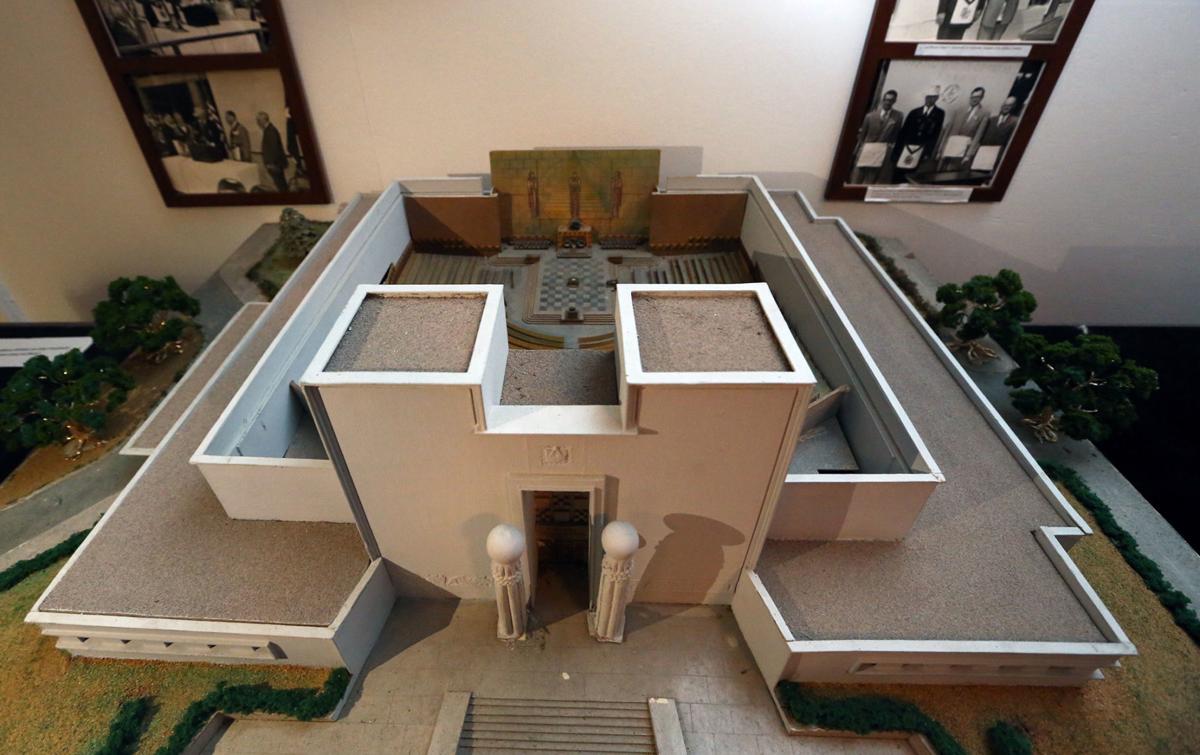
The Waco Tribune-Herald highlighted the Grand Lodge of Texas' impressive headquarters in Waco back on January 11th. Their imposing granite Temple, built in 1948, was designed as a modernist depiction of Solomon's Temple on the exterior, based on then-current archeological theories of its style (which have varied wildly according to fantasies and winds of fashion for a thousand years). 


This amazing 150,000 square foot Temple has a 3,700 seat auditorium and was built at least two decades after the greatest Masonic building boom in the U.S. during the City Beautiful movement of 1900-1929. According to the article it was designed by a team of Texas modernist architects that included Robert Leon White, who helped design the distinctive University of Texas Tower; Thomas Broad, who designed the Love Field Administration Building in Dallas; and Donald Nelson, who designed the Dallas Mercantile Bank building. The resident Waco architect was Walter Cocke Jr. Texas Masons spared no expense and lavished $2 million on it in 1948 (more than $23 million today):

From Grand Lodge of Texas an overlooked treasury of history, architecture by J.B. Smith:

The building façade includes a stained-glass depiction of the origins of Texas Freemasonry near an oak tree in Brazoria. At ground level is a carved bas-relief sculpture of the construction of Solomon’s Temple by the French sculptor Raoul Josset, known for his sculptures at Dallas Fair Park, the 1939 World’s Fair and the La Salle statue in Indianola, Texas. He also designed the giant pillars that hold celestial and terrestrial globes.
The article also features WB Robert Marshall of Waco Lodge 92, who shows off the extensive Grand Lodge library and museum in the building.


An important aspect stressed in the article is the role of the Temple in the community of Waco - how it has been used in the past, and the importance it needs to retain in the future:

The building has been used in the past for community events such as Waco Symphony Orchestra concerts, and it is still available for rent. Marshall said the two-level auditorium was designed to give everyone the best seat in the house, and the acoustics are superb.

About three years ago, climate control was installed for the auditorium, making it suitable for events year-round.

Marshall said he believes the facility needs more community use if it is to continue serving Waco through the coming decades.

“As Masons, we use this three weekends out of the year,” he said. “The other 49 weeks, it could be used for anything. … I think there’s a giant gap between the potential value and the actual value of the building. It could really be a hotbed of culture.”

On a similar note, Dayton, Ohio's 1928 Masonic temple (now known as the Dayton Masonic Center) has recently undergone $2 million worth of renovations and has formed an independent, local promotions team to book more weddings, concerts and public events.

From Dayton Masonic Center gets upgrade and new focus as concert venue by Don Thrasher in the Dayton Daily News on Tuesday:


“The Masonic Center’s main Schiewetz Auditorium space is a pristinely preserved, one-of-a-kind theater,” Dayton Masonic Live’s facilities manager Brian Johnson said. “As a still independently owned and operated facility, this sizable investment to updates is yet another milestone in Dayton’s renaissance that we’re excited to help actualize through great concerts and events.”

The Masonic Center, formerly known as the Masonic Temple, was completed and dedicated in April 1928. It has been the site of meetings, conferences, dinners, concerts and more. Dayton Masonic Live, which has a seating capacity of about 1,700, is now booking “a diverse mix of entertainment options, including nationally touring bands, renowned tribute acts, spoken word performers, along with family-centric and local events.”

[snip]

“The Masonic Center has always had a commitment to Dayton through hosting a variety of local events over the years,” Johnson said. “As we continue to activate the space more and more, we still want to have a strong commitment to our neighbors. We want Dayton Masonic Live to be a space where everyone feels welcome.”

The points made in both articles cannot be stressed enough. If our most significant Masonic halls and temples are to survive and thrive in this age of shrinking interest in our fraternity, we need to remind our communities (and ourselves) that these were meant to be places for the public, too. Our predecessors were active civic participants and leaders - they built and grew our towns and cities; they founded, ran or worked at the local industries; and they contributed mightily to local charities and causes long before we became obsessed with national, industrialized charities on a massive scale. The temples were an extension of their insistence that Masonic ideals were transmitted to the public and infused their actions every day. Time after time, local citizens would comment when some project was funded or completed, "Oh, the Masons did that." Masonic buildings, like Masons themselves, made up the very fabric of our communities. It's long past time we took up that banner again. We can start by opening our halls and temples as meeting and gathering places for everyone.

Saturday, January 25, 2020

Vegans, Vinyl and Masonic Aprons


"The lambskin, or white leather apron, is an emblem of innocence and the badge of a Mason..." 
So goes the Masonic description of the aprons we Freemasons wear in the rituals commonly used throughout North America and most of the world.

Like nearly everything else in Freemasonry, the white lambskin apron is symbolic of a pure, spotless and unblemished character to which we all aspire to achieve in our own lives. It comes from the Torah/Old Testament accounts of the Passover sacrifice of the paschal lamb, which was to be a young, unblemished male lamb or goat. In Christianity, Christ was called the Lamb of God by John the Baptist, and His crucifixion, death and resurrection fulfilled the Passover sacrifice by dying for the sins of the world.

And so, our Masonic lambskin is emblematic of the lamb's symbol of innocence and purity.  It is given to us as Entered Apprentices, and we are told to wear it throughout an honorable life, to keep it unspotted and unblemished by the world, and that it is to be laid to rest with our eternal remains when we pass away.

A peculiar article appeared in The Scottish Sun yesterday, announcing that the Grand Lodge of Scotland has broken its 280-year tradition and is now "allowing vegans" to join the fraternity by permitting *gasp* vinyl Masonic aprons. 

Exclamation point.

Who knew vegans WEREN'T allowed to join in Scotland? I'm no pescatarian, but something seems fishy about this story. It's either a solution in search of a minor brouhaha, or somebody had a slow news day and tried to manufacture a headline.

VEGANS will now be allowed to become Freemasons in a move that has seen the Grand Lodge of Scotland change centuries-old traditions.

For years, masons have work lambskin aprons while taking part in rituals - but a vegan alternative is now being offered.
Lambine, an artificial fabric that imitates lambskin, is available for those wishing to join the Lodge without using animal products.
A spokesperson for the Grand Lodge, which once included Robert Burns in its ranks, said there were no reason why vegans could not join the 280-year-old fraternal organisation.
 
In a social media post seen by The Times, they said: "Many lodges now use vinyl [aprons]. Please remember that it is symbolic and does not need to be real."
And the Freemasons' sister organisation down south, the United Grand Lodge of England, has been allowing vegans and vegetarians to use lambine for decades. 
"Our Districts, which are spread across areas such as Asia and Africa include thousands of members from a variety of religions which are primarily vegetarian.
"Since the 1960s both vegan and vegetarian Freemasons of the United Grand Lodge of England have been able to use lambine regalia, which is made from a high grade, soft feel plastic as an alternative to traditional regalia.
"We sold 1,200 lambine aprons in 2019 and 1,900 traditional aprons so they are a popular options here."
However, some masons were not too keen on the idea of breaking tradition.
Speaking to The Times, Gordon Kilgour, a lodge member from Glasgow, said: "In the address to the apron would the ritual be changed from 'You will observe that it is made from the skin of a lamb' to 'You will notice that it is made of vinyl?"
And Sotiris Sakellarios, a Greek mason, said: "Some traditions and symbolism should remain intact."


[snip]

A spokesperson said: "We have 200,000 members and a 300 history of welcoming people from all walks of life, regardless of their race, religion, sexual orientation or socio-economic position in society.

I hate to break it to the Sun, The Times, Brothers Kilgour and Sakellarios, or anyone else, but non-lambskin Masonic aprons have been around since at least 1717 and probably before. While there are early, oddly-shaped white leather Masonic aprons in museums, many of the earliest surviving American and European aprons from the mid-1700s are silk, and often hand-painted with extensive decoration. 


Different from Scottish, English and European traditions, it's common in the U.S. for a Mason to be given a plain, white lambskin apron as an EA — frequently with a storage tube for safekeeping — that he never again wears after his MM degree conferral. Instead, American lodges usually provide stacks of plain, white cloth aprons to members and visitors for general lodge meetings, and only officers have more elaborate aprons that accompany each position. Our original leather apron is meant to be stored away until our death, and our families are to be informed of what is to be done with it when we depart for the Celestial Lodge.


As for the vegan glories of "Lambine,"  white vinyl Masonic aprons have been marketed in the US for decades. Vinyl's been around for a long time - it was developed in the 1930s, and vinyl leather substitute was marketed under the name of Naugahyde starting in 1936, along with the mythological 'Nauga." 

 The J.P. Luther Company in Wisconsin (where they raise plenty of sheep, by the way) has been selling aprons made of "Luthertex" for well over 30 years now, and probably longer. In truth, vinyl aprons are far more durable and long-lasting than actual lambskin, which is very susceptible to yellowing and cracking. Examining hundred year old lambskin aprons that haven't been stored very carefully can be a depressing exercise, because the leather dries out when improperly stored. It's also devilishly difficult to clean if it gets stained, marked or scratched. Vinyl is also considerably less expensive the lambskin leather. And it survives being rolled up or folded in a small apron case or tube better than the real macoy does.

So I suspect the large proportion of vinyl vs. leather aprons sold as cited in the article has almost zero to do with welcoming vegans into Freemasonry and almost everything to do with budget and practicality. Nevertheless, if this dramatic change of heart brings unforeseen hordes of vegan petitioners pounding on the doors of Scotland's venerable lodges heretofore kept away by our perceived cruelty to sheep, who am I to scoff?