"To preserve the reputation of the Fraternity unsullied must be your constant care."

BE A FREEMASON

Showing posts with label Masonic Week. Show all posts

Friday, February 27, 2026

Dr. Paul Rich Named Blue Friar #114


by Christopher Hodapp

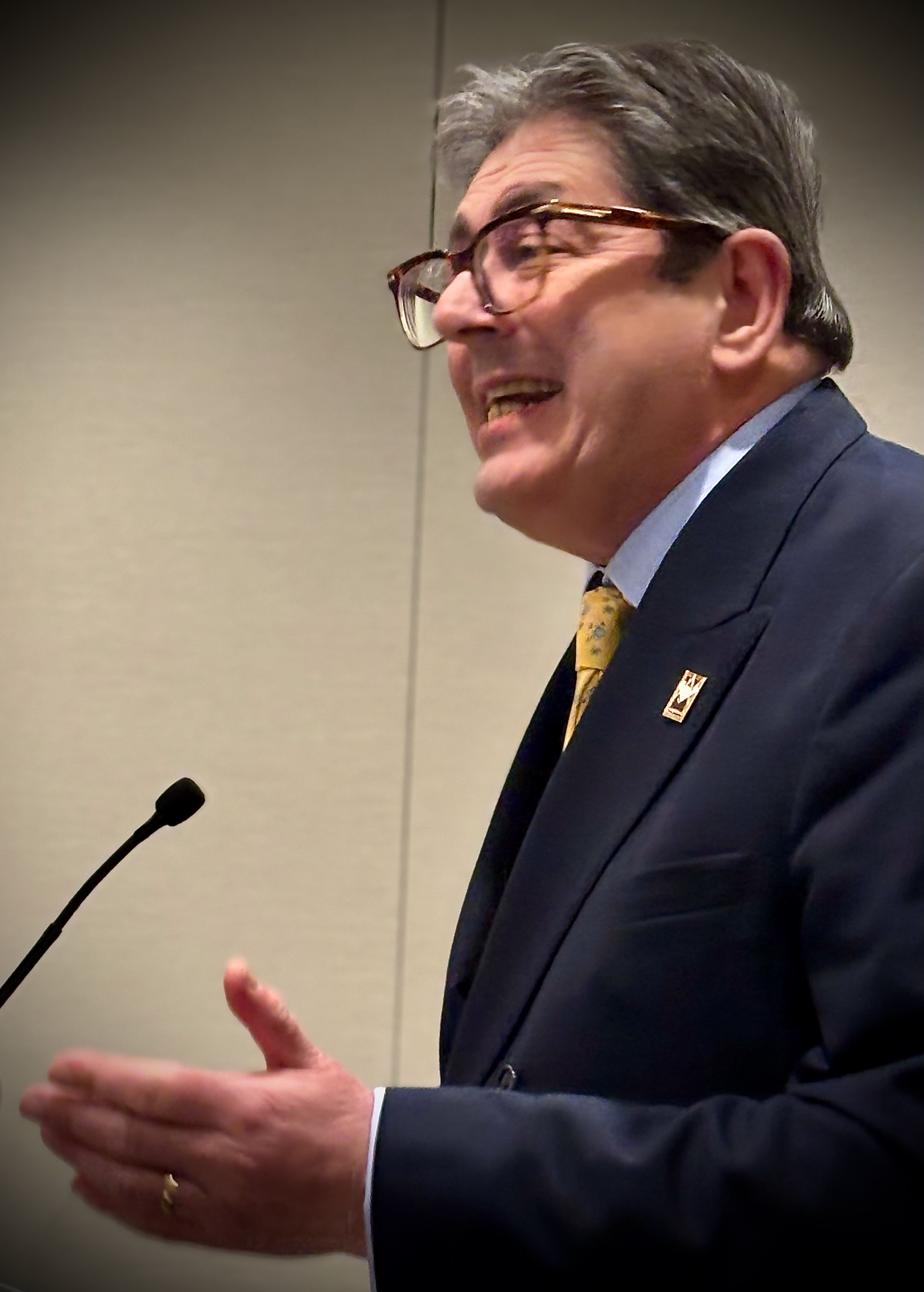
I have been incredibly remiss in not reporting this story from Masonic Week 2026. My friend and Brother Paul J. Rich has been named this year as Friar #114 in the Society of Blue Friars at Masonic Week 2026 in Alexandria, Virginia. 


The Society of Blue Friars was founded in 1932 for the express purpose of recognizing outstanding Masonic authors throughout the world. Traditionally, the Society convenes each year during Masonic Week in the Washington, D.C. vicinity to induct a new Friar, and its gatherings are open to the public, unless the presenter specifies otherwise.

Authors like Arthur E. Waite, Harold V.B. Voorhis, Dwight L. Smith, Brent Morris, Allen Roberts, Thomas Jackson, Yasha Beresiner, Alain Bernheim, Robert G. Davis, Alton Roundtree, Mark Tabbert, Shawn Eyer, Michael R. Poll, Robert D. B. Cooper, Josef Wäges, Piers Vaughan, Adam Kendall and Rick Berman are just a few prior Blue Friar honorees. In a rare moment of weakness, they even let a Dummy in. (After all - their prior Abbott is an Idiot, so I was in good company.) Sadly, I was unable to attend this year, and I truly wish I'd been there to congratulate Paul in person.

Paul's presentation was such a great idea that I'm ashamed that none of the current lineup of my fellow Friars have ever thought to do this over the last 20 years, at least (and possibly never before): he has researched the English origins of the first organization of Blue Friars that likely influenced Masonic Week's founders (largely the North Carolina Lodge of Research guys led by J. Raymond Shute back in the 1930s) to create the current Society.

Never heard of Paul Rich? 

Dr. Paul J. Rich may be the most intellectually accomplished modern Freemason you've never heard of, and he has an incredible life story and astonishing list of accomplishments, beyond his Masonic writings. Let me put it this way: there's no possible way to make a comprehensive listing of all of Paul's accomplishments, honors, titles, memberships, diplomas, or even mailing addresses.

He's currently a Harvard professor, businessman, publisher, philanthropist, and much more, and his interests and travels span the globe. He's lived in Mexico, Quatar, Saudi Arabia, worked with universities in Australia and Canada. His resumé lists more accomplishments than any five people I know: He established the International Policy Studies Institute and is its president. He's been the US representative for the Dali Llama. Member of Government House Foundation. Served on the board directors of the Roosevelt Institute. Written for the Hoover Institution. Fellow in the Royal Society of West Australia, Royal Society Arts, Royal Microscopical Society (history section), Royal Numismatic Society, Royal Society Antiquaries, Royal Anthropological Institute, Royal Asiatic Society (Hong Kong branch), Royal Geography Society, Royal Meteorological Society. 

He's a compulsive fraternalism enthusiast, belonging to scores of clubs, societies, orders, and every other kind of voluntary associative body you've never heard of. Most recently, he organizes International Masonic symposia in the US and France, called the World Congress on Fraternalism, Social Capital, and Civil Society.

Whenever I've visited him in Washington, it's always a dilemma as to which private club he wants to dine at - he belongs to most of them in the city. In addition, he has what is probably the largest collection of memorabilia of President (and Mason) James Garfield, and even lives in Garfield's former home in D.C.

And finally, his publishing company, Westphalia Press, has an enormous catalogue on a wide range of topics, and that includes a growing list of Masonic related titles. 

Allow me to quote WB Shawn Eyer's introduction at the Blue Friars meeting at Masonic Week this year: 
"Paul Rich was born in Buffalo, New York, where his family has been connected with the food business and philanthropy for over 100 years. He entered Harvard from the Tonbridge School in England and got his AB kumlaude at Harvard where he was chair of the junior common room and secretary of the liberal union and he also got a Harvard master's degree in educational administration at Harvard. He worked for the Adlai Stevenson campaign and has been active in the Democratic Party for many years. He was a research professor at the University of Western Australia in Perth where he obtained his PhD and was on the university council for 13 years. He was head of supervisory programs at the Emirate of Qatar and adviser to the royal family. He was then a fellow at Stanford's Hoover Institution and senior professor of the University of the Americas in Mexico, developing the country's largest postwar sculpture park. He's president of the policy studies organization and its Westfailia press in Washington which includes governments, think tanks and political science departments and is an advisory organization to the United Nations. It publishes well-known titles such as world affairs and world medical. Westfallia now publishes the entire Masonic Library collection, keeping all the titles since its inception in print. He is a life member of St. John's Lodge in Boston, both the Northern and Southern Scottish Rites, and numerous research lodges and collateral bodies. He's active in Harvard alumni activities. He is the author or editor of three dozen books, including several involving Freemasonry. Paul is life governor of Harris College in the University of Oxford. Past president of five Beta Delta International, recipient of the Cameron Medal Medal for Scholarship, Chancellor of Pi Alpha Alpha, fellow of the Royal Historical Society and fellow of the Royal Society of Antiquaries."
Let's just say, his being named to the Society of Blue Friars is LONG overdue.

Congratulations, my friend and Brother. Next time, dinner's on me for a change.

Monday, September 01, 2025

2026 Masonic Week Feb 4-8: Registration Now Open


by Christopher Hodapp

Registration is already up and running for next February's Masonic Week at the Crystal City Double Tree by Hilton in Arlington, Virginia. Mark your Masonic calendar for February 4th through 8th. 

Held continuously around the Washington DC area ever since 1938, Masonic Week (or more officially known as AMD - Allied Masonic Degrees - Week) is an event that brings together numerous small, generally invitational, Masonic organizations for their annual meetings, officer elections, award presentations, and degree conferrals. Yes, those do go on, but there are also lunches, banquets and lectures, and one of the best Masonic marketplaces anywhere. It's a chance to meet brethren from all over the world who converge here, to make new friendships and rediscover old friends you only see annually.

While the AMD is the largest of the groups meeting in February, there's also the Commemorative Order of St. Thomas of Acon, Sovereign Order of Knights Preceptor, Holy Royal Arch Knight Templar Priests, the Masonic Order of Athelstan, Masonic Order of Pilgrim Preceptors, York Rite Sovereign College, Knight Masons, the Chevaliers Bienfaisant de la Cité Sainte, the Worshipful Society of Free Masons, and the Rough Plaisterers and Bricklayers (the Operatives). Some groups have come and gone over the years — the Masonic Society is now defunct, sadly, and the Rosicrucians have their own annual gathering in Louisville now each November — but there's still loads going on.

Even if you're not part of any of the bodies that meet there officially, there's lots to do, and the organizers will be offering a half-hour Orientation program every morning for newcomers, so you won't feel lost or intimidated by all this. Master Masons can attend meetings and the banquet for the Philalethes Society (the oldest Masonic research organization in America), where there's always a speaker, the Society of Blue Friars (an invitational body of noteworthy Masonic authors that inducts a new friar each year who must give a presentation), the Grand College of Rites (publishers of Collectanea, which publishes and preserves some of the most obscure Masonic-related or derived degree rituals and materials from over the last 300 years). IAnd i you've got the itch to leave Washington with a couple of new degrees under your Masonic apron, there's the Grand Order of the Sword of Bunker Hill (appropriate this year, as it's the 250th anniversary of that famous battle), and it's the 100th year of the Annual Cellar of Ye Antient Order of Corks.

It's also a great opportunity to visit the countless sites, museums and memorials around the Washington DC area. Masons should take advantage of the chance to visit both the Scottish Rite SJ's magnificent House of the Temple (which will be open on Friday, February 6, from 10 AM to 4 PM) and the George Washington Masonic National Memorial (open from Thursday, February 5, to Sunday, February 8, from 9 AM to 5 PM). With some advance planning,  communication and permission, you might even try to visit a meeting Thursday or Friday night at an area Masonic lodge in DC, Virginia or Maryland. 

Visit the Masonic Week website HERE for registration and hotel information. 


Seasoned attendees note that this is a venue change this year. The Crystal City Double Tree by Hilton is located at 300 Army Navy Drive in Arlington, just south of the Pentagon, on the other side of the interstate, which is still only about a 5 minute Uber drive from Reagan National Airport. I'm not seeing much in the way of walking distance restaurants, but that may be deceiving.


I'll add a shameless plug for one of my books here, only because Masons traveling to Washington find it to be extremely helpful when seeking out Masonic-related sites in Washington. Solomon's Builders has descriptions of the lodge halls and important Masonic-related buildings and sites in the Washington area. It's a little dated now (it was published in the Dan Brown Mania period when the whole publishing world wanted to cash in on the post-Da Vinci Code craze), but the historical and geographical information hasn't really changed.


Tuesday, February 11, 2025

Masonic Week 2025: Ric Berman Named As Newest Blue Friar, and Philalethes Names Four New Fellows

Friar No. 113 Ric Berman
by Christopher Hodapp

At quite literally the very last minute on Thursday, I flew to Washington D.C. to catch a couple of events at Masonic Week: the Consistory of the Society of Blue Friars, and the Friday night banquet for the Philalethes Society.

The Society of Blue Friars was founded in 1932 for the express purpose of recognizing outstanding Masonic authors throughout the world. Traditionally, the Society convenes each year during Masonic Week in the Washington, D.C. vicinity to induct a new Friar, and its gatherings are open to the public, unless the presenter specifies otherwise. 

Authors like Arthur E. Waite, Harold V.B. Voorhis, Dwight L. Smith, Brent Morris, Allen Roberts, Thomas Jackson, Yasha Beresiner, Alain Bernheim, Robert G. Davis, Alton Roundtree, Mark Tabbert, Shawn Eyer, Michael R. Poll, Robert D. B. Cooper, Josef Wäges, Piers Vaughan and Adam Kendall are just a few prior Blue Friar honorees. In a rare moment of weakness, they even let a Dummy in. (After all - their prior Abbott is an Idiot, so I was in good company.) I was very sorry to have missed last year's Masonic Week festivities, when my friend John Bizzack was named as Friar No. 112.

This year's newest Blue Friar is the extremely prolific Richard ('Ric') Berman, author of numerous historical works about both English and American Freemasonry. Ric concentrates his studies and writings on 18th and 19th century Freemasonry in both the British Isles and America, and if you've never read any of his books, he always brings unique insights as to the social forces going on around the changes in the fraternity at key moments in history.


Ric Berman addresses the Society of Blue Friars 
(Photo: Billy Hamilton)

When a Friar is named each year, he is expected to present a paper at the Consistory, and Ric spoke on the political and religious background in England in the years leading up to the formation of the Premiere Grand Lodge of England. There had been a great influx of Huguenots (French Anglicans) fleeing severe persecution from France into London just prior to the founding of grand lodge Freemasonry in 1717, and they had been welcomed into the English lodges with open arms. If things had gone just slightly differently, we Masons would have had to learn how to spell John Theophilus Desaguliers instead of James Anderson when referring to the Constitutions. Thank your stars our rituals aren't in French.

Ric holds a Masters in Economics from the University of Cambridge and a Doctorate in History from the University of Exeter. His post-doctoral research was carried out at the University of Oxford's Modern European History Research Centre and as a Visiting Research Fellow at Oxford Brookes. A Fellow of the Royal Historical Society, he is the author of numerous journal articles and books, and has presented keynote papers globally. A Freemason for more than forty years and twice a Prestonian Lecturer, Ric holds Grand Rank in the United Grand Lodge of England and is a Past Master of three English Lodges, including Quatuor Coronati Lodge # 2076, the premier lodge of Masonic research. He is also an American Freemason, a member and honorary member of lodges in California, Georgia, North Carolina, Texas and Washington D.C., and a Fellow of the Philalethes Society.

Friday, February 10, 2023

Blue Friars 79th Consistory WILL Take Place Today 2/10/23

Our late Friars Rex Hutchens (left) and Alain Bernheim (center) seen here 
with Grand Abbott Arturo De Hoyos (right) several years ago.


by Christopher Hodapp


Despite what you may have read in the last week, there WILL be a Consistory held today (Friday February 10th).

Previously, Arturo de Hoyos, the Grand Abbot of The Society of Blue Friars, announced that this year's Consistory and induction of a new Friar has been cancelled. 

The Society was founded in 1932 for the express purpose of recognizing outstanding Masonic authors throughout the world. Traditionally, the Society convenes each year during Masonic Week in the Washington, D.C. vicinity to induct a new Friar, and its gatherings are open to all Master Masons. Each year's Consistory is a highlight of Masonic Week 

Authors like Arthur E. Waite, Harold V.B. Voorhis, Dwight L. Smith, Brent Morris, Allen Roberts, Thomas Jackson, Yasha Beresiner, Alain Bernheim, Robert G. Davis, Alton Roundtree, Michael R. Poll, Robert D. B. Cooper, Josef Wäges and Piers Vaughan are just a few prior Blue Friar honorees. In a rare moment of weakness, they even let a Dummy in.

 Last year's new friar was Adam Kendall, author and editor of the Plumbline, the quarterly publication of the Scottish Rite Research Society. He was named as the 111th Friar of the Society.

In his announcement, the Grand Abbot explained that he wasn't "sufficiently impressed with any Masonic authors over the past year" to name a new Friar for 2023. He also explained that there was an unfortunate convergence this year of conflicting events that prevented him from being in Alexandria this week. 

However, our immediate past Grand Prior, Friar S. Brent Morris, will be opening the Consistory this afternoon at 4:30 p.m., following the meeting of the Grand College of Rites of the USA. In lieu of the traditional presentation of a new Friar's original allocution, I will be presenting a talk on the origins of the Scottish Rite within the intellectual climate of the Age of Enlightenment, originally written in 1995 by our late Friar Rex R. Hutchens, who passed to the Celestial Lodge  in mid-December. (See UPDATED 1/6/2023: Illus. Dr. Rex R. Hutchens Passes Away; Celebration of Life Announced.)

Tragically, our Society lost two esteemed Friars in December.  In addition to Friar Hutchens, Friar Alain Bernheim passed away the day after Christmas in Montreaux, Switzerland at the age of 91.

Alain’s Masonic research spans more than 40 years, and his works have been published in English, French and German, in nearly every major Masonic research publication in the world. But while many Freemasons know of his detailed works, many aren’t aware that he was also a renowned, award-winning classical pianist who performed more than 2,000 concerts all over the world between the early 1950s and 1980, when he retired.

Born in Paris in 1931, Alain was arrested by the Gestapo during the Nazi occupation at the age of twelve and was interned at Drancy concentration camp in the north of the city. When the war ended, he entered the Paris Conservatory of Music and was the first French student to receive a Fulbright Scholarship to study music at Boston’s New England Conservatory of Music.

Please join us this afternoon.

Saturday, December 17, 2022

Masonic Week Feb 8-12, 2023


by Christopher Hodapp

The website for making reservations for the 2023 AMD Masonic Week is up and running. This year's festivities will be held February 8th -12th, once again at the Hyatt Regency Hotel in the Crystal City area of Arlington, Virginia (a mere cocktail glass' throw from Reagan International Airport, across the Potomac from Washington, D.C.).

Eighteen Masonic appendant bodies, invitational groups, research organizations, and others will be holding their annual meetings, degree conferrals, elections, banquets, speeches, and other assorted sundry activities. There is also always a healthy dose of Masonic product vendors on hand. 

The direct link to reserve a room at the Hyatt with the convention rate is HERE.

If you've never been to Masonic Week before, the real benefit of going is that it is the largest concentration of seriously proactive Masons from across the country and around the world you'll find on an annual basis, along with many of the best known Masonic researchers, authors, editors, and other personalities. While the bulk of the groups holding their meetings and ceremonies require existing York Rite membership as a precondition for their own admission (and some are invitational only), you will still find plenty to keep you more than occupied for these three and a half days, even if you're not a member of any of those groups. And there is as much to be absorbed in the hallways, at the bar, or in the hospitality rooms as in the meetings themselves. Make new friendships from around the world, and rekindle old ones. Be sure to bring plenty of filthy lucre as there will be numerous vendors on hand to separate you from your hard-earned simoleons.

On a selfish note, I'll announce the annual Masonic Society Dinner on Friday, February 10th, 2023. Our guest speaker will be Brother Robert Dupel who is the Sovereign Grand Master of the Grand Council of the Allied Masonic Degrees of Canada as well as the Deputy Grand Master of the Grand Lodge of Quebec. The tantalizing title of his talk is “It’s About Me” which promises to be a refreshing approach to a tantalizing subject.

If you've never been to the Washington, D.C. area before, this is the perfect excuse to go. I will tell you from experience that there is a 50/50 chance of the weather either bringing three feet of blowing snow, or 70 degree sun-drenched days. Sometimes both. That's just Washington in February. (Pack your toothbrush and an extra set of underwear in your carry-on bag in case your flights get canceled. Old hands know this.) But add a day to your trip to sightsee, and be sure you visit the Scottish Rite's House of the Temple no later than Thursday, because it is CLOSED Fridays and weekends. Visit the Capitol, the monuments, the Smithsonian, the unique Egyptian-themed Potomac Lodge, and much more. Have drinks and cigars at the Old Ebbitt Grill around the corner from the White House (you'll find Masons there nearly any night that week). Or go the other direction to Alexandria and visit the George Washington National Masonic Memorial, and have dinner at Gadsby's Tavern. There's no shortage of historic sites tied to Masons concentrated in the area.

Historically, Masonic Week was long tied to the scheduling of the annual Conference of Grand Masters (COGMMNA), which was scheduled, in turn, to coincide with George Washington's Birthday. That was back in the days when the Grand Masters met every year in Washington D.C. at this time. Consequently, Masonic Week would happen the weekend before at the venerable Hotel Washington, which sat in the shadow of the White House. But sometime in the early 1990s, that connection got frayed by the Grand Masters taking their annual meetings on the road and cycling around the country. Still, Masonic Week has always tried to arrange itself to happen the weekend before, or thereabouts. Weather in D.C., the Super Bowl, and other factors have put pressure on organizers over the years, but after this year's Masonic Week, the COGMMNA will return to the Washington area, at the nearby Crystal Gateway Marriott, also in Arlington.

Coinciding with THAT event, the George Washington National Masonic Memorial will also be celebrating the 100th anniversary of the laying of its cornerstone on Monday, February 20th.

Indiana Masons are excited to know that one of our own members, Brother Tyler Whittaker, is an operative mason from Muncie, and he has created a new cornerstone to celebrate the occasion that will be dedicated at that Monday event. (Tyler will be making a live presentation at the Dwight L. Smith Lodge of Research in Indianapolis following the Grand Lodge of Indiana's annual Founder's Day festivities on January 14th.)

Friday, March 25, 2022

Philalethes Society Award of Merit 2022


by Christopher Hodapp

I had been unable to attend the 2022 Masonic Week festivities in Alexandria in February, and thus missed the annual gathering of the Philalethes Society. And so, at the spring equinox meeting of the Indiana College of the SRICF, our Chief Adept Roger VanGorden presented me with a very special award on behalf of the Society — their Award of Merit. Roger had been in Alexandria last month and was similarly honored with his own Award of Merit for being the founding force behind the creation of the Masonic Society.

Specifically, the Award of Merit was bestowed for “efforts to see the Light of Freemasonry disseminated without prejudice or animus” and for “contributions to create The Masonic Society as a new journal of Masonic education.”

For one research organization to give a couple of upstarts an award for starting another, arguably competing, research organization doesn’t happen every day. 
The Philalethes Society had been started back in 1928 by some of the biggest names in the fraternity at that time. But for those who were around in 2008 when we started The Masonic Society, you know that it grew out of turmoil, frustration, and bitterness within this very Society. 

Our hope fourteen years ago was never to beat down or sink the Philalethes, but to fill a niche that wasn’t being addressed by anyone else on a national or international basis. The Philalethes at that time was being dominated by a single man’s hubris, who fought beak and claw against anyone who challenged his authority. Such things do happen in Masonry, almost never out of malice, but almost always from a belief that no one else can save the ship. And so, in the lobby of the Alexandria Hilton, Roger formulated a framework for our nascent organization that skewed heavily towards serving the rank and file Freemason, and not just the same well-worn list of ‘celebrity’ Masons. 

As most of you probably know, after serving as the founding editor of the Journal of the Masonic Society for several years, I was compelled by a stack of health challenges to relinquish that position and turn the magazine over to Michael Halleran to edit, who was subsequently followed by Michael Poll, who has done a wonderful and masterful job over many years now; and John Bridegroom, our longtime art director continues to make it the best looking Masonic publication available. While it might have been momentarily gratifying to know it took two or more people to replace me at that time, I was arguably a moron for trying to do it all myself back then. Or at least, that's what the guy in the ambulance said. That's why I'm uniquely qualified to write Dummies books.

While these awards to Roger and me have been bestowed on individual Masons, the gesture is, in reality, a kind and generous acknowledgement between our peer societies. When PS Secretary Terry Tilton spoke in Alexandria last month as he gave Roger his award, he said, “Every organization needs to step up and own its past.” Perhaps, but I regard this much more as an acknowledgement that what we did was worthwhile and beneficial, and, in turn, did as we really intended: a rising tide really did lift everybody's dinghies.  Our sudden appearance compelled the Philelethes Society to do better for itself, to improve the quality of its own journal and organization, not in imitation of what we were up to, but to reestablish its own important place in Masonic scholarship, research and thought. Our publications and goals are quite different, deliberately so, and that only helps the wider fraternity. I salute the many years of fine work Shawn Eyer has done in the pursuit of that mission.

Paths often cross in life, only to join up again at the strangest of moments. Back in the days when the Philalethes had its own internet mailing list and Yahoo group, that collection of ‘electronic’ Masons from all over the world deeply affected and influenced me in my first few years in the fraternity. One Mason in particular stood out as being one of the most remarkably philosophical, thoughtful and deeply spiritual men I’d ever encountered in my life. His name was Rashied Sharrieff-Al-Bey, and whether or not he knew it at the time, his public posts, and several private ones we exchanged, made a profound impact on me all those years ago. And so I find it especially poignant that this award of merit bears his name and signature as the President of the Philalethes Society this year.

So, my deepest thanks to Rashied, Terry, the officers and members of the Philalethes Society for this award and for all it represents. I shall endeavor to be at your next meeting in Alexandria in 2023 so I can thank you in person.

Sunday, February 09, 2020

Jay Hochberg Elected President of the Masonic Society


As Masonic Week kicked off on a Thursday night twelve years ago, a half-dozen of the shadowy 'Knights of the North' of Laudable Pursuit notoriety were hosted at a dinner at historic Gadsby's Tavern in Old Town by a group from Alexandria-Washington Lodge 22. Nearly everyone in that group was already well acquainted with each other from meeting electronically on a now-defunct Masonic discussion forum called MasonicLight, and the hot topic on everyone's lips the entire weekend was "Masonic reformation." 

Two nights later, the ideas that became the Masonic Society were noodled about over drinks in the Hilton Alexandria Mark Center's lobby bar. 


WB Jay Hochberg was there from the very start that fateful February of 2008, and he was named as a Founding Fellow of the Society when we officially announced ourselves as open in May 2008. So it is with great honor and pride that I report that Jay has just been elected this weekend as the seventh President of the Masonic Society at their dinner and annual meeting. Some sixty brethren and guests attended the Masonic Society dinner in Crystal City. 

Jay is a Past Master of New York City's Publicity Lodge No. 1000 and New Jersey Lodge of Research and Education No. 1786. Masonic readers have enjoyed his Masonic Magpie blog since 2008, and he has been involved as advertising director for the Journal of the Masonic Society, news and story gatherer, Masonic event calendar coordinator, and/or board member and officer from the very beginning.

From Jay's blog post this weekend:
• Board member Greg Knott advances to the Second Vice Presidency, and so Oscar Alleyne becomes First Vice President. Other personnel changes are to come. 
• Our membership stats fluctuate, but if you once were a member we somehow lost, don’t be surprised when you find me on your doorstep with a pizza and a six pack looking to talk about you rejoining. Actually, a survey to current and past members will help us understand what about the Society is appreciated, and what is disappointing. Coming soon. 
• We are talking about ways to enhance membership value in the Masonic Society. When Masons in my travels talk to me about our dues, the consensus is “Forty-five bucks—no problem!” But those of us inside the brain trust want to deliver more for your dollar, so we will find a way forward using media technologies. A discourse community, for sane Masonic conversations, and videos, to bring far away lectures to you, are feasible. We are blessed to have several eminent Masons, who do this sort of thing professionally, guiding us here.
• Special events? God, I hope so! It seems like another Masonic-con or Esoteric-con springs up somewhere in the United States every couple of weeks. In years past, the Masonic Society hosted a number of unforgettable experiences, and I hope to regain that momentum before [my] impeachment hearings commence!
We are grateful to Mark Tabbert for his after-dinner remarks this evening in which he presented the historical record of George Washington’s actual Masonic life. Not the myths nor the exaggerations, but just the facts concerning what has become a misunderstood chapter in Masonic history. Look for Mark’s upcoming book on this subject due soon from University of Virginia Press...
In its first decade alone, the Masonic Society served the entire fraternity worldwide by preserving vital Internet resources like Paul M. Bessel's indispensable research site;  created media references about Masonry for the press during the height of Da Vinci Code/Lost Symbol/Dan Brown mania; hosted seminars and symposia across the country and in the U.K.; the Quarry Project established widely-adopted writing style guidelines for Masonic authors, historians, researchers, libraries and museums. And the Masonic Society still publishes the most valuable, useful and beautiful Masonic magazine of original research, artwork, photography and essays anywhere — the Journal of the Masonic Society, edited by Michael Poll and art directed by John Bridegroom. 

But it has been close to a dozen years now. I listened in at the electronic keyhole to the Board Meeting of the Society on Friday afternoon, and members both current and former will be happy to know the Board is undertaking a much-needed evaluation of things as they enter their twelfth year. Jay's message alludes to some of that. Look for exciting new announcements very soon.

Not a member of the Masonic Society, or were you once but are no longer? Annual membership is a paltry $45 and can be accomplished online HERE.


By the way, in January 2020, the Masonic Society was informed that a Facebook Group called the “Global Fraternal Network” changed its name to “The Masonic Society”. The Masonic Society is not associated with the Global Fraternal Network in any way. The owners of the Global Fraternal Network are not members of The Masonic Society, and the name change was made without TMS' approval or any prior request.

TMS notified Facebook of this clear attempt to hijack the good name of TMS, and has changed its name of their Facebook group to “The Masonic Society – Official Facebook Page”. Here is the link to the real Masonic Society Facebook group. The only other Facebook presence with official TMS sanction is the page The Journal of The Masonic Society. Any other Facebook group purporting to call itself “The Masonic Society” has no permission to do so and should be considered illegitimate and spurious. As a result of the complaint to Facebook, the 
“Global Fraternal Network” returned to its original name. 

Just another Internet day in trademark hell.

Saturday, February 08, 2020

Kamel Oussayef Named 110th Blue Friar


The 76th Consistory of the Society of Blue Friars was convened Friday at the Hyatt Regency in Crystal City, Virginia as part of Masonic Week
The Society of Blue Friars was founded in 1932 for the express purpose of recognizing outstanding Masonic authors throughout the world. 

At the conclusion of last year's Consistory, Dr. S. Brent Morris, the longest-serving Grand Abbott in the Society's history, announced his retirement after 15 years, and named Arturo de Hoyos as his successor. Friday's gathering was the first under Grand Abbott De Hoyos.


The newest Blue Friar named to the ranks of the Society is Kamel Oussayef of Massachusetts, and he becomes the 110th Masonic author to be admitted into to this august organization. 

His books include: Saint Edoüard: A 1748 Masonic Scottish Lodge During the French Enlightenment: The Spirit of Freemasonry; and The Book of Wisdom - all of which have been published in beautiful editions by the Scottish Rite Northern Masonic Jurisdiction


All are painstakingly translated and heavily notated from long-hidden French manuscripts from the 1700-1800s that illuminate the lodges and lives of their members in this critical (and cataclysmic) period of growth, social turmoil, revolution, Empire, and transformation in France. His works go far beyond mere translations of archaic French-language lodge minutes and notes. He brings alive the Masons themselves who were members of these lodges by unearthing their lives, occupations, lodgings, and habits. These are not dry histories, they are personal ones. It is from this important period that the hautes grades were developed, which eventually crossed the Atlantic and became what we know as the Scottish Rite today.

Friar Oussayef was born in Sétif, Algeria and attended school in France, where he lived for many years. He holds an MA from the Fletcher School of Law and Diplomacy at Tufts University and an MS from the School of Public Communications at Boston University.


Kamel is a Past Master of William Parkman Lodge and Converse Lodge. He has been awarded the prestigious Henry Price and Joseph Warren medals for distinguished service to Freemasonry in Massachusetts. In the AASR, he is an Assistant Master of Ceremonies with the Massachusetts Consistory of the Valley of Boston.

Upon being named a new Friar, each inductee is expected to present a short paper at the Masonic Week gathering. Due to him being out of the country on this immovable date, Friar Oussayef's paper, "Researches and Adventures in the N.M.J. Archives,” was read by Deputy Grand Abbot Mark Tabbert.

The Society convenes each year during Masonic Week in the Washington, D.C. vicinity to induct a new Friar, and their gatherings are open to all Master Masons. Authors like Arthur E. Waite, Harold V.B. Voorhis, Dwight L. Smith, Allen Roberts, Thomas Jackson, Yasha Beresiner, Alain Bernheim, Robert G. Davis, Alton Roundtree, Michael R. Poll, Robert D. B. Cooper, Josef Wäges and Piers Vaughan are just a few prior Blue Friar honorees. In a rare moment of weakness, they even let a Dummy in.

This year's brochure listing all 110 Blue Friars, both living and deceased, can be seen below. Click images to enlarge.


Tuesday, January 21, 2020

2020 Masonic Society Annual Dinner & Meeting 2/7

"Homer, a man who called himself “you-know-who” just invited you to a secret “wink-wink” at the “you-know-what.”*


The Officers and the Board of Directors
cordially invite you to attend
The 2020 Annual Dinner and Meeting
of
The Masonic Society

At Masonic Week 2020
The Hyatt Regency Crystal City at Reagan National Airport
Arlington, Virginia

Friday Evening, February 7, 2020
Gather at 6:45 PM
Dinner at 7:15 PM

Featured Speaker:
WBro. Mark Tabbert
“A Deserving Brother: George Washington and Freemasonry”
A discussion of WBro. Tabbert’s recent research that went into his new book on the subject.

All Freemasons and Ladies are Welcome!

Please make all reservations through the Masonic Week 2020 Website 
(note NEW LINK):


PLEASE NOTE:
The Masonic Society will not have tickets for sale.
All tickets MUST be purchased in advance from the Masonic Week organizers; see links above.
Tickets will NOT be available at the door.

Dinner price per person: $55

RESERVATIONS MUST BE MADE AND CHECKS RECEIVED BY THE MASONIC WEEK STAFF BY THEIR DEADLINE — PLEASE CHECK THE MASONIC WEEK WEBSITE FOR DETAILS.

Sorry — No TMS Masonic Week Hospitality Suite in 2020

Unfortunately, we are not in a position to operate a hospitality suite this year. We know this is a popular activity and we look forward to returning to hosting a suite in 2021. Please catch us in the lobby bar or in other places around the Week.


The Masonic Society is a research organization dedicated to the service of the fraternity and to Masonic scholars everywhere. Its quarterly Journal is one of the top Masonic magazines in the world, and provides news, information, essays, original research, book reviews, and more.
Not a member yet? 
For information about joining The Masonic Society, visit www.themasonicsociety.com


*Jay Hochberg over on The Magpie Mason blog reminds us that the Stonecutters episode of The Simpsons aired 25 years ago  this month, on January 8th, 1995. Meaning that Homer is now qualified for his 25 year pin. 

Sunday, February 03, 2019

Piers A. Vaughan Announced As 2019 Blue Friar


The Society of Blue Friars was founded in 1932 for the express purpose of recognizing outstanding Masonic authors. Authors like Arthur E. Waite, Harold V.B. Voorhis, Arturo de Hoyos, Thomas Jackson, Mark Tabbert, Robert G. Davis, Alton Roundtree, Michael R. Poll and Josef Wäges are just a few prior Blue Friar honorees. They even inducted this Dummy as Friar No. 101 back in 2012. Since 2004, the Grand Abbot of the Society has been Dr. S.Brent Morris, Masonic author, and editor of the Scottish Rite Journal and the Scottish Rite Research Society's annual Heredom collection.

Breaking with prior, longstanding tradition of announcing the Blue Friar at their annual meeting during Masonic Week, the Grand Abbott has announced the 2019 Blue Friar ahead of time as Piers A. Vaughan.


Worshipful Brother Piers Vaughan has one of the most diverse and fascinating backgrounds for the study and understanding (and explanation) of Masonic, appendant, and other esoteric orders you will ever encounter. Originally, he is from England, and he belongs to lodges in England, Canada, and the U.S. Throughout his life he has lived in several European countries, Canada, and now resides in New York. He has a Master's degree in Divinity and another in Experimental Psychology; experience in both the Anglican and Catholic denominations and traditions; an MBA in Business Studies; a teaching diploma in Music; and much, much more. 

Piers has made extensive studies in history, alchemy, language (he has translated many texts from French to English), symbolism, cultures—truly what anyone would acknowledge to be a "Renaissance Man." Appropriately, one of his most recent books is 2017's outstanding Renaissance Man & Mason.

He is also is the proprietor of Rose Circle Publications that is a source of other fascinating books along similar explorations of esoteric thought that mirror his eclectic mind and interests. 


Upon being named a new Friar, each inductee is expected to present a short paper at the Masonic Week gathering. Piers' topic will be "Did St. Martin Influence the RER Rituals?" 

If you are at Masonic Week on Friday February 22, 2019 be sure to stop in for 10:30 AM-11:45 AM - All are welcome to attend.

For info on Masonic Week go to: Masonic Week 2019

Thursday, January 10, 2019

Masonic Week in Arlington, VA: 2/21-24


The website for making reservations for the 2019 AMD Masonic Week has been up and running for a while now, and it's just about a month away. This annual event will be held a little later this year than in the past: February 21-24, 2018, once again at the Hyatt Regency Hotel in the Crystal City area of Arlington, Virginia (a mere cocktail glass' throw from Reagan International Airport, across the Potomac from Washington, D.C.). 

Eighteen Masonic appendant bodies, invitational groups, research organizations, and others will be holding their annual meetings, degree conferrals, elections, banquets, speeches, and other assorted sundry activities. There is also always a healthy dose of Masonic product vendors on hand.

The direct link to reserve a room at the Hyatt with the convention rate is HERE.

If you've never been to Masonic Week before, the real benefit of going is that it is the largest concentration of seriously proactive Masons from across the country and around the world you'll find on an annual basis, along with many of the best known Masonic researchers, authors, editors, and other personalities. While the bulk of the groups require existing York Rite membership as a precondition for their own admission (and a few are invitational only), you will still find plenty to keep you more than occupied for these three and a half days. And there is as much to be absorbed in the hallways, at the bar, or in the hospitality rooms as in the meetings themselves. Make new friendships from around the world, and rekindle old ones.

Plus, if you've never been to Washington, D.C. before, this is the perfect excuse to go. I will tell you from experience that there is a 50/50 chance of the weather either bringing three feet of blowing snow, or 70 degree sun-drenched days. Sometimes both. That's just Washington in February. (Pack an extra set of underwear in your carryon bag in case your flights get canceled. Old hands know this.) But add a day to your trip to sightsee, and be sure you visit the Scottish Rite's House of the Temple no later than Thursday, because it is CLOSED Fridays and weekends. Visit the Capitol, the monuments, the Smithsonian, the unique Egyptian-themed Potomac Lodge, and much more. Have drinks and cigars at the Old Ebbitt Grill around the corner from the White House (you'll find Masons there nearly any night that week). Or go the other direction to Alexandria and visit the George Washington National Masonic Memorial, and have dinner at Gadsby's Tavern. There's no shortage of historic sites tied to Masons concentrated in the area.

Historically, Masonic Week was long tied to the scheduling of the annual Conference of Grand Masters (COGMMNA), which was scheduled, in turn, to coincide with George Washington's Birthday. That was back in the days when the Grand Masters met every year in Washington D.C. at this time. Consequently, Masonic Week would happen the weekend before at the venerable Hotel Washington, which sat in the shadow of the White House. But sometime in the early 1990s, that connection got frayed by the Grand Masers taking their annual meetings on the road and cycling around the country. Still, Masonic Week always tried to arrange itself to happen the weekend before, or thereabouts. Weather in D.C., the Super Bowl, and other factors have put pressure on organizers over the years, so this year's event will actually follow the Grand Masters' Conference in Rapid City, South Dakota that happens February 16-20th.

Wednesday, October 31, 2018

2019 Masonic Week Schedule Available Now


The 2019 Masonic Week schedule has been published. This annual event will run from February 20-24 at the Hyatt Regency Hotel in Crystal City, Virginia (a stone's throw from Washington DC, the Reagan International Airport, and the Pentagon). Masonic Week traditionally hosts annual meetings and degree conferrals of lesser known Masonic organizations, many of which are invitational bodies.

The following groups will be represented this year: 

  • Commemorative Order of St. Thomas of Acon
  • Masonic Order of Athelstan
  • Grand Council of Universal Craftsmen
  • Allied Masonic Degrees
  • Order of Knight Masons
  • Society of Blue Friars
  • Holy Royal Arch Knight Templar Priests
  • The Royal Order Masonic Knights of the Scarlet Cord of the United States of America
  • The Masonic Society
  • Philalethes Society
  • Rectified Scottish Rite (CBCS)
  • Ye Antiente Order of Corks
  • Noble Order of Muscovites
  • Grand College of Rites
  • York Rite Sovereign College
  • Sovereign Order of Knights Preceptor
  • Masonic Order of the Bath
  • Worshipful Society of Free Masons, Rough Masons, Wallers, Slaters, Paviors, Plaisteres and Bricklayers (aka “The Operatives”)
The official registration form has not been posted yet, but the hotel reservation form is up and running. So keep an eye on the page for upcoming updates.

Wednesday, March 28, 2018

When Builders Built

“What we think, or what we know, or what we believe is, in the end, of little consequence. The only consequence is what we do.”
— John Ruskin
I came across a lament from a Brother Mason over the weekend, and I'd like to share it with you:
"A half century ago, and I am told that even today in some areas, Grand Lodges were ultraconservative, ruled by what properly be called cliques—due to the practice of the Grand Masters appointing their prodigies at the bottom of the official line, who with the passage of time, eventually became Grand Masters of Grand Lodge and, in turn, appointed future Grand Masters and, thereby, denying the Craft in general the right of selection of their governing officials. This undemocratic policy may have resulted in securing some outstanding men as Grand Masters, but it also guaranteed obtaining many incompetents in that office, whose only qualification was being that fortunate appointee of a friend to whom a permanent obligation was obvious. Since it was custom to appoint PGMs as chairmen of the more important committees, and to elect them as Grand Treasurer and Grand Secretary, the entire operating fabric of Grand Lodge was a “closed shop” and woe betide him who would seek to disrupt the plan. Change was opposed by the vested interest and innovation was not only frowned upon but it was usually bitterly contested, and prevented. A new idea had to have more than merit to have a chance of being adopted. Support had to be secured from the PGMs, which was difficult and seldom obtainable. “Change not the ancient landmarks” was more than a cliche, but was the rallying cry of opposition by the majority of the entrenched leadership..."
It sounds so familiar, doesn't it?

It was written 44 years ago, back in 1974, but it was really referring to the period of the late 1920s when Freemasonry was going through an enormous explosion of popularity and membership gains — what we think of today as its 'Golden Age.' But it could be written today just as well.

So who wrote these words? Most American Masons have never heard of him these days, and yet he was one of the most important members of the fraternity during the 20th century, and perhaps of its entire 300 year modern, speculative history.


Allow me to introduce you to J. Raymond Shute II of North Carolina. The reason he's so important is because he didn't just sit on the sidelines and bitch and moan and expect "somebody else" to improve the fraternity. Shute loved ritual and was endlessly fascinated by the huge variety of Masonic rituals and systems that had developed around the world after 1717. In 1930, he and a group of North Carolina brethren founded North Carolina Lodge of Research No. 666, AF&AM, believed to be the first American lodge of that type to be formed. They nicknamed it 'Nocalore' to make the name less cumbersome, and they also adopted that moniker as the name of their published collection of papers.


And then they went to work.

Shute was still in his twenties when they began. He had joined the fraternity at 21, and became Master of his lodge just three years later (in case you think that's a new development these days). In later years he called the group of brethren who worked with him at the time 'The Innovators,' and their research lodge soon organized a Correspondence Circle to build their network of interested Masons far beyond the borders of just North Carolina. In a world long before Internet communications and fast, cheap overseas travel, Shute and The Innovators scoured the world for lesser known Masonic degrees and organizations. They collected their findings under the aegis of Lodge 666, and those documents and research materials today can be found in the 'Shute Masonic Collection' in the Southern Historical section of the Library of the University of North Carolina at Chapel Hill.

Out of that group clustered around that one single lodge sprang the overwhelming majority of the smaller, more specialized Masonic bodies in North America, most of which still meet each year at Masonic Week near Washington, D.C. each February. Many were imported from Europe, while a few were homegrown, or at least American hybrids. But consider the scope of the list:
  • Allied Masonic Degrees (originally the Supreme Quarry of the World, Masons of Tyre)
  • Knight Masons of Ireland
  • Knights of the York Cross of Honour
  • Red Cross of Constantine
  • Societas Rosicruciana in Civitatibus Foederatis
  • Priestly Order of the Temple (now called the Holy Royal Arch Knight Templar Priests)
  • Knights Beneficient of the Holy City
  • The Operatives
  • Order of the Bath
  • Society of Blue Friars
And just as a bonus, they also helped to corral various, conflicting Chapter and Council degrees floating around in the U.S. into a more standardized format. For the stray rituals that wouldn't fit anywhere else, or that were regarded as too obscure or defunct, they also formed the Grand College of Rites to publish those rituals in their annual Collectanea.

And they accomplished almost all of this between 1931 and the mid-1940s. Note that all of those organizations are still very active. In fact, the Allied Masonic Degrees has been the fastest growing Masonic body in the U.S. for the last fifteen years, and the SRICF is expanding rapidly as well.

The Innovators included Masons who were enormously active and influential during their time: J. Hugo Tatsch, Harold Van Buren Voorhis, Dr. William Moseley Brown, Ray V. Denslow. Many of them were also involved with writing articles for The Builder magazine, which went defunct in 1930.  So, Shute was far from alone, but he was the glue that bound them together. He was the one who always wanted to know more, discover more, accomplish more.

And that's why I'm telling you about him now. We are almost 80 years beyond the days when Shute and the Innovators accomplished their incredible feats of research, organization, and building — and we are living off the fruits of their labor, no more and no less than those of us who take for granted the majestic temples our brethren built for us in the 1920s. They were dreamers, builders, visionaries, storytellers... and leaders. They expected the very best of the fraternity, and then they went out and made it happen.

In my new book Heritage Endures about Indiana's Masonic bicentennial this year, I talk about our great achievers and visionaries from our own past. In particular, I write a lot about Dwight L. Smith and all that he accomplished and left behind for us between 1940 and 1993. His works Whither Are We Traveling? and Why This Confusion In The Temple? continue to challenge and inspire Masons today, more than 50 years after he wrote them. And they were mere footnotes to his enormous Masonic accomplishments.

All of those men are gone now. It's a new age, a new century, with new horizons to conquer now. And that means one thing.

You and me and all of the rest of us are today's Dwight Smiths and Ray Shutes. It's up to us now to take up the torch, to lead, to build, and to see a vision of what can be, instead of just strip mining our own past and living off of what we inherited. 


Just as important, it's up to all of us to record what we have lived through, to document and preserve those events and past achievements before they die with us, so that others can learn from what came before. I woke up earlier this month to discover I'd been a Freemason for nineteen years, and I've seen so much come and go in what seems to me to be just a tiny sliver of my own lifetime. We have lived history ourselves, even when we didn't realize it at the time. You and your lodge and your experiences are important, because history is what happens when you aren't paying attention.

Texas congressman and Speaker of the House Sam Rayburn once famously said, "Any jackass can kick down a barn, but it takes a carpenter to build one." Ray Shute was impatient and expected his fraternity to be better than it was in 1924. So instead of carping about the leadership, or the ' good old boys,' or his grand lodge, or their egos, and its politics, he decided to go out and improve Freemasonry, and he convinced a group of likeminded brethren to do the same. They didn't expect "somebody else" to present them with a pre-digested, ready-made course of Masonic enlightenment. They didn't complain about the lack of "esoteric education" in their lodges. They didn't break the rules or stomp off and start a competing storefront 'Grand Lodge of Chapel Hill Incorporated.' They worked within the system, dreamed big, worked very hard, and then they left American Freemasonry better than they found it. 

The only consequence is what we do.

(Read J. Ray Shute's own encapsulated memoir of those formative years on the website of the Grand College of Rites HERE.)