"To preserve the reputation of the Fraternity unsullied must be your constant care."

BE A FREEMASON

Sunday, March 11, 2018

Ancient Temple in Syria Damaged By 'the Devastations of War"


It is a heartbreaking irony that the regions described in the holiest books of three of the world's major religions still remain the most war-torn parts of the globe today. A Turkish Air Force missile attack has severely damaged an historic Hittite temple site in Syria dating to 1,000 BC, and believed to be similar in design to Solomon's Temple in Jerusalem. It has survived for 3,000 years, but it may not survive the 21st century.

The American Schools of Oriental Research’s Cultural Heritage Initiatives is reporting that an important Biblical-era archeological site known as the Tell Ain Dara Temple in northwest Syria was hit on or before January 22, 2018 by two Turkish missiles. Preliminary surveys of the site show substantial damage to the already toppled ruins caused by the explosions. Analysis of shrapnel indicates the damage was caused by two JDAM missiles fired by a Turkish F-16.

What partially makes this temple important to archeologists is that it is believed to be a design similar to the famed Temple of Solomon on the Temple Mount in Jerusalem that plays such a central role in Masonic ritual and symbolism. Most of the Syrian buildings themselves had been toppled perhaps centuries ago, but these new explosions have destroyed surviving artifacts and carvings at the site.


According to the ASOR website: Current Status of the Tell Ain Dara Temple:


The most significant find at Tell Ain Dara is the remains of an Early Iron Age (ca. 1200–550 BCE) ​in antis​ temple. This structure is the best-preserved example of a temple from this region during this time period. Located along the northwestern edge of the high mound, the northwest-southeast oriented temple rests on a low platform and is decorated with a series of basalt reliefs and animal protomes (an adornment consisting of the frontal view of the creature) carved in the highly distinctive Syro-Hittite style. The core of the temple consists of a portico, an antecella, and a cella. In addition, a passageway runs around the western, northern, and eastern faces of the central series of rooms. A series of limestone thresholds in the temple’s main doorways are adorned with carvings of larger-than-life human footprints that lead inward, conveying the idea that a deity has entered the temple. The presence of these impressions is unique to this building. 
The precise dates of the temple’s construction and use remain unknown. The temple was likely founded towards the end of the second millennium and underwent a series of changes before its destruction, possibly in the 8th century BCE. According to the excavator, the building was cleared of rubble in preparation for its reconstruction, but this never materialized. The building was eventually covered and built over in the following centuries.
The god or goddess worshipped in the building remains unknown. The excavator attributed it to Ishtar on the basis of a stele depicting that goddess that was found in a secondary context. Scholars have also offered other suggestions, including the weather god Ba’al Hadad.
Since its discovery, the Ain Dara temple has played a central role in discussions about the appearance of the contemporary Temple of Solomon, which is described in the Old Testament. Some scholars view it as a close parallel. Others are less certain.
The Temple site in 1990.

More details and photos at the link HERE.

Tuesday, March 06, 2018

2018 International UCLA Conference April 7th: "Secular Enlightenment—Balancing Faith and Masonic Virtues"


On Saturday, April 7th, 2018, the 7th International Conference at UCLA, sponsored by the California Masonic Foundation, will take place in Los Angeles. 

This year's topic is "Secular Enlightenment: Balancing Faith and Masonic Virtues."
The Enlightenment created a new culture that formed the basis of our modern civil society. As this movement spread throughout Europe, Masonic lodges became an important enclave for social transformation. Learn how Masons balanced the intersection of religious and secular forces during this period, with an approach that was both radical and revolutionary. Hear from iconic Masonic scholar Margaret Jacob as she completes her pre-retirement tenure at UCLA. Speakers from around the world will travel to Los Angeles to honor Professor Jacob's remarkable career and share global perspectives of Masonic scholarship.

Scheduled presentations include:
• The French Revolution: Did existing Masonic values of fraternity and equality fuel the French Revolution, or was it the French Revolution that enshrined these values in Freemasonry?
- José Antonio Ferrer Benimeli, University of Zaragoza, Spain
• Early secular Freemasonry: Although early Freemasonry claimed to accept men of all faiths, in the 19th century, this aim was oftentimes limited by imperialist forces.
- Jessica Harland-Jacobs, University of Florida
• Secular spirituality: From the unique vantage point of 20th century Turkey, discover how Freemasonry offers men an avenue for exploring secular spirituality through universal esotericism.
- Remzi Sanver, Ph.D., Istanbul Bilgi University, Turkey
• Lodges as sanctuaries or workshops for the world: In the 18th century, Masonic lodges found themselves at a crossroads when some members wanted to limit philanthropy to the intimate setting of the lodge and others wanted to promote Masonic values within the public sphere.
- Pierre-Yves Beaurepaire, University of Nice, France
• Revisiting the Illuminati: Although the Illuminati Order was dismissed as a school for radicalism in the 1700s, contemporary research suggests that Illuminati degrees may in fact align with the central ideas of radical, secular Enlightenment thought.
- Reinhard Markner, University of Innsbruck, Austria (Markner, who edited "The Secret School of Wisdom: The Authentic Rituals and Doctrines of the Illuminati," was awarded the Regulus Award by the Policy Studies Organization in 2015)

Also speaking at this conference will be:
• Susan Mitchell Sommers, Ph.D. (author of “Thomas Dunckerley and English Freemasonry”) – Saint Vincent College, Pennsylvania
• María Eugenia Vázquez Semadeni, Ph.D. (author of “The Formation of a Republican Political Culture: the Public Debate on Freemasonry in, Mexico 1821-1830,”) – University of California, Los Angeles
Details:

April 7, 2018
University of California, Los Angeles
1200 De Neve Drive
Covell Commons, Grand Horizon Ballroom
8:30AM - 5:30PM
Conference registration is $30. Add a Southern-style buffet lunch for just $20. To register, visit the Conference website HERE.


Boston University Fraternalism Lecture: Katherine Lennard, "Fraternalism and the Ku Klux Klan" 3/28

To the average, casual scanner of internet headlines these days, when the phrase "Ku Klux Klan" pops up, there's an immediate snapshot association in the mind of a pathetic handful of tobacco-dipping yahoos in a clearing in some rural Southern backwoods, burning a cross, and yelling at each other about white purity while their wives heat up the baked beans. That's the contemporary Klan that networks like A&E and the Discovery Channel go out and videotape for their TV shows. 

If the reader encountered the Klan in high school or college, they probably know about the Klan's origins and rampant violence of the post-Civil War period, and its 1960s revival as a murderous group battling against the 1964 Civil Rights Act, with its bombings, kidnappings and killings.


But there was a middle period that gets glossed over in American history. It tends to get briefly mentioned, if at all, even though it provided the greatest photo opportunity "the Klan" ever had — the 1925 march on Washington, DC, with 125,000 Klansmen swathed in their robes, marching with American flags down Pennsylvania Avenue with the Capitol Dome in the background. That second period of the Klan doesn't get talked about very often, and there's a reason why: it was a national humiliation during the Golden Age of Fraternalism, when Klan membership soared into the millions, all across the nation. At its height, the Klan of the 1920s had between 4 and 5 million members (some estimated 15% of the U.S. population), and an awful lot of great-grandfathers out there who were fine, upstanding men paid their annual klecktokens and carried a KKK dues card from the Invisible Empire in their wallets for about four years or so. After all - it was just another club...

That period of the Klan had a momentary success in America because it rode on the back of the Golden Age of Fraternalism. The Klan of the 20s used commissioned salesmen to spread across the country and enthusiastically sell their newly polished image of "100 Per Cent Americanism" as an ultra-patriotic, anti-immigration, Christian fraternity, with ritual, uniforms, its own peculiar terminology, and bilious officer titles, just like the Odd Fellows, Knights of Pythias, the Woodmen of the World, or the Freemasons. In fact, in many states their salesmen specifically targeted Masons for their promotional efforts. It's far more complex than this simple explanation, for a variety of political and social reasons that all converged in the eight years before the Depression struck, but the result was that the KKK became a very brief, but very powerful and influential political force in the 1920s. (I have an extensive chapter in my new book Heritage Endures that covers this turbulent period, because Indiana had the greatest percentage of its citizens who were both proud Kluxers and Freemasons, including two major players in their national organization.)

Boston University has announced its 4th annual Fraternalism Lecture at the end of this month. On March 28th, Dr. Katherine Lennard of Stanford University will present a lecture entitled “’Yours in the Sacred and Unfailing Bond: Fraternalism and the Ku Klux Klan” as the 2018 annual fraternalism lecture sponsored by the American & New England Studies Program at Boston University. The lecture will take place at 7:30 in Room 101 of the Kenmore Classroom Building, 565 Commonwealth Ave, in Boston Massachusetts. It is free and open to the public.

Dr. Lennard holds a Ph.D. in American Studies from the University of Michigan. Her dissertation examined the design, production, distribution, and use of Ku Klux Klan regalia in the first third of the twentieth century.

The annual fraternalism lecture series is made possible through the generosity of Boston University Lodge, A.F. & A.M. Previous lectures in the series have been presented by David G. Hackett, Joscelyn Godwin, and Corey D.B. Walker.

For more information, or to make a contribution to support future lectures, contact William D. Moore, Director of the American & New England Studies Program at moorewd@bu.edu.

Monday, March 05, 2018

"Looking Back At Our Future" Masonic Symposium, Dayton, OH This Weekend: 3/9/18

Last chance to sign up for this weekend's Masonic Lodge Symposium, "Looking back At Our Future," at the Dayton Masonic Center, 525 West Riverview Avenue, Dayton, Ohio
Friday, March 9, and Saturday, March 10, 2018.

Registration ends tonight, Monday, March 5th, so don't wait!


"This symposium is designed to offer the participants a look at how five lodges have approached the challenges of practicing Freemasonry in the Twenty-First Century. Each of these lodges have followed a path unique to them in exploring Freemasonry, its lessons, teachings, and past practices whereby to assemble a operating paradigm which meets the needs of their members. It is our hope that all who attend will gather ideas that they find helpful to the operation of their own lodges to launch them on the path to a more enlightened and rewarding practice of Freemasonry. The goal is not to create clones, but to inspire as we all learn from each other."

I'm proud to see three members of Indiana's own Lodge Vitruvian 767 as Presenters:
  • Dan Hrinko - author of The Craft Driven Lodge
  • Richard Frederick - Arts and Sciences Lodge
  • Clifford Nicol - Arts and Sciences Lodge
  • Brent Arnold - Immediate Past Master of Lodge Vitruvian No. 767, Indianapolis
  • James R. Dillman - PM Lodge Vitruvian No. 767, Indianapolis and former president of The Masonic Society
  • Steve Vedra - PM Lodge Vitruvian No. 767, and Dwight L. Smith Lodge of Research U.D., Indiana
  • Richard Graeter - author of Reform Freemasonry?
  • Larry Solomon - PM Caliburn Lodge No. 785, Cincinnati
  • Jason Rogers - Caliburn Lodge No. 785, Cincinnati
  • Robert Miller - Caliburn Lodge No. 785, Cincinnati
  • Samuel Lawson - Lodge Vitruvian No. 767
  • Jeff Okrutny - Tippecanoe Lodge No. 174, Tipp City, Ohio
  • Paul Bathgate - Tippecanoe Lodge No. 174, Tipp City, Ohio
  • Zach Jacobs - Tippecanoe Lodge No. 174, Tipp City, Ohio
  • John Bizzack - Lexington Lodge No. 1, author of Island Freemasonry

For more information and registration, see the website: http://www.21stcenturyfreemason.org/

Sunday, March 04, 2018

A Fraternal Gem: J. H. Rathbone Museum and Resource Center


Every state in the union has its share of odd museums dedicated to a wild variety of preservation causes (or obsessions, depending on how it's organized). That's what makes small, specialized museums so interesting in the first place, because what may be eminently missable to much of the population can alternately be endlessly fascinating to others.

Lafayette, Indiana (hometown of Purdue University, for you out of staters) is home to one of those unique museums that few have ever heard of, but if you have an interest in frateralism in America, you need to know about it. 

The J. H. Rathbone Museum and Resource Center was originally founded to store, preserve, and display Knights of Pythias memorabilia. In fact, their building is also the meeting location of Lafayette Lodge No. 51, Knights of Pythias. This was the home lodge for James Carnahan who was the founder of the Uniform Rank Knights of Pythias, a military branch best known for their drill teams, similar to the Masonic fraternity's Knights Templar. But since the Museum's creation, it has grown into fulfilling a much larger purpose. It now comprises a collection of thousands of items concerning all things fraternal.


The role of fraternal societies in America, especially during the period of their explosive growth between the end of the Civil War and the 1929 Great Depression, cannot and must not be ignored or forgotten. In 1927, author Charles Mertz estimated that 30 million of the 106 million people in the United States at that time held membership in at least one fraternal group. Just ten years later, author Charles W. Ferguson upped his estimate to 50 million fraternal members out of 122 million Americans. These societies helped people young and old to learn and appreciate the American way of democratic life and values during a period of massive upheaval and immigration from countries with little or no experience of it. In a different nation, such a huge clash of disparate foreigners arriving into a country might have become enormously fractious and divided along ethnic, religious, economic, or political lines. But America was different then, and fraternal groups had a lot to do with that. (And no, I'm not forgetting the elephant in the room of racial segregation that was enforced through the early 1960s.)

They taught their members basic civility, organizational skills, administrative roles, public speaking, religious and social tolerance and equality, and lessons of civic responsibility. And they provided economic stability and a social safety net when millions might very well have become what was referred to then as "wards of the state," or at least suffered tremendous poverty long before the days of government welfare, Medicare, Medicaid, and social security. 

The segregated African-American fraternal societies also exploded in popularity at the exact same time, many directly paralleling their white counterparts, and teaching the exact same lessons and skill sets to their members. Black fraternal groups arguably had as great an influence on their part of American society as the black churches in strengthening their community, family life, faith, business and civic skills at a time when white America was largely ignoring them.

Without fraternal societies at that critical period in time, America would have been a very, very different place. In fact, it's arguable that society is in severe need of a rebirth of the fraternal society right this very minute, for many of the exact same reasons, and more. America seems to have lost its most essential civic and civil skills these days, what with all of our internal tribalistic divisions and total lack of social manners and abilities, and a lodge room is perhaps the most ideal place of all to relearn them. 

But that's another post for anther day.


The Rathbone Museum is packed floor to ceiling with artifacts, clothing, regalia, hats, swords, books, newsletters, and all of the other ephemera that the fraternal societies of the 19th and 20th century poured out to their members. Freemasonry and the Odd Fellows were merely the largest of the groups, but the Knights of Pythias, Woodmen of the World, the Red Men, the Grange, the Foresters, the American Legion, the Veterans of Foreign Wars, the Knights of Columbus, the "animal lodges" of Elks, Moose, Eagles, and hundreds of others (an estimated 800 in 1927) were every bit as active and proud of their orders. Like Freemasonry, they had rituals and ceremonies, officers with bilious titles, costumes and regalia, jewelry, lapel pins and medals (Oy! the medals!), and more. Countless examples of all of this are on display in the Rathbone Museum's limited space.


Surprisingly, there are very few other museums like the Rathbone. (In fact, I hope that one day a friend and Brother of mine will open his unique Washington D.C. house as a museum, as it is packed with thousands of these types of items, as well, and deserves to be seen and protected.) While the Rathbone is a labor of love curated by Dr. Ken Moder, it is noteworthy that his board of directors is made up of others who may be known to some of you: Pennsylvania's fez-obsessed resident Seth C. Anthony; the House of the Temple's Heather Calloway; Kelby Dolan (who has done much work with us at the Masonic Museum and Library of Indiana); Odd Fellows member Michael Greenzieger; John Hardesty; and Teresa Snarr. 


So if you find yourself in west-central Indiana, maybe passing through on your way to Chicago or elsewhere on I-65, and Lafayette is not out of your way, be sure to stop in at the J. H. Rathbone Museum and Resource Center at 134 South Earl Avenue, Lafayette, Indiana. And if you encounter a treasure trove of items related in any way to any of the countless fraternal societies in America, please contact Dr. Moder and his team before you just shrug and consign grandpa's top drawer of rings, old ribbons or silly hats to the dumpster. They might have little or no monetary value, but they are not just junk. They might help to tell the story of an important period in time when organizations like Freemasonry and numberless others helped to weave the very fabric of American society into something unique and strong.

Saturday, March 03, 2018

Anti-Masonry: Be Careful What You Print


Here's a publishing tip: Don't go rooting around in Nazi propaganda for your stock photos.

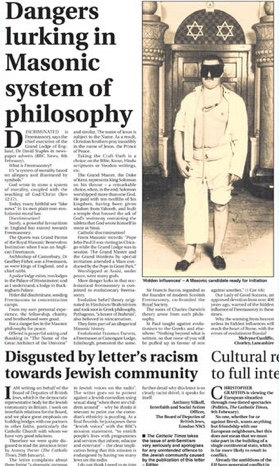
During the anti-Masonic media tumult in England in February, the Manchester, England-based Catholic Times newspaper decided to weigh in with their own take on Freemasonry by publishing a letter from one of their readers on the 'Letters To The Editor' page. Blaring the headline, 'Dangers Lurking In Masonic System Of Philosophy,' the letter contained the usual array of canards against the fraternity. Given the Roman Catholic Church's official strictures against joining Masonic lodges, that's to be expected in a paper specifically skewed to that particular audience. If any organization has the right to create their own lopsided messaging that is specifically anti-Masonic in nature, it would certainly be the Catholic press, no matter how incorrect they might be.

Unfortunately, the large graphic they chose to accompany the letter couldn't have been a stupider choice. 

Immediately below the anti-Masonic letter was a different letter, this one a complaint that the paper had recently published blatantly anti-semitic material in an earlier issue. Anthony Silkoff, the Interfaith and Social Action officer of the Board of Deputies of British Jews  wrote a strong objection to the Catholic Times about a different reader’s letter which had alleged “a dramatic increase in Jewish voices on the radio”, as well as complaining about a “Jewish comedian” using sexual slang. Mr. Silkoff described the original letter in the paper as “racist drivel,” and his message was printed on the same page as the anti-Masonic letter. Right under it, as a matter of fact.

So what did the Catholic Times use to illustrate their reader's takedown of the fraternity? 

A photo that's appeared in books like The Hiram Key and others, and apparently has been around since the 1940s. 


The man, blindfolded with his trouser leg rolled up, was standing in front of a door with two Stars of David above it.
However, as Mr Silkoff highlighted, the picture of the man was taken from a Nazi-era antisemitic pamphlet about Jews using Freemasonry for subversion.
In a second letter to the Catholic Times, Mr Silkoff wrote: “At best, this is an incredibly grave mistake for you to use this Nazi image, and especially to use it on the same page where you had to print an apology for antisemitism.
“Where did you find this Nazi image and how did it end up in your paper?”
Mr Silkoff told the JC: “This episode has caused such concern because the Board really values the strong relationship we have with Catholics in Britain.
“We cooperate on lots of issues, particularly education and faith schools.
Our many friends in the Catholic church will be just as surprised as us to see this happen twice.”
Mr Flaherty said: “I had no idea the photograph was an antisemitic image.”
He said he had found the image on Google and not checked its source.
Ooops. Pesky details like that tend to reinforce the beliefs of Freemasons, especially in England and other European countries, that the press is never to be trusted.

Just as a matter of reference, two recent surveys of U.S. and Canadian Freemasons have shown that as many as 23% of Masons in those two countries identify themselves as Catholic. The fraternity does not restrict Catholics from joining. On the contrary—Freemasons do not ask a petitioner or their own members what particular faith they espouse. 

These two surveys were anonymous and unofficial. Freemasonry is designed specifically NOT divide its members by religion, politics, race, economic class, or profession. As a result, when Speculative Freemasonry first became widely known in the first half of the 18th century, the lodge was the first organization of its kind in England where Catholics, Protestants, and Jews met and socialized side by side without discrimination.

Apparently that is still considered a radical notion by a shrinking handful of people who just can't contain their contempt for it to this day.

Upcoming 2018 Masonic Conferences and Symposia

Elizabethtown, Pennsylvania: March 17, 2018
Pennsylvania Academy of Masonic Knowledge Spring Symposium

Speakers: 2016 Prestonian Lecturer Ric Berman - "Foundations: New Light on the Formation and Early Years of the Grand Lodge of England"
Adam Kendall - "The Geometry of Mystery: Ancient Egypt, Freemasonry, and Secret Societies"


Attleboro, Massachusetts (Ezekiel Bates Lodge): April 28, 2018
Masonic Con 2018


Featured presentations this year will include:
For more information, see the website at: https://eb1870.org/masonic-con-2018/

And if you are coming to town the night before on Friday, April 27th, Ezekiel Bates Lodge and Bog Iron Brewery have teamed up to host the Masonic Con Pre-Party, complete with two specially brewed craft beers just for the occasion. See this separate page to reserve a spot: https://eb1870.org/bog-iron-night/


Alexandria, Virginia (George Washington National Masonic Memorial): May 10-13, 2018.
Apollo 2018 World Festival of Masonic Arts.


The Apollo Festival of Masonic Arts is a world celebration of the symbolic culture of Freemasonry, organized by the Association of Masonic Arts (AMA), and hosted by different grand lodges around the world. The main purpose of the festival is to present the centuries old masterpieces of the Craft and contemporary art products, made by brethren from different cultures and countries.


Washington DC (The Whittemore House), May 18, 2018.
World Conference on Fraternalism Social Capital, and Civil Society 2018: Not Men Only - Sisters, Sororities, and Ritualistic Societies.  

Speakers will include: Cécile Révauger, Olivia Chaumont, Emanuela Locci, Paul Rich, Guillermo de los Reyes, Nancy Theiss, Demetrio Xoccato, and Teresa Lynn.


Kananaskis, Alberta, Canada (The Delta Lodge): April 6-8, 2018
53rd Spring Masonic Workshop


"The Development of Freemasonry into a symbolic society"
This year's theme has an historical bent as it looks at the change from Operative Masonry to Speculative Masonry in Scotland and other parts of the world.

Featured Speaker: Robert L. D. Cooper


Istanbul, Turkey (Movenpick Hotel): April 14, 2018
Fifth International Symposium on Freemasonry


Speakers include Ric Berman, Susan M. Sommers, Yavuz Salim Agaoglu, and Okan Yunusoglu.
For information contact Bro Ahmet Senkut, the Grand Orator for the GL of Turkey at ahmetsenkut@gmail.com


(Click image to enlarge)


Beirut, Lebanon: June 8-10, 2018
A “Masonic Discovery Travel to Lebanon” is offered by the District Grand Lodge of Lebanon (Scottish Constitution) in conjunction with the installation of Bro Rabih Jarmakini as District Grand Master. In conjunction with thus event, organizers will be offering a tour to Hiram’s Tomb in Tyre and to the Temples of Baalbek.


Check out www.dgll.org or email to dgm@dgll.org for further information


Toledo, Ohio (Camp Miakonda): August 9-12, 2018
Camp Masonry 2018

Speakers: Eric R. Schau, J. Keith Green, Robert Johnson, Harry Weaver III, Jason Bryce, Chad E. Simpson

See the website for meals, camping information, lodging, and pricing plans.
http://campmasonry.xara.hosting//index.htm


Alexandria, Virginia (George Washington National Masonic Memorial): September 14-16, 2018

Quatuor Coronati Lodge of Research will host a rare North American Conference for 2018 with a program of research papers and debates.
www.quatuorcoronati.com/meetings/2018-conference/programme


Fort Worth (Fort Worth Masonic Temple): September 15-16, 2018
Texas MasoniCon 2018

Speakers: Michael Poll, Piers Vaughan, Charles Dunning, Jr., Pete Normand, Brad Billings, Roberto Sanchez, John Tolbert, David Bindel, Larry Fitzpatrick.

Tickets $45 in advance.


Wednesday, February 28, 2018

The Economist Explains: What Is Freemasonry?


Given the current wave of anti-Masonic press coverage in England so far this year, it's refreshing when a news outlet there actually publishes a rational, fairly even-handed examination of the fraternity. Check out this summary article from The Economist on Tuesday, The Economist Explains: 'What Is Freemasonry?' by K.W.
Misinformation and conspiracy abound. Is it a benign organisation or one bent on subverting government? 
THE literature on freemasonry does not offer straightforward explanations. Is it benign or bent on subverting government? Is it a community of knowledge or of the occult? Such questions are not new. Since its development in the 18th century, freemasonry has drawn the ire of the Catholic church, right-wing politicians and, more recently, Britain’s Home Office. (Fearing that masons in the police and judiciary were giving preferential treatment to other masons, the Home Office between 1998 and 2009 required judicial appointees to disclose their membership.) Freemasonry can appear incomprehensible because it contains no coherent ideology or doctrine, and is defined instead by a commitment to universal brotherhood and self-improvement. Nor does a single governing body exist. It is made up of a loose network of groups, known as lodges, that fall under regional and national grand lodges. What, then, is freemasonry all about?
Read the rest HERE. 

Perhaps the UGLE's new recent public responses have borne more positive fruit.

Apollo 2018 World Festival of Masonic Arts: May 10-13 at GW Memorial


The Second World Festival of Symbolic and Masonic Arts, APOLLO 2018, will be held May 10th—13th at the George Washington Masonic National Memorial in Alexandria, Virginia. 


The Apollo Festival of Masonic Arts is a world celebration of the symbolic culture of Freemasonry, organized by the Association of Masonic Arts (AMA), and hosted by different grand lodges around the world. The main purpose of the festival is to present the centuries old masterpieces of the Craft and contemporary art products, made by brethren from different cultures and countries.

Because Freemasonry has a distinguished history of reaching back to operative masonic times, so rich in religious symbolism, much artistic imagery falls within the Masonic milieu. The AMA considers that many works of art, architecture, music, and literature have a Masonic relationship in their origin. Therefore, works which manifest a sincere respect for deep Masonic convictions, in their use of Masonic symbols or themes are included as Masonic arts. These include: visual and plastic arts, music, drama, literature, and architecture crated by Masonic artists to evoke Masonic themes; all "ornaments of the Lodge" including regalia, jewels, and ritual implements; historical designs and motifs connected with operative Masonry; fine arts or artisan objects created by

While it has not been finalized yet, the preliminary APOLLO 2018 program includes:

• General Exhibition of Masterpieces of Masonic and Symbolic fine arts. Presentation of the history of grand lodges, Masonic libraries and museums, Masonic authors and artists. 
• Lectures and presentations on the history and contemporary development of the Symbolic and Masonic arts and material culture. Papers by writers and researches from all around the world are welcomed. The papers will be published in the Catalog of the Symbolic Arts.

• Concerts, Musicals, Dramas. The stage is open to all musicians and performers of Symbolic and Masonic art 
• Student contests at poetry, fine arts, music and short documentary movies.
• Lunches, dinners, cocktails, and awards.
• Fellowship time.
The organizers are still actively seeking more interested authors, researchers, artists, craftsmen, and musicians to participate in the event's programming. Confirmed speakers at this time include AMA Chairman Thomas Jackson, Dimitar G. Mavrov, Ryan Flynn, Barbara Castrucci (Italy), Ferenc Sebok (Belgium), and more. Concerts will be performed by Alexandre Dietrich (Brazil), Janos Cegledy (Japan), and the Youth Symphony Orchestra. 

Vendors, publishing companies, museums, and libraries related to the themes of the symbolic Masonic arts and culture are also welcome. For information on entering and presenting, contact the Festival though the website or at masonicartsmedia@gmail.com

As part of the APOLLO 2018 Festival, the AMA is also holding a Student Art Contest. The Student program is intended to reward culturally artistic work, pieces, or compositions whose themes relate to Masonic and Symbolic art, Masonic history, Masonic culture, Masonic traditions, or famous Masonic figures who have contributed to the progress of humanity. The Student Art Contest of APOLLO 2018 will cover the following areas:
• Poetry
• Fine arts: paintings, graphics or sculptures

• Short Documentary movie

• Music: musical composition, which may also include lyrics.
Tickets for the four day event are $400 and include admission to all presentations, exhibitions and concerts. Lunches and three dinners are also included.

If you are interested in being a part of the program as a presenter, exhibitor, student entrant, or other active participant, please contact them IMMEDIATELY before the March 30th deadline via the website or via email at masonicartsmedia@gmail.com

Founded in 2013, the Association of Masonic Arts is actively involved in laying the groundwork for a far greater appreciation of the significance of the Masonic Arts, and its recognizable material culture in Western history and beyond. Though the beautiful objects of the Craft have long been a focus of great fondness for Masons, the serious potential in using the wider appreciation of its themes and symbolic meanings has been under-appreciated as a simple way of bringing all those connected with Masonic traditions together. The AMA will strongly pursue the goal of fostering greater research, dialogue, courteous debate and vigorous application of basic artistic enthusiasm towards a higher purpose.


Saturday, February 24, 2018

Brisbane, Australia Masonic Centre Severely Damaged In Drunken Rampage


Why does it seem that more and more real-life events around the world have come to resemble parody stories from The Onion these days?

The Daily Mail admittedly tends to exaggerate and isn't always reliable, so when I saw this positively daffy headline out of Australia late Thursday, I thought it surely was a gag:

"Former Freemason, 51, found drunk and naked inside a huge pipe organ with a toy gun and remote-controlled police car says he got lost while trying to hand out cheeseburgers to the homeless"

For a while I thought it might have just been badly translated from Romanian, or Italian maybe. Then it got followed up the next day with:

"'What Aussie hasn’t woken up after a big night out naked, surrounded by cheeseburgers and full of regret': Supporters get behind man who was found passed out inside $1 million pipe organ"

But even closer to the scene of the crime, the Perth Now website reported it this way: 

"Former Brisbane Freemason Glenn Langford apologises after being found naked in broken pipe organ, surrounded by cheeseburger"

Believe it or not, the simplest and most rational telling of this story really was the Daily Mail's version written by Matt Leclare after all. I post it here in its entirety, just because it's too deranged to just summarize: 


A former freemason found drunk and naked inside a huge pipe organ has appeared in court accused of damaging the historic instrument - insured for more than $1 million.

Glenn Langford was arrested on Wednesday after allegedly flooding the Brisbane Masonic Memorial Centre and setting off the fire alarms.
The 51-year-old faced charges at the Brisbane Arrest Court on Thursday and was granted bail. 
But he said his intentions were initially well-meaning and the night had got out of hand after downing a bottle of Johnny Walker whisky, 7 News reports.
The court was told he had been meaning to hand out cheeseburgers to the homeless.
Food was left scattered on the floor of the grand hall of the heritage-listed temple in Brisbane's CBD, which features one of the biggest organs in Queensland.
It is feared the organ, installed in the 1930s, may be too damaged to be repaired despite it being insured for $1 million.

Mr Langford is charged with allegedly damaging a number of organ pipes and destroying part of a decorative wall.

He was also discovered naked along with clothes, a remote controlled police car and toy gun.
The magistrate heard from Mr Langford's lawyer who explained he had last week lost his job and was getting over the breakdown of a 16-year relationship.

He was granted bail on the condition that he stayed more than 100 metres away from the centre in Ann Street.
'Things just got a little loose, I was out of it,' Mr Langford told 7 News.
He apologised to 'all the righteous Freemasons everywhere'.

'I did have a lot of cheeseburgers to give to the homeless. I'm going to see a shrink and don't drink,' he added.


The Grand Lodge was very quick to point out that Langford is NOT a current Freemason in good standing. The question certainly arises as to whether he is a madman or a fool. But I frankly question the sanity of a judge granting him bail and letting him walk out of the courtroom on Friday.


As downright bizarre as this story is, the damage to the irreplaceable pipe organ and the temple building is nothing to laugh about. The Brisbane Masonic Memorial Centre is home to what is reportedly one of the largest pipe organs in Queensland, Australia. Apparently, in addition to busting up the decorative grating around it and destroying several organ pipes, he also managed to cause a major flood in the building before his drunken antics were done. 


The Brisbane Masonic Memorial Centre is a magnificent building, and more information can be found on their website HERE. Let's hope the damage isn't as catastrophic as the Centre's caretaker reportedly first perceived it to be.


UPDATE 2/25/2018:

Well, as usual, the press never actually speaks to any Freemasons who might know something about the stories that affect them. It seems that all of the press accounts contained the same erroneous information about the extent of the damage to the Centre and the organ.

This morning, I received this message from a Brother in Queensland who really does know about it:

"The caretaker was not spoken to by the reporter, she made that up. The Organ is entirely repairable and initial estimates from the organ builder are around $20K. [Langford] did bend and rip out pipes and throw them at police while he was barricaded in the pipes loft - that is what broke the bits off the plaster screen - which is going to be the hard part to repair. The toys and his clothes were all in the middle of the Grand Hall, nowhere near the organ loft where he ran to try to escape being arrested..."

Friday, February 23, 2018

Fredericksburg No. 4 To Restore Historic Washington Masonic Bible


Officers of Fredericksburg Masonic Lodge 4 in Virginia will be retrieving the Washington Bible in Indianapolis this evening, and the Masonic Library and Museum of Indiana would like to express our deepest gratitude to them for graciously entrusting us to display their famous artifact here since January. That is something they have rarely permitted in the past. 

The generosity of our Virginia brethren has contributed greatly to our celebration of the Bicentennial of the founding of the Grand Lodge of Indiana, as well as to the Conference of Grand Masters of North America in Indianapolis this week. As a result, an estimated 2,000 visitors from all over the world have been able to see this important part of American Masonic history for themselves during its stay here in our city.

The Bible that George Washington took his Masonic obligations upon has never been properly conserved in the past, and it is an extremely fragile artifact as you can imagine. The book itself was printed in 1668 and was already nearly a century old when young George placed his hands upon it. It is 350 years old now, and is in need of costly restoration by museum professionals. Consequently, the MLMI has made a substantial contribution to the lodge for this purpose, as a token of our gratitude to them for letting us display it.

Not many people get to be this close to such an historic item from 
both our nation's and our fraternity's past. 
So, yes, I was perfectly thrilled to step up and get my picture taken 
with the Fredericksburg Bible this week.

 Fredericksburg Lodge has issued the following information about their Restoration Fund:

(Click image to enlarge)

"The members of Fredericksburg Masonic Lodge # 4 A.F. & A. M. Fredericksburg, Virginia are the proud caretakers of the George Washington Masonic Bible.
"It is on this bible the our Illustrious Brother George Washington took his masonic obligations:
• November 4th 1752-Entered Apprentice• March 3rd, 1753- Fellow Craft• August 4th, 1753 Master Mason.
"One of our lodge projects this year is to restore and preserve the bible. We have been working with master book binder Peter James to determine what work is needed to be done to preserve this historic manuscript.
"If you or you lodge would like to be a part of this most important undertaking you can do so by contributing to this endeavor.
"Contributions can be made on line at www.masoniclodge4.org or by check

• Click on the store button and scroll down to the George Washington Masonic Bible restoration tab.

• Make checks payable to Fredericksburg Masonic Lodge 4 and mail to P.O. Box 702, Fredericksburg, Virginia 22404

• Write 'Bible Restoration' on the memo line.

"In token of our gratitude we will read and include the names of those Lodges or Brethern to the minutes of our Lodge Stated Communication In December 2018."
Interview with Peter James about historic book restoration.