|
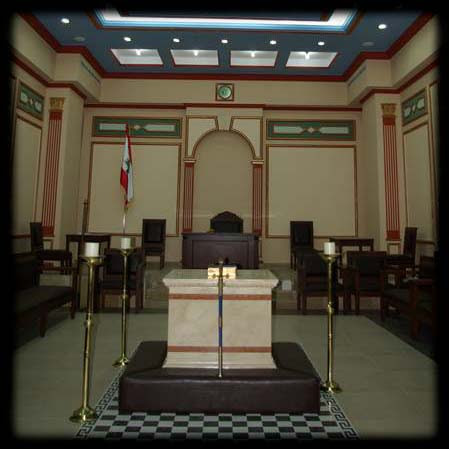
Brethren of Esperenze Lodge 317 receiving their New Jersey charter on June 27, 2018.
The lodge has actually been in existence for more than 40 years.
|
If you look through the archives of your own grand lodge, you will likely find a handful of lodges chartered by your jurisdiction way back when that worked in different languages, especially in the 1800s and early 1900s. While they were technically following your state's approved ritual, these lodges performed theirs in the native language their members were most comfortable with. German was by far the most common, but there were noteworthy Italian- and French-speaking U.S. lodges as well. Pennsylvania, New York, and Washington D.C. still have several of these today. D.C. especially has quite a number of chartered 'cosmopolitan lodges' that often serve foreign-born Masons temporarily living in that city in connection with government, lobbying or embassy jobs. Many others like Massachusetts, Florida, and California also have foreign language lodges.
Those are properly chartered lodges under those mainstream jurisdictions. But there's a relatively recent and growing wrinkle in the realm of 'clandestine' lodges and Masons. With the influx of more foreign born immigrants into America's large urban centers, there are a growing number of independent lodges made up of Cuban, Central and South American, Filipino, or other foreign-born Masons who have been ignored (or even shunned) by mainstream Masonry in this country. To answer their desire to become Masons — or to attend lodges that work in their native languages from back home — more 'clandestine' lodges spring up every day that cater to them specifically. Some have been connected with legitimate foreign grand lodges which have invaded U.S. jurisdictional claims by chartering lodges here. But a large number of them are independent, self-created lodges. And more than a few have been around for a very long time, operating off of the radar screens of our grand lodges.
MW Roger Quintana, the current Grand Master of the Grand Lodge of New Jersey seems to have taken the bull by the horns in his jurisdiction. New Jersey being a densely populated state and just across the border from New York, there are scores of clandestine Masonic lodges sprinkled throughout that jurisdiction. Instead of going on the attack against them, or ignoring them altogether, the Grand Lodge of New Jersey is trying a different approach. Portuguese-speaking Brazilian Masons in New Jersey have been hunting a legitimate lodge to join, and so the Grand Lodge is reaching out to find new ways to bring them under the umbrella of proper recognition and regularity. In 2018, the Grand Lodge of New Jersey has announced the transformations of formerly clandestine Esperanza Lodge 317 in Union City and Perucho Figueredo Lodge 370 in Elizabeth into fully chartered and regular, recognized ones under the Grand Lodge of New Jersey.
 |
First regular meeting of Perucho Figueredo Lodge 370
under its charter from the GL of New Jersey |
Further, New Jersey has just received applications to do this from another independent clandestine lodge, Solomon Lodge. According to MW Quintana's letter (see below), their members will be re-obligated at a special One Day Class, and the formerly clandestine lodge will be consecrated with a proper charter from the GL of New Jersey.
(Similarly, numerous Prince Hall grand lodges in the US have special 'healing' ceremonies in order to re-obligate Masons who joined 'clandestine' lodges first, and then later wished to become PHA Masons. NJ's actions seem to be a lodge-wide extension of that sort of thing.)
 |
| Click image to enlarge |
While other states have not talked much about this in public, his letter says that the Grand Lodges of New York, Washington, DC, and Pennsylvania have also been doing similar lodge conversions in this manner. (If I'm not mistaken, this has also taken place in Florida with former Cuban lodges – please correct me if I'm wrong. And I'm guessing California has done something similar over the years.)
I'm told that the Grand Lodge of Arizona has a standard ritual in Spanish, and a handful of other states may also have their own in various languages as well. This is no longer a situation peculiar to just the coastal states and cities, or to southern border states. For the rest of us across the U.S. who find ourselves with growing foreign-born populations and communities in our various states, it is downright foolish and short-sighted to ignore this vast and growing population. And this is not even remotely just a big city issue. Look at these startling statistics.
According to a 2017 study by the Center for Immigration Studies,
Newly released Census Bureau data for 2017 shows nearly half (48.2 percent) of residents in America's five largest cities now speak a language other than English at home. Overall, the number of U.S. residents speaking a foreign language at home reached a record of nearly 67 million. The total number is up seven million since 2010 and has increased by nearly 35 million since 1990.
Among the findings:
- In 2017, a record 66.6 million U.S. residents (native-born, legal immigrants, and illegal immigrants) ages five and older spoke a language other than English at home. The number has more than doubled since 1990, and almost tripled since 1980.
- As a share of the population, 21.8 percent of U.S. residents speak a foreign language at home — roughly double the 11 percent in 1980.
- In America's five largest cities, 48 percent of residents now speak a language other than English at home. In New York City and Houston it is 49 percent; in Los Angeles it is 59 percent; in Chicago it is 36 percent; and in Phoenix it is 38 percent.
- In 2017, there were 85 cities and Census Designated Places (CDP) in which a majority of residents spoke a foreign language at home. These include Hialeah, Fla. (95 percent); Laredo, Texas (92 percent); and East Los Angeles, Calif. (90 percent). Perhaps more surprisingly, it also includes places like Elizabeth, N.J. (76 percent); Skokie, Ill. (56 percent); and Germantown, Md., and Bridgeport, Conn. (each 51 percent).
- Nearly one in five U.S. residents now lives in a city or CDP in which one-third of the population speaks a foreign language at home. This includes Dale City, Va. (43 percent); Norwalk, Conn., and New Rochelle, N.Y. (each 42 percent); and Aurora, Colo., and Troy, Mich. (each 35 percent).
- In contrast to many of the nation's cities, in rural areas outside of metropolitan areas just 8 percent speak a language other than English at home

Consider that there are sixteen lodges today in New York's 10th Manhattan District, and they grew out of the enormous immigrant populations that came to America and settled in the New York City area. The Tenth Manhattan is home to lodges permitted to work Craft degrees in French, Italian, and Spanish, and more, which differ—often substantially—from the traditional Preston-Webb rituals you find in almost every other state in the U.S. (with the notable exception of Pennsylvania's). It's not for nothing that this group of lodges refers to themselves as the 'Cosmopolitan Tenth,' which is how you'll find them on Facebook these days. Now, New Jersey has just established its own similar 6th District specifically geared to working with their newly christened foreign language and 'cosmopolitan' lodges in order to conform their sometimes very different rituals with current New Jersey practices.
This is a not a new idea, and by no means is it any sort of Earth-shattering innovation. A French-speaking New York lodge was asked to be the first lodge leading George Washington's funeral procession at Mount Vernon in 1799. Foreign language lodges were common a century and a half ago throughout America, and there's no reason why they shouldn't be again.
Think of it a different way: Freemasonry is actually growing and thriving in Central and South American nations, where the bulk of our current immigration wave originates. Untold numbers of men join Masonic lodges in these Spanish- or Portuguese-speaking nations, only to find no lodges in which they feel comfortable or at home once in the U.S. Their only recourse is to establish or join a clandestine lodge, knuckle under and become proficient in English, or not attend at all. In other words, these are existing Freemasons living in our midst whom we are simply ignoring. It's long past time to be chartering new lodges in our jurisdictions that are permitted to work our official rituals (or at least close to them), just in a different language.
Almost twenty years ago when faced with Masonic temples that were searching for rental possibilities, I suggested that lodges should be offering their dining room facilities for use by language tutors and schools to teach immigrants English, and/or Americans Spanish. It was clear then that there was already a growing need for such classes, and I suggested it as a new way to highlight the importance of Masonic halls in our communities once again. At that time, immigration wasn't really on many people's radar, and no one took it seriously. As the statistics above show, it's long past time to take it seriously now.
While Masons haven't been paying attention, America has changed dramatically. Instead of decrying it or hiding from it as our membership continues to plummet, we need to see it as an opportunity to once again adapt to serve the society in which we reside - just as Freemasonry has always done in the past. Improving the world one Mason at a time is still our mission, no matter how our communities may change around us. Let's find a way to accommodate this upheaval in demographics instead of burying our collective heads in the sand.