"To preserve the reputation of the Fraternity unsullied must be your constant care."

BE A FREEMASON

Showing posts with label Traditional Observance lodges. Show all posts

Thursday, August 24, 2023

Kentucky's Rubicon Masonic Society 11th Annual Feast and Symposium


by Christopher Hodapp

I'm tardy in thanking the Brethren of Lexington Lodge 1 in Kentucky, the William O. Ware Lodge of Research, and the members of the Rubicon Masonic Society for hosting such a fantastic event last weekend. Friday night was the Society's 11th annual Festive Board at the beautiful Spindletop Mansion, and it was outstanding, as always. Brother Antonio Mantica from Lexington Lodge delivered the keynote address. There was a superb dinner, wonderful surroundings, warm friendships, and the quite unexpected surprise of making me an honorary member of their august group. 

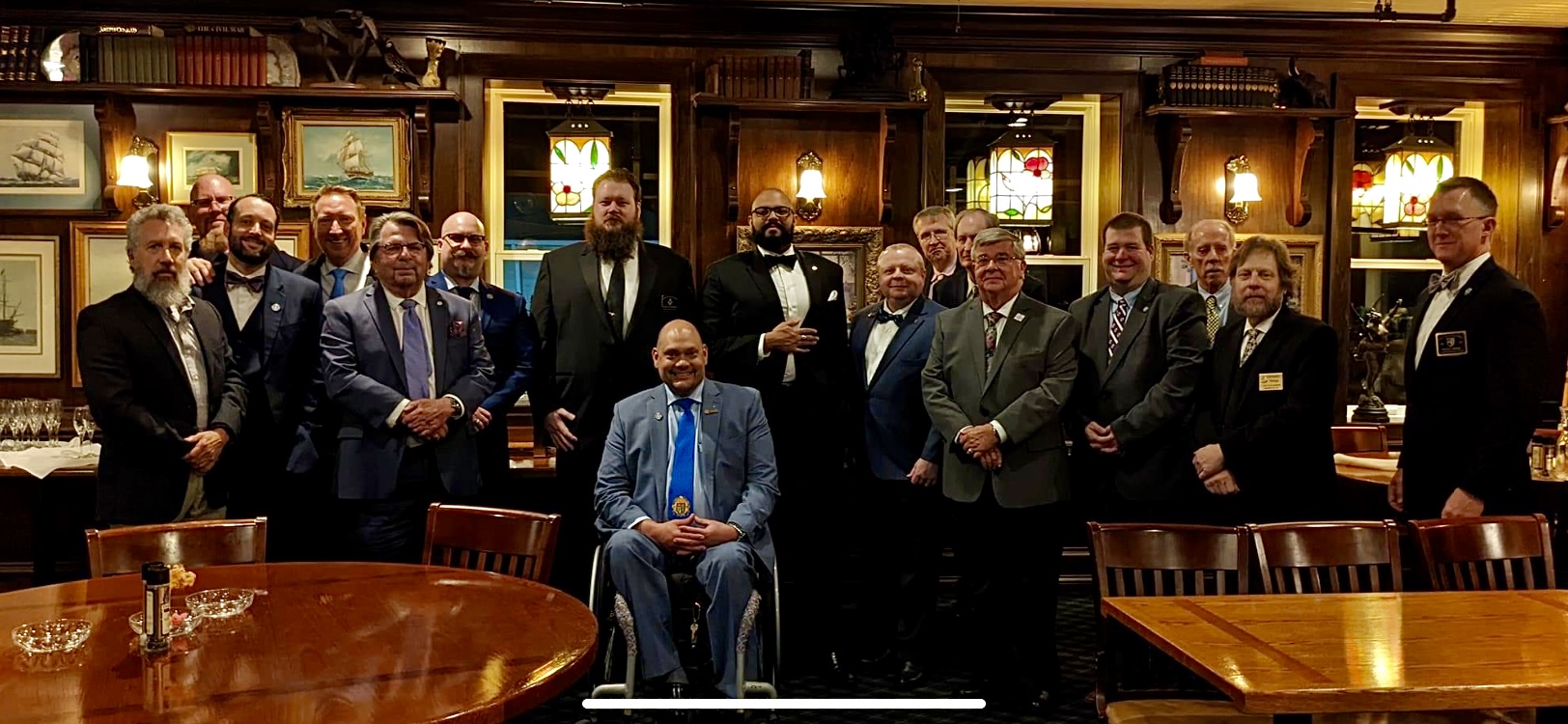
No Rubicon Feast is complete without a group photo
on the grand staircase (like this one from 2017)

On Saturday, I was one of the presenters of papers celebrating four “CLASSIC MASONIC AUTHORS OF THE 20th CENTURY:

* ANDREW SOMMERVILLE MACBRIDE – presented by W.B. Andrew Hammer.

* JOSEPH FORT NEWTON – presented by W.B. Dan M. Kemble.

* DWIGHT L. SMITH, P.G.M. – presented by W.B. Christopher L. Hodapp.

* THOMAS W. JACKSON – presented by W.B. John W. Bizzack.

Brother Mantica introduced the speakers and was moderator for the Q&A session. The program will be made part of Rubicon’s ongoing educational video channel on YouTube.

During COVID summer Rubicon began taping Masonic education presentations and posting them on YouTube. These programs feature a wide variety of speakers, both seasoned veterans and many new faces. They’re currently up to 52 episodes, and they continue to create new ones. I highly recommend these programs — they’re suitable for listening to in the car, or for showing them as part of an ongoing education program for your lodge. 

https://www.youtube.com/@RubiconMasonicSociety/featured

If you’ve never had the experience of attending Rubicon’s annual feasts, or if you are considering hosting a traditional Masonic festive board for your own lodge, I highly recommend a video that was created by these Brothers last year, The Masonic Table. Rubicon is blessed to have the services of Brian T. Evans Jr., who is a professional videographer. As a result, The Masonic Table is a beautifully shot program that demonstrates Rubicon’s traditions and practices when gathered around the festive board. There are as many ways to hold a Masonic evening meal and celebration as there are lodges in the world, but Rubicon’s draws upon formal English Masonic ceremonial dinners for inspiration. 


My deepest appreciation goes to everyone at Rubicon, especially John Bizzack and Bryan Evans for their invitation, their enthusiasm, and their always-warm hospitality.

Unfortunately, the rest of my weekend wasn’t nearly as enjoyable, and is the reason for my delay in posting. I took a hard fall at home early Sunday morning and somehow managed to fracture the business end of my fibula where it connects to the ankle. It’s in a plaster splint, but I’ll find this week whether that means a walking boot, a full on cast, surgery, or if I’ll just be frozen in a clock of carbonite and handed over to Jabba the Hut.


I'm furious that I didn't even get a decent story out of my injury. (AW, yeah, it looks bad, but you should see the OTHER guy!As you can see, even Sophie's already bored with the whole experience. 

Tuesday, September 27, 2022

They say absence makes the heart grow fonder. I'm certain they meant absinthe.


by Christopher Hodapp

My deepest fraternal apologies for the long silence on this site. We've had road trips, medical issues, family challenges, roofers, and other episodes at Hodapphäus that have kept me preoccupied for some time now. Plus, Alice and I are currently engaged in some actual paid employment from the For Dummies folks at Wiley Publishing, for which we are grateful.


Thanks to Indianapolis Valley of the Scottish Rite


A belated thanks to the kind brethren who invited me to speak at the Scottish Rite Valley of Indianapolis' annual bean supper night on September 9th. Hat tip especially to Tom Fallis who has just been named as the new Executive Secretary of the Valley and who saw that the evening went off flawlessly. 

As Homer Simpson once said, "If I could say a few words... I'd be a better public speaker." 

I leave it to the audience to decide whether my speech was rousing, or just a dreadful abuse of a wind instrument.


Another Outstanding Festive Board at Rubicon Masonic Society

From a similar Festive Board evening in Spindletop Mansion

I had the pleasure of being a guest of the Rubicon Masonic Society in Lexington, Kentucky on August 26th for their annual Festive Board at the magnificent Spindletop Mansion. Speaker for the evening was dear friend and Brother S. Brent Morris. There's always a certain level of galactic concern when a Dummy and a Complete Idiot come into contact with each other (sort of like the Lazarus episode of Star Trek, but totally different), but it was wonderful to see so many familiar faces again. 

A previous Festive Board
crowd at Spindletop

If you haven't been to one of Rubicon's Festive Boards, have a look at their film The Masonic Table (streams on Amazon Prime), which is a detailed, how-to guide to hosting the sort of event they put on.

Rubicon has been creating videos of Masonic education for quite some time now, starting when COVID shutdowns became ubiquitous. There are currently 24 episodes and they can be seen online HERE.

Hat tip to Brian Evans, Worshipful Master of Lexington Lodge 1, and WB John Bizzack, who seems more like an unstoppable force of nature every time I see him. 

Kentucky's historic Lexington Lodge 1 is one of the top observant-style lodges in the U.S. today, and if you're interested in belonging to a lodge such as this, you owe it to yourself to attend their meetings and events. It's a very different experience than you're probably used to in your local, neighborhood lodge.


New Book Project: RV Vacations For Dummies


Finally, our current project, RV Vacations For Dummies, just popped up for pre-sale on Amazon and is due out on April 11, 2023, so we're busily pounding our faces into the keyboard. 

This one also acts as a companion piece to our 2021 RVs & Campers For Dummies so we can do the old Chico Marx sales job:


"No, itsa not in thata book. Itsa not in thata one, either. You haven't GOT thata book."

"I don't, huh? I'll bet I'm going to get it in a minute, though."

"One'sa no good. Ya gotta have the whole set..."

Unlike our first RV book, RVs & Campers For Dummies, this one's more about planning an actual itinerary for RV road trips, and we've got sixteen different ones to recommend. This one is not a completely original work from us—it was first published in 2003 in conjunction with the Frommer's travel book people, and it is generally revised every few years. Ours will be the seventh edition, and a lot has changed across the fruited plains just since the COVID closures. 

Saturday, May 21, 2022

Indiana's Lodge Vitruvian 767 Celebrates 20th Anniversary


by Christopher Hodapp

Friday night was the 20th anniversary of the founding of Lodge Vitruvian 767 in Indianapolis. It was a wonderful evening and it was especially great to be with WB Jeff Naylor, our founding Worshipful Master. Many thanks to WB Christopher Bentlage for arranging this event at the Aristocrat.

Twenty years ago today - May 21st, 2002 - a year after first receiving a dispensation to work, a group of Indiana Masons assembled at the Temple of Broad Ripple Lodge on the north side of Indianapolis to receive our official charter for Lodge Vitruvian No. 767

Technically, that makes us 21 years old today, but it's 20 under our official charter.

Jeffrey D. Naylor was our founding Master, and he received the charter that day from Roger S. VanGorden, Grand Master of the Grand Lodge of Indiana. Jeff would serve in the East for the first two years, and was responsible for much of what we did, how we "looked," and the philosophy that guided us (and still does even today).

It started as a conversation between Jeff, Eric Schmitz, Roger VanGorden, Nathan Brindle, and myself one Saturday afternoon in 2000 about how to create a new kind of lodge, and it turned out that other Masons around the U.S. and elsewhere at the time were (or had already been) coming to many of our same conclusions. (Sort of a Masonic version of Hodgkins' Law of Parallel Planetary Development... Yes, I'm just that sort of nerd.) 

Kent Henderson in Australia first noodled some of these ideas in a paper called Back To the Future back in 1992, along the lines of a “European concept," and he and a handful of brethren established Lodge Epicurean 906 there. Meanwhile in College Station, Texas, Pete Normand labeled their local experiments as "traditional best practices" and established St. Alban's Lodge 1455 along similar notions. John Mauk Hilliard applied many of these ideas as well, with Independent Royal Arch Lodge 2, in New York. 

Around the time we were scheming in Indiana, a different group of brethren was assembling their own philosophy under the umbrella term "traditional observance," and Dennis V. Chornenky and others came up with the Masonic Restoration Foundation to promote their similar evangel. (Dennis would be one of the founders of Academia Lodge in Oakland, California.) 

Independent from all of these others, our own growing circle of guys explored concepts and collected our thoughts into what became an extended paper called Laudable Pursuit.

All of us sought to approach the problem of the dull monthly lodge business meeting that offered Masons no education or enlightenment, bad or no food, under-financed programming, lackluster participation and retention, and little actual brotherhood - in short, any sense of "specialness" that Freemasonry had promised us all, but sadly, rarely delivered. We all went at it a little differently, but we all knew that lodges could be better than what most of us were experiencing if they would only demand excellence from themselves and their members.

Those of us starting Vitruvian established several primary tenets:
  • Dignity and high standards are to be maintained by the Lodge in all its undertakings.
  • Nothing short of excellence in ritualistic work is acceptable.
  • Masonic education - especially original papers or guest speakers - will be expected for every meeting.
  • Candidates shall be advanced only after having undertaken an intensive program of Masonic education and proving themselves proficient in open Lodge.
  • The Lodge enjoys the fellowship of the Festive Board at a local restaurant following all Regular and Emergent Meetings of the Lodge.
  • Members are expected to dress properly to attend to the duties of the Lodge. 
  • The Lodge shall create its own distinctive regalia, within the limitations of Grand Lodge regulations.
  • Attendance is mandatory. Members receive a summons for meetings and are required to attend or provide apologies. Those unable to do so will be politely asked to demit after a year and find another lodge.
  • The Lodge officers are to be elected based on merit and active participation alone, and not merely advanced through the chairs as an annual expectation.
  • A Lodge of excellence and high caliber must be paid for.
  • Explore and exemplify alternative degree rituals from other recognized foreign jurisdictions as a demonstration of the worldwide variations in regular Masonic practices (i.e. Emulation ritual, Rectified Rite ritual, etc.). We wanted very much to use Emulation ritual. In fact, we entertained the idea of passing legislation that would give us the kind of flexibility Masons have in the United Grand Lodge of England to use another set of rituals instead of the standard Preston-Webb formula that almost all U.S. lodges require. (That turned out to the one major disappointment we were unable to rise above.)
We agreed to meet quarterly, not monthly. We also informally agreed that we would deliberately not accept more than 36 members, because a man can't truly get to know and care about more than three dozen members or so. We felt that if we got that popular, the answer would be to spin off a "daughter lodge," not expand our own size. At the time, we set the most expensive dues in the state, and numerous predictions of our eminent demise were commonly expressed by naysayers. Nevertheless, when we circulated the word about what we were proposing, twenty-three brethren eagerly jumped on board:


· W. Bro. Dale Adams, Mt. Moriah Lodge No. 77 (*)

· Bro. Wallace K. Aiken III, Broad Ripple Lodge No. 643

· W. Bro. William K. Bissey, North Park Lodge No. 646

· W. Bro. David Bosworth, PM, Calvin W. Prather Lodge No. 717 

· W. Bro. Nathan C. Brindle, PM, Broad Ripple Lodge No. 643

· W. Bro. Jerry T. Cowley, PM, Broad Ripple Lodge No. 643

· W. Bro. Howard A. Farrand, Centennial Lodge No. 541

· W. Bro. James Guffey, PM, Millersville Lodge No. 126 

· W. Bro. Christopher L. Hodapp, PM, Broad Ripple Lodge No. 643

· W. Bro. Michael W. Klepper, PM, Morristown Lodge No. 193

· W. Bro. Rodney A. Mann, PM, Farmers Lodge No. 147, Current Grand Master of Indiana (2017-2018)

· W. Bro. Jeffrey D. Naylor, PM, Losantville Lodge No. 674 (*)

· W. Bro. Irwin H. Sacks, PM, Monument Lodge No. 657

· Bro. Travis G. Sandifur, Monroe Lodge No. 23

· W. Bro. Eric T. Schmitz, PM, Monroe Lodge No. 23

· W. Bro. Edward R. Smith, PM, Spencer Lodge No. 95(*)

· W. Bro. John B. Stevens, PM, Grant Lodge No. 637

· W. Bro. W. Keith Stiner, PM, Quincy Lodge No. 230 (*)

· Bro. Louis P. Tompkins, Monroe Lodge No. 22

· M.W. Bro. Roger S. VanGorden, Grand Master of Indiana (2001-2002)

· Bro. Jack D. Weagley, McCulloch Lodge No. 737

· W. Bro. Roderick V. Welker, PM, Jonesboro Lodge No. 109

· W. Bro. Cleon H. Wright, PM, Eureka Lodge No. 397


(*) Past Master of Vitruvian

All of our members at the time communicated electronically - unheard of then. We also regularly had a 90+% participation rate among all of our members - also unheard of. 
And when we strolled into a local restaurant for our festive boards in our tuxedos - a supremely unusual scene in America anymore, outside of a wedding reception - we actually turned heads, and attracted questions from other diners merely because of the group of Masons they saw. 

Vitruvian's first festive board 5/21/2002 at the
Corner Wine Bar's private dining room in Broad Ripple

Founding Worshipful Master Jeffrey Naylor
addresses the  brethren


Is that "shallow?" Maybe. 

"Elitist" looking? Possibly. 

Putting forth a public image of the fraternity as the world's premiere society of gentlemen? You betcha. We still do today.

Sadly, some grand lodge jurisdictions have actually banned anything remotely looking or sounding like what are now being generally branded as "observant" styled lodges, under a mistaken and unfounded fear that we are practicing something odd, foreign, elitist, spooky, or even antithetical to the equality of Freemasonry's basic tenets. That is a shame. Those of us who are members of these lodges or just visit them know that nothing could be further from the truth. 


Twenty years after we started, there are about 70 lodges similar to Vitruvian around the U.S. and Canada - a lot maybe, but not an overwhelming flood of acceptance - though Indiana has another one now, with Crowned Martyrs Lodge 771. And long-established Pentalpha Lodge 564 in Indianapolis (chartered in 1881) has been transforming itself to an observant style lodge over the last couple of years. 

No other lodge or grand lodge has anything to fear from these observant-styled lodges. None of us actually proclaim (or we shouldn't be, anyway) that anyone else is practicing Freemasonry incorrectly, nor that we have some higher moral ground and that only we are "doing it right" Observant lodges have not taken the Masonic world by storm, nor are they some silver bullet that will magically save the fraternity from plummeting membership numbers each year. But they have become a home to numerous Freemasons who might otherwise have left the fraternity because their longing for a more affecting personal and intellectually stimulating lodge experience was not being fulfilled.

For two decades we've been proud to host many of the top Masonic authors and speakers in the country, kicking off our first year with Dr. S. Brent Morris, longtime editor of the The Scottish Rite Journal and Heredom. Others have included: Robert G. Davis, PGM of the Grand Lodge of Oklahoma and author of The Masons Words; Chuck Dunning from Ohio, author of Contemplative Masonry; John Bizzack from Lexington Lodge 1 in Kentucky and author of Island Freemasonry; Arturo DeHoyas, grand archivist of the Scottish Rite SJ; Oscar Alleyne from the grand Lodge of New York; Andrew Hammer, author of Observing the Craft; Joseph Wäges, author and editor of The Secret School of Wisdom; Shawn Eyer, editor of The Philalethes magazine; Mark Tabbert, author of A Deserving Brother; and many, many more. They are on top of our own members whose works are admired throughout the fraternity. 

Vitruvians haven't been slouches over the years. The creation of the Masonic Society was spearheaded by several of Vitruvian's founding members: Roger Van Gorden, James Dillman, Kenneth Davis (who all served as early presidents of the Society), Nathan Brindle, founding and current Secretary; and myself, who was the founding editor of the Society's Journal.

The result is that we actually look forward to Vitruvian's lodge night, enjoy our meetings and Festive Boards, learn something new each time, linger late into each evening, and are truly "happy to meet, sorry to part, happy to meet again." I'll take that to be a good development, and one I encourage every lodge to emulate, no matter how they choose to accomplish it.


Today, Vitruvian has more members than we started with, and demits have been rare for the last eight or ten years now. We've had our ups and downs, our family fights, and other challenges. But we solved them as men and Masons should. We still have not bumped up against our limit of 36 members, although we've come close a few times over the years. That's okay, because what is more gratifying is that we regularly have handfuls of visitors from across Indiana, other states, and even international visitors who are eager to see what we are doing differently. They return to their own lodges and argue for their officers to adopt some of our practices because they've seen how successful we have been and how much they actually enjoyed a stated meeting, maybe for the first time in their Masonic lives.

Perhaps that is the most satisfying aspect of Vitruvian's model in these 20 years in Indiana. Maybe we haven't turned the whole U.S. Masonic culture on its ear, or solved every issue. But we are influencing the leaders of tomorrow to go home and make their own lodges the very best they can be, following whatever path that leads them. By doing so, a rising tide raises all boats - or lodges, as the case may be. And that is a success to which our little lodge has happily contributed.

Sunday, May 01, 2016

New Book: "Millennial Apprentices" by Samuel Friedman

On my flight to Las Vegas a couple of weeks ago, I had the opportunity to read a book that had found its way to me by a circuitous route. The author had sent a copy to my lodge back in November (kind of odd, since my contact information is all over the web and I'm really easy to find). I retrieved it from my lodge Secretary, placed it in my apron case the night of our Past Master Degree, and then promptly forgot it was there until April when I was packing for Las Vegas.

So, my deepest public apologies go out to Brother Samuel Friedman, the author of Millennial Apprentice: The Next Revolution in Freemasonry (2015). Brother Friedman is a New York Mason who joined at the age of 21 - just three years ago - and represents three generations of Freemasonry in his family. (His father, Richard Friedman, is currently the Chairman of the Custodians of the Work of the Grand Lodge of New York.)

Brother Samuel has written a book that answers many of the questions that some older Masons are now asking within the fraternity about the generation of men who will succeed them in passing on our traditions. Now normally, I don't care for works that attempt to make broad generalizations about artificial categories of population cohorts. As a "baby boomer" myself, I realized there were huge differences between the men in my so-called generation who were born in 1946 versus those born in 1964. I wasn't part of the group, for instance, who were drafted and did military service in Southeast Asia - I didn't even have to register for Selective Service. I also spent every weekend of my formative teenage years volunteering at a railroad museum, where all of my friends were in their 40s and 50s. So, despite the stereotyped "anti-establishment" mindset that was often ascribed to "boomers," I was extremely conservative in my social, political, and economic views before I could even drive a car. That kind of breaks the generalized mold of what boomers are supposed to be like.

So, I have much the same skepticism when people start discussing "the millennials," who were born between the mid-1980s up to about 2000. In fact, there's nothing quite so disheartening as a room full of Masons in their 70s making organizational plans based on "what young people want." Hell, I'M too old to know myself! So, it's difficult when I speak somewhere and Masons start asking me these kinds of questions. All I can do is make a few guesses and pretend I know.

Brother Samuel Friedman doesn't just guess. He's living through it right now, at the age of 24, with a long and active Masonic family history behind him. More important, he has taken an approach few have done in this fraternity - he's actually researched a stack of independent polls to get a clearer understanding of the philosophical, religious, social, and economic habits of his own age group. Yes, they are of course generalizations, but they are far more useful to us than mere anecdotes and guesses. 

I think his book is important enough to provide more than just a cursory blurb about it, so forgive me if I go on for a while about its contents here (and please don't let this long preview dissuade you from actually investing in the book and reading the whole thing).

First, Samuel is very fond of the "observant lodge" concept. This kind of lodge, promoted by the Masonic Restoration Foundation and thoroughly explored in Andrew Hammer's book, Observing the Craft, is growing in popularity in the U.S. and Canada. There are currently 44 of these lodges at work in 23 states, and their number is growing. While they are not all alike in design or practice, they are usually hallmarked by excellence in ritual, formal attire and white gloves, higher dues, Masonic education at every meeting, and a festive board at a fine local restaurant. They often require longer waiting periods between degrees, and some expect candidates to write a paper about what they have learned before proceeding. They often hold their meetings by candlelight. Some play contemplative music between orders of business. Some place their EA candidates in a Chamber of Reflection before his degree (originally derived from the European Scottish Rite tradition - and in jurisdictions where it is not permitted as part of the ritual, it is simply done before the lodge officially opens). And once a man is raised, he is not immediately pressured into then joining an appendant body, and another, and another. He is instead encouraged to first fully participate in the Blue Lodge and what it has to offer, because he has a lifetime to go join another body if that is his choice. None of these practices are especially shocking or even innovative - and yet, there remain some states that prohibit observant lodges from being chartered (or existing lodges converted) in their jurisdictions. That is short-sighted.

It is Brother Friedman''s contention that these lodges will continue to grow in popularity, especially among millennials. As a group, they tend to have more interest in esoteric subjects like philosophy and symbolism than do many of their older brethren. They expect a high quality lodge experience, and they understand that such a lodge must be paid for. They don't especially look forward to cold spaghetti on paper plates. And they expect the attainment of Masonic degrees to require work beyond simply parroting back memorized questions and answers, or showing up for an "all the way in one day" group event. They expect initiation to be an individual transformative experience, and they don't mind waiting for it. And they fully recognize that lodges that are run this way may not be for everyone's taste.

(On a personal note, I am a member of an observant lodge myself, and while we are successful with close to a 85% participation rate at our quarterly meetings, I don't see them becoming the dominant style of lodges in the future. Rather, I see them as giving visiting Masons individual ideas to take back to their lodges and adopting the features they like.)

In another chapter, Brother Friedman digs into various studies concerning the social fabric of America as it exists today. Right off the bat, he points out that the baby boomers literally changed everything in society from the 1960s forward, in part simply because of their enormous population numbers (over 75 million). From the civil rights movement, the sexual revolution, the rebelliousness as a generational force, to music, economics, technology, and much more, the boomers redefined society in ways that shocked the generation that came before them. But what few people realize is that the millennial generation is currently the same size - also 75 million. They currently make up more than 25% of the U.S. population. By 2020, according to Samuel's notes, millennials will make up 50% of the nation's labor force, and they are already having a huge influence on social change, just as the boomers had before them.

Samuel cites several studies and sources (mostly not Masonic ones) to establish broad trends for the generation, and several of them are quite surprising. For instance, while boomers had little respect for the older generation, 8 out of 10 millennials tend to believe that older generations have "higher morals," and 60% of them say they consult their parents for advice about adulthood. But he finds that while younger men do not despair that their lodges have many older members than young ones, they do resent being excluded by them from leadership positions and decisions. They dislike it when a lodge or grand lodge is run like a "good ol' boy's club."

Millennials are also the most diverse generation in U.S. history, by race, faith, and sexual orientation. Some 40% of them are racial minorities; 43% are religious minorities; and 70% believe in the legality of gay marriage. As a result, they do not expect their lodges to be overwhelmingly white and Christian, and they absolutely find discrimination to be abhorrent. They are the most highly educated generation the country has ever had, with almost 50% of them between ages 25 and 34 holding a college degree. Just 11% are interested in Masonic history. Only 12% are interested in a lodge or grand lodge's charitable programs. And yet, they are not cheap or uncharitable - a massive 87% say they give $100 or more a year to charity. While the vast majority of them do not attend regular religious services, almost half of them say they pray at least once a week, and 75% describe themselves as "spiritual."  Some 46% of millennial Masons say they joined because they were searching for personal of spiritual knowledge.  All of these results and more give a more well-rounded view of the millennial generation than perhaps many of us have had, and I urge you to seek out this book, if only for this very extensive chapter alone.

Two other chapters of the book are also worth mentioning. In one, Friedman (who is Jewish) describes the highly unusual circumstances of Freemasonry as it is practiced in the troubled nation of Lebanon. He delves deeply into the tumultuous history of that country, and explores its remarkably diverse ethnic and religious society, along with the highly secretive nature of belonging to a Masonic lodge in the nation that is the legendary home of major figures in our ritual. The other chapter is Samuel's personal vision of his utopian Masonic lodge. While not everyone will agree with his ultimate wish list, he certainly provides a different way of looking at lodge practices that might be considered. The U.S. has literally thousands of individual Masonic laboratories for us to experiment in, as long as we stay within the boundaries of our rules and rituals. So, read it with an open mind. You might find something worth trying in your own lodge.

His book is not long - just 135 pages - and you can easily finish it in a couple of hours. But especially if you are in a position of lodge or grand lodge leadership, I highly encourage you to read it. You may agree with some of his observations and vision of Masonry's future, or you may strongly disagree, but I urge you not to simply dismiss it out of hand. The millennials have been joining our lodges for the last several years, and many, many more are on the way. We ignore their opinions and desires at our peril. If lodges fail to adapt to their social and philosophical attitudes, these men will either charter new ones, or simply walk away. As leaders, the choice is ours.

Saturday, August 13, 2011

Masonic Restoration Foundation Symposium 8/19-20

The 2nd Masonic Restoration Foundation Symposium will take place next weekend, August 19-20, 2011 at the George Washington National Masonic Memorial in Alexandria, VA.

Alexandria-Washington Lodge No 22 will host the event.

The Keynote Speaker will be Julian Rees, Past Junior Grand Deacon, UGLE and Contributing Editor of Freemasonry Today.

Featured Speakers include Robert G. Davis, Shawn Eyer, Andrew Hammer, Pierre G. Normand, Cliff Porter, Paul Jacob Roberts, Mark Tabbert and Douglas Wood.

Books, Regalia and more will be available from The Craftsman's Apron, Toye USA, and the GW Memorial Gift Shop.

Registration fee is $60 and can be handled online here.

The MRF was formed in 2001 and provides education and training to individuals, lodges and Grand Lodges on ways to establish quality programs, academic excellence and social relevance in their Masonic communities.

Wednesday, June 08, 2011

Andrew Hammer in Ann Arbor, MI 6/11

W:.B:. Andrew Hammer, author of Observing The Craft, will be speaking this Saturday evening, June 11th, at Milan Lodge No. 323 in Ann Arbor, Michigan.

The Feast of St. John the Baptist dinner will take place at Milan Lodge, 37 Tolan St. Milan, MI, with registration beginning at 6:00 PM, reception at 6:30, and dinner at 7. Cost is $75, and is limited to 72 attendees. Price includes a complimentary copy of “Observing the Craft”. Note: this is a location change from the Comfort Inn Chelsea noted on the lodge website.

For more information see the website, or contact contact Bro. Jake Foster at 734.770.2105 or fosterj323@gmail.com.

Andrew is a Past Master of Alexandria-Washington Lodge #22 in Virginia, and a member of the Board of Directors of the Masonic Society.