
"To preserve the reputation of the Fraternity unsullied must be your constant care."

BE A FREEMASON

Showing posts with label Masonic myths. Show all posts

Tuesday, August 15, 2023

Stalking the Fraternal Lodge Goat


by Christopher Hodapp

The July 2023 issue of Indianapolis Monthly Magazine featured a unique artifact from the Masonic Library & Museum of Indiana in Indianapolis: 'Bucky,' our very own fraternal mechanical goat. (Click the image to enlarge)


This local guide magazine features news, entertainment, dining picks and reviews, museums, theater information, lifestyle articles, and more. Nearly every month, their staff seeks out unusual artwork, displays and other odd items, generally from local museums. 

A couple of years ago, they featured a unique piece of fraternal folk art — a composite assembly of hand-carved wooden symbols and objects used in the rituals of Freemasonry, the Woodmen of the World, and the Knights of Pythias, all made by a Hoosier Freemason in the 1860s and 70s (See HERE).


Unfortunately, the July 2023 issue's short blurb about our goat didn't give a whole lot of information, and didn't even mention our Museum as its home. But because I assembled a fair amount of material about our goat, I submitted a longer article that was in the Summer 2023 issue of the Indiana Freemason Magazine.


Freemasons, Fraternities, Lodges, and Goats

                          The house is full of arnica*,

And mystery profound;

We do not dare to run about

Or make the slightest sound;

We leave the big piano shut

And do not strike a note;

The doctor’s been here seven times

Since father rode the goat.


He joined the Lodge a week ago—

Got in at four A.M.,

And sixteen Brethren brought him home,

Though he says that he brought them.

His wrist was sprained and one big rip

Had rent his Sunday coat—

There must have been a lively time

When Father rode the goat.


“When Father Rode the Goat”, from The Lodge Goat and Goat Rides by James Pettibone (1909)
* — Arnica is a plant with yellow flowers that was commonly used to treat bruises.


At some point in our Masonic lives, most of us have heard brethren joking with nervous candidates about a “lodge goat” tied up out back for later in the evening. We’re told over the years that these jokes are inappropriate, that there’s no such thing as a “lodge goat,” and that the stories about Masons riding goats in their initiations are just myths. So, when first-time visitors explore the Masonic Library and Museum of Indiana, many are startled to round a corner and come face to face with a large, horned, furry billy goat. At several times throughout the history of the Grand Lodge of Indiana, various grand masters and grand secretaries have issued stern warnings to lodges, admonishing brethren to never joke about the solemn degree ceremonies, specifically warning against making goat jokes. And yet, here sits a prime specimen of the Capra hircus on the 5th floor of the Grand Lodge building (albeit an artificial, wheeled, mechanical critter of the species).


So, is our ‘Billy’ proof that the Masons really do “ride the goat” in their ceremonies?! Well, not exactly. 


The public has always had a fascination with the secret initiation rites of fraternal societies like the Freemasons, the International Order of Odd Fellows, the Knights of Pythias, the Rosicrucians, the Red Men, and many others, and goat lore has been attached to the “Secret Orders” from the very start. Interestingly, the word caper, meaning “a playful or slightly questionable activity” actually comes from the Latin root capra, the word meaning “nanny goat.” 


The eminent 19th-century English Masonic historians George Oliver and Robert Freke Gould traced the origin of Masonic goat tales back to the Middle Ages when bearded rams were seen as symbolic of the devil himself.  Legends were told of witches who called forth Satan, riding into town on a he-goat to take part in their blasphemous orgies, and witches were often depicted riding goats themselves. Early anti-Masons accused Masons of deviltry (when that meant actually dealing with the Devil, and before the term evolved to more commonly mean just childish mischievousness), and the goat-riding tales quickly got shifted from witches to Masons. 


The Golden Age of Fraternalism, from the end of the American Civil War up through the 1929 Great Depression, exploded with new fraternal groups and secret orders. In an article in the North American Review from 1897, the writer H. S. Harwood reported that fraternal groups claimed five and a half million members, out of a total adult U.S. population of about nineteen million. Four out of every ten American men belonged to at least one of more than 1,000 different “secret societies”, all competing for their hearts, minds, participation, and membership dues. Truly obsessive and enthusiastic fraternalists could attend a different lodge meeting every single night of the month, and every group had their own pseudo-esoteric initiation ritual that usually used classical, literary, or Biblical symbolism to teach lessons about morality, charity, honesty, and more. Some were more serious than others, but with so many groups a typical lodge meeting consisted of reading the minutes from the previous month, paying the bills, maybe enjoying a pitch-in dinner, followed by a hot hand of euchre. And so, to attract more members, newer groups began to invent decidedly un-serious initiation ceremonies. And on occasion, they could get quite raucous. Initiation rumors about the “Secret Orders” became so widespread during this period that it was only a matter of time before some group really would add a goat to their meetings.

The Modern Woodmen of America was founded in 1883 by Joseph Cullen Root specifically to offer insurance benefits to its members. In 1894, their ritual book introduced a new ceremony they called the “Fraternal Degree.” The ritual specified that the hoodwinked initiate be placed on the back of a mechanical goat and bounced around the “hall three or four times, care being taken not to be too rough.” Their official history, written in 1924, stated, “there was an immediate increase in interest in the work of our 'Camps' (i.e. lodges) and a corresponding impetus to growth resulted.”

The DeMoulin Brothers in Greenville, Illinois were already manufacturing furniture, costumes, props, and other paraphernalia for fraternal lodges by 1890, and they weren’t alone. They had lots of competition around the country to satisfy the needs of literally thousands of lodges, but the DeMoulin boys began specializing in building elaborate props for hazing new initiates, and their business skyrocketed. Products included exploding altars, collapsing chairs, electrified carpets, butt-paddling machines, trick guillotines, life-sized skeleton marionettes, water-squirting devices of all kinds, and, of course, mechanical goats. As you can imagine, college fraternities also became eager customers for the DeMoulins. 


At their height, they offered at least five different models of bucking goats, with optional accessories like electrified stirrups and water-squirting collars: The Bucking Goat; the Lowdown Buck; the Fuzzy Wonder; the Rollicking Mustang Goat; and the Ferris Wheel Coaster Goat.  The business became so lucrative that, around Greenville, their plant became known as “the goat factory.” 
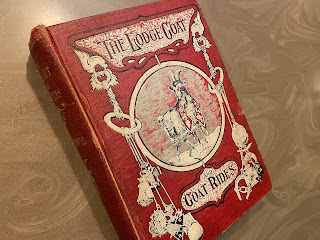


Other fraternal supply houses began offering their very own goats and patenting their designs – J. Pettibone, J.P. Luther, Louis E. Stilz & Brothers, and several others all made mechanical goats for decades. In 1909, James Pettibone even published a 600-page book of poetry, cartoons, plays and stories about lodge goats, collected from dozens of different fraternal organizations, called The Lodge Goat and Goat Rides.


Lodge goats also appeared in pop culture during this period. In 1900, American artist Cassius Marcellus Coolidge, best known for his “dogs playing poker” painting, created one print in his famous dog series that showed a fraternal lodge filled with canines initiating a hoodwinked St. Bernard, led with a cable-tow around his neck by a cocker spaniel, and riding on the back of a goat. 


In 1916, a short, silent animated cartoon featuring a popular bad-boy character named Bobby Bumps was released, about a young prankster attempting to trick his best friend Mose into being blindfolded and butted in the backside by a barnyard goat. And over the years, many novelty postcard companies offered up collections of “lodge goat” cartoons, showing Masons or other fraternal members with a tipsy goat among their group, drinking toasts, butting candidates, acting as the lodge Tyler, and more.


Our particular billy goat at the Masonic Library & Museum of Indiana is a DeMoulin Brothers’ Model 188 “Bucking Goat.” Its metal wheels are mounted deliberately off-kilter to provide a more wobbly ride for the poor unsuspecting initiate, and the push handle in the rear allowed the tormenting operator to make the goat wildly pitch back and forth. Such a critter was never permitted for use in any Masonic degree ceremonies, and ours actually came from a former Odd Fellows lodge in southern Indiana. But that didn’t stop plenty of fraternal lodges from creating clubs and unauthorized  “inner orders” that made up side degrees specifically to make use of these kinds of hazing devices. 


If lodge members weren’t especially gifted at inventing their own ceremonies, the DeMoulins helpfully sold playbooks with various scenarios and recommendations for more effectively humiliating or scaring the hell out of candidates in order to enliven meetings, raise charity money, and delight the audience.  Of course, the whole point of all these raucous, hazing hijinks was that, after a new initiate had successfully withstood the humiliation from his Brethren, his greatest desire as the newest member of the lodge was to inflict the same treatment  – or even worse – on the next poor, blind candidate who knocked on the door.


Alas, the demand for goats and guillotines in fraternal lodges has long since fizzled out, but the DeMoulins are actually still in business today, specializing in band uniforms. They have their own very fun and unique museum in Greenville, Illinois displaying their wilder products from the fraternal past, including a selection of their bucking billies. It’s well worth a visit. 


He’s resting on the couch today


And practicing his signs


The hailing signs, working grip,


And other monkey-shines


He mutters passwords ’neath his breath 

And other things he’ll quote;

They surely had an evening’s work


When father rode the goat. 


Friday, March 08, 2019

Vermont Town Elects Goat As Mayor


The residents of Fair Haven, Vermont have elected a new Mayor, and I'm sure there are Masons involved in this story somehow. Or at least Odd Fellows.

Fair Haven is a town of about 2,700 along the border with New York, just southeast of Ticonderoga, if you know where that is. The town doesn't actually have an administrative position of mayor, per se. But they do elect an honorary mayor to do things like march in parades and be an ambassador for visitors and such. It is a one-year position, and Hizzoner will be officially installed this coming Tuesday.

This year's honorary Mayor is named Lincoln. He is a three-year old Nubian goat.

It was a close race. Mr. Lincoln won with 13 votes, squeaking past Sammie the dog with 10. The other candidates combined for a total of 30.


The saavy candidate kissing hands and shaking babies.
During his term of office, Mayor Lincoln will be expected to attend a variety of local events, beginning with the Memorial Day Parade in May. He will be festooned with a custom made ceremonial sash.

The candidate — shockingly — is not married, but cohabitates with a black nanny goat named Lucy, who was unavailable for comment. The press has prudently agreed to keep coverage of their barnyard relationship to a minimum.

Town Manager Joseph Gunter said he heard about a small town in northern Michigan trying something similar and he thought it would be a good way to raise money for a local playground. It only raised about $100 through a $5 entry fee, but it provided other benefits.
“It was a great way to introduce the elementary school kids to local government,” he said.
The balloting for pet mayor was held alongside the regular Town Meeting Day vote, but any town resident could vote.
There is no mention as to Mr. Lincoln's possible fraternal affiliations. However, Eureka Lodge 75 is on Main Street and was chartered in 1867. And earlier Masons have been at work in the town since 1810. Morning Star Mark Lodge No. 4 first convened in that year (defunct), and Fair Haven residents were also members of nearby Aurora Mark Lodge No. 2 in 1797 (also defunct). So you know Freemasons rigged this election. Don't kid an old kidder.

At the conclusion of Mr. Lincoln's one-year term, I'm just hoping some shrewd huckster comes up with a new Main Street attraction. Like this for instance...


UPDATE:

I've caught some flack for perpetuating the Masonic goat business. Yes, it's juvenile. Yes, I wish that Masons wouldn't haze new candidates with goat stories. But honestly, as moronic Masonic myths go, this is a pretty minor irritant. And mostly harmless. It's also a longstanding one, with a - dare I say it - long-bearded pedigree.


I would like to call attention to the former Methodist Church and Masonic Lodge in Dundee, Kentucky, the historic 1902 home of Dundee Lodge 733 (now defunct). Sometimes called 'The Goat Building.' For more than a century, perched high atop the steeple has been this very special weather vane.


Just sayin'.

Tuesday, July 12, 2011

Jack The Ripper Evidence To Remain Sealed


Jack the Ripper was the name given to possibly the most notorious serial killer in history, even though he was far from being posterity’s most prolific or eccentric murderer. In September of 1888, the killer methodically murdered five women, all prostitutes, in the Whitechapel neighborhood of London. He slit their throats, then dismembered them, in some cases removing portions of their inner organs. The killings stopped suddenly two months later, and the case has never been solved.

This curious little story appeared in Sunday's Daily Mirror in the UK, "Secret files on Jack the Ripper will not be released to the public" by Nick Owens:

Secret files which name four new Jack the Ripper suspects will not be released to the public.

Retired murder detective Trevor Marriott has fought to have a 900-page dossier on the 1888 Whitechapel murders released. But a tribunal last week ruled they must be kept hidden. Scotland Yard said living relatives of the suspects could be attacked.

It added that releasing the papers which name “grasses” would jeopardise the recruitment of modern-day informants.

Yesterday Mr Marriott, who is writing a book about the Ripper, who was never caught, said: “To censor the documents is absurd.

“They could help solve the mystery after all this time.”


So what does this have to do with Freemasons? (And what are "grasses", while we're at it.)

In 1976, Stephen Knight published Jack the Ripper: the Final Solution, in which he theorized that the killer was Dr. William Gull, private physician to Victoria, Queen of England. Knight alleged that Gull was a Freemason, and had been ordered by the Queen (or the Prime Minister, Robert Gascoyne-Cecil, 3rd Marquess of Salisbury) to kill the prostitutes because they knew of a secret marriage between the Queen's grandson, Prince Albert Edward, and a prostitute named Annie Crook. Eddy, as he was known, was in line to the throne after his father, the Prince of Wales, and being married to a hooker was bad enough. Worse was that she was Catholic, and compounding the scandal, she supposedly gave birth to a daughter. This would have been earth-shattering stuff if Eddy ever became king, because his successor would be his firstborn child, whether mom was working girl with a mattress on her back or not. And a Catholic heir was not exactly kosher for the Protestant English royalty.

The theory goes on that Masonic Dr. Gull went about killing all the women who knew about the marriage and the child. He cut them from ear to ear. He tore open a left breast or two. He cut open a torso and removed the organs, and even burned them.

Other supposed Masonic “evidence” was a message scrawled in chalk on a wall near one of the murder scenes: “The Juwes are the men That Will not be Blamed for nothing.” Sir Charles Warren, Commissioner of the Metropolitan Police and a Freemason, ordered the message destroyed, because he was afraid that anti-Jewish sentiment would be inflamed and Jews would be blamed for the killings (there had already been several near-riots). Knight’s version is that Warren erased the words before they could even be photographed to protect Freemasons. Knight believed that the Juwes were actually a reference to the attackers of Hiram Abiff in the Master Mason degree, Jubela, Jubelo and Jubelum. Never mind that no one besides Knight has ever referred to the three ruffians in Masonic ritual as Juwes.

The final victim, Mary Kelly, was murdered on the same evening as the quarterly meeting of Quatuor Coronati Lodge #2076, London's premiere research lodge. The first Worshipful Master of that Lodge, who may have attended that meeting not far from the murder scene, was Sir Charles Warren, who resigned as Police Commissioner that very night. Of course, records of the lodge show that he wasn't at the meeting that evening, but pesky details never stop a good conspiracy theory.

Knight’s theory hangs on the allegations of Joseph Sickert, who claimed he had learned the "truth" from his father, Walter Sickert, a well-known eccentric and painter of the period. Walter claimed to have been a friend of Prince Eddy and had supposedly witnessed the marriage. In fact, claimed Sickert, Eddy and Annie had met in his father's art studio, where they became besotted with each other. In later years Joseph Sickert retracted the entire yarn, gleefully calling it “a whopping fib” and a hoax. Mystery author Patricia Cornwell’s book Jack the Ripper: Portrait of a Killer-Case Closed, actually makes a fairly compelling case that the Ripper was, in fact, none other than Walter Sickert himself, who put clues to the killings in his own paintings.

Nevertheless, with his new-found success based on the lurid book, in 1984 Knight went on to write another anti-Masonic book, "The Brotherhood: The Secret World of the Freemasons," attempting to smear the fraternity even more. His wild allegations led to a flurry of anti-Masonic coverage in the British press. When he died in 1985 of a brain tumor, a fellow anti-Mason named Martin Short (not the comedian) went on the radio and implied that the Masons used an ultrasound death ray to kill him.

I didn’t make this stuff up. I’m not that good. Amazingly, Short quickly became the BBC's go-to guy for many years whenever an anti-Masonic story hit the headlines.

Regardless, no one seriously believes the William Gull/Freemason theory. The names of the three attackers of Hiram Abiff had been removed from English Masonic ritual 70 years before the Ripper murders took place, and no one ever called them Juwes anyway. The women’s bodies were horribly mutilated, but there was no pattern to them to really suggest any connection to Masonic ritual. Sir William Gull was 72 years old with a heart condition and had recently suffered a stroke—hardly a likely man to run down dark alleys after young girls, much less engage in the grueling act of carving them up while they struggled. Oh, there's also the sticky problem that Gull wasn't a Mason. And the English public would hardly have needed to be protected from the scandals of philandering princes, as they were as common as ragweed. English law forbade a Catholic from ascending to the throne, and it turned out that the real Annie Crook wasn’t even a Catholic to begin with. There remains zero evidence of any secret marriage between her and Prince Albert Edward. And for the pregnancy and birth dates of Annie's child to work out properly, there's the little problem that Prince Eddy was swanning about in Germany when the child was conceived.

This whole cockamamie theory would have died out in the 1980s after Joseph Sickert had blown the whistle on himself if it hadn’t been for a graphic novel by Alan Moore and Eddie Campbell. From Hell is considered to be a masterpiece of the graphic novel genre (we used to call them comic books, back when the world was young and dinosaurs ruled the Earth). In 2001 it was made into a film starring Johnny Depp. In many ways, a better telling of the story was made in 1978. Murder By Decree dramatized the same story as a Sherlock Holmes case, starring Christopher Plummer as Holmes and James Mason as Dr. Watson. Completely untrue, it is an entertaining yarn (and when I was in college, it was one of the first references I had ever seen to Freemasonry).

Which brings us back to the story in Sunday's Daily Mirror.

Just what are those four suspects' names that Scotland Yard still hides from the public?

Odd Fellows, perhaps?

As for "grasses", there's this explanation from The Phrase Finder:

Informers are variously known as squealers, noses, moles, snouts and stool pigeons. These terms invoke imagery of covert snooping around and of talking. Grass is less intuitive. It could just have arisen from 'snake in the grass', which derives from the writings of Virgil (in Latin, as 'latet anguis in herba') and has been known in English, meaning traitor, since the late 17th century.

There is another route to the word and this is via rhyming slang. Farmer and Henley's 1893 Dictionary of Slang defines 'grasshopper' as 'copper', i.e. policeman. The theory is that a 'grass' is someone who works for the police and so has become a surrogate 'copper'. The rhyming slang link was certainly believed in 1950 by the lexicographer Paul Tempest, when he wrote Lag's lexicon: a comprehensive dictionary and encyclopaedia of the English prison to-day:

"Grasser. One who gives information. A 'squealer’ or ‘squeaker'. The origin derives from rhyming slang: grasshopper - copper; a 'grass' or 'grasser' tells the 'copper' or policeman."


That comes only a few years after the term grass was coined and there seems little reason to doubt it as the derivation. The original users of the term 'grass up' were from the London underworld and would have certainly been better acquainted with rhyming slang than the works of Virgil.

Monday, September 29, 2008

Are Dummies and Idiots Wrecking Freemasonry?

The latest edition of the Scottish Rite Research Society's collected papers, Heredom (Vol. 15), arrived while I was enjoying myself in Connecticut last week, and I picked it up over the weekend to savor its contents. It includes Stephen Dafoe's detailed and very important paper on the Morgan incident and the aftermath that led to the huge changes in the fraternity that followed in the wake of Morgan's disappearance—right up to the Baltimore Convention in 1843. Stephen's is a seminal work on the subject, collecting the episode together in a way that has not been done before. I urge Masons with an interest in the history of how and why US Freemasonry developed differently from the rest of the Masonic world to read this important work.

But the first article in Heredom is by Brother Josh Gresham Gunn (right), who currently teaches at the University of Texas at Austin. Brother Gunn's paper is "The Two Rhetorics of Freemasonry," and I urge you to read it in its entirety. This is the third incarnation I have read of this paper (one on his website in bits and pieces, once in a shortened article in the Scottish Rite Journal, and now this one). In all three versions, Brother Gunn has taken issue specifically with me and a passage I wrote in Freemasons For Dummies. He is not alone in having his hackles raised by the passage. I will not attempt to paraphrase his article—again, I urge you to read it for yourself. But I do want to respond to that part of his work that references me. The quote that Gunn and others find bothersome, offensive or otherwise irksome is this:
In your research about Freemasonry you will doubtless come across the writings of Albert Mackey, Manly Hall, Arthur Edward Waite, and Albert Pike. These men and many others have filled reams of paper with scholarly observations of Freemasonry. They eloquently linked the Craft to the ancient Mystery Schools of Egypt and elsewhere. They wrote that Masonry was directly descended from pagan rites and ancient religions. Some wrote that Masonry was the stepchild of magick, alchemy, and the shadowy mystics who dabbled in the world of the Kabala (Jewish mysticism) and in mysterious ancient writings like Hermes Trismigestes and the Key of Solomon. The works of these men were filled with fabulous tales of beliefs and cultures and cryptic theories of the deepest and earliest origins of Freemasonry. In short, they wrote a lot of crap. Guys like Pike and Mackey were incredible scholars and had dazzling intellectual and spiritual knowledge. Their works are both enlightening and frustrating, because they reach into obscure legends and beliefs and drag out what appears to be a lavish and alluring connection over a 3,000-year period to modern Freemasonry. Unfortunately, much of it is metaphysical wishful thinking. Sadly, they ignored the paper trail and documented evidence that exists in England and Scotland that really tells the story.
Freemasonry descended from the stonemason guilds and was taken over in the late 1600s by philosophers and men of science and learning. The Masons did not build cathedrals by using incantations to levitate stones. They did not cast spells to turn their enemies into stone gargoyles shaped as demons. They did not transmogrify base metals into gold to pay their wages. As Arthur C. Clarke has said, “Any sufficiently advanced technology is indistinguishable from magic.” Geometry was not a sorcerer’s art — if it were, no one would be safe from an Advanced Placement high schooler with a calculator and a protractor.
Unfortunately, Pike, Mackey, and Hall were prolific. They wrote big, thick books that are in every Masonic library, so people who don’t understand their works to be Masonic folklore trot them out as experts, “noted” Masonic scholars, and long-dead spokesmen. The problem is that their writings are continually cited as “proof” of an occult connection to Masonry. Worse, their writings are often deliberately altered by the critics of the Craft, and Freemasons have to explain all over again to their relatives and ministers that, no, they aren’t reenacting the dismemberment of Osiris, making pagan sacrifices to Lucifer, stirring cauldrons, or worshiping goats. They were all well read on the wide variety of world religions and cultures, and their work on the subjects of symbolism and philosophy can be fascinating. But let’s just say their version of history of modern-day Freemasonry is not accurate and leave it at that. —Freemasons For Dummies
Albert Pike literally plagierized much of Morals & Dogma from the French mystic Eliphas Levi, who had his own peculiar theories of Masonic origins. Mackey in his later years reconsidered his more fanciful writings from his younger days. Waite, well, was Waite, who desperately wanted Freemasonry to be something it was not. Hall wrote his most extravagant works on Freemasonry when he was 27, and didn't join the fraternity until he was in his 50s. I stand by my assertion. They wrote fascinating works that explore symbolic and philosophical topics that had never existed in the fraternity before. They wrote books that are quite fascinating. And they also wrote a lot of crap. Or at least a lot of wishful thinking. I make it clear in the book that it is my opinion, and that no one book, no one author, is authoritative on Freemasonry. And it is my opinion is that Pike, Waite, Hall, Crowley, Mathers and others found Freemasonry was lacking the ancient, mystical aspects they had hoped for. It wasn't spooky enough for them, and so they added it themselves. 

We had an old gag in advertising: "Where do good ideas come from? SOMEBODY ELSE!" Freemasonry did not spring forth, fully formed, plump and swollen with its own unique symbolism, and delivered up with drinks at the Goose and Gridiron by the handsome maid Hannah. I don't discount the influences of alchemy, astrology, Rosicrucianism, gnosticism, and a raft of other isms on the formation of the Blue Lodge degrees. Everything comes from somewhere. And the period from the end of the English Civil War up to the Romantic Age (which sprouted its own very different kinds of fascinations) literally turned all accepted dogma and philosophy on its keister. 

The change from operative to speculative Freemasonry was, in my mind, a very conscious effort by a group of men who sought to use it to educate a wider audience in the tenets of Enlightenment thinking. Drinking and social clubs were the rage in Britain during the period, and they popped up like crabgrass. Initiation rituals in these clubs were quite common. Men like the members of the Royal Society saw the symbolism of the building trade as an opportunity to teach the new rational methods of thought and education, painlessly, with a memorable initiation event, followed by a fine dinner. It's why I'm an oddball and think the Preston-Webb Fellow Craft Middle Chamber lecture is my favorite part of the three degrees. When it developed there was no third MM degree. There was just Apprentice and Fellow of The Craft. But the MC lecture was—and is—a crash course in the Liberal Arts, and it was created to teach unlearned men who, in most cases, had never encountered these ideas before. 

Gunn argues that perhaps the reason why US Freemasonry has lost more than 50% of its membership in the post-1960s era is because of a new sense of openess and transparency that has stripped the fraternity of its aura of secrecy and mystery. Books like Freemasons For Dummies and Brent Morris' Complete Idiot's Guide to Freemasonry, along with a nationwide attempt by Grand Lodges to say "No secrets here!" have made the Craft TOO accessible, TOO simple. And Gunn is not the first or only critic to claim that Freemasonry had some earlier, better time when it wrapped itself more thoroughly in occult mysteries. 

The Dummies and Idiots books are designed to be the first ones someone picks up on a subject, not the last ones. They are informal, easy to digest introductions to a complex topic, designed to answer the common questions, and provide enough information to hopefully spur the reader to dig deeper. Masonic historians have been dancing angels on pinheads over the origin of the fraternity for two centuries, once they started coming to the conclusion that James Anderson's fairy tales might be suspicious. Reading Pike and Waite and Hall, and to a lesser extent, Mackey, requires a few years in the fraternity, experiencing both Blue Lodge and appendant body degrees, and lots of reading, along with a healthy dose of skepticism. 

All of that is beyond the scope of either Freemasons For Dummies or The Complete Idiots Guide To Freemasonry. While I understand the feeling of some Masons that seeing the term Dummy or Idiot in conjunction with Freemasonry gives them stomach upset, I would say that you are not the audience the books are trying to educate. If the identical book—same text, same sidebars and cartoons—were to be published by the Grand Lodge of Your-Name-Here as the "Official Grand Lodge Masonic Education Manual" with a gray cover and official Grand Lodge seal on the cover, few would read it, secretaries wouldn't order it for candidates, and grand lodge warehouses would be stacked to the rafters with unshipped copies. It is the Dummies and Idiots brands that appeal to two generations of readers who have come to depend on the two series as introductions to subjects they want to know about quickly. Neither my book nor Brent Morris' are designed to be the be all and end all of Masonic education. But if they spur new Masons (or old ones) to study further—Masons who might otherwise have never read a book about the fraternity before—then they have done their job. 

I do not believe that some “golden age” of esoteric Masonry has EVER really existed on a large scale within the Craft, and I would challenge anyone to identify it. I would argue that the Royal Society members who most probably shaped the change from operative to speculative Freemasonry certainly used the currency of Enlightenment thinking and philosophy when they fashioned the changes in ceremonies. Face it: they were the nerds of their own time period. But if you look at the earliest English and French exposures between the 1717 formation of the Grand Lodge, up through the 1750s and 60s, you don’t get the big waves of symbolic lecture material appearing until Preston comes along in the 1790s. And if Freemasonry really descended from Scottish traditions, as David Stevenson alleges, I don’t see the esoteric or gnostic evidence there either. Anderson’s Constitutions read like an updated Regius poem, even though he never saw it. Lodge hierarchy and traditions came from a provable paper trail that leads back to at least the 1300s, and it is steeped in Christian, née Catholic, antecedents. 

But Grand Lodge was formed to revive the Annual Feast, NOT the annual reading of papers on the ancient alchemical elements. I don’t deny that Masonry, in particular the Scottish Rite degrees, is rife with imagery and concepts borrowed from earlier sources. I do NOT believe, however, that Blue Lodge, Craft Freemasonry in its post-1717 form is a direct descendant of the Mystery Schools, Kabbala, Alchemy, or Rosicrucianism (which sprouted at almost exactly the same time). Everything I study points me in the belief that Freemasonry is more the child of the cosmopolitan eating/drinking/reading/philosophy clubs of London that were exploding in popularity at this same period, than of some ancient “mystery” tradition. 

Freemasonry did not appear out of a vacuum. I believe that the speculative gentlemen who took over the guild did exactly what our traditions say they did - they saw in the stonemasons something unique, they co-opted the allegory of cathedral building as a lesson in character building, and they draped it with myth and symbolism grabbed from a wide variety of existing sources. The explosion of other similar clubs and fraternal groups that did the same sort of thing during the same period of time points to the conclusion that modern Freemasonry was part of a larger social movement, and probably not an extension of a medieval or older mystery cult. 

Did the hundreds of degrees that sprouted across France and Germany after Ramsey's Oration bring gnosticism, alchemy, astrology, Qaballah, Jewish and Christian mysticism, Martinism, and more into Freemasonry? Sure. For 150 years or more there was a mania for creating new degrees across Europe. But if a degree filled with Rosicrucian philosophy was invented in 1782 by someone who was fascinated with Rosicrucianism, that's not evolution. That's a self-fulfilling prophecy. Do these additional degrees bring "wise and serious truths" to Freemasonry? Of course they do. Even if they are comparatively modern creations, do they introduce ancient philosophies into the fraternity? Again, no contest. But like Pastafarianism, it's the intentional design of someone cherry picking old concepts and wrapping them in a new package. They are "ancient" in that they use ancient ideas, not that they descended in an evolutionary line traceable to an ancient source. Creating a new degree, then jumping back and shrieking, "Look! This ancient degree is descended from Egyptian Sun God worship!" isn't exactly divine revelation. It's self-aggrandizement. It may be interesting, enjoyable, and even enlightening. But you just wrote it. And claiming you found it under an old apron in a dusty box in the library where it was left by Unknown Superiors, or that some gnarled bookseller along the Seine tucked it out from under her skirts where it had been secreted away since Charlemagne... sorry, call me a skeptic. 

Finally, there is little no evidence whatsoever that the loss of Masonic members today has anything to do with some loss of occult, esoteric tradition that existed at some mythical point in the 19th or 20th century. That IS wishful thinking. The losses the fraternity is suffering from today has to do with the statistical aberration of waves of joiners between 1939 and 1952. I submit that Freemasonry has never lost large groups of its members because of some nebulous elimination of esoteric philosophy from the lodges. Lodges, by and large, have NEVER had an overwhelming concentration on the ancient “mysteries,” whatever you may conceive them to be. George Washington didn’t join a lodge to divine the secrets of the ancients, no matter what Katherine Kurtz novels may claim. Freemasonry was, as early as the 1730s, largely an organization to socialize with the movers and shakers in the community. 

There have always been men within the fraternity who have sought to trace modern Freemasonry’s traditions to an earlier philosophy, religion or tradition. Men like Pike and Hall and Mackey and many others truly believed what they wrote (although Mackey in later years admitted that his more youthful writings had been self-fulfilling wishful thinking. Would that Pike had done the same in later years with what he cribbed from Levi). But modern scholarship has has blown the dust off of quaint 19th century notions about many things in the world. I find comfort and wisdom in those earlier scholars’ works. But there is much that is just plain wrong, and worse, much that is just plain made up. And it is intellectually dishonest not to call them on it, simply because we might want to believe what cannot be proved, or has been disproved. Would Freemasonry profit by introducing more mysterious aspects, locking the doors and cultivating instead of shunning the “secret society” moniker? Possibly. This is what Traditional Observance lodges are attempting to do. But, while satisfying to their members, they remain a small curiosity within the fraternity right now. In an age that hangs on every word written about Jedi Knights, Lord of the Rings, Harry Potter, and other legendary, mythic stories, groups, and characters, it could be that Freemasonry is pursuing exactly the wrong tactic with its new openness. Frankly, I wanted my lodge to be, well, cooler than it turned out to be in life. A little incense, guys in black robes… (Wait! Those would be Jesuits!) So, it could very well be that we need to be cultivating a more mysterious aura. Time will tell. And as the reins of the fraternity get turned over to a younger group of leaders, perhaps those changes will happen at a faster clip. The lack of the Baby Boomers who didn’t join as young men have given Masonry a bad case of hardening of the arteries. That is changing. And there should always be a place in Freemasonry for individual lodges to pursue that path, if it is the will of its members. I don't discount the enjoyment and fascination many of my brethren derive from studying such topics. The fraternity has survived and grown because of its elastic walls that have embraced a huge array of disciplines and philosophies—there certainly haven't been 10,000 books written about the Odd Fellows or the Knights of Columbus. But personally, in the end, I tend to come down on the side of H. L. Haywood's remarks in A Bird’s Eye View of Masonic History (1921):
“Freemasons, for some reason or other, always have been, and even now remain, peculiarly susceptible to the appeal of the occult; we have had some experience in this country during recent years that prove this. No doubt a learned dustman can find particles of gold buried away in the debris of occultism and the true gold, even in small quantities, is not to be despised; but the dangers attendant upon trifling with the magical are a heavy price to pay for what little we can gain. Those who have, with worn fingers, untangled the snarl of occult symbolism, tell us that these secret cults have been teaching the doctrine of the one God, of the brotherhood of man, and of the future life of the soul; all this is good but one doesn’t need to wade through jungles of weird speculations in order to come upon the teachings that one may find in any Sunday School. It behooves the wise student to walk warily; perhaps the wisest things is to leave occultism altogether alone. Life is too short to tramp around its endless labyrinths. Moreover, there is on the surface of Freemasonry enough truth to equip any of us for all time to come.”