"To preserve the reputation of the Fraternity unsullied must be your constant care."

Proudly serving the fraternity since 2006
BE A FREEMASON

Wednesday, January 10, 2018

Martin Luther King, Jr. and the Freemasons


by Christopher L. Hodapp

A bill was just signed into law by President Trump aboard Air Force One while he was visiting Atlanta, Georgia on Monday. A week before the national holiday of Martin Luther King, Jr. Day, Donald Trump signed into law the Martin Luther King, Jr. National Historical Park Act of 2017. Alveda King, the niece of the slain civil rights leader, joined the President for the mostly private signing ceremony. It didn't get much press notice, didn't make the nightly news, and at first glance, it might be hard to see the connection to Freemasonry. 

Yet, it's actually central to this new Act.


The Auburn Avenue Prince Hall Masonic Temple in Atlanta, Georgia

The bill was sponsored by US Representative John Lewis, (D-GA), who is a member of Atlanta's St. James Lodge No. 4 PHA. What this new law signed by President Trump does is to establish the area around Rev. Martin Luther King Jr.'s birthplace in Atlanta to officially become a national historical park, making it the first such park in Georgia. (It's currently just designated as a national historic site, and this changes its status and importance within the National Park Service system.) The site is established "to preserve, protect, and interpret for the benefit, inspiration, and education of present and future generations, the places where Martin Luther King, Jr. was born, where he lived, worked, and worshiped, and where he is buried, while ensuring connections are made to his life and legacy." It already includes King's birthplace, the church where he was baptized, and his burial place. But the legislation also slightly enlarges the existing designated area in order to also specifically include Atlanta's Auburn Avenue Prince Hall Masonic Temple. 


After the end of our Civil War in 1865, Freemasonry among African Americans began to spread from the Northern states into the South, where it had previously been a damned dangerous thing to openly attempt. The twists and turns of segregated Freemasonry in America are complex, and the story does not lend itself to simple explanations. Freemasonry was far from the only lofty-sounding organization that talked about equality while strictly enforcing a color barrier. Countless other fraternal groups had their own parallel black and white counterparts that operated without any acknowledgement between each other.  When slavery was abolished, the practices of "separate but equal' institutions sprouted and flourished, and by 1896, Plessy v. Ferguson carved them into stone for another half century.

After the war, three black lodges were soon organized in Georgia in 1866, forming into an F&AM grand lodge by 1870. Because the National Compact era was going through its own internal and external pangs and schisms, a second AF&AM grand lodge was formed in 1874, with both finally merging in 1888. Both groups could trace their origins back to Prince Hall's English chartered African Lodge No. 459 in Boston. Today, that merged body is the Most Worshipful Prince Hall Grand Lodge of Georgia, F&AM.

In 1871, Atlanta's first lodge of African Americans was chartered, St. James Lodge No. 4 (F&AM), with Frances J. Peck as its Worshipful Master. Peck was also the pastor of Atlanta's Big Bethel African Methodist Episcopal Church at the time, the oldest predominately African American congregation in metropolitan Atlanta. The church became a center of the black community there, as well as a gathering place for social action. The strong connection between Big Bethel and St. James Lodge also made Freemasonry among Atlanta's black population a vital part of that community, binding faith and fraternalism, and creating a strong atmosphere for leadership at every level within the then still deeply segregated society. 

John Wesley Dobbs and Rev. Emory Searcy dedicating a local cornerstone in about 1956


Starting in 1937, the Prince Hall Masonic Temple and the attached Tabor Building at 332-34 Auburn Avenue were built. The main Renaissance Revival-style building was designed by architects Charles Hopson and Ross Howard at the behest of then Grand Master, John Wesley Dobbs. Atlanta at that time was home to about 90,000 African Americans, and Dobbs was instrumental as a local political leader and organizer. He had been elected as the 10th Grand Master of the Most Worshipful Prince Hall Grand Lodge of Georgia in 1932. Dobbs would serve as Grand Master in Georgia for 29 years, 1932-1961, and was widely known in Atlanta simply as "The Grand" and the unofficial "Mayor of Auburn Avenue." 

At the time, Auburn Avenue was a prosperous commercial district in Atlanta. If you have any question just how popular fraternalism was in the black community in the 20th century, consider that by 1945, along with the Masons and the Odd Fellows (who had their own enormous theater and auditorium building), there were twenty-five other fraternal groups also located on Auburn Avenue.

Martin Luther King, Jr. was not a Mason during his lifetime, but both his father and his grandfather were Prince Hall Masons. Interviews from 1968 indicate that Grand Master X. L. Neal of the Most Worshipful Prince Hall Grand Lodge of Georgia had arranged for Dr. King to become a Freemason upon his return to Atlanta that year. King's assassination in Memphis on April 4th of 1968 had abruptly prevented that event from happening. 

But that was not the end of the question about King's association with Freemasonry. Not by a long shot.
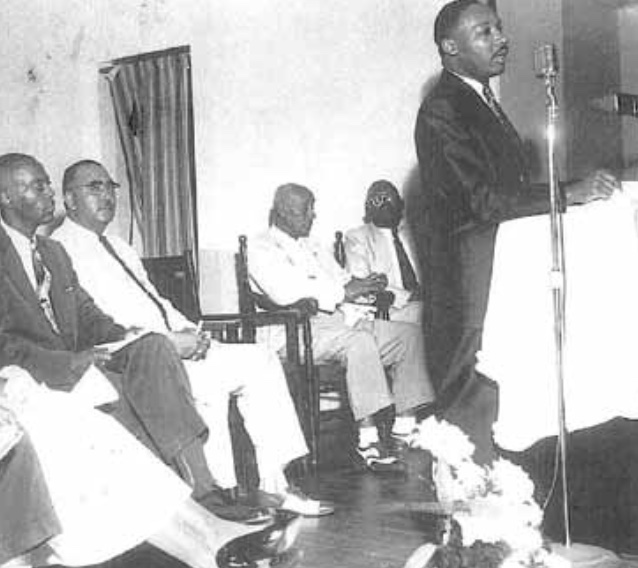
Dr. Martin Luther King speaking at the Prince Hall Masonic Temple in Columbus, Georgia, 
circa 1959. Behind him sits Grand Master John Wesley Dobbs. 


Starting in 2000, a rumor snowballed into a controversy, widely claiming that sometime between 1999 and 2000, then Grand Master Benjamin Barksdale of the MWPHGL of Georgia made Dr. Martin Luther King, Jr. a Mason "at sight" posthumously. As word spread of it, the Masonic world went berserk. Shrieks over the violation of "Landmarks" went out around the internet and in Masonic magazines, and there was a great gnashing of teeth. 

A decade after the alleged incident, the website for the MWPHGL of Georgia said the following about it:
“There is one local Masonic legend that claims that Dr. King, Jr. was good friends with Grand Master X.L. Neal, both of whom came out of Morehouse College. The legend claims that Grand Master Neal had promised to make Dr. King a Mason when he came back from the Sanitation Strike in Memphis; but as fate would have it, Dr. King never made it back from Memphis. However, in 1999, Grand Master Benjamin Barksdale gave him a posthumous honor by declaring him a member of the Craft and presenting it to his widow, Coretta Scott King, at a Morehouse celebration for our Civil Rights icon.”
At the time this allegedly happened, it was one of those explosive topics guaranteed to start a good old fashioned flame war in the early days of online Masonic discussion groups. Masons all over the world went collectively hysterical, and railed that no grand master could constitutionally confer the degrees of Masonry on a dead man. Conflicting definitions of making Masons "at sight" got trotted out and endlessly flogged over jurisdictional differences, along with the usual sagely chin wagging and general air bending. Most wound up dejectedly admitting that grand masters will do whatever they intend to do, like it or not, and if their own members of their grand lodge don't fix problems left in their wake, all the carping in the world isn't going to change anything. Nevertheless, there remain today a few lists of "Famous Freemasons" floating around that include King as a Mason without explanation. 

And yet, no one who was actually there that day finally stepped forward to definitively say whether or not the action really even took place.

Finally in 2012, in Vol. 39, No. 1 of the Phylaxis Magazine (p. 16), Brother Burrell D. Parmer of the PHGL of Texas researched this contentious and thorny event, and actually decided to go straight to the source. Brother Parmer actually asked PGM Barksdale what happened. 

The event in question occurred  at King's alma mater, Morehouse College. On April 1st, 2000, 'Millennium Sunday,' Dr. Lawrence Carter officially founded the 'Gandhi King Ikeda Hassan Institute for Ethics and Reconciliation.' That Sunday was the 40th anniversary of the Atlanta Civil Rights Movement and the inaugural celebration of the 'Season of Nonviolence' in 1960. Among the dignitaries assembled there that day were then Grand Master Barksdale, Mrs. Coretta Scott King, and Martin Luther King III, along with members of the Gandhi family. 

Prince Hall Masons had a longstanding connection to the site at Morehouse College, and they had dedicated the cornerstone in 1992 for the Martin Luther King, Jr. International Chapel on the Morehouse campus where the event in 2000 took place. The gathering on Millennium Sunday was for the unveiling of a large bronze plaque that contains the entire text of King's famous “I Have a Dream Speech.” An estimated 1,000 people attended that day, including 200 PHA Masons dressed n full regalia. It was when GM Barksdale stepped to the podium and spoke that the confusion came about. 

Parmer's article explains, in part:
As the event occurred over a decade ago, PGM Barksdale cannot recollect the date or year, but remembers that he did not make Dr. Martin Luther King, Jr. a Mason, neither “at Sight” nor provide him with honorary membership posthumously. “Dr. King is not a Mason; you cannot make a dead person a Freemason,” said PGM Barksdale.

To the reference that GM Dr. X.L. Neal stated that he will make Dr. King a Prince Hall Mason “at Sight” when he returned from Memphis:

“The above is true. I was Grand Senior Warden when GM Neal made the statement which was in the presence of the Grand Lodge membership in Augusta, GA,” said PGM Barksdale. “Again Dr. King was never a Prince Hall Mason; however, with the permission of Mrs. Coretta Scott King, I was given permission to name a Dr. Martin Luther King, Jr. Scholarship to assist a worthy young man to attend Morehouse College.”

[Past Master Douglas Evans, Past Grand Historian of Georgia] remembers some details about that day.
“I was in the audience as a young five-year-old Mason when (an) honor was read by PGM Barksdale in the company of Mrs. King and King III along with other Grand Lodge officers while on stage inside the King Chapel, and I, as many others, thought that they were making Dr. King a ‘Mason at Sight,’” said PM Evans. “I do not think that PGM Barksdale may have made it clear that a dead person could not be made a Mason.”

“I believe that during the ceremony as Mrs. King was on the stage was when PGM Barksdale and the Masons announced that it was “honoring Dr. King’s death posthumously.” None of us really knew what this meant since it wasn’t previously disclosed to us before the event,” said PM Evans. “We heard it all at the same time. I took it as something you might honor the governor or someone with, but the word posthumously made many feel as if Dr. King was being given the honor of being a Mason. I tend to believe that this was not the intent of PGM Barksdale but maybe the wording of the statement was not filtered or edited enough.”

According to PM Evans there was neither a proclamation nor similar communications that would have informed the Craft that such an honor of membership for Dr. King would be bestowed.

“I’ll be the first to echo PGM Barksdale’s statement that he did not make Dr. King a Mason. He couldn’t if he tried; it’s unmasonic,” said PM Evans. “I will offer that the language used at that ceremony may have been misleading.”
“During my historical tours in Atlanta, I offer that Dr. King is NOT a Mason, but an Alpha (a Greek college fraternity). If he had lived longer we believe that he would have joined since his father (Daddy King) and grandfather were all preachers and Prince Hall Masons,” said PM Evans. “We think Dr. King would have joined W. C. Thomas Lodge No. 112 since it is thought that this is where Daddy King was Raised, and due to GM Neal belonging to the same Lodge and knowing Dr. King from Morehouse College.”
In any case, the real reason for the expansion of the historical site in this new legislation Trump signed is because Atlanta's Prince Hall Temple was where the Southern Christian Leadership Conference (SCLC) established its initial headquarters on Auburn Avenue in Atlanta in 1957. That historic civil rights organization was co-founded by Dr. King, who also served as its first president until his murder in 1968. The SCLC became one of the most prominent non-violent groups in the country, and was instrumental in the growing efforts to finally end racial segregation in the U.S., starting in the late 1950s.

The cooperation between Prince Hall Masons, their temples. and civil rights groups was not at all unusual. These landmark buildings frequently were also home to offices of black professionals like lawyers, doctors, dentists, and accountants, along with other businesses and organizations vital to their segregated communities. Birmingham, Alabama's historic Colored Masonic Temple, for example, was built by the Most Worshipful Prince Hall Grand Lodge, Free and Accepted Masons of Alabama between 1922-24. That temple became the headquarters of the NAACP in Alabama and housed the legal teams during the time of the Freedom Riders in the 1960s. It was declared by the National Parks Service in 2016 as part of the History Birmingham Civil Rights District, a wide area of that city that encompasses many significant buildings in the same general area. 

Trump also signed two other related bills into law on Monday. The African American Civil Rights Network Act of 2017 instructs the National Park Service to link together various historical sites related to the civil rights movement, making it easier to trace the development, growth and success of the fight against racial segregation. He also signed the 400 Years of African-American History Commission Act to commemorate the arrival of the first Africans in the English colonies at Point Comfort, Virginia. in 1619.

I would be remiss if I didn't add as a footnote to this post that the Grand Lodge of Georgia F&AM at their annual meeting in October 2017 tabled without action yet another attempt at recognition of the MW Prince Hall Grand Lodge of Georgia, in spite of now PGM Gary Leazer's efforts and the encouragement of several others. I've lost track at this point of how many times the Prince Hall Masons have been turned down or ignored in Georgia. Alabama, on the other hand, passed joint recognition with their Prince Hall counterparts on November 14, 2017. Counting Georgia, there remain eight U.S. states that continue to deny Prince Hall recognition. 

A visual aid may be helpful to understanding this.


There is one last bit of confusion over Martin Luther King and Freemasonry. His final speech before his assassination on April 4th of 1968, his stirring "I've Been To The Mountaintop" address, was given in Memphis, Tennessee at the Church of God in Christ headquarters. That landmark building is known as "Mason Temple," but it was not then, and never has been, a Masonic temple. It was purpose built as a church and enormous auditorium complex in 1945, and is actually named for Bishop C. H. Mason of Memphis, the church's founder. 

Saturday, January 06, 2018

Special Masonic Exhibits Come To Indiana

The Bible of Fredericksburg Lodge No. 4 upon which young George Washington took his three Masonic obligations between 1752-3.

It may be an abuse of history to suppose that any one group of men could be enough of an influence to alter the course of the past. History has a taste of inevitability. But as Americans we were once commonly taught that the mere presence of a singular group of men, Washington and Adams, Jefferson and Franklin, Otis and Hancock, steered a nation toward Man’s first experiment in liberty and self–governance, preserving that experiment from the sort of bloodbath that marked the revolution in France. And yet, were it not for such significant men, and countless others, this country would have unquestionably had a very different destiny.

Most Freemasons are aware that the Holy Bible upon which George Washington took the first oath of office as President of the United States was borrowed at the last minute from New York’s St. John’s Lodge No. 1 in 1789. But very few realize that there is another Masonic Volume of Sacred Law that our most celebrated American Brother was first associated with Masonically, almost forty years before he became President.

When he was just twenty years old, George Washington was initiated on the evening of November 4th, 1752 into the newly established “Lodge of Fredericksburgh” in Virginia. That night, he placed his hand upon the lodge’s 1668 edition of the King James Bible and took the obligation of an Entered Apprentice. He would receive his Fellow Craft and Master Mason degrees over the next nine months upon that same Bible, raised at last to the Sublime Degree on August 4th, 1753. This extraordinary artifact has been preserved by Fredericksburg Lodge No. 4, and survives to this day.

The Indiana Territory was once a part of Virginia’s westernmost boundaries, and all but one of our own early lodges received charters or dispensations from Kentucky lodges that first began life as part of the Grand Lodge of Virginia. Now, as part of the celebration of the 200th anniversary of the founding of the Grand Lodge of Indiana, our Masonic Library and Museum of Indiana will display George Washington’s rarely seen Masonic Bible for a very limited time. From now through February 22nd, through the gracious permission and cooperation of our Virginia brethren of Fredericksburg Lodge No. 4, it can be viewed by both Masons and the general public. 


Fredericksburg's Secretary Mike Moses, Worshipful Master Dan Goodwin, and Senior Warden Jamie Snyder delivering the Washington Bible to MLMI Director, PGM Michael Brumback this morning.

We are deeply grateful for their generous loan to mark this special occasion. Their lodge has not widely permitted this fragile book to leave their premise before, which is what makes this such a unique opportunity for us. It stays inside of a plexiglass display case when it is on the road, but Fredericksburg Lodge is now actively seeking donations to properly conserve its delicate binding and pages. Consequently, they have just created new guidelines for requesting it HERE. Three Past Masters or officers of their lodge transport it, and it must be hand-carried. Since it does not have a TSA-safe traveling case, that means it must stay within comfortable driving range of Virginia. While it is residing in Indiana, it will be supervised during the day or locked safely in our fireproof vault.

That said, George Washington's Lodge Bible is not the only special exhibit in Indiana this year...


For a Hoosier, a walk along the Wabash Heritage Trail, from an isolated frontier fort to an historic battlefield where Kentuckians and Hoosiers fell side by side, encompasses the whole of our settler past, a tiny strip of territory where a group of remarkable men secured what would be a new state. 

For any historian with a romantic bone in his body, its hard not to personalize the Battle of Tippecanoe on November 11, 1811 in terms of the ongoing grudge match between the legendary figure of Native American warrior chief Tecumseh, versus the Indiana Territorial governor, General William Henry Harrison. Tecumseh was away at the time, attempting to organize more warriors to join his cause of uniting the Indian tribes to turn back white settlement. Tippecanoe was a win for Harrison, and the chief blamed his brother, Tenskwatawa, who was called “The Prophet,” for the loss, banishing him for life. Weeks after the battle, Tecumseh returned to ride through the ashes of Prophet’s Town and swore to meet Harrison again in battle. They did indeed meet again, at the Battle of the Thames in Upper Canada in 1813, where the great chief finally fell. Harrison went on to become President.

But for Masonic historians, Tippecanoe is seen through another lens, that being the number of Freemasons present and among the fallen. Considering that Vincennes Lodge had only been raising Indiana Territory Masons for two years, it’s an impressive number of brave men, but there’s a reason for it. Many of the officers and men who died were Kentuckians, members of the parent lodges that gave birth to the lodge at Vincennes. In their joint fight for the Territory of Indiana, the ties of Masonic brotherhood between them are carved for all time on the lists of the dead at the memorial raised on the Tippecanoe Battlefield. It’s now a part of the Wabash Heritage Trail, thirteen historic miles through and around Lafayette, running appropriately from Fort Ouiatenon to the battlefield of Tippecanoe. It’s something every Hoosier should see, not only for its incredible natural beauty, but for the historic markers that give three-dimensions to our history.


For Freemasons, key events were unfolding in Vincennes Lodge a week before members left for the battle. Easily the most significant Masonic episode to occur in the Indiana Territory during the pre-Grand Lodge period was the visit of the Virginia-born Grand Master of Masons in Kentucky, Colonel Joseph Hamilton “Jo” Daveiss, to the lodge at Vincennes, then Kentucky’s Vincennes Lodge No. 15. Daveiss was on his way with troops to the upper Wabash country to face The Prophet and his warriors. On four evenings—September 18, 19, 21, and 22 of 1811—the Grand Master met with his brethren at Vincennes, and conferred all three degrees on four new brethren; Isaac White, Nathaniel Adams, Josiah Foster, and Henry McGee.

Many new friendships were forged in that week, and old ones were strengthened by the knowledge of the coming conflict with the Indians. One of these friendships was between Jo Daveiss and Colonel Isaac White, another Virginian, now a Hoosier. The men were of an age, and thought much alike. White was college-educated, and he’d been in charge of the salt works at Saline River, sent by the Governor, salt being a necessary commodity for food preservation, and at that time in short supply. He had been a captain in the Knox County militia, later raised to a colonel, and was a popular man in Vincennes, handsome and with a winning manner. He had originally volunteered to go with Governor Harrison, but the Governor said he had plenty of men when he left to head north, and hoped a battle wouldn’t be necessary on that account. And so, at Vincennes Lodge, White volunteered into the Kentucky Dragoons led by Daveiss, instead. He was one of a dozen officers who fought officially in the battle as privates for this reason, which has often led to a baffling confusion of proper military titles by writers in later years.


On that night in September, Daveiss and White knew they were going into battle together. The two men had formed a deep friendship, and so they exchanged swords. According to an 1889 memorial written by Jo Daveiss’ grandson, it was White’s sword he would carry into battle. In his book Goodly Heritage, Dwight Smith relates the story of Judge Levi Todd of Indianapolis, a Past Master of Montgomery Lodge No. 23 at Mt. Sterling, Kentucky, who came to have Daveiss’ sword and belt in his possession. This was around 1860, and he’d once been a law student of Daveiss’ in his Lexington law office. The sword was given to him by Daveiss’ widow, and he presented it to Grand Lodge of Kentucky. 

It is this treasured artifact that the Grand Lodge of Indiana has been graciously loaned by the Grand Master and the Grand Lodge of Kentucky to display at the Masonic Library and Museum in Indianapolis for our Bicentennial year. 


In addition to this special artifact, our Museum is also in possession of Jo Daveiss' unique York Rite-influenced Lodge apron from that same week. It is regularly a part of our constantly rotating collection.


An amazing number of men fighting in General Harrison’s army at Tippecanoe were, or later became, prominent Freemasons, especially considering that the first organized lodge in Indiana had only been chartered two years before. Members of Vincennes Lodge 15 in the fight included William Prince, member of the Territorial Assembly, and Parmenas Backes, later sheriff of Knox County. Others in the battle who went on to found the Grand Lodge of Indiana included: Major Waller Taylor, Territorial judge and Indiana’s first U.S. Senator; General Washington Johnston and Benjamin Beckes of Vincennes; Joseph Bartholomew, later of Charlestown; John Tipton and Davis Floyd, later of Corydon; and Marston G. Clark, who settled at Salem.

Jo Daveiss went on to lead a courageous strike against the Indians at Tippecanoe where he fell, wounded in the chest, and Isaac White died not far from him. The bodies of the Kentucky Grand Master and the newest Master Mason in the Indiana Territory were laid in the earth side by side, their battle cloaks wrapped around them. Thomas Randolph, who had constituted Vincennes Lodge 15, and Colonel Abraham Owen of Kentucky’s Solomon Lodge 5 from whom the lodge received their first charter were among those to fall on the field of battle at Tippecanoe. Other men died that day, Kentuckians and Hoosiers, but the story of Daveiss and White struck a deep chord at the time, a note of unity of the two states, and of courage. And of Masons. Few know it today, but Indiana might just as easily become a Spanish territory under the traitorous plotting of Vice President Aaron Burr, whom Daveiss had battled in a Kentucky courtroom five years before. Men like him and others who were among Kentucky and Indiana’s first Masons kept Indiana safe, and free, and a part of America.


A Masonic marker erected by the Grand Lodge of Indiana in 1966 stands today near the Tippecanoe Battleground Monument. Indiana’s Freemasons first proposed a tall, columnar monument in the 1830s with contributions from Kentucky brethren, as well. However, when so little money was raised for the project, it finally vanished from further consideration after the 1850s. The present obelisk was erected in 1908. In 1929, a much smaller stone marker was also erected by the Daughters of the American Revolution at the base of the large stone outcropping along Burnett's Creek known as “Prophet’s Rock,” where The Prophet chanted and sang to encourage his warriors during the fight, assuring them the white man’s bullets would not pass through their bodies.

The Fredericksburg Bible and the Daveiss Sword are just some of several very special exhibits that will be displayed throughout the Bicentennial year of 2018 that tells the story of Freemasonry at the Masonic Library and Museum of Indiana. Both of these artifacts are on display now, and can be seen at both Founders' Day on January 13th and through the Conference of Grand Masters of Masons of North America in Indianapolis next month. 
The Masonic Library and Museum of Indiana is located in Indiana Freemasons Hall at 525 North Illinois Street in downtown Indianapolis.

But always remember that Masonic history is never isolated to just a handful of members or “important” lodges. Every single lodge, large and small, new or old, has a past with stories to tell. Take this opportunity of the Grand Lodge’s 200th anniversary to pour through your own lodge’s archives to discover the hidden nuggets of lore that will help bring the past alive for all of us.

Wednesday, January 03, 2018

UGLE Responds To News Organizations On Anti-Masonic Police Smears


The following notice has just appeared on the Freemasonry Today website of the United Grand Lodge of England in response to the New Year's furore generated by the press, alleging Masonic police officers have blocked reforms within the Police Federation of England and Wales. (See my earlier posts HERE and HERE.) This non-story was first whipped up in The Guardian, but other news sources soon picked up the scent, and it quickly went worldwide (thus making The Guardian story the story itself).

The UGLE letter from CEO Dr. David Staples can be seen online HERE, but I duplicate it below in its entirety. 

The question now is, how many - if any - of these very same news sources will bother to report this response? Anyone taking bets? Not that it matters. Once the smear is in the headlines, it bores into the collective minds of the public at large, perpetuating the anti-Masonic myth on into the future. 

And that was the intention all along.


FOLLOWING THE NEWS COVERAGE IN THE GUARDIAN, TIMES, SUN, MAIL ONLINE AND INDEPENDENT ONLINE RELATING TO FREEMASONRY AND POLICE FEDERATION REFORMS, DR DAVID STAPLES, CHIEF EXECUTIVE OFFICER OF THE UNITED GRAND LODGE OF ENGLAND, HAS SENT THIS LETTER (TAILORED) TO EACH OF THESE NATIONAL NEWSPAPERS

Dear Editor

I write in response to your articles Freemasons are blocking reform, says police chair and Why the secret handshake between police and Freemasons should worry us in The Guardian on 1st and 2nd January.

The articles show a complete and disappointing misrepresentation of Freemasonry. Furthermore, we understand, having spoken to the outgoing Chairman of the Police Federation, that recent media coverage does not accurately reflect his views.

We are quietly proud that, throughout history, when people have suffered discrimination both in public and social life, Freemasonry has welcomed them into our Lodges as equals. It is a shame that Freemasons are now quite openly discriminated against and that too many of our members, therefore, feel the need to keep their membership to themselves.

The idea that reform within the Police Federation or anywhere else is being actively thwarted by an organised body of Freemasons is laughable and suggests an unbelievable element of will and influence from an organisation which is non-political, non-religious, values integrity and upholds the law.

In 2001 and again in 2007 the European Court of Human Rights ruled that Freemasonry was not a secret or unlawful organisation.

There is absolutely no reason why police officers, or anyone from any other walk of life, should not be a Freemason and we highlight our shared organisational values of integrity and service to the community.

Dr David Staples
Chief Executive Officer
United Grand Lodge of England

California's Newest Lodge

Every Masonic lodge, everywhere, started in someone's head as an idea he shared with others, until it grew with enough insistency to become reality.

California's newest lodge, Anchor Bell Lodge U.D., will be receivings its dispensation this Sunday, January 7th, 2018, and Brother Bryan Godwin has been a part of the discussions leading to this foundation since the start. For a couple of years now, the Grand Lodge of California has been actively encouraging Masons in that state who are dissatisfied with the lodges in their areas to strike out and start whole new ones, instead of dejectedly just giving up on Freemasonry. They are quite deliberately fostering the formation of more, smaller, active lodges. As a result, brethren are beginning to think outside of the traditional box and to bring creative ideas to the table when it comes to lodges and programming.

Brother Godwin has just written an outstanding article about his experience with helping to get Anchor Bell Lodge off the ground over the last year and a half, and it is well worth a careful read. Starting a new lodge is not for the faint of heart, and no lodge anywhere has a lifetime guarantee of success. But it can be a mighty rewarding experience, and chances are pretty good that you'll get a damned fine lodge in the end, as long as you go in with the proper expectations and know the pitfalls.

From Microlodges And Chartering A New Lodge:

So, why a new lodge anyway? Why not infiltrate save a lodge that’s having problems and help the reinvigorate? Many of us have probably tried to “be the change they want to see” at an existing lodge, and have experienced why that can be an incredibly difficult endeavour. Most lodges, even ones that are experiencing a decline in active membership, have decades, if not a century of traditions, concepts, ideas, and ideals that are built into their foundation and subsequent superstructure. Trying to remove one of these bricks, or add something new to the foundation is akin to a Masonic game of Jenga. Those elements are solidly cemented into the lodge and likely have significant meaning to the stalwart superintendents that have seen the lodge through thick and thin, and kept the light alive over the years. Not only are these brothers less than interested in your brilliant new idea to have all the officers start the masonic year with a juice cleanse, or make the mandatory wardrobe for members and officers white neoplatonic robes, but they cherish the history that they have built, and the traditions they’ve worked so hard for. Most lodges experience an ebb and flow as the lodge, and the people surrounding it evolve over the years, and sometimes, they even close.

The chartering of new lodges, should be considered, in this author’s opinion, a completely separate idea from the improvement of existing lodges. There is little to show a connection between new lodges being chartered, and a decline of membership in existing lodges, and the opposite might actually have more credence. The theory behind starting new, small lodges or “micro-lodges” is that it is easier to create a lodge experience from scratch that appeals to a small group of members, than to take an existing lodge and uproot their history and bend it to what often amounts to a very vocal minority. New lodges can try new ideas and pivot quickly if those ideas fail without fear of a large, complicated and controversial vote. It is hard enough to do something well for twenty people with similar ideas, and it is far harder to manage an organization of hundreds that have a variety of interests. Ideally, new lodges, much like a start up corporation, can be incubators for new, and old ideas. They can test concepts, fail quickly, and find traditions that not only work for their membership, but inspire visiting brethren to borrow for their own lodges.

More lodges equal more Masonry. In business this is called clustering, or cluster economics. Have you ever wondered why fast food chains tend to be right on top of eachother? Or thought, wouldn’t a Burger King caddy corner to a McDonalds cut the other's margin in half? In fact these businesses tend to cluster to one another strategically, because it increases traffic and revenue. The term “Business Cluster” was coined by Michael Porter in The Competitive Advantage of Nations in 1990. Porter claims that clusters have the potential to affect competition in three ways: by increasing the productivity of the companies in the cluster, by driving innovation in the field, and by stimulating new businesses in the field. I believe this can be applied to lodges similarly, that a district full of small, active lodges that cater to specific interests successfully will drive more activity in a Masonic community...

My friend and brother Jeff Naylor, founding Master of Lodge Vitruvian 767 who was our man with a vision at the very start, once said this:


"If you can get enough Master Masons who like to dress up like train engineers and who want to start Lionel Lodge No. 769, or whatever the number is now, let the cheer go up and celebrate the chartering of a new lodge. These guys have something in common, they want to pull together and appeal to a particular group of men whose interests are not antithetical to the fraternity and who might just bring quality men into Freemasonry. Don't fight it, embrace it, promote it."
Anchor Bell Lodge's dispensation ceremony will be Sunday at 6:30PM at the Sunset Masonic Center in Santa Monica. It is by invitation only, but their first Stated Meeting will be Friday, January 26th at 7:00PM.

Tuesday, January 02, 2018

Upping the Attacks On English Masonic Police Officers


On New Year's Eve, Steve White, the bitter, now ex-head of the Police Federation of England and Wales resigned his post instead of facing the humiliation of a certain no confidence vote by his rank and file members. On his way out the door, he alleged that he had been thwarted from making enough serious reforms to the Federation over his three year term by some unspecified cabal of secret Masonic police officers, even though he had no idea how many of his officers are actually members of the fraternity, who they might be, how influential (or ineffectual) they really are, or whether Masons had actually done anything at all to block his plans.

Aw, facts, schmacts. Who cares when smacking Freemasons around is concerned? 

The Guardian dutifully printed White's smears against Freemasonry (while not bothering to mention that pesky no confidence vote). You can read the longer version HERE from Sunday. By Tuesday, the story got picked up by Google's news aggregator, and even the Russian Times network wire service. See, because in Europe, Mason-bashing is a favorite press pastime.

Well, the Guardian saw fit to up the ante with the anti-Masonic smears of police officers in an editorial Tuesday (those are hard to differentiate from the supposed straight reportage these days). Duncan Campbell burbled out an opinion piece, Why The Secret Handshake Between Police and Freemasons Should Worry Us (perpetuating the endless obsession the English press corps has over our supposedly nefarious Masonic hand clasps). Campbell peers into the past to dig up two—count 'em, TWO!—"troubling" references to possibly suspicious actions by English police officers who also happened to be Masons in order to prove the horribleness and the awfulness of this Masonic scourge.


The first "incident" was almost FORTY years ago (that was around the time E.T., Tootsie, and Fast Times At Ridgemont High were in the movie theaters, and your Pink Floyd 'The Wall' cassette tape kept getting jammed in your Sony Walkman). It involved the perceived change in the attitude of a senior officer to a subordinate one, once their shared Masonic membership was discovered. Nothing concrete, mind you. 
Brian – now Lord – Paddick, in his autobiography, Line of Fire, disclosed that both he and and his father had been Freemasons. Paddick himself joined almost as soon as he could, at the age of 21, when he was already an officer working under an unpopular superintendent in west London. “I asked the superintendent if he was ‘on the square’ and his attitude changed completely; suddenly he became my best friend and showed me his Masonic regalia, the decorated apron worn in Masonic meetings … I found his complete volte-face quite disappointing but it was not the last time someone’s attitude to me was to change instantly when he discovered my Masonic links.” Paddick duly decided to give up attending Masonic meetings.
How traumatic it must have been for the poor sod for his superior (described by His Lordship as "unpopular," at least in his own humble opinion back when he was a humble plod) to discover they now had an outside activity in common. I can't imagine why any man branded as unpopular by his employees would warm up to anyone who had expressed nothing but scorn for him previously. But perhaps I'm simpleminded.

The other case was "as recently as" almost TWO DECADES ago. Here's how Campbell spins it:
As recently as 1999, a former detective and a Freemason, Duncan Hanrahan, was jailed for more than eight years for conspiracy to rob, supply drugs and pervert the course of justice. It emerged in his Old Bailey trial that he had used a fellow Freemason, who was a serving officer, to help him make contact with another officer, whom he tried unsuccessfully to bribe. And this came just three years after the home affairs select committee had announced: “We believe that nothing so much undermines public confidence in public institutions as the knowledge that some public servants are members of a secret society, one of whose aims is mutual self-advancement.”
Where the hell did Campbell get the cockeyed notion that the aim of Freemasonry is "mutual self advancement" in anything other than an individual's self-improvement of character and intellectual and philosophical knowledge? The answer is, he didn't. He's deliberately mischaracterizing the goal of the fraternity to suit his own twisted messaging and to pretend Freemasonry is really about job advancement and profiting financially. Huh. I somehow missed that part of the ritual. It's actually straight out of Stephen Knight's slanderous anti-Masonic fantasies from the 1980s. How did Campbell leave out the Jack the Ripper Masonic coverup, while he was at it?

Here's the serious pull-quote he's really trying to get to, in a clear reference to the Brexit controversy and the EU rules enforced by its Human Rights Commission and Court:
[I]n 2014, the then commissioner, Bernard Hogan-Howe, said that it would be difficult under human rights legislation to make a register of membership compulsory, but he made it clear that “for me as a police officer, the secrecy of membership is a concern. I think police officers should be transparent: nothing to hide, then why not mention it? My view would be that you ought to be open about your associations.”
See, if only England could ditch those pesky EU-imposed protections of privacy and pass laws to specifically persecute people like Masonic police officers, lawyers, and judges over their private associations, everything would be just fine. Then once the Masons are purged, perhaps they could move on to getting rid of cops who are Manchester United fans, and then get to the members of tea cozy collectors' clubs... 

Here's the way Campbell sums up his little polemic:
If the public thinks that a secret handshake can still swing a prosecution and officers themselves feel that the same handshake can affect a promotion, then it is as clear as ever that membership of both bodies is incompatible. And it is time that all those officers who are Freemasons decided to “forgo the prospect of pleasure and social advantage” until they have left the service.
The ONLY reason the public has this toxic perception in the first place is because certain members of the press and opportunistic politicians have spent nearly 40 years beating this same meritless drum over and over. They brand Freemasons, on the one hand, as a doddering, dwindling collection of sad, old white men engaging in silly rituals behind closed doors of crumbling buildings, who have no reason to exist in a modern world. Yet, on the other hand, they treat Freemasons as an all-powerful secret society that pervades professions like the police departments and the judiciary, exchanging secret semaphore signals with criminals or accomplices to get each other promotions or to escape the strong arm of justice they so richly deserve.

So which is it—stupid dinosaurs on our collective death bed, or all-powerful manipulators who surreptitiously pick the winners and losers? The anti-Masons can't have it both ways, but they sure do huff and puff and keep trying to do just that

(Image shamelessly stolen from a particularly disgusting, lunatic fringe anti-Masonic website that I have no intention of linking to. They know how to contact me if they want to complain.)


UPDATE 1/3/2018, 1:00PM:

While the two Guardian anti-Masonic pieces went worldwide with their smears and got picked up by other news sources for global public consumption, the point of view of a London police officer, Police Federation chair, and a real live actual Freemason was most definitely not. No, that was left to reside on the relatively obscure PoliceProfessional.com website today, where few besides other police officers are ever liable to stumble on it. 

Ken Marsh is the chair of the Metropolitan Police Federation and was interviewed for the website. From "MPF chair: days of Masonic influence in policing ‘are just so far gone’":
Allegations that Freemasons are blocking reform and diversity in policing are unfair and untrue, according to the chair of the Metropolitan Police Federation (MPF).
Ken Marsh said he was “bewildered” by accusations that secretive cabals of Masons are preventing female and black and minority ethnic (BME) officers from reaching the top tiers of policing.
Mr Marsh, himself a Mason, claims he has never known colleagues exploit their membership of the society for personal gain or to prevent others progressing.
He was responding to allegations by former national federation chair Steve White, who recently said female federation representatives have approached him and raised concerns over the influence Masons hold in the service.
Three of the nine members of the MPF’s executive board are Freemasons.
“I’m really struggling to see how Freemasonry is hampering BME and female officers coming forward,” said Mr Marsh. “I have never seen anything like that in my tenure as chairman of the police federation and I have never seen anything like that in my service – and I’ve done 20-plus years. I’m just amazed by it.
“We have more BME and female fed reps than any other force in the country. Within our exec, 33 per cent are BME and 13 per cent are female. Across the whole of our fed reps, considering we’ve got 280, around 16 per cent are BME and 18 per cent are female.

“That’s far higher than the national statistics. Please tell me how this is supposed to be happening.”
[snip]

Mr Marsh denies that Masons would be able to exert any influence in the MPF even if they wanted to as just 33 per cent of the executive board are members of the organisation.
He added that former MPF chair John Tully – another Freemason – did not help him get appointed as he “never even spoke to me".
“I would challenge anyone to say that I have ever tried to use the word ‘Freemasonry’ to achieve, obtain or procure anything within the work I do,” he said. “I am far too professional to consider something like that.
“As part of being a Freemason, I have raised over £1.3 million for charity and have been awarded an MBE for it. I have never, ever, seen anyone give me a foot up or any other rubbish that is being spoken about.
“It’s a little bit sad really. We are in 2018. Those days are just so far gone. We’ve moved heaven and earth… to make the federation more open, more public, and more available to the officers – as it should be.”
Chief Constable Martin Jelley, national lead for ethics and integrity, claims “it is clear that concern over real or perceived threat to impartiality of this has decreased”.

He added: “If convincing evidence ever came to light which clearly showed that Freemasonry was adversely affecting the integrity of the police service then we would take appropriate action.”

Monday, January 01, 2018

Happy A.D. 2018 - A.L. 6018!


Non-Masons may be especially curious about the two different years generally found on Masonic cornerstones, usually marked as A.D. and A.L. In fact, many of our own members may not really know the reason themselves. So, New Years Day is as good a time as any to explain it.

The Gregorian calendar was standardized by Pope Gregory XIII in 1582, though the non-Catholic Western world took another 200 years before they went along with the pope’s idea. Since 1776, most of the world has been on the same calendar page (though Greece and Russia didn’t adopt it until after World War I). Because Western Europe and America switched to the Gregorian calendar in the mid-1700s, conflicting ages are sometimes attributed to some of the notable figures of the period (like George Washington, who was born before the changeover). Because of the confusion, they themselves weren’t always positive of their exact age right off the top of their heads

In 1658, Bishop James Ussher in Ireland believed he had determined the exact date of God's creation of the world. Using the biblical account along with a comparison of Middle Eastern histories, Hebrew genealogy, and other known events, he determined that the Earth was created on Sunday, October 23, 4004 B.C. 


At about the same time, John Lightfoot, vice chancellor of Cambridge University, went on to further clarify that the Creation actually happened at about 9 a.m. No, Daylight Saving Time was not specified.

Ussher called his dated calendar Anno Mundi, the 'Year of the World.' Ussher and Lightfoot’s calculations of the exact date and time of the Creation were soon widely accepted as fact by most Christian denominations. Beginning in 1701, new editions of the King James Bible clearly stated it right up front in an added introduction that was not part of the biblical text, but might as well have been as far as readers were concerned. Up until the evolutionary theories of Charles Darwin were popularized, many Christians (and Jewish scholars as well) were firmly convinced that the Earth was no more than about 6,000 years old.

Because Ussher’s Creation date was so strongly believed at the time of modern Freemasonry’s origin in 1717, Masons began dating documents using 4004 B.C. as their beginning year . . . sort of. 4004 was an inconvenient number to remember, so Masons simply took the current year and added 4,000 to it. So, 1717 became 5717, and today 2018 becomes 6018 Anno Lucis, or A.L., since Anno Lucis means “Year of Light” in Latin. Masons called it that to coincide with the Genesis passage, “And God said, ‘Let there be light’; and there was light.” They did this early on to lend the fraternity an air of greater, more solemn antiquity. If they dated their documents as being 5,717 years old, they’d certainly sound more respectable and impressive than some newly formed London drinking club. Thus, today you will often see two dates on Masonic cornerstones—both A.D. and A.L.

But it doesn't stop there. The appendant bodies very quickly got into the act, as well.

Royal Arch Masons date time from the year 530 B.C., when the Second Temple was commemorated by Zerubbabel. Anno Inventionis (A.I.), which means "In the year of Discovery," is the term used in RAM Chapter documents, charters, and other literature. This adds 530 to the current date, therefore the year 2018 becomes A.I. 2548.

Royal and Select Masters, or Cryptic Masons, date their documents from the year in which the original Solomon's Temple was completed and the "secrets" were deposited in its vaults. They called it Anno Depositionis (A.D., but not the Anno Domini everyone was used to already), which means "In the year of the Deposit." It adds 1,000 to the current year, transforming 2018 into A.D. 3018.


The Masonic Knights Templar start their calendar with the formation of the original order in Jerusalem in 1118 A.D. Anno Ordinis (A.O.), which means "In the year of the Order," is the term they use. This deducts 1,118 from the current year, so 2018 becomes A.O. 900 in the Commandery.

If you thought the Ancient Accepted Scottish Rite was going to just let that all go unchallenged, think again. The AASR followed the the similar idea of numbering years from the Creation that Craft Masons did, except for their use of the Hebraic chronology that Ussher had originally deviated from. They clearly felt that rounding up numbers was for lazy cheaters. The Hebrew calendar has several differences from the Gregorian calendar, one of which is that some months in the Hebrew version have 29 days and some have 30 days. Therefore, Ussher's term of Anno Mundi (A.M.) is also the label for the AASR dating system and adds 3,760 to the current year. Therefore the year 2018 becomes A.M. 5778.

And just because I'm stubborn and have been a firm adherent to the deliberate ways of coot-dom ever since I was a teenager, you will not ever find me voluntarily knuckling under to the modern use of B.C.E. and C.E. while I'm on this side of the dirt. B.C. and A.D. have worked just fine as descriptors ever since Dionysius the Humble applied them in the 6th Century, thank you very much. I see no reason to change now.

Cheers!

(H/T to Brother Michael Riddle, from whose Facebook posting I cribbed this artwork. If anyone knows its original source, please let me know and I will dutifully identify its proper creator.)

Sunday, December 31, 2017

Press: England's Masonic Police Officers Get a Last New Year's Swipe


Ah, it wouldn't be New Year's Eve without one last 2017 swipe against the fraternity by the stalwart English press, and the Guardian stepped right up to the plate. 

Today's Guardian brought a story about Steve White, the departing chairman of the Police Federation of England and Wales. Since cops there are not permitted to unionize, the Federation represents 120,000 rank and file officers as what sounds like their counterpart to the Fraternal Order of Police in the U.S. (and if anyone can clarify this, please feel free). It was created by an act of Parliament in 1919 specifically because police there are prevented by law from taking "industrial action," most notably, striking. However, when White was elected in 2014, the Federation was widely regarded as a corrupt wreck internally, so much so that then-Home Secretary Theresa May gave a speech at their annual assembly declaring that the government was poised to take them over if they didn't clean up their act by enacting a laundry list of three dozen reform measures—which they immediately did. There were financial shenanigans and allegations of favoritism and discrimination, but apparently the biggest scandal was the habit of top Federation officials "bladdering" (to wit, hanging out at the headquarters building all hours and getting plastered on their members' money). So, White has been on a clean up crusade ever since. His three year term ended in August, and he steps down on New Year's Day. But from the sound of it, he just couldn't manage to get everything done that he wanted to in the way of reforming their internal practices in those three short years.

So what does he declare to be the biggest obstacle to further police reforms? You guessed it. When all else fails, rattle the bones of Freemasons in the ranks of the English police, who apparently run about with rolled up trouser legs, exchanging dodgy handshakes, secretly giving all their lodge brothers pay raises, secretly winking at their brother criminals, secretly shutting out the women and minorities from the really choice jobs, and doing other secretly secret stuff secretly...

Or something.

And naturally the Guardian was obliged to proclaim this totally baseless smear in 72 pt. type, because the English press eats up anti-Masonic stories with a very large spoon. From their article today, Freemasons Are Blocking Reform, Says Police Federation Leader:
Reform in policing is being blocked by members of the Freemasons, and their influence in the service is thwarting the progress of women and people from black and minority ethnic communities, the leader of rank-and-file officers has said.
Steve White, who steps down on Monday after three years as chair of the Police Federation, told the Guardian he was concerned about the continued influence of Freemasons.

White took charge with the government threatening to take over the federation if it did not reform after a string of scandals and controversies.
Critics of the Freemasons say the organisation is secretive and serves the interests of its members over the interests of the public. The Masons deny this saying they uphold values in keeping with public service and high morals.”
White told the Guardian: “What people do in their private lives is a matter for them. When it becomes an issue is when it affects their work. There have been occasions when colleagues of mine have suspected that Freemasons have been an obstacle to reform.
“We need to make sure that people are making decisions for the right reasons and there is a need for future continuing cultural reform in the Fed, which should be reflective of the makeup of policing.”
One previous Metropolitan police commissioner, the late Sir Kenneth Newman, opposed the presence of Masons in the police.
White would not name names, but did not deny that some key figures in local Police Federation branches were Masons.
White said: “It’s about trust and confidence. There are people who feel that being a Freemason and a police officer is not necessarily a good idea. I find it odd that there are pockets of the organisation where a significant number of representatives are Freemasons.”
The Masons deny any clash or reason police officers should not be members of their organisation.
Mike Baker, spokesman for the United Grand Lodge, said: “Why would there be a clash? It’s the same as saying there would be a clash between anyone in a membership organisation and in a public service.
“We are parallel organisations, we fit into these organisations and have high moral principles and values.”
Baker said Freemasonry was open to all, the only requirement being “faith in a supreme being”. He said there were a number of police officers who were Masons and police lodges, such as the Manor of St James, set up for Scotland Yard officers, and Sine Favore, set up in 2010 by Police Federation members. One of those was the Met officer John Tully, who went on to be chair of the federation and, after retirement from policing, is an administrator at the United Grand Lodge of England.
Masons in the police have been accused of covering up for fellow members and favouring them for promotion over more talented, non-Mason officers.
White said: “Some female representatives were concerned about Freemason influence in the Fed. The culture is something that can either discourage or encourage people from the ethnic minorities or women from being part of an organisation.”
[snip]
The National Police Chiefs’ Council’s lead for ethics and integrity, the chief constable Martin Jelley, said: “While we recognise that there has been concern in the past around serving officers also being Freemasons, it is clear that concern over real or perceived threat to impartiality of this has decreased. Regular external scrutiny of the police service by Her Majesty’s Inspectorate of Constabulary and Fire & Rescue Services has not raised this as an issue of concern.
“Strict guidelines require officers to declare anything which might be deemed a conflict of interest in their force’s register of interests. If convincing evidence ever came to light which clearly showed that Freemasonry was adversely affecting the integrity of the police service then we would take appropriate action.”
As usual, there's never any actual allegation, never any proof of wrongdoing, never anything that can be pinned to the tail of police officers who are Freemasons simply by virtue of the fact that they ARE members of the fraternity. It's always left hazy and non-specific. It's always just a possibility, a perception—and one that is happily promoted by anti-Masons to serve their own ends or to explain their own shortcomings, or their own failure receive promotions. 

In Mr. White's case, he's leaving his position not because he was such a terrific success that his job is finished, but because he was about to get it in the face with a vote of no-confidence from the rank and file police officers. So, it's far easier to leave and then claim all those hordes of secret, dastardly Freemasons blocked him at every turn. Naturally, the Guardian didn't mention that part. No, he was just "stepping down." 

(Although, as one Brother wryly quipped today on Facebook, "Freemasons Are Blocking Reform" is not an entirely unbelievable headline, given some of our own grand lodge sessions.)


Of course, lest you think we are entirely immune on this side of the Atlantic, we're not. The Boston Globe tried to get into the act out of the blue back in November. In the midst of all of the caterwauling last month over Alabama's special election, the Boston Globe went on its own witch hunt and came up with Brett Tally, a judicial nominee for the federal bench nine states away from Massachusetts (where he once lived and attended Harvard). Because federal judges are appointed by the President, naturally Tally is now part of the scorched Earth political climate in the U.S. that brands all people as either saints or Satanic, depending on their partisanship and who's wielding the branding iron. 

It should probably be noted for foreign readers that Massachusetts is overwhelmingly a state that is in political opposition to the current Administration, and in the case of one of its Senators, vehemently so. That would be the equally "controversial" Elizabeth Warren, who immediately declared she would vote against Tally's confirmation.

The Globe took up the cause of helping to declare Tally as "unqualified" to be a federal judge, and so it published this little gem on November 15th, Brett Tally, Controversial Nominee For Ala. Federal Bench, Has Mass. Masonic Ties (note that he must be "controversial" because the headline screams it):
By now you’ve probably heard of Brett Joseph Talley, the 36-year-old Justice Department lawyer and horror writer nominated to the federal bench in Alabama by President Trump.

You’ve probably seen the unflattering headlines, too — from the American Bar Association deeming him unqualified to a Washington Post report that Talley failed to disclose in a Senate Judiciary Committee questionnaire that he’s married to a Trump White House lawyer.
Less attention has been paid to Talley’s Massachusetts ties, which he cultivated as a student at Harvard Law School. He graduated from Harvard in 2007 and later took a job as a writer for Mitt Romney’s 2o12 presidential campaign.

In addition, he identified himself in the Senate questionnaire as a member of The Harvard Lodge A.F. & A.M., a Masonic group based in Massachusetts that requires university affiliation for membership.
“One of the many unique characteristics of The Harvard Lodge is that its members don their academic robes and regalia at the Lodge’s regular meetings,” the group’s website says.

The site adds that a “Mason’s duties are first to his God, then, to his family and those dependent upon him, and then to his fellow men.”
Among the lodge’s charitable efforts is the Masonic Angel Fund, which supports Cambridge schools and children in need, the site says.
Speaking on behalf of the lodge, Christopher Rooney of the Massachusetts Freemasons said Talley joined the Harvard group in 2006, but further information about his involvement wasn’t available Wednesday.

Talley couldn’t be reached for comment.

He noted in his Senate questionnaire that the lodge is a “masonic, fraternal organization limited to men, although there is a corresponding organization for women.”
May the dawning of A.L. 6018 bring a more calming year for us all. Happy New Year.