"To preserve the reputation of the Fraternity unsullied must be your constant care."

Proudly serving the fraternity since 2006
BE A FREEMASON

Showing posts with label taxes. Show all posts

Saturday, November 08, 2025

Washington D.C.'s Prince Hall Masonic Temple Retains Tax Status

(Google)

by Christopher Hodapp

With so many stories of Masons losing their century-old, architectural and historically significant temple buildings all over the country, it's gratifying to be able to report actually keeping one. The Prince Hall Masons of Washington D.C. have prevailed in retaining tax-exempt status for their historic building on U Street in the nation's capital. 

The Prince Hall Masonic Temple, located at 10th and U Street in D.C., is a historic spot with deep social and cultural roots in the city’s black community. Headquarters of the 
Most Worshipful Prince Hall Grand Lodge F&AM, Prince Hall Affiliated, District of Columbia,  this building isn’t just bricks and mortar – it’s a symbol of black business, culture, and social life, dating back to when U Street was known as the “Black Broadway.” Designed by African-American architect Albert Cassell and built between 1922 and 1930 by DC's Prince Hall Masons, the building has served as a restaurant, bowling alley, ballroom, and office space for black-owned businesses. It’s been a hub for social events and community gatherings for generations. Over the years, the area has changed a lot, with gentrification pushing out many longtime residents and businesses, replacing them with new arrivals, but the temple has remained a key landmark.

The D.C. Prince Hall Masons recently faced a huge challenge: keeping ownership of their building and maintaining its tax-exempt status after they made was a seemingly innocuous change: they changed the name of their charity arm, and that meant they had to reapply for the tax exemption. It wasn’t automatic. (The new name is a mouthful: the Prince Hall Free & Accepted Mason and the Order of the Eastern Star Charitable Educational Foundation, or PHFAMOESCEF for short. Really.)

In most states and municipalities, Masonic halls are exempt from paying property taxes because of the long history of charitable works and civic engagement Masons have been known for. Taxing authorities often treat them like churches in that respect. They believe that the Masons contribute far more to their communities than any property taxes on their aging buildings ever could. But note I said MOST states and municipalities – not all. The fortunes and misfortunes of downtown areas have waxed, waned, and waxed again over the last century or more, and many Masonic temples built during the City Beautiful Movement between the 1890s and the 1930s were often erected right downtown or in the earliest suburbs of their era. When those neighborhoods fall on hard times, property taxes go down; but when things get prosperous again, property taxes go up.

According top an article on the Black Enterprise website ("Prince Hall Freemasons Retain Historic Site") when the foundation changed its name in 2022, the tax exemption didn’t just follow it. Marquis McCants, the president and CEO, explained that they had to go through a stack of paperwork and get help from D.C. Council member Brianne Nadeau to reapply for the exemption. They put in the application in 2024 and had to reintroduce it again in 2025. Fortunately, the D.C. Council approved the legislation without controversy, and the temple got to keep its tax-exempt status. This means the foundation can continue to own and operate the building without the financial burden of property taxes. 
(Note to Masonic Temple trustees everywhere: Freemasonry and Masonic lodges are considered exempt from paying federal income tax on revenues as 501(c)10 organizations, but contributions to the lodges cannot be deducted as expenses when calculating your tax liabilities. However, you CAN create a 501(c)3 tax exempt foundation or corporation for the non-fraternal parts of your temple as long as you offer up its use to the general public. That means you can issue tax deductions to those who contribute to the upkeep or improvements of the building's interior and exterior, or infrastructure like plumbing or heating systems, as long as those donations are NOT used for the lodge room itself. Your lodge can't be a 501(c)3, but your building can. Bear in mind – I'm NOT a tax attorney. Consult your accountant before attempting to take my advice on tax issues.)
Prince Hall Freemasonry started in the 1770s when Prince Hall, a free black man in Boston, formed the first Masonic lodge for African Americans after the degrees were conferred upon him and 14 others by the Master of a British traveling military lodge. The Premiere Grand Lodge of England granted a charter to Hall's African Lodge in 1787 after white Massachusetts Masons snubbed them. From that beginning, so-called African Masonry for black men spread into the northeastern states.

In 1818, a group of free black men petitioned the African Grand Lodge of North America in Philadelphia for a warrant to organize African Masonry in the District of Columbia. Social Lodge No. 7 was chartered in the District in 1825 and was made up, at first, of black men who had joined African lodges in Pennsylvania and England. By 1848, the three black lodges in the city formed the Union Grand Lodge of the District of Columbia, and Social Lodge became No. 1. As part of a national movement among Prince Hall-descended grand lodges to standardize their pedigree, they changed their name in 1948 to the Most Worshipful Prince Hall Grand Lodge F&AM, Prince Hall Affiliated, District of Columbia.

The neo-classical temple on U Street was built thanks to the generosity of Jesse Mitchell, founder of the Industrial Bank of Washington, and Albert Cassell, a local black architect. Over the years, the temple has had some famous members, including former D.C. mayors Marion Barry, Walter E. Washington, Vincent C. Gray, and Anthony Williams. 
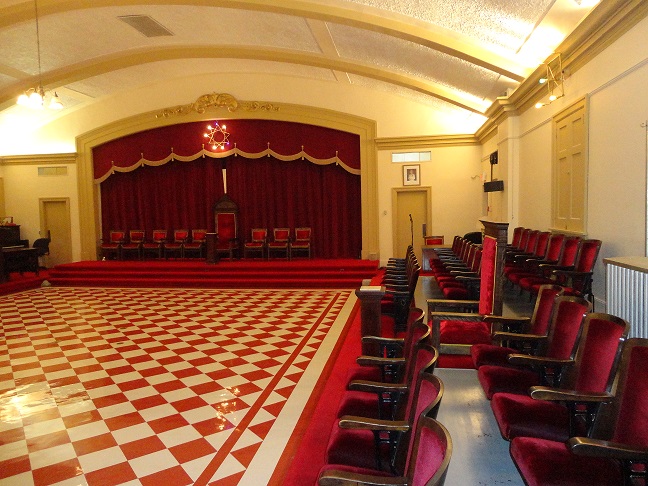
The temple is home to the offices of the grand lodge and the Eastern Star. It contains lodge rooms, and additional facilities to host Grand Lodge sessions and banquets. There are also office rental spaces, and until recently, a CVS Pharmacy was located on the ground floor. At one time there was even a bowling alley in the basement. 

Next to the temple is a plaza featuring the African American Civil War Memorial, dedicated to the 'colored' soldiers who fought to save the Union during the Civil War. A nearby museum contains exhibits about the role of black soldiers during the war.

Friday, November 01, 2019

Soaring Taxes Force Calgary's Freemasons Hall Up For Sale


Calgary, Canada's historic 1928 downtown Freemasons Hall at 330 12th Avenue SW has officially gone up for sale. According to an article on the Real Estate News Exchange, the brethren can no longer afford the crippling taxes on the property. 

The eventual loss of this central temple will be a massive upheaval for Calgary's Masons. Nine lodges currently meet in Freemasons Hall's Blue Lodge Room and Red Lodge Room: Bow River 1; Perfection 9; Ashlar 28; Mount Lebanon 54; Zetland 83; Concord 124; Lodge Renefrew 134; and Calgary 230. The Calgary Valley of the Scottish Rite, and the Grand Chapter of the Order of the Eastern Star are based here. In addition, York Rite bodies meet in the upstairs Red Room. A large banquet hall in the basement can accommodate 300 people.

It was originally the home of the Grand Lodge AF&AM of Alberta's offices and library, but they moved out several years ago.


Blue Lodge Room
Red Lodge Room

Hand-painted pipes on the Blue Room's Casavent organ

Property taxes on the Calgary Freemasons Hall have skyrocketed - from CA$93,622 in 2015 to CA$158,150 in 2019. That's nearly a 70% increase in only four years, just for taxes alone. In 2020 it is expected to rise to CA$188,000. 

Brethren who live in municipalities, states, or countries where Masonic buildings are tax exempt never give these kinds of issues a second thought, but it's a very serious consideration for countless other lodges around the world. Calgary tax officials have valued the building at CA$8 million, but all of us know from long, bitter experience that it won't actually sell for that. Such is the voodoo of tax assessors.


In an article from the Calgary Herald last year, local councilman Jeromy Farkas cited the Masonic temple as a prime example of out of control taxing of large, historic properties:
Coun. Jeromy Farkas, who has advocated for lower property taxes since he was elected to council last fall, said the Freemasons Hall is yet another example of a commercial property tax burden that is spiralling out of control.
“It would be such a shame to have a historic building like this replaced by another highrise,” Farkas said.
“This is another key organization that is being overburdened by rising taxes, an important part of our city’s can-do history.”
Farkas says he wants to work closely with the Freemasons to see what their options are in terms of a tax exemption.
One possibility, he explained, would be to change their designation from Masonic Temple to Masonic Museum.
But Raykhlin said that could introduce a whole new set of administrative and financial challenges.
“It means we have to hire a tour guide, a security guard, and handle all the administration connected with actually being a museum.”
As sad as losing this temple will be when and if it sells, it's even sadder that it is unlikely to be replaced with a facility its equal. With extremely rare exceptions, Freemasons no longer build significant Masonic buildings anymore. Our days of proudly erecting landmark buildings that are worth preserving a century later are long gone. So when the fraternity gives these up, they are gone forever. That's practical in these days of shrinking membership, I know. But I don't think like an accountant, and never have. Economical steel pole barns in remote soybean fields have their uses, but not as Masonic temples that were designed to be bold, impressive, and at the center of their communities.

As for the demographics of the area around Calgary, my friend WB Mike Bayrak writes, "Alberta continues to boast the youngest population per capita in Canada and I believe North America as well. Edmonton has youngest per capita in Alberta. You’d think it was ripe for new members..." 

Yes, you'd think. But not if we don't get busy and start telling our story to the public with greater insistency.  As each generation slides farther and farther from any shared cultural knowledge of who and what the Freemasons are, our job is harder than ever before because we have to remind the public on a regular basis. 

Calgary is a case in point. When their Freemasons Hall was built, the mayor was a Mason, countless local officials and community leaders were Masons, and so was a measurable proportion of the population. Now, I'll guarantee you that most mayors,  city councils, and everyone in tax assessors' offices wouldn't have the slightest idea who the Masons are without resorting to Wikipedia. 

That's nobody's fault but our own.

UPDATE 11/2/2019: 
I am informed that my original last statement of opinion unfairly characterized Calgary's elected officials, who have apparently been quite sympathetic to the plight of the Masons and Freemasons Hall for several years and made suggestions to assist any way they could under the current laws and tax code. The hall did actually receive a substantial tax credit in 2018 because of that help. As a result, I have slightly altered my wording in the last paragraph to make it more generalized. 
However, as the quote from Jeromy Farkas above illustrates, the Masons didn't seem interested in actually doing something like reclassifying the hall as a museum and hiring a token museum employee to get a tax break that would have more than offset the expense.
Interestingly, it still doesn't appear that any of those officials mentioned are, in fact, Masons today - which only illustrates the vast difference between now and when it was built in 1928. Like it or not, we have lost our prestige and cachet of the past that once attracted the men who were the movers and shakers in our communities. Today we remain something those modern officials vaguely recall their grandfathers belonging to without seeing any compelling reason or benefit or attraction join themselves. 
And yes, that is our own fault for getting to this point. 
CH


(BTW, I was looking over the Grand Lodge of Alberta's website for information for this story, and came across a listing of their officers and districts. I don't know about anybody else, but I sure wouldn't want to be known as the District Deputy Grand Master of the Dinosaur District. I fact, I'd be hard pressed to want the word 'dinosaur' to appear on a web page about Freemasonry under ANY circumstances. There's also a link to the Dinosaur Schedule. Yes I know it's a local name for the area, but you're just asking for somebody to point you to the nearest tar pit...)

Sunday, June 12, 2011

275,000 U.S. Non-profit Groups Lose IRS Tax Exempt Status

W:.B:. Nathan Brindle, ever our vigilant SecretaryTreasurer of the Masonic Society, passed along this item today from TaxProfBlog:

The IRS yesterday [Wednesday, June 8] announced (IR-2011-63) that 275,000 organizations have automatically lost their tax-exempt status for failure to file Form 990s for three consecutive years, and announced (Announcement 2011-35) the publication of the list of those organizations on its website. The IRS also issued guidance (Rev. Proc. 2011-33, Notice 2001-43, Notice 2001-44) on how organizations can apply for reinstatement of their tax-exempt status.

Review the database of the 275,000 organizations here just to make sure your lodge or appendant group is not on it. If you search for "Masonic", there are 373 groups listed.

Sort of like checking the obituary page to make sure nothing happened to you in the night.