"To preserve the reputation of the Fraternity unsullied must be your constant care."

BE A FREEMASON

Showing posts with label ritual. Show all posts

Monday, March 18, 2024

Guthrie, Oklahoma Scottish Rite Spring Reunion April 5-7


by Christopher Hodapp


The Guthrie, Oklahoma Valley of the Ancient Accepted Scottish Rite - SJ has one of the most magnificent Masonic buildings in the U.S., and they are understandably proud of their architectural treasure. But Guthrie also is renowned for its outstanding presentations of the complete AASR Southern Jurisdiction’s Pike-derived rituals of the 4th-32nd degrees.


Their Spring 2024 Reunion will be held April 5-7th. Registration opens Friday at 7AM, and the opening ceremonies will begin at 8AM. (Click the schedule below to enlarge.)


If you’re an existing Scottish Rite member in either the NMJ or SJ, don’t miss the opportunity to experience these degrees as they were meant to be staged, in person, in this beautiful temple, and in full pageantry. If you’re not a member and you are a recognized Master Mason in Guthrie’s jurisdiction, contact them directly and ask about membership.


Sunday, February 04, 2024

Ohio's Goose & Gridiron Lodge 1717 Meeting April 27th


by Christopher Hodapp

Ohio's unique Goose and Gridiron Lodge 1717 will host their next meeting on Saturday, April 27, 2024 at the breathtaking Dayton Masonic Center. Lodge will open at noon and the brethren will retire afterwards downstairs to hold their excellent Festive Board. 


What makes "The Goose" unique, you ask? Unless someone pipes up and corrects my oftimes-fallacious memory, I believe they are the only regular Masonic lodge currently at work in the United States that is permitted by the Grand Lodge of Ohio to use England's Emulation Ritual instead of the typical American Preston-Webb work. 
The lodge will be installing its officers that day using the Emulation ceremony, as well. If you've never had the opportunity to visit an English lodge, or a Canadian one that uses Emulation, Ohio may be a quicker trip for you.

Because of the very special nature of the lodge, they try to travel around the state of Ohio throughout the year so members and guests don't always have to make a 5-hour round-trip drive to attend every time. 

In addition, they try to provide some extras before the meeting day for early arrivals. On Thursday, they will have a long field trip to Detroit, Michigan to visit the Detroit Masonic Center (largest Masonic building in the world); on Friday, there will be a tour of the National US Air Force Museum at Wright Patterson AFB just outside of Dayton. And there will be an informal "meet and greet" dinner for members, guests, spouses and partners on Friday night.

WM Daniel Mossop and a certain "Anonymous" Dummy visitor

I got the opportunity to visit Goose and Gridiron last October. When I spoke at the lodge, the Brethren quite generously made me an Honorary Member, and I was deeply honored. If you've never traveled and seen a different – but perfectly regular – ritual besides your own grand lodge's accepted work, make your way to Dayton that weekend! 

If you intend to attend the meeting and Festive Board, CLICK HERE to register. Registration deadline is April 17th. 

Saturday, November 11, 2023

Ancient & Accepted Rite for England and Wales Drops Trinitarian Christian Requirement


by Christopher Hodapp

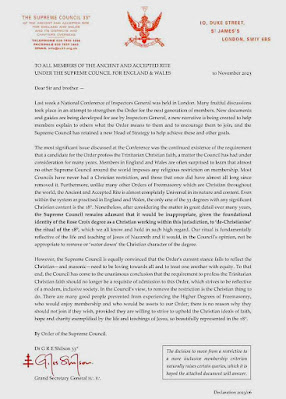
The Supreme Council 33° of the Ancient and Accepted Rite for England and Wales (what American Masons know as the Scottish Rite) announced a significant policy change in its jurisdiction this week. Following a National Conference of Inspectors General, a letter was issued Friday stating that they are removing their longstanding requirement for petitioners to specifically declare a belief in Trinitarian Christianity.

This is an important change in this jurisdiction's membership prerequisites. Prior to this, the requirements for Masons seeking membership in the Ancient and Accepted Rite for England and Wales were as follows: 

"All candidates for membership of the Ancient and Accepted Rite under the jurisdiction of the Supreme Council for England and Wales must profess the Trinitarian Christian faith and have been Master masons for at least one year in UGLE, or have joined a lodge under UGLE from a recognized Grand Lodge."

Friday's announcement reads, in part:

Members in England and Wales are often surprised to learn that almost no other Supreme Council around the world imposes any religious restriction on membership. Most Councils have never had a Christian restriction, and those that once did have almost all long since removed it. Furthermore, unlike many other Orders of Freemasonry which are Christian throughout the world, the Ancient and Accepted Rite is almost completely Universal in its nature and content. Even within the system as practiced in England and Wales, the only one of the 33 degrees with any significant Christian content is the 18°.

Nonetheless, after considering the matter in great detail over many years, the Supreme Council remains adamant that it would be inappropriate, given the foundational identity of the Rose Croix degree as a Christian working within this jurisdiction, to 'de-Christianize’ the ritual of the 18°, which we all know and hold in such high regard. Our ritual is fundamentally reflective of the life and teaching of Jesus of Nazareth and it would, in the Council's opinion, not be appropriate to remove or 'water down' the Christian character of the degree.

However, the Supreme Council is equally convinced that the Order's current stance fails to reflect the Christian—and Masonic—need to be loving towards all and to treat one another with equity. To that end. the Council has come to the unanimous conclusion that the requirement to profess the Trinitarian Christian faith should no longer be a requisite of admission to this Order, which strives to be reflective of a modem, inclusive society. In the Council's view, to remove the restriction is the Christian thing to do. There are many good people prevented from experiencing the Higher Degrees of Freemasonry, who would enjoy membership and who would be assets to our Order; there is no reason why they should not join if they wish, provided they are willing to strive to uphold the Christian ideals of faith, 
hope and charity exemplified by the life and teachings of Jesus, so beautifully represented in the 18°.


As alluded to in the letter, the traditional Rose Croix 18° as it is worked in the majority of Scottish Rite jurisdictions today is founded upon Christian imagery and symbolism — events in the life of Christ are used as an allegory for its lessons of monotheistic universality and the importance of Faith, Hope, and Charity. 

In many Scottish Rite systems around the world, the 18th is the culmination of the first half of the Rite's degrees, and it can take many years to attain that level outside of the U.S. It's not uncommon for many Scottish Rite members in certain jurisdictions to never rise above the 18th — their degrees are taken one at a time, in order, often months (or even years) apart. This dramatically differs from the U.S. where a candidate generally becomes a full 32° Scottish Rite Mason in a single day or weekend. 

Albert Pike's post-Civil War revision of the 18° for the Southern Jurisdiction of the Scottish Rite in the U.S. kept the original structure and allegory of the Rose Croix degree that had originally come to America from France through Etienne Morin as part of the hauts grades making up the Rite of Perfection. (Refer to the Francken Manuscript for this early version.) While it tells the story of the life, death, and resurrection of Jesus Christ, Pike removed the original degree's obligation to live a specifically Christian life and accept all of the tenets of Christianity. He felt such an obligation violated the most basic Masonic principles of universality and tolerance. So he kept the story, but reworked the obligation of the degree.

The Northern Masonic Jurisdiction of the Scottish Rite in the U.S. took a bit longer to remove the specifically Christian obligation from the 18°. In the degree, Jesus of Nazareth is the Exemplar, and any monotheistic believer can confidently take the obligation. 

The NMJ's website explains their own current version of the 18° (as revised in 1941 and later, in 1964) this way:

In 1941, Sovereign Grand Commander Melvin M. Johnson appealed to revise the 18° so it could be better suited for men of all faiths. He said: "This is the heart of what the Rite seeks to inculcate in its degree of Rose Croix, this common faith. (That good will overcome evil) When the battle is won, Freemasonry’s greatest secret – secret only, because the world will not learn it – will be secret no longer for then humanity will find peace in brotherhood."

[snip] 


[T]he Knight of the Rose Croix of H.R.D.M (Heredom), relays the life and death of Jesus. The allegory is based on the New Law he declared at the Last Supper: the law of love, which all men everywhere may understand and practice. His teachings exemplify the universal principles of life and encourage candidates to be virtuous, endeavor to eliminate vice, and practice tolerance and love. Upon the doctrine of Universality, the 18° should be interpreted by each Brother according to his own faith.

While Craft Lodge Freemasonry has been historically non-sectarian in its membership requirements since at least 1717, there are several Masonic-related appendant organizations that a Freemason can join that do have a specifically Trinitarian Christian requirement. These include the Knights Templar, the Masonic version of the Rosicrucians (SRICF), the Red Cross of Constantine, the White Shrine of Jerusalem, and more. The Supreme Council 33° for England and Wales has been unusual by having such a requirement, since no other Scottish Rite jurisdiction does.

Just as a bit of background, in May 1801, the first Supreme Council 33° for the Ancient Accepted Scottish Rite was opened in Charleston, South Carolina, and eventually became known as the Southern Jurisdiction of the USA. It was followed by France (1804), Spain (1811) and the Northern Masonic Jurisdiction of the USA (1813). Ireland (1826) was the sixth, England and Wales (1845) — receiving its Patent from the Northern Masonic Jurisdiction — was the eleventh, and Scotland (1846) the twelfth. There are now independent Supreme Councils in over 60 countries.

Monday, October 30, 2023

NEW BOOK: 'Freemasonry From the 1st to the 33rd Degree' (1875) translated by Kamel Oussayef


by Christopher Hodapp

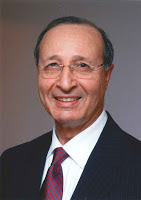
Illus. Kamel Oussayef 33° has just released a new book through the Scottish Rite Northern Masonic Jurisdiction as part of an ongoing program of rediscovering a treasure trove of 18th and 19th century French Masonic manuscripts. Entitled Freemasonry From the 1st to the 33rd Degree: the Complete Ritual of the Sovereign Grand Inspector General of the 33rd and Last Degree of the Ancient Accepted Scottish Rite, it is an English translation of an original document in French, written down in 1875 by an unknown Mason during an international Scottish Rite Congress held at Lausanne, Switzerland. 

They loved book titles in the 19th century that were so long they ended in a different zip code.

While Albert Pike was presenting his newly-revised degrees in the Southern Jurisdiction's Supreme Council in the U.S., this document is a record of the Scottish Rite rituals being worked contemporaneously in Switzerland.

Illus. Brother Kamel has been volunteering for almost 20 years at the Scottish Rite (NMJ) Museum & Library working on this series of very special translation and publication projects. The archives of the museum contain a priceless collection of rare, handwritten French manuscripts that have languished in the vaults for a century or more without ever having been translated into English. His previous books include: Freemasonry By Questions and Answers; Saint Edoüard: A 1748 Masonic Scottish Lodge During the French EnlightenmentThe Spirit of Freemasonryand The Book of Wisdom - all of which have been published in beautiful side-by-side translation editions by the Scottish Rite Northern Masonic Jurisdiction


Like his other books, The Complete Ritual  is presented in a photographic facsimile manner, with a color photo of each original manuscript page on the left side, and the English translation on the right. 


The degree rituals themselves are summarized, and there are no real "dramatic vignettes" as in the American Northern and Southern jurisdictions. They describe the transmission of signs and passwords, designs for aprons, sashes or other regalia for each degree, and perhaps a historical or philosophical explanation, as presented in the original document. 

The degrees include the Entered Apprentice, Fellow Craft and Master Mason as part of the overall Scottish Rite system. The Rite has always been a self-contained system of its own, but in most jurisdictions, they agree not to work their first, second, and third degrees in order to coexist with an established grand lodge's sovereignty. Some countries don't follow this model, and there are many jurisdictions in the world in which the complete Scottish Rite degree system is their grand lodge. In more than a few places, this led to schisms that remain to this day of sovereign grand lodges competing with a parallel Scottish Rite Supreme Council/grand lodge.

There is also an outstanding historical introduction by Illus. Jacques G. Ruelland, Scottish Rite Deputy for the Province of Quebec, Canada that provides much background information about the Lausanne Congress, the circumstance in which this manuscript had been written. He provides a detailed social, political and Masonic background for this important period that has been rarely examined here in the U.S.

The Lausanne Congress of 1875 was important, in part, because pro-secularism French Masons in the Grand Orient de France were attempting to convince French-speaking Masonic bodies to remove all references to God, a "supreme being," or the "Grand Architect of the Universe" from their degree systems and as a requirement for petitioners. 

France's secular Grand Orient craft lodge degrees consisted of (and still do) the Scottish Rite's first three degree rituals, and they were (unsuccessfully) attempting to strong-arm the Swiss into purging God from all of their rituals at this time. Doing so is an awkward situation since many of the Scottish Rite degrees are centered around the Biblical story of building or re-building Solomon's Temple (and are also very similar to what we call in America the York Rite degrees). It's tough to remove references to God successfully from Masonry's Biblical symbolism, especially if you're trying to leave out the Universe's Great Architect from the story of building sacred temples in the hearts of men, patterned after the holiest place on Earth and erected to God by Solomon. Apparently the Swiss thought so too, and didn't follow the Grand Orient's recommendations.

Research has shown that the earliest haute grades ("high degrees") of what we call Scottish Rite Freemasonry had been created or influenced by late-1700s Jacobites - pro-Catholic Scottish and English exiles living in France who had supported the Stuart line of kings back in their homelands. Their Catholic beliefs clashed with the secular forces of the French Revolution period that sought to remove the Church's influence from all government, education, and social aspects of life – even Freemasonry. But even though French movements for "complete freedom of thought" continued to grow in popularity, the French Masonic bodies retained the belief in God as a requirement after the Revolution. That clash of ideologies eventually led to the Grand Orient de France removing the requirement of its members of believing in a Deity in 1877 (two years after the Lausanne Congress), which created a schism in worldwide Freemasonry that exists to this day, and which is why the smaller but widely-recognized Grande Loge Nationale Française is considered the only regular grand lodge in that country by the vast majority of the Masonic world. 

In 2020, Illus. Kamel Oussayef 33° became the 110th author to be admitted into the Society of Blue Friars, a very special organization formed in 1932 to specifically honor Masonic authors.

Friar Oussayef was born in Sétif, Algeria and attended school in France, where he lived for many years. He holds an MA from the Fletcher School of Law and Diplomacy at Tufts University and an MS from the School of Public Communications at Boston University.

Kamel is a Past Master of William Parkman Lodge and Converse Lodge in Massachusetts (
Masons in that state do not number their lodges). He has been awarded the prestigious Henry Price and Joseph Warren medals for distinguished service to Freemasonry in Massachusetts. In the AASR, he is an Assistant Master of Ceremonies with the Massachusetts Consistory of the Valley of Boston.

Freemasonry From the 1st to the 33rd Degree: the Complete Ritual of the Sovereign Grand Inspector General of the 33rd and Last Degree of the Ancient Accepted Scottish Rite is available as an oversize 272-page paperback from the Scottish Rite Northern Masonic jurisdiction's website for $72.80, or as a Kindle edition for $9.99 for cheapskates, skinflints, and starving Masons... (I can't stand e-books myself, but it still does present each full-color manuscript page, followed by the English translation on alternating pages, which makes it a little more cumbersome to read than the dead tree edition.)

Sunday, April 10, 2022

Welcome Brothers: GL of Ohio Raises 780 in Statewide One Day Class


by Christopher Hodapp

On March 26th, the Grand Lodge of Ohio F&AM conferred the Entered Apprentice, Fellow Craft and Master Mason degrees on a total of 780 candidates as part of a statewide One Day Class at several locations. Naturally, the Masonic Intertube discussion boards, Twitbook, and Facetwit sites went mildly berserk over the news. As many as 780 may sound, it's only about 10% of the record 7,700 Masons raised by the Grand Lodge of Ohio at a similar statewide one day event back in 2002.

Even though these types of mass membership events originated thirty years ago, they continue to remain controversial within the fraternity. Indeed, many online discussions that took up the subject over the last couple of weeks sounded every bit as vitriolic as they did twenty years ago.

Origin

The first 'Grand Master's Class' was held in 1992 as a two-day festival by the Grand Lodge of the District of Columbia . In that single event, their small jurisdiction raised 113 candidates — an astonishing 55% of all of DC's candidates for the entire year of 1992. 

Despite having no internet in those days, it didn’t take long for the word to spread. By the next February, DC's event—the first mass raising of Master Masons of its kind—was the heated talk of the Conference of Grand Masters. The practice picked up steam nationwide in a startlingly short time, especially for an institution as resistant to change as Freemasonry. By 1998, the Grand Lodge of New Jersey trumpeted that 96 lodges participated in their first one-day degree event, and raised 434 new Master Masons.

At the time, the bulk of Freemasons worldwide were aghast, and more than a few foreign grand bodies grumbled about perhaps withdrawing recognition of their U.S. counterparts that had held such mass raisings. While similarly massive events were overwhelmingly typical of degrees conferred on large classes of Scottish Rite members, the vast majority of Masons agreed that they were wholly inappropriate for new initiates into the fraternity. The three Symbolic Lodge degrees—especially for the Entered Apprentice and the Master Mason—were particularly considered to be individual and deeply personal experiences. At best, critics alleged, men made Masons in a day or two would undoubtedly be the fastest ones to leave. They would fail to become proficient in the required memory work. If they remained members at all, they certainly would cease to participate, much less take on the requirements to become officers. Lodges that relied on such classes to do all of their degree work for them would quickly lose any ability to confer their own degrees forever. In short, the naysayers claimed, the entire fraternity would be both cheapened and robbed—from the candidates themselves, right down to the lodges and their own members.

Ohio's Record-Setting Class of 2002

By 2001 at least thirty-one U.S. grand lodges had conducted one or more of these events in varying permutations. Then in April 2002, Ohio left everyone else in the statistical dust, setting the astonishing record of initiating, passing, and raising 7,700 Master Masons in multiple locations throughout the state in a single day. Throughout the seven years prior to their first enormous Grand Master’s Class, the state of Ohio had raised a combined total of 10,341 Master Masons in the traditional, individual manner. Their 2002 Grand Master’s one-day event nearly doubled their entire prior seven-year membership increase in just a matter of hours. The rest of the Masonic world’s nose-counters bolted straight up in their collective seats and took notice.

Ohio’s colossal one-day increase was never again equaled anywhere. They staged two more such events in 2003 and 2005, and studied the after-effects at the end of 2006. In a little more than five years, one-day Masons raised at their three events alone represented more than 10% of Ohio’s total Masonic membership. While their two subsequent classes never came close to equaling their enormous premiere event, other jurisdictions still looked enviously at Ohio and judged them a triumph. Numerically speaking, anyway.

Results

One of the major criticisms from the start was an assumption that one-day Masons would not go on to become active lodge participants, proficient ritualists, or officers. “Easy in, easy out,” was the oft-repeated, doleful warning. But several jurisdictions that amassed enough data over time were able to disprove that assertion.

A study was conducted in 2001 by Paul M. Bessel for the Grand Lodge of the District of Columbia, which was the first of its kind to analyze the long-term results of such conferrals. Their grand lodge was unique, since they had conducted two-day degree events annually for eight years and had the data to analyze. Bessel found that the retention and participation rate of members initiated, passed, and raised in the slower, traditional manner, versus the Grand Master’s Class candidates, were statistically identical. Subsequent years demonstrated the same results, clearly disproving objections based only upon fears that dejected Master Masons who were disappointed or unimpressed by their one day experience would vanish faster than their traditionally raised brethren.

Other jurisdictions that bothered to investigate their own circumstances and results came to the same conclusions. Ohio did its own study in 2007, five years after their record setting class. In the three Grand Master’s Classes held between 2002 and 2005, they found that 8% of one-day class members were serving or had already served as lodge officers. That worked out to more than 1,000 officers in their 534 lodges, or almost two officers per lodge. The actual numbers among lodges varied—several reported as many as five of their current officers were one-day members. 

In addition, lodges reported an average of 15% of one-day members attended meetings regularly, which was virtually identical to (and often greater than) the participation rate of traditionally made Masons. Numerous lodge secretaries expressed the belief that one-day classes had actually “saved” their lodges. 

More recently, a 2015 study of current lodge officers in Washington State revealed that one out of six officers are one-day class members.

As of 2017, my own Grand Lodge of Indiana has raised a total of 6,976 Master Masons via one-day events since its first in 1997. Of those, 3,958 still remain Masons across those twenty years. Many have been officers and Worshipful Masters, and all have simply been as active or inactive as their traditionally-made brethren. To date, there have been several grand masters all across the U.S. who received their degrees at one-day events. 

Tens of thousands of U.S. Masons have been initiated, passed, and raised in one-day classes, and the loss of them due to inactivity and demits is no better or worse than traditionally made members. In Indiana’s case, figures clearly show that one-day Masons have actually remained members in a substantially greater percentage than those traditionally made.

That which was lost

The philosophical question as to the loss to the candidate of a more individual, transformative, initiatic experience is what cannot be measured. What has been commonly echoed by men who received the accelerated degrees is that they returned to their own lodges and discouraged their officers and fellow members from sending future candidates to them. So in their own way, one-day classes actually encourage lodges to increase their proficiency at conducting degree work, and not abandon it, as was initially feared by some. 

Retention and participation comes down solely to the way the members are treated and mentored once they start attending their lodges, and rests on the interest and dedication of each individual Mason. A one day class conferral of the three lodge degrees doesn't let the lodge and its members duck their responsibility to provide a trusted, knowledgable mentor to those brethren who need more coaching and education, not less. 

Maybe more to the point is that we don't have two classifications of Master Mason in this fraternity. If at their next meeting after their raising they are referred to by ostensible brethren as ‘McMasons,’ ‘Blue Lightenings,’ or ‘One Day Wonders,’ receive no mentoring follow up, and suffer through dull stated meetings with no Masonic education and un-Masonic infighting, they will be unlikely to send in their dues renewal in December.

One-day classes were developed largely in response to the screams of lodges over membership losses and their own inability to confer their own degree work. So, those early massive classes did exactly what the lodges begged for—they brought in new members, by the bucketful. One day classes will only end if lodges stop demanding them. As I've said repeatedly, if you have a visceral reaction against the practice, fault the lodge who sent him to the class, not the candidate who is now your Brother. 

The lodges that failed to keep them coming back managed to accomplish that part all by themselves.


This isn't the first time I've tried to tackle this topic, and probably won't be the last. Have a look at:

Tuesday, February 08, 2022

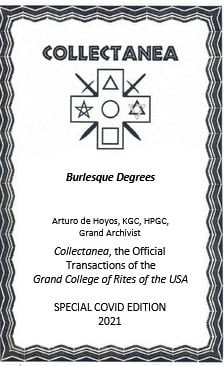
Grand College of Rites Offers Bonus Book: 'Burlesque Degrees'


by Christopher Hodapp
The Grand College of Rites of the United States of America is a regular Masonic body that is dedicated to preserving the history and rituals of defunct and inactive Masonic orders. Formally organized in 1932, the Grand College of Rites publishes an annual volume known as Collectanea which contains reprinted rituals of various officially extinct organizations deposited within its archives. The College and its members agree that these rituals are published and copyrighted strictly for the purpose of research and preservation, and are not to be worked or performed. Over the last couple of years, for example, Collectanea has been featuring the degrees of the Cerneau Rite system, which caused more than its share of excitement in the 1800s when it began to spread throughout the northeastern states. (Still to this day, the Tyler's Oath administered to visitors in Pennsylvania specifically requires sojourning Masons to swear they are not members of a Cerneau lodge and have not had the degrees of the Cerneau Rite conferred on them! Talk about holding a grudge.)

But the book that came this week is actually something quite special, and not the usual sort of obscure esoteric rituals the College has traditionally published in the past. Because of the COVID-19 pandemic precautions in the DC area last year, the 2021 Masonic Week was canceled. In light of this, Most Illustrious Duane L. Vaught, KGC, the current Grand Chancellor of the College, was struck by the notion of offering a special bonus book to the members that features some lighter-hearted levity than the usual offering of serious degrees.

And so, this volume of "Burlesque Degrees" is being provided as a Bonus Book to all 2020 and 2021 dues-paying members as a way of saying thank you for their continuing support of the mission of the College throughout the COVID-19 pandemic. 


During the Golden Age of Fraternalism, quite literally hundreds of fraternal groups proliferated. Most tried to be solemn in nature, with degrees to impart wise and serious truths. But others were created as unofficial 'side degrees' to provide an entertaining night for members, or as one pamphlet put it, "a comic ceremony designed to cure the blues and fill the treasury." 

The fraternal groups included in this collection are truly obscure and deliberately comic: The Haymakers, the Munchers of Hard Tack, the Sublime Order of Arabian Knights, Uncle Sam's Eagles, the Up-To-Date Order of Goosie Girls, the Grand and Noble Order of Button Busters, and more.


These types of side degrees sometimes became quite elaborate and required special props as part of the gags involved. DeMoulin Brothers in Greenville, Illinois published an enormous catalog of goofy (and occasionally dangerous) props for side degrees, and became known as "the goat factory" because of the wide variety of various mechanical bucking goats they manufactured. The C.E. Ward Company in New London, Ohio also published a catalog strictly for "burlesque goods," and several pages of their offerings are included at the end of this volume.

Annual dues in the GCR is a paltry $20. If you are a current dues-paying member who was NOT paid up in 2020 or 2021 - you can contact the Grand Registrar at grand.registrar@grandcollegeofrites.org for purchase information for this bonus book.

Meanwhile, the regular 2021 edition of Collectanea will conclude the series of the Cerneau Rite (30° - 32°) is at the printers now and will ship very soon.

Any Master Mason holding membership and in good standing in a regular symbolic lodge recognized by a majority of grand lodges of Freemasonry in the United States may petition for membership as a Fellow in the Grand College of Rites. (click here for a petition)

Friday, January 28, 2022

Pre-Order From Masonic Book Club: Samuel Pritchard's Masonry Dissect'd


by Christopher Hodapp

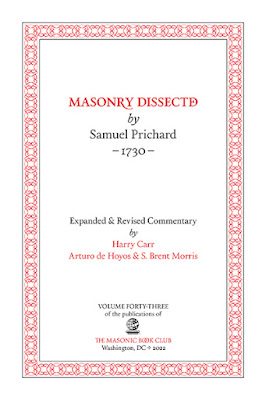
The newly revived Masonic Book Club has just announced the pre-publication ordering window for their second volume: a new edition of Samuel Pritchard's 1730 ritual exposure, Masonry Dissected

The pre-publication order window will be open from January 27, 2022, until February 28, 2022, at 11:59

The 'old' Masonic Book Club first published this book in 1977 with wonderful commentary by Masonic scholar Harry Carr, Past Master and Secretary of Quatuor Coronati Research Lodge No. 2076 in London.This 144-page reprint of that 1977 edition features Carr’s classic commentary, revised and updated by Ill. Arturo de Hoyos, 33°, G.C., and S. Brent Morris, 33°, G.C.

Pritchard's book included the first known publication of the details of the Master Mason degree, which had only been incorporated into the premiere Grand Lodge of England's ritual in 1726, just nine years after the 1717 formation of their grand lodge.

During the years before 1726, English ritual consisted of only the Entered Apprentice and Fellow Craft degrees. While Pritchard's book was doubtless seen as a dastardly act and a betrayal of Masonic secrecy and honor at the time, it does provide historians a written record of the Masonic degrees as they existed in those formative years. It was also extremely popular at the time, presumably for both a curious public, and for Masons trying to learn to memorize their ritual.

From the MBC's description:
"When the Grand Lodge of England was formed in 1717, there were only two degrees: Entered Apprentice and Fellow Craft. A “master mason” either held the contract at a job site (think “general contractor”) or was the elected presiding officer of a lodge. The first conferral of the Third or Master Mason Degree in a Masonic lodge occurred in March 1726 in Lodge Dumbarton Kilwinning No. 18. The degree apparently was conferred in May 1725 at a social club of Masons in London, the Philo Musicæ et Architecturæ Societas. There is no hint of what the ceremony may have been—not in the Old Charges, manuscript rituals, or publications. Nothing!
"Then on October 20, 1730, Samuel Prichard published Masonry Dissected with full details of the ritual for what he claimed was the Master Mason Degree. A second edition came out on October 21, and a third edition on October 31, all three published by Wilford in London. A presumably pirated edition dated “MD.CC.XXX” (1730) and printed by Thomas Nichols “without Temple Bar” (London) probably had made its appearance by the end of October 1730. Other presumably pirated versions were printed in Read’s Weekly Journal or British Gazetteer, on October 24, 1730; Northampton Mercury, in two parts on October 28, 1730, and on November 2, 1730; and the second half in The Original Mercury, York Journal: or, Weekly Courant, on November 2, 1730 (the reprint of the first half has not been located).
"Thus, there were three separate editions by Wilford for Prichard, a pirated edition by Nichols, and a newspaper version, all printed in London, plus a two-part pirated newspaper version printed in the Midlands, and another pirated newspaper version printed in the North of England, all within fourteen days. This was a popular book!

Here are the specifics from Brent Morris:


The pre-publication order window will be open from January 27, 2022, until February 28, 2022, at 11:59  
 
The special MBC pre-publication price is $30. Regular retail price will be $40. 
 
This time during the pre-publication sale period, we also will be offering a "First Day of Issue" signed edition for $45. These copies will not be available later for retail. 
 
We only will accept pre-publication purchases placed using the MBC order form. Pre-publication orders are not available through the Scottish Rite Store.

The printing industry currently is experiencing massive supply chain disruptions. We cannot place the order for Masonry Dissected until pre-publication purchasing is completed and reviewed. We hope to place the order by March 3, 2022. Our printer estimates "approximately 78–83 business days" to manufacture the books. We expect the books to be mailed about June 15–22, 2022, and will keep you informed of progress and changes. Thank you for your understanding during these unusual times.

**Due to GDPR and other complications, we only can accept credit card charges from and ship to the USA, US territories, Canada, and Mexico.

** However, Lewis Masonic in the United Kingdom is accepting a limited number of pre-publication orders (signed & unsigned editions) for the rest of the world. For details, please click the "Order Masonry Dissected" button below and answer "All Other Countries" to the first question.

If you have any questions, please visit the "FAQs" section on our MBC web page or email us at mbc@scottishrite.org.
There are no dues for the new Masonic Book Club. Books are announced for pre-publication orders and payments are only collected as books are ready to be manufactured. All transactions are handled exclusively online. Without a rigid calendar driving publications, new books can come out as quickly as nine months or as late as eighteen months, as resources permit. Book prices range in the $30 vicinity for pre-publication orders, or $40 retail if you miss the pre-pub ordering window. Volumes will no longer be numbered as in the old Club, but if the hardback edition sells out, the MBC will make a paperback print-on-demand edition available of the books. 

If there are sufficient pre-publication sales, MBC members will be notified after the pre-publication window closes at 11:59 pm ET on Monday, February 28, 2022. The books will be printed, and will ship around June 15–22, 2022.

If there are insufficient sales, members will be notified; and refunds will be credited about March 21, 2022.

To the relief of the MBC's older original members, the new Club actually communicates with its members twice a year with an electronic newsletter to keep everyone in the loop about upcoming volumes in the works and their production status. Despite his recent retirement from his longtime job of editing the AASR-SJ's Scottish Rite Journal, S. Brent Morris 33° continues to manage the MBC, and this endeavor has truly been a labor of love for him. 


The mission statement of the resurrected Masonic Book Club is to publish classic Masonic works with the goal of increasing Masonic knowledge and to become a profit center for the House of the Temple Foundation. More information can be found at the MBC's website HERE. If you are interested in this or subsequent volumes, you need to sign up on the website. If you have any questions or suggestions, please address them to mbc@scottishrite.org.

Sunday, November 21, 2021

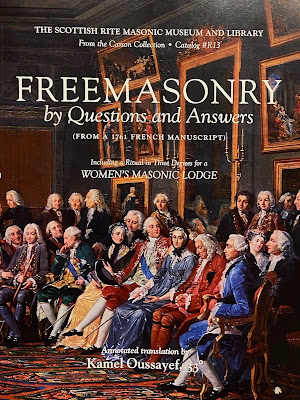
New Book: 'Freemasonry By Questions and Answers' by Kamel Oussayef

by Christopher Hodapp

Illus. Kamel Oussayef 33° has been volunteering for almost 20 years at the Scottish Rite (NMJ) Museum & Library working on a series of very special projects. The archives of the Museum contain a priceless collection of handwritten 18th and 19th century French manuscripts that have languished in the vaults for a century or more without ever having been translated into English. His previous books include: Saint Edoüard: A 1748 Masonic Scottish Lodge During the French EnlightenmentThe Spirit of Freemasonry; and The Book of Wisdom - all of which have been published in beautiful editions by the Scottish Rite Northern Masonic Jurisdiction

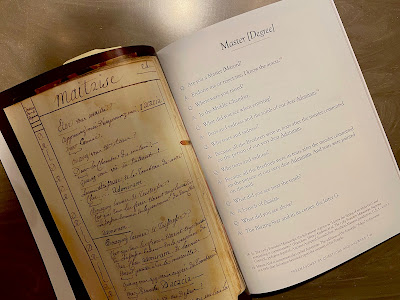
His new book is the latest in that series. Freemasonry By Questions and Answers is a translation of a 1761 French manuscript made up of a series of notebooks, plus several additional documents up through 1806. If you have any interest in the development of Masonic ritual — both in the Craft lodge and in what became the Scottish Rite — this book is remarkable. French and so-called continental Freemasonry veered off into both major and minor differences from the Preston-Webb rituals we work in the U.S. or the Emulation rituals in Britain. Also, bear in mind that a year after the first notebook in the collection was written down, Etienne (Stephan) Morin carried a patent to the Caribbean and the Americas to establish a Supreme Council of the Rectified Scottish Rite. The degrees in the notebooks reflect the words and rubric of the Rectified Rite at that time. There are also notes concerning English and Scottish rituals demonstrated to the French brethren from visitors across the Channel. There is even a suggested series of toasts for table lodge/festive boards included. If you are a U.S. jurisdiction that uses a particular odd-sounding "table lodge" format that includes the line "To erect Temples to Virtue, and to dig dungeons for vices," that wording doesn't exist in Preston-Webb. It originally came from French ritual in this formative period.

Many of the early French Masonic lodges were extensions of salons of the period, where influential and learned men and women would gather to discuss philosophy, the arts, social and political issues and other topics of the day. Consequently, a special treasure in this manuscript is the inclusion of the Q/A lectures from a French female "lodge of adoption." That term comes from the male lodges that would sponsor or "adopt" a lodge for women, with substantially different rituals and wording. And as a final bonus item, a letter is included from 1806 that explains how and why Napoleon Bonaparte became "protector of Freemasonry" without ever actually joining himself, why he encouraged his sister Caroline, his brothers, and his military officers to become Masons, and how he encouraged his wife, the Empress Josephine, to become Venerable Maîtresse of a female Masonic lodge that attracted influential women to join with her. In addition to the translations, the entire manuscript is heavily annotated to provide insights about the Masons involved, noteworthy historical contexts, ritualistic variations, and more.


Like his other books, Freemasonry By Questions and Answers is presented in a photographic facsimile manner, with a color photo of each manuscript page on the left side, and the English translation on the right. 

Studying the changes in Masonic ritual from one country to another in the first century of grand lodge speculative Masonry is fascinating. It should be noted that French writing in the 18th century is not the same French you might have taken classes in or what you find in "French phrases for tourists" guidebooks. It's more complex, and occasionally obscure. Having these French Masonic records and notebooks translated into English opens them up to wider study by more scholars. 

By the way, Kamel's books make excellent companions to a rare, out of print work published back in 1971 by Quatuor Coronati Lodge of Research No. 2076 in London. Track down The Early French Exposures, edited by the legendary Masonic author, Harry Carr.

In 2020, Illus. Kamel Oussayef 33° became the 110th author to be admitted into the Society of Blue Friars, a very special group of Masonic writers. Friar Oussayef was born in Sétif, Algeria and attended school in France, where he lived for many years. He holds an MA from the Fletcher School of Law and Diplomacy at Tufts University and an MS from the School of Public Communications at Boston University.

Kamel is a Past Master of William Parkman Lodge and Converse Lodge. He has been awarded the prestigious Henry Price and Joseph Warren medals for distinguished service to Freemasonry in Massachusetts. In the AASR, he is an Assistant Master of Ceremonies with the Massachusetts Consistory of the Valley of Boston.

At the moment, Freemasonry By Questions and Answers is only available as a Kindle download for $9.99 from Amazon.com. The Scottish Rite NMJ Supreme Council website is in the process of being updated following their change in leadership a couple of months ago. Once the print version of book is added to the NMJ's online Marketplace, be aware that a limited number of the hard copy, paperback are being printed in its first run. It is expected to be in the $50 price range. If that initial printing is popular enough to sell out, an additional print run will be considered. I'll update this post when that comes available.

UPDATE 12/13/2021
Paperback edition now available.
The oversized paperback edition of the book is now available from the Scottish Rite NMJ Marketplace website for $52. CLICK HERE TO ORDER


Friday, August 27, 2021

Templar Eye Foundation Offers Historic 19th Century 'Knight Templar Monitor' Reprint


by Christopher Hodapp

UPDATED 8/31/2021 at 11:30PM: The original version of this post incorrectly stated that this is a leather-bound edition. I have also added more ordering options at the end of the story.

In the late 1880s, Sir Knight George Cooper Connor of Tennessee made a florid, handwritten transcript of the rituals of the Masonic Knights Templar Orders of the Red Cross, Malta and the Temple for use in the Grand Commandery of Tennessee. His manuscript later became a basis for the development of the adopted Templar Orders we know today. Now researchers and students of the evolution of Masonic-related rituals have a beautiful new historical reprint to pore over, thanks to the Knights Templar Eye Foundation and Lookout Commandery No. 14 in Chattanooga, Tennessee.

This hard-bound reprint of George Cooper Connor's Templar Monitor was designed by Brother Steve Adams, who has designed and illustrated several recent books for the Scottish Rite Research Society. The Monitor includes commentary from PGC George Marshall, KGT, on the ritual of each of the Orders, and the publication reflects the tireless efforts of SK Piers Vaughan, KCT. Like some recent Scottish Rite NMJ publications of the Francken Manuscript and several early French Masonic manuscripts, this volume features Connor's beautifully handwritten text and illustrations on one page, and a modern typeset version with new, clearer graphic illustrations and diagrams on the facing page. 


Unlike the relatively simple choreography of degree floor work in a Craft Lodge, the Templar Orders require more cast members and much more complexity of movement with the candidate throughout the asylum. Consequently, Cooper's original manuscript included many hand-drawn watercolor images relating to staging each of the Orders, along with illustrating the design of the jewels of the Orders.


Connor served as Right Eminent Grand Commander and Most Worshipful Grand Master of Masons in Tennessee. He later served as Grand Recorder of the Grand Commandery of Tennessee as well as serving on several committees of the Grand Encampment of Knights Templar US. You will find more information about him in the preface to the book, along with items regarding his Templar Funeral Service and the Templars and dignitaries from around the nation who attended his funeral.

There is a limited supply of the Templar Monitor, and it is being offered as a fundraising item for the Knight Templar Eye Foundation. The price is $150 and 100% of the proceeds go directly to the KTEF. Please note that there are no online sales offered at this time. To purchase it, you must CLICK HERE, print, and mail the order form along with a check or money order, or fax the form with your credit card information. I'm only reporting it.

I'm also informed that it can be ordered by phone from the Foundation office at 214-888-0220.

(Images are shamelessly snagged from Steve Adams' Facebook page.)

Sunday, August 01, 2021

Masonic Book Club Will Publish Samuel Pritchard's 1730 'Masonry Dissected'


by Christopher Hodapp

The newly resurrected Masonic Book Club (MBC) has announced its upcoming second volume: a new edition of Samuel Pritchard's 1730 Masonic exposure, Masonry Dissected, featuring commentary by the late Harry Carr, and revised and updated by Arturo De Hoyos and S. Brent Morris. The pre-order window for Masonry Dissected will be announced in late Fall 2021 or early Winter 2022.

Pritchard's book included the first known publication of the details of the Master Mason degree, which had only been incorporated into the premiere Grand Lodge of England's ritual in 1726, just nine years after the 1717 formation of their grand lodge. 

During the years before 1726, English ritual had contained only the Entered Apprentice and Fellow Craft degrees. While Pritchard's book was doubtless seen as a dastardly act and a betrayal of Masonic secrecy and honor at the time, it does provide historians a written record of the Masonic degrees as they existed in those formative years. It was also extremely popular at the time, presumably for both a curious public, and for Masons trying to learn to memorize their ritual.
Title Page from original Masonry Dissected

From the MBC announcement: 

"When the Grand Lodge of England was formed in 1717, there were only two degrees: Entered Apprentice and Fellow Craft. A “master mason” either held the contract at a job site (think “general contractor”) or was the elected presiding officer of a lodge. The first conferral of the Third or Master Mason Degree in a Masonic lodge occurred in March 1726 in Lodge Dumbarton Kilwinning No. 18. The degree apparently was conferred in May 1725 at a social club of Masons in London, the Philo Musicæ et Architecturæ Societas. There is no hint of what the ceremony may have been—not in the Old Charges, manuscript rituals, or publications. Nothing!
"Then on October 20, 1730, Samuel Prichard published Masonry Dissected with full details of the ritual for what he claimed was the Master Mason Degree. A second edition came out on October 21, and a third edition on October 31, all three published by Wilford in London. A presumably pirated edition dated “MD.CC.XXX” (1730) and printed by Thomas Nichols “without Temple Bar” (London) probably had made its appearance by the end of October 1730. Other presumably pirated versions were printed in Read’s Weekly Journal or British Gazetteer, on October 24, 1730; Northampton Mercury, in two parts on October 28, 1730, and on November 2, 1730; and the second half in The Original Mercury, York Journal: or, Weekly Courant, on November 2, 1730 (the reprint of the first half has not been located).
"Thus, there were three separate editions by Wilford for Prichard, a pirated edition by Nichols, and a newspaper version, all printed in London, plus a two-part pirated newspaper version printed in the Midlands, and another pirated newspaper version printed in the North of England, all within fourteen days. This was a popular book!
Technically, this will be Volume 43 of MBC's books published since it originally formed in 1970, but this new edition of the book isn't the first time the the MBC has offered it. The 'old' Masonic Book Club published it in 1977 with wonderful commentary by Harry Carr, Past Master and Secretary of Quatuor Coronati Lodge No. 2076 in London.
"In 1977 the Masonic Book Club reprinted Masonry Dissected with a commentary by Harry Carr, Past Master and Secretary of Quatuor Coronati Lodge No. 2076, London. The MBC will be reprinting this classic edition with Harry Carr’s commentary revised and updated by Ill. Arturo de Hoyos, 33°, G.C., and S. Brent Morris, 33°, G.C. This forty-third MBC volume should have its pre-publication sale in late fall 2021 or early winter 2022. All MBC members will be notified when the book is available for pre-publication purchase."
The first volume of the new MBC was the beautifully-bound The Perfect Ceremonies of Craft Masonry & The Holy Royal Arch and went out to members at the beginning of this year.

Front Cover of Perfect Ceremonies 2021

There are no dues for the new Masonic Book Club. Books are announced for pre-publication orders and payments are only collected as books are ready to be manufactured. All transactions are handled exclusively online. Without a rigid calendar driving publications, new books can come out as quickly as nine months or as late as eighteen months, as resources permit. Book prices range in the $25 vicinity for pre-publication orders, or $35 retail if you miss the pre-pub ordering window. Volumes will no longer be numbered as in the old Club, but if the hardback edition sells out the MBC will make a paperback print-on-demand edition available of the books. 

To the relief of the MBC's older original members, the new Club actually communicates with members twice a year with an electronic newsletter to keep everyone in the loop about upcoming volumes in the works and their production status. Despite his recent retirement from his longtime job of editing the AASR-SJ's Scottish Rite Journal, S. Brent Morris 33° continues to manage the MBC, and this endeavor has truly been a labor of love for him. 

More information can be found at the MBC's website HERE. If you are interested in this or subsequent volumes, you need to sign up on the website. 
The mission statement of the resurrected Masonic Book Club is to publish classic Masonic works with the goals to increase Masonic knowledge and to become a profit center for the House of the Temple Foundation. If you have any questions or suggestions, please address them to mbc@scottishrite.org.