
"To preserve the reputation of the Fraternity unsullied must be your constant care."

BE A FREEMASON

Showing posts with label library. Show all posts

Thursday, July 02, 2026

Detroit Masonic Temple Library Booted From the Biggest Temple in the World

by Christopher Hodapp

The trustees and management of the massive Detroit Masonic Temple have evicted the Detroit Masonic Temple Library from the building. The 10,000-volume library has been in the building since it was opened a hundred years ago, and in recent years they have also organized and operated the popular tours of the landmark building. 

I find it hard to believe that the Temple Association couldn't accommodate the Library somewhere with its 1,000 (mostly unoccupied) rooms and over a 550,000 square feet of space. It's almost unbelievable for the Temple Association to find no way to keep this precious resource in this amazing structure. It is the largest Masonic building in the world, so I'm speculating that there were other reasons besides crowding. Possibly money; possibly some unannounced plan to redevelop the building (how many times have I heard THAT one up there?); possibly a plan to move it to the Grand Lodge up in Alma (about 80 miles northeast of Grand Rapids); and just possibly this is down to nothing but clashing egos, which happens all too often these days. But whatever the reason may be, this announcement is shocking. 

(EDIT: I've just been told that the situation involves NONE of my speculations...)

The following press release was posted on the Library's Facebook page today:


IMPORTANT ANNOUNCEMENT REGARDING LIBRARY NAME CHANGE & RELOCATION
FOR IMMEDIATE RELEASE
DETROIT, MICH - JULY 2, 2026
Our name has changed a few times over the past 143 years, but our mission has always remained the same: to preserve the rich history of Freemasonry in Detroit. With this in mind, we have decided to re-adopt our original 1882 name: Masonic Library of Detroit. These changes will be gradually rolled-out over the coming weeks and months. We feel this historic name better represents our broader purpose, and is more appropriate following recent events.
On June 30th, 2026, the long-standing lease for our space on the 4th Floor of the Detroit Masonic Temple expired, and the Masonic Temple Association of Detroit declined to offer a renewal lease. We are deeply saddened by having to leave our home of 100 years, but we remain steadfast in our mission, particularly the preservation and digitization of our historic documents & 10,000-volume collection of Masonic books. Our new business address for donations and correspondence is: 1401 W Fort St. #32090 Detroit, MI 48233.
While we have thoroughly enjoyed providing engaging & informative tours of the Detroit Masonic Temple in partnership with the Masonic Temple Association of Detroit for the past decade, as of February 2026, the Masonic Temple Association terminated our tour operating agreement without notice. We are unaware of what plans the Masonic Temple Association may have for tours going forward. We will certainly miss sharing our knowledge, passion, and love of the Detroit Masonic Temple with our Brothers as well as the public at large.
We wish the Detroit Masonic Temple a happy Centennial Anniversary, and wish the Masonic Temple Association of Detroit success in their future endeavors.
For further inquiries, please contact us at: info@masoniclibrarydetroit.org
The business address of the newly renamed Detroit Masonic Library is nothing but a post office box, so there's no word on where the actual collection may go at this time.

Sunday, November 21, 2021

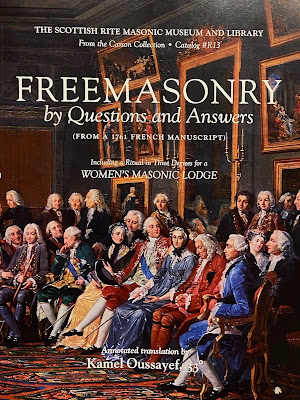
New Book: 'Freemasonry By Questions and Answers' by Kamel Oussayef

by Christopher Hodapp

Illus. Kamel Oussayef 33° has been volunteering for almost 20 years at the Scottish Rite (NMJ) Museum & Library working on a series of very special projects. The archives of the Museum contain a priceless collection of handwritten 18th and 19th century French manuscripts that have languished in the vaults for a century or more without ever having been translated into English. His previous books include: Saint Edoüard: A 1748 Masonic Scottish Lodge During the French EnlightenmentThe Spirit of Freemasonry; and The Book of Wisdom - all of which have been published in beautiful editions by the Scottish Rite Northern Masonic Jurisdiction

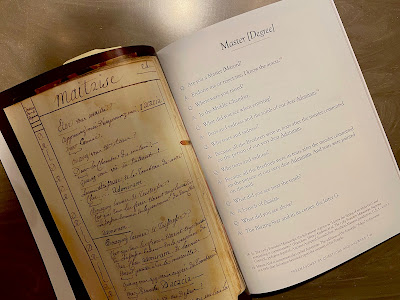
His new book is the latest in that series. Freemasonry By Questions and Answers is a translation of a 1761 French manuscript made up of a series of notebooks, plus several additional documents up through 1806. If you have any interest in the development of Masonic ritual — both in the Craft lodge and in what became the Scottish Rite — this book is remarkable. French and so-called continental Freemasonry veered off into both major and minor differences from the Preston-Webb rituals we work in the U.S. or the Emulation rituals in Britain. Also, bear in mind that a year after the first notebook in the collection was written down, Etienne (Stephan) Morin carried a patent to the Caribbean and the Americas to establish a Supreme Council of the Rectified Scottish Rite. The degrees in the notebooks reflect the words and rubric of the Rectified Rite at that time. There are also notes concerning English and Scottish rituals demonstrated to the French brethren from visitors across the Channel. There is even a suggested series of toasts for table lodge/festive boards included. If you are a U.S. jurisdiction that uses a particular odd-sounding "table lodge" format that includes the line "To erect Temples to Virtue, and to dig dungeons for vices," that wording doesn't exist in Preston-Webb. It originally came from French ritual in this formative period.

Many of the early French Masonic lodges were extensions of salons of the period, where influential and learned men and women would gather to discuss philosophy, the arts, social and political issues and other topics of the day. Consequently, a special treasure in this manuscript is the inclusion of the Q/A lectures from a French female "lodge of adoption." That term comes from the male lodges that would sponsor or "adopt" a lodge for women, with substantially different rituals and wording. And as a final bonus item, a letter is included from 1806 that explains how and why Napoleon Bonaparte became "protector of Freemasonry" without ever actually joining himself, why he encouraged his sister Caroline, his brothers, and his military officers to become Masons, and how he encouraged his wife, the Empress Josephine, to become Venerable Maîtresse of a female Masonic lodge that attracted influential women to join with her. In addition to the translations, the entire manuscript is heavily annotated to provide insights about the Masons involved, noteworthy historical contexts, ritualistic variations, and more.


Like his other books, Freemasonry By Questions and Answers is presented in a photographic facsimile manner, with a color photo of each manuscript page on the left side, and the English translation on the right. 

Studying the changes in Masonic ritual from one country to another in the first century of grand lodge speculative Masonry is fascinating. It should be noted that French writing in the 18th century is not the same French you might have taken classes in or what you find in "French phrases for tourists" guidebooks. It's more complex, and occasionally obscure. Having these French Masonic records and notebooks translated into English opens them up to wider study by more scholars. 

By the way, Kamel's books make excellent companions to a rare, out of print work published back in 1971 by Quatuor Coronati Lodge of Research No. 2076 in London. Track down The Early French Exposures, edited by the legendary Masonic author, Harry Carr.

In 2020, Illus. Kamel Oussayef 33° became the 110th author to be admitted into the Society of Blue Friars, a very special group of Masonic writers. Friar Oussayef was born in Sétif, Algeria and attended school in France, where he lived for many years. He holds an MA from the Fletcher School of Law and Diplomacy at Tufts University and an MS from the School of Public Communications at Boston University.

Kamel is a Past Master of William Parkman Lodge and Converse Lodge. He has been awarded the prestigious Henry Price and Joseph Warren medals for distinguished service to Freemasonry in Massachusetts. In the AASR, he is an Assistant Master of Ceremonies with the Massachusetts Consistory of the Valley of Boston.

At the moment, Freemasonry By Questions and Answers is only available as a Kindle download for $9.99 from Amazon.com. The Scottish Rite NMJ Supreme Council website is in the process of being updated following their change in leadership a couple of months ago. Once the print version of book is added to the NMJ's online Marketplace, be aware that a limited number of the hard copy, paperback are being printed in its first run. It is expected to be in the $50 price range. If that initial printing is popular enough to sell out, an additional print run will be considered. I'll update this post when that comes available.

UPDATE 12/13/2021
Paperback edition now available.
The oversized paperback edition of the book is now available from the Scottish Rite NMJ Marketplace website for $52. CLICK HERE TO ORDER


Monday, August 30, 2021

Indiana University Establishes New Research Center for Fraternal Organizations


by Christopher Hodapp

Indiana University in Bloomington, Indiana is now home to the newly established Center for Fraternal Collections & Research (CFCR), headed up by Dr. Heather Calloway. The CFCR will collect, preserve, and provide fraternal objects and ephemera for study and research in a permanent and accessible collection. 

During the "Golden Age of Fraternalism" from the end of the American Civil War until the Great Depression, over a thousand fraternal, ritual-based or "secret societies" formed in the U.S. Out of all of those hundreds and hundreds of societies with their millions upon millions of members, few survive today:  Odd Fellows, Eagles, Elks, Moose, Foresters, B'nai Brith, Knights of Columbus, Woodmen of the World, Knights of Pythias, Red Men, along with the Freemasons — these were the most commonly known American fraternal societies, and they still exist. But every year that passes, less and less evidence of them endures, especially the most obscure ones. 

Grand Encampment of the Independent Order of Odd Fellows
in Redding, California in October 1900. (Photo: Shasta Historical Society)

For too long, American fraternalism wasn't considered to be important enough for respectable historians to investigate. Yet the fraternal movement was critical to the building and strengthening of American communities, and every bit as important as churches, politics, activism and other local institutions. The "secret societies" were organized to support immigrant and racial groups, religious communities, to provide social assistance like burial or life insurance and retirement homes, to organize early patriotic or labor movements, or just become welcoming social clubs for the community in an increasingly urban society. Current generations have little or no understanding of the very existence and importance of these organizations, and too many of their publications, artwork, artifacts and jewelry disappear into the garbage or get melted down for their precious metals. 

At long last, there is a place where this important history can be found and preserved. With this announcement, IU becomes a welcome and secure repository for the quickly vanishing ephemera of American fraternal history. And the initial Board for the Center includes some notable names in the study of fraternalism:
  • If you've been around Freemasonry for a while, you may recognize director Dr. Heather Calloway from her fourteen years at the Scottish Rite SJ headquarters, the House of the Temple in Washington, D.C. 
    In 2018, she was hired as the first executive director of collections for Indiana University. The university has an estimated 220 collections comprised of about 30 million individual objects spread all across IU’s many campuses, schools, and departments all over the state.
  • Dr. S. Brent Morris is one of the world's most well-known and respected Masonic authors today. A list of the books he has written or edited and the Masonic organizations he has been associated with could fill a good-sized book by itself. Brent has recently retired from many years as the editor of the Scottish Rite Journal (for the Supreme Council Southern Jurisdiction), and continues to serve as editor for Heredom, the Scottish Rite Research Society's annual collection of papers. Most recently, Brent has resurrected the Masonic Book Club and continues to manage it.
  • Dr. Ken Moder is the founder and director of the J. H. Rathbone Museum of Fraternal History in Lafayette, Indiana. If you don't know of Ken and the Rathbone Museum, it has what may be described as one of the largest collections of fraternal organization artifacts, costumes, furniture, rituals and more in the world. Ken has been active in fraternal organizations for many years, including the Knights of Pythias, (Past Grand Secretary, Past Supreme Representative, and Knights of the Golden Spur for Indiana), Dramatic Order Knights of Khorrason, (Past Imperial Treasurer, Past Imperial Prince, and current Imperial Secretary). Ken also is a 32nd degree Scottish Rite Mason, the current president of Masonic High Twelve Club #99 in Lafayette, and a B.P.O. Elk. Ken also serves as a director of the Historical Society for American Fraternalism and the Tippecanoe County Historical Association. 
  • Seth C. Anthony is a Pennsylvania Mason and the creator of the online Museum of Fezology. The site features items from Seth’s own extensive collection of fezzes, from the apparel of the American Woodmen to the masonic White Shrine of Jerusalem. Seth’s other collecting interests include banners, jewels, and ephemera related to fraternal organizations that are less well-known.
  • Mark Tabbert has been the director of library and museum collections for the George Washington Masonic National Memorial in Alexandria, Virginia for sixteen years. Before that, he was curator for Masonic and fraternal collections at the Scottish Rite Library & Museum in Lexington, Massachusetts. He is the author of American Freemasons: Three Centuries of Building Communities and the upcoming A Deserving Brotherthe definitive work about George Washington and his Masonic involvement throughout his life.  In 2012 he co-edited Secret Societies in America & Other Foundational Studies in Fraternalism. Mark is also a past president of the Masonic Library & Museum Association.
  • Wendy Waszut-Barrett, PhD is an author, archivist and artist, specializing in scenic art and stage systems for historic theaters in North America and Europe. For the past thirty-three years, Wendy has documented, preserved, and painted scenes for a variety of performance venues, including fraternal lodges, vaudeville theaters, opera houses, ethnic halls, and film. The preservation of theatrical and fraternal heritage, as well as the continued training of artists in historic painting methodologies and materials, is her passion. Wendy is the president of Historic Stage Services, LLC, a company specializing in historic scenery and stage systems. As an author, Wendy’s past publications include The Santa Fe Scottish Rite Temple: Freemasonry, Architecture and Theatre (Museum of New Mexico Press, 2018), and numerous journal articles. She is a member of the International Organization of Scenographers, Technicians and Theatre Architects (OISTAT), United States Institute of Theatre Technology, the Canadian Institute of Theatre Technology, the Scottish Rite Research Society, and Phi Beta Kappa.
The CFCR is located in the new IU Collections, Teaching, Research and Exhibition Center, located in the historic McCalla building on the IU Bloomington campus. Following a $6 million renovation of this one-time elementary school building, the center now provides a safe, climate controlled facility for collections, plus seven display galleries, meeting areas, and a state-of-the-art media digitization and preservation department, all under one roof.


From their announcement:
We are an Indiana University research center devoted to the collecting, protecting, and sharing of fraternal collections for the sake of research and public engagement. We hope to improve scholarship and understanding of fraternal groups, explore their impact on American society, and elucidate their importance across time and to different social groups.

Whether you are interested in famous fraternal traditions such as Freemasonry, influential women's auxiliaries and orders, fraternal groups that served important roles in African American or other communities, or other orders that have served as cornerstones to American cities and towns, we hope that you will find the Center for Fraternal Collections and Research to be an exciting and welcoming place for your academic and personal inquiry.
Scholarly support
The center will provide three types of scholarly support to IU students and faculty, non-IU scholars, and the public:
  • The collection and stewardship of rare fraternal organization materials donated to Indiana University, for the sake of scholarly research.
  • Creating and supporting research related to fraternal studies at the student and faculty scholarly levels.
  • Disseminating research and information related to fraternal studies via public events, academic symposia, exhibitions, media presentations, and publication.
For more than a decade, our own Masonic Library & Museum of Indiana has benefitted greatly from our association with the Indiana University/Purdue University/Indianapolis Museum Studies program. Interns from that program have been invaluable to us for adopting proper collections and preservation methods, accessioning objects, creating new displays, and much more. Combined with the IU Bloomington Curatorship Program, Indiana University offers one of the top degree and post-graduate programs in the U.S. for students seeking museum and library careers. So the news of the Center for Fraternal Collections & Research is an outstanding development.

As an aside, Dr. Calloway and several of the Center's board members have also formed the Historical Society for American FraternalismAs the HSAF website says on its home page, "Understanding American Fraternalism is a means to understand how generations of American built stable communities within restless and ever-changing society."

Central to the HSAF's mission is an up-to-date, comprehensive and searchable list of these groups in its online Encyclopedia HERE.

Friday, September 04, 2020

George Washington Memorial's Masonic Digital Archive Is a Research Treasure


by Christopher Hodapp

For many years, Mark Tabbert at the George Washington Masonic National Memorial in Alexandria, Virginia has been actively seeking support for and promoting a digital collection made up of the proceedings of all U.S. grand lodges and appendant grand bodies. 

This ongoing project is being done through the Memorial's Louis A. Watres Library, named after the Association’s second president who oversaw the Memorial’s construction. Opened in 1952, the Library contains a substantial collection of approximately 7,000 volumes, including Masonic literature and U.S. Grand Lodges’ and other major Masonic organizations’ annual Proceedings.


The scope of the Masonic Digital Archives project is enormous - consider that a grand lodge like my own has been publishing these reports annually for over two hundred years, generally at the rate of a couple of hundred pages each year. Then multiply that by 51 Grand Lodges, plus Grand Royal Arch Chapters, Grand Cryptic Councils, and Grand Knights Templar Commanderies.

The Memorial Association is digitizing each governing body’s complete annual proceedings collections for a flat rate of $1000 as a service to the Craft. That price is non-adjustable, regardless of the number of books or pages digitized. After that, a $200 annual subscription fee maintains and updates the online collection on the Memorial's LUNA database platform. LUNA presents each book in pdf form and is fully searchable, making the hunting of names, places, topics, dates and more fast and simple. 

The Memorial's digitization project has primarily used the much faster and less expensive 'destructive' method of scanning, meaning that bound books must be sacrificed in order to speed the scanning process. For that reason, the Watres Library has requested two full sets of proceedings from each grand body so that the Memorial still has one complete and undamaged, bound set of volumes on its shelves to augment the online digital scanned versions. They have gotten underway with scanning the duplicate volumes they already have.

To see the proceedings currently online from 21 states and grand bodies, visit the Masonic Digital Archives HERE. 


Mark just sent me an update this week advising that, as of August 2020, the Memorial staff has digitized all of their duplicate proceedings collections, alphabetically from Alabama to New Hampshire so far. They expect to complete the full project through Wyoming before 2022. 

So here's the catch.

If you are a grand officer of a Masonic Grand Lodge or Grand York Rite Body of a state alphabetically between Alabama and New Hampshire, Mark can tell you what proceedings years have been digitized and which are still needed. If you confirm your jurisdiction's $1000 commitment to the project and the annual $200 subscription fee, the available digitized proceedings of your grand body will appear in the LUNA catalog within five working days.

If you are grand officer of a Masonic Grand Lodge or Grand York Rite Body of a state alphabetically between New Jersey and Wyoming, the Library has not yet organized your proceedings and is unable to give you a detailed inventory just yet. However, with your confirmed commitment to the project, Mark will pull your state’s proceedings and provide an inventory of what they have. Once a complete proceedings set is in hand from you and the $1000 is received, digitizing and posting on-line into LUNA will take approximately 30 working days or less.

This massive undertaking is an incredible research resource for historians and researchers, be they Masonic, academic, or genealogical. If your Grand Lodge hasn't stepped up and contributed to this project, the scanning and annual hosting fees are more than fair. Indiana scanned our proceedings many years ago, and to have them in digitized form has been a godsend - I couldn't have written my book Heritage Endures without it. And each year our jurisprudence committee and others regularly dive into our online proceedings hunting minute and otherwise hard-to-find information. Plus, organizing these collections onto an easy to use and access database is not a simple project for your grand lodge to take on - the Memorial is doing all the hard work.

If you have any questions about participating the Masonic Digital Archives Project or about LUNA, contact Mark Tabbert, Director of Museum and Library Collections.

The Louis A. Watres Library is available to the public and researchers by appointment only. Appointments must be made a least 24 hours prior. 

Wednesday, August 26, 2020

Iowa's Masonic Library & Museum Highlighted


by Christopher Hodapp

The Gazette in Cedar Rapids, Iowa yesterday featured a substantial and nicely written piece about the Grand Lodge of Iowa's magnificent Library and Museum and its curator/librarian, WB Bill Krueger. It doesn't get the attention that the venerable Masonic museums and libraries in America's northeast often do, but Cedar Rapids is arguably one of the top Masonic research resources in the world. The original library's home was erected in 1884 and was the first Masonic-specific library building in America. The present 1955 facility today has more than 155,000 volumes, in addition to its fine museum collection.

The reporter asked Bill to name the top five treasures in the Museum today. His choices were: 


•The Sargent Table
Built in the early 1900s by Cedar Rapids Mason Philip J. Sargent, this stunning marquetry drop-leaf table features 37,000 tiny pieces of inlay from 100 kinds of wood, and scores of Masonic symbols.


•"The First Three Degrees of Masonry" painted by artist Grant Wood in 1922.
A stunning triptych symbolizing the Masonic degrees and stages of man.


•Benjamin Franklin’s 1734 printing of James Anderson's 1723 'Constitutions of the Freemasons'

•PGM Theodore Sutton Parvin's diaries
Parvin was one of the founders of the Grand Lodge of Iowa, and started the Iowa Masonic Library in 1842 with a $5 gold piece.

•Joseph Smith’s Ledger
Smith's final ledger book from the Mormon community in Nauvoo, Illinois that was being kept at the time of his death at the hands of a mob in 1844.

The entire article with photos can be seen HERE.


Please call the Grand Lodge of Iowa Library & Museum to ask about visiting hours, especially during the COVID shutdowns. I called several times in the last couple of months, but the building has been closed for much of the year. In fact, it's always a good idea to call before visiting any Masonic library and museum. They are generally staffed infrequently by volunteers, and can often have erratic hours.

Monday, August 10, 2020

Spain's Biblioteca Pública Arús


by Christopher Hodapp

At the end of the Spanish Civil War in 1939, Fascist dictator Francisco Franco took power and would rule Spain for another four decades. Like his fascist contemporaries Adolf Hitler and Benito Mussolini, Franco outlawed Freemasonry. Lodges were shuttered, many Masons were persecuted, and more than a few Masonic leaders were imprisoned or killed. And for almost three decades, the top Masonic library in Spain had to remain hidden from view.


In 1895, the Biblioteca Pública Arús (or the Arús Public Library) opened on the second floor of a downtown townhouse in Barcelona as one of the city's first public libraries. The library was donated to the people of Barcelona upon his death by Spanish playwright, journalist, philanthropist and Freemason Rossend Arús for the education of the working classes. Located at 26 Passeig de Sant Joan in Barcelona, the Arús Public Library today is home to 80,000 books, booklets, manuscripts, documents, microforms and more. In addition to being one of the largest reference libraries on Freemasonry in Spain, it also houses one of the world’s most comprehensive Sherlock Holmes collections. It is also has extensive material about labor unions, social and cultural movements, and more. But because of its large Masonic collection, the rise of Franco resulted in the owners of the library closing its doors to the public in 1939, and it remained safely closed and hidden from sight for another 28 years.

According to an article on the Daily Beast website, the closure of the library prevented it from being plundered. While books were destroyed or requisitioned from other libraries throughout Spain, the Arús Public Library’s collection was kept intact. The Library's concierge lived with his family in part of the property and would not let anyone in without express permission from the Barcelona City Council.

A close ally of Adolf Hitler in Germany and Benito Mussolini in Italy, Franco’s sworn enemies included the labor unions, Communists, Jews, homosexuals, and any groups promoting liberal or anti-clerical values, such as the Freemasons. Franco passed specific legislation to outlaw Freemasonry, and thousands of trials were held, resulting in firing squads, extensive prison sentences, property seizures, and exile, for those found guilty of Freemasonry. Following the death of Franco in 1975, it took a further four years for Spanish Freemasons to be legalized and have their rights restored.
“At the end of the war, the library had a reputation for being ‘Red and Masonic’,” explains [Maribel Giner, Director of the Biblioteca Pública Arús]. “Red—or Communist—due to its backing of the labor movement and commitment to educating the working classes, and Masonic, because of the collection it inherited from the private library of its founder.”
[snip]
In 2011, it received a collection on Sherlock Holmes, donated by Catalan collector Joan Proubasta, consisting of more than 6,000 books in 42 languages, and more than 2,000 related objects, from comics to posters, stamps, statues, puppets and insignia. It is one of the most extensive collections in Europe and the largest in Spain. Why did Proubasta make this donation to the Arús Public Library? It turns out that Holmes’ creator, Arthur Conan Doyle, was a Freemason.
For any library enthusiasts staying in Barcelona, Maribel Giner believes the Arús Public Library is worth a visit.
“This is a well-preserved 19th-century library that has maintained its original design details. Stepping in here is like being transported to another era, and also an opportunity to explore a piece of Barcelona's history,” she says.

Photos by Isabelle Kliger/Daily Beast 

Wednesday, March 04, 2020

Iowa's Masonic Library & Museums' Book Restoration Project


The Grand Lodge of Iowa A.F.&A.M.'s incredible Masonic Library and Museums complex in Cedar Rapids has one of the largest Masonic collections of books and manuscripts in the world. Assistant Librarian Bill Kreuger now reports in the March 2020 issue of the Grand Lodge of Iowa Bulletin that Grand Master William R. Crawford has selected as one of his major fundraising projects the restoration and re-binding of books from their Rare Book collection. 

The first Iowa Masonic Library in Cedar Rapids in 1884

It's depressingly uncommon for a grand lodge to support their own library and museum as enthusiastically as Iowa does, and they have reason to brag. In 1884 Iowa opened the first Masonic library building anywhere in the world in Cedar Rapids. In 1952, the inadequate 19th-century library was demolished, and the current marble, Mid-Century Modern building opened on the same site in 1955. Today, the library houses over 250,000 volumes of both rare and circulating Masonic books. 

Iowa's Masonic Library and Museum is also home to several noteworthy specialized collections, including the A.E. Waite Collection of esoteric and occult science, and the Joseph A. Walkes Collection of Prince Hall Masonry. (If you're serious about researching African-American and Prince Hall-derived Freemasonry, Iowa absolutely needs to be on your itinerary. They have numerous volumes that don't exist anywhere else, including many sets of annual proceedings dating into the mid-1800s from the earliest predecessors of what we refer to as 'Prince Hall Masonry' today.)


The basis of Iowa's Library came about in the 1882 after the death of Brother Robert Franklin Bower, who was reputed to have owned one of the largest and most valuable Masonic book collections in the world at the time. Born in Philadelphia, Bower was first made a Mason in 1850 at Madison, Indiana (the Ohio River town that was the location of the founding of the Grand Lodge of Indiana in 1818). He moved to Iowa 20 years later, and he became General Grand High Priest of the Grand Chapter of the Royal Arch in 1880. Upon his death, the Grand Lodge of Iowa purchased his vast Masonic book collection from his estate. 


Many of the volumes in Bower's famed collection were quite rare, even for the late 19th century. The passage of 140 years has made them even rarer and more valuable than ever. And more fragile. Between environmental conditions, the original materials, decades of use by researchers, and the ravages of time itself, some of the rarest books have fallen into disrepair.

Recently conserved books include: Benjamin Franklin's American publication of Anderson's Constitutions (1734); an Ahimon Rezon (1817); and an 1840 manuscript by Mormon founder Joseph Smith. 


The books currently being restored include Anderson's Constitutions of Free-Masons (1723), and The Freemasons Monitor (1797). There are also several extremely rare, bound volumes of late-1700s Masonic magazines: Freemasons Magazine (1797-98); Sentimental and Masonic Magazine (1793-94); and American Museum or Universal Magazine (1790).

Conservation of these delicate works is not an inexpensive proposition — the estimated cost of re-binding and repairing a year's volume of the fragile, two century-old bound magazine sets is approximately $500. The restoration and re-binding work is an ongoing project being done by Brother James Twomey, a Mason and proprietor of the Book Restoration Company over in LaFarge, Wisconsin. 


Iowa's vast Masonic Library collection listing can be accessed online HERE.

To donate to Iowa's book restoration project or the Library & Museums, contact Associate Librarian Bill Kreuger at librarian@gl-iowa.org

Tuesday, January 14, 2020

Writing Your Own Lodge's History


Over the weekend I flew back to Indianapolis to preside over the winter meeting of the Dwight L. Smith Lodge of Research. We had an outstanding meeting, and I presented my recent research about the Army/Navy Masonic Service Centers during World War II that were set up in some 90 large Masonic temples around the country. Encouraged by then-Senator and PGM of Missouri, Harry S Truman and organized as a national movement by Carl Claudy and the Masonic Service Association, these were similar to USO centers. It's truly a fascinating bit of history that most Masons have never heard of today.

However, I took advantage of having John Bridegroom as our Secretary and had him pass out an article from the latest Journal of the Masonic Society to our members. (John is the art director for this outstanding quarterly magazine.) Issue No. 47 hit mailboxes at the beginning of the month, and it includes a piece that every Mason should read: 'Thoughts About Writing a History of Your Lodge' by Brother Samuel S. Laucks, II from Pennsylvania.

A few years ago, one of our research lodge members lamented that he felt that he should be contributing to our meetings by writing original "research," but he was concerned that he wasn't much of a writer. Moreover, he felt that after three grand lodge history books since the 1890s (mine being most recent), that all of the "important" stories had been told already, and there wasn't much else interesting to write about. Yet not five minutes later, after I asked about his own Mother lodge, he told me a story about how their old building had burned down in the 1990s and that the Worshipful Master at the time had run into the burning building to save the lodge charter and Bible from destruction!


Every one of us is living through history right this very moment, and it gets made every day when we're not paying attention.

Brother Lauck's article describes how he pored over his own lodge's minute books, treasurer and trustee reports, financial documents, trustees reports, old letters, photos and other obvious sources. If you are a diligent detective, you'll find treasures and tales inside of forgotten lockers, filing cabinets, desk drawers, tucked into books on paper scraps, and in dusty old boxes under the back stairs. Turn everything over and look carefully. In my own case, I've found fascinating clues written on the backs of pictures hanging in our lodge building. And always hunt down grand lodge history books to see if your lodge is mentioned anywhere in your state's Masonic past. Hopefully, there is a decent grand lodge library/museum in your jurisdiction. They generally have local lodge histories that were assembled in earlier days on file. And if you're lucky, your grand lodge may have put your older magazines online in a searchable format, as we have done in Indiana in conjunction with our state library.

Once you've exhausted the Masonic sources, move to the newspapers and magazines both online and in libraries. Check the state, county and local historical societies. And be armed with the list of names of your Past Masters since the beginning, as you may uncover piles of information about the men who started and perpetuated your lodge, yet without reference to their Masonic membership. And always, always, always take the time to scan through local newspapers of various time periods to help comprehend the culture and context that surrounded and shaped your lodge members at different times in history. WHY was your lodge formed WHEN it was formed? What compelled those early brethren to plant their cornerstone where they did?

If you haven't done it before, it's long past time to record the oral histories of all of your living Past Masters and the oldest and most influential (or most colorful) members of your lodge. We've all got audio recorders and cameras in our pockets these days, and we carry them everywhere. Don't wait until these men pass away before realizing the invaluable information from the past they take to the grave. Be sure to also ask these men why they joined, what they loved and hated about the fraternity and the lodge, what their lodge activities were, their successes and dreams, and their disappointments.   

Brother Laucks makes the important point that a lodge history should not be locked in time, especially now that technology makes it so convenient to keep adding to the tapestry of these chronicles. “I believe that a lodge history should not be a purely static document but should provide a sense of optimism and anticipation for that which is to come. The audience should not only be proud of their lodge’s history, but should also be inspired and energized by it as they plan for the future.”


Issue 47 of the Journal of the Masonic Society includes the following:

* "Change 2019" by David J. Cameron, Grand Master of the Grand Lodge of Canada in the Province of Ontario

* "Alchemy in Masonry" by Raul Sarmiento

* "Conceptual Metaphors in Masonry" by Alan Schwartz, Ph.D.

* "The Kaleida Code" by Joseph Hatcher

* "Thoughts About Writing A History of Your Lodge" by Samuel S. Laucks, II, M.D.

* "Major John Melville Allen – Soldier, Politician, and Mason" by Billy Hamilton

* "That Good Men Do Something: A Defense of Freemasonry" by Brendan Hickey


Plus the regular book reviews, Editor's Corner, WBro. Greg Knots "Camera's Lens" feature, "Masonic Treasures" by John Bridegroom and more. If you are not a member or subscriber, you should be! At a paltry $45 a year, you're  missing a lot!


Thursday, August 08, 2019

Detroit Hosts 2019 Masonic Library & Museum Association Conference: 9/20-22


The Masonic Library & Museum Association was founded in 1995. Its ongoing mission is
“to assist and support, through education, facilitation of communication, coordination of effort, and other means, those individuals charged with the collection, management, and preservation of the Masonic heritage.” Its members range from trained museum and library professionals to dedicated members of the fraternity who work voluntarily and have all different levels of experience. Membership in the MLMA is open to any person who expresses an interest in Masonic libraries or museums. Institutional membership is open to any Masonic body considered “regular” by most Grand Lodges in the United States.

The Detroit Masonic Temple Library, Archive, and Research Center is hosting the 2019 Masonic Library and Museum Association Conference. The center is located in the breathtaking Detroit Masonic Temple, 500 Temple Street, Detroit, Michigan. The Detroit Temple is the largest building 
in the world dedicated to the Masonic fraternity.

Participants will enjoy two days of excellent presentations, and unparalleled networking and fellowship.

Masons and non-Masons alike are welcome to attend.

TENTATIVE SCHEDULE

Friday, September 20th
  • 12:00 pm: Finger lunch 
  • 12:30 Brian Rountree, President, Masonic Library and Museum Association: Welcome/Introductions
  • 1:00: Rob Moore, Executive Director, Detroit Masonic Temple Library, Archive, and Research Center 
  • 1:30: Dirk Hughes, Director, Michigan Masonic Museum and Library 
  • 2:15: Mark Tabbert, Director of Museum and Library Collections, George Washington Masonic National Memorial: "George Washington and Freemasonry "
  • 3:00 Library Service Work
  • 6:00 Dinner

Saturday, September 21st
  • 9:00 am: Coffee/light refreshments 
  • 9:30-11:30: Detroit Masonic Temple tour 
  • 11:30-1:00: Lunch on your own
  • 1:00: Glenn Visscher, Museum of Masonic Culture, Trenton NJ: "Building and Developing a Masonic Museum "
  • 1:30: Maureen Harper, Collections Manager, Scottish Rite Museum and Library: "Packing Artifacts for Shipment "
  • 2:00: Thomas Hauder, Past Grand Master, Grand Lodge of Nebraska, A:. F:. & A:. M:. "Freemasonry and the Roman Catholic Church "
  • 3:00: Christiano Franceschini, Museo Simbologia Massonica, Firenze, Italy: "Freemasonry in Italy "
  • 4:30: Visit Burton Historical Collection
  • 6:00: Dinner on your own 

Sunday, September 22nd
  • Optional Library Service Work 

Registration includes attendance of the entire program and dinner on Friday evening. Tickets for this event are priced at $75. But if you take advantage of their Early Bird rate, it is just $55 per person through August 20th. The cutoff for general registration is September 8th ($90 after that).

To make reservations, visit the Eventbrite page HERE.

ACCOMMODATIONS

A block of rooms has been reserved at Motor City Casino Hotel (2901 Grand River), a short distance from the Temple. Register by calling 1-866-STAY-MCC and mention the Detroit Masonic Temple Library block or go to this link:

https://booking.motorcitycasino.com/?package=091919MASO#/

QUESTIONS?

Contact Rob Moore at 248-863-8008 or dmtdocents@gmail.com

Wednesday, May 15, 2019

‘Indiana Freemason Magazine’ Collection Joins the State's Indiana Memory Project


The Masonic Library and Museum of Indiana, in conjunction with the Indiana State Library, is now making available the complete collection of the Indiana Freemason Magazine from 1923 – 2003 for online access, as part of the Indiana Memory Project.

This searchable online collection of more than 39,000 pages will be a treasure trove for historians, genealogists and other researchers, and includes historical articles, photographs, current events, lists of lodges, plus Masonic members and officers involved in countless activities, and even advertising of businesses of the 20th century across Indiana.

The Indiana Freemason had several editors over the decades, but was especially dominated after WWII by noted Masonic historian, author, Past Grand Master and Past Grand Secretary, Dwight L. Smith.


Also included in the collection are approximately 900 pages of a selected number of local Masonic lodge histories from across the state, which were assembled around 1968. These frequently contain historical lists of former members and officers, along with telling the stories of lodges with their communities.

At the height of its membership in the 1950s, the Grand Lodge F&AM of Indiana had some 165,000 members, and was the fifth largest Masonic jurisdiction in the world. The magazine was originally created as the official publication of the Grand Lodge of Free and Accepted Masons in the State of Indiana in 1923 as a project of the in-house print shop within the Indiana Masonic Home in Franklin, now known as Compass Park. That professional printing facility was established partially as a vocational training program for some of the eventual 860 orphans of Freemasons who lived at the Home until 1975.

There are about 50,000 Freemasons in the Grand Lodge today.

The entire Grand Lodge of Indiana Collection can be accessed at the Indiana Memory Project website or by a link from the Library and Museum's website at www.mlmindiana.org 

The Masonic Library and Museum of Indiana is located on the fifth floor of Indiana Freemasons Hall at 525 North Illinois Street in Indianapolis.

Tuesday, March 22, 2016

Huge Stash of Nazi-Confiscated Masonic and Occult Books Discovered

The grand lodge building of the Norwegian Order of Freemasons in Oslo.

A collection of 13,000 books on occult subjects, including Freemasonry, were amassed by Nazi SS-Reichsfuhrer Heinrich Himmler's forces during Germany's wartime occupation of Norway. The collection was stolen, in part, from the Norwegian Order of Freemasons' grand lodge library in Oslo. 

Shortly after the war ended, the collection was put into a storage building near Prague, Czechoslovakia.  In 1948, the Communists took power, and as part of the Warsaw Pact nations, they were effectively lost behind the Iron Curtain for many years.  Even after Czechoslovakia's opening to the West, they remained hidden away without any record since the 1950s.

These were just a small part of an enormous library of works on Masonic, occult, esoteric and witchcraft subjects that were confiscated throughout occupied Europe by a division of the Nazi SS.

From a story on the Prague Post website:


Books on witchcraft and the occult collected by SS chief Heinrich Himmler were found in a storage depot near Prague used by the Czech National Library.
The depot has not been accessed since the 1950s, according to UK tabloid the Daily Mail, which cited Norwegian newspaper Verdens Gang. 
Bjørn Helge Horrisland, a Norwegian Freemason historian, told Verdens Gang he was involved in identifying some of the books. “Many of them belonged to the central Norwegian Order of Freemasons library in Oslo,” he said.
The collection of books totals some 13,000 volumes, some 6,000 of which allegedly came from a library of books owned by the Norwegian Order of Freemasons. The Masonic library [was] seized by Nazis when Norway was occupied during World War II.
Himmler began amassing the collection in 1935 and had a strong interest in the occult, He had a special unit within the SS to collect and manage information on witchcraft.
Many of the books deal with witchcraft trials in Germany, and Himmler reportedly believed that the trials were part of historical plot to weaken the Germans. He also claimed to be descended from a witch that was executed.
 Himmler also believed that knowledge of the occult could be used to benefit the Third Reich.
The books were not meant for Prague but for Wewelsburg Castle in Germany. Himmler intended to make that castle a modern-day Camelot with a round table of SS officers in the place of knights. Himmler signed a 100-year lease on the triangular castle in 1934. The building is now a museum.
The books will now be examined by scholars, and a Norwegian TV company is planning a documentary.
The project to recover the library of books received European Economic Area funds from Norway and is a result of a cooperation between Stiftelsen Arkivet, the National Library of Norway and the Czech National Library, according to Norwegian new server TheLocal.no.
Himmler's interest in collecting occult items has been well-documented and has inspired works of fiction including the 1981 film 'Raiders of the Lost Ark.'
Himmler was captured May 21, 1945. He committed suicide with a cyanide capsule May 23 and was buried in an unmarked grave near near Lüneburg, Germany. The exact location is not known.

In 1935, Himmler founded the Ahnenerbe Forschungs-und Lehrgemeinschaft (the Ancestral Heritage Research and Teaching Society), to use the methods of science to bend history and archeology enough to back up the Nazis’ racial and cultural policies. (In the film Raiders of the Lost Ark, the Nazi group looking for the Ark of the Covenant is supposed to be a contingent of Ahnenerbe archeologists.)

The tales of Himmler's alleged fascination with the occult have waxed and waned over the years. The Reich Security Main Office (RSHA) was formed in 1939 as part of the SS, combined with the SD, and was subordinate to Himmler.  It's purpose was to fight all enemies of the Reich both inside and outside of Germany.  It eventually grew to become a massive bureaucracy with close to one hundred sub-sections, divided into seven main divisions. Amt II was headed up by SS-Brigadefuhrer Professor Franz Albert Six, and was dedicated to "Ideological Investigation." 


Not long afterwards, Amt II was reorganized and split off as Amt VII for "Ideological Research and Evaluation," again headed by Franz Six (and after 1943 by SS-Obersturmbannführer Paul Dittel.) Their mission was partially to create anti-semetic and anti-Masonic propaganda, as well as surveying occupied Nazi population's public opinion.


Modern scholarship has dug into captured Nazi documents long held by Warsaw Pact countries, which have revealed Amt VII's other activities, including the collection of stolen  esoteric libraries. They also, allegedly, created an extensive card catalog on publications and other resources regarding witchcraft, a special interest of Himmler's (it was long whispered that a relative of his had been burned at the stake for being a witch). 


After the Soviets took parts of Berlin, and Germany was divided into East and West after the war, many of the records and books from their confiscation of occult, esoteric and Masonic libraries eventually wound up in Russia, the Silesia region of Poland, and Czechoslovakia, and were not researched until the 1990's.

In 2002, 750 crates of Masonic objects and papers stolen from occupied lodges and Grand Lodges across Europe and held by the Russian Military State Archive were delivered to the Museum of Freemasonry of the Grand Orient of France in Paris. These included membership lists that were used to help round up Freemasons to be sent to concentration camps. (The entire library of the Grand Orient of France was confiscated when the Nazis occupied Paris, and the books were taken to Berlin and subsequently burned.) 

A lengthy work, Restitution of Confiscated Art Works - Wish Or Reality?, was published in Czechoslovakia in 2008 as a collection of presentations from a conference in the city of Liberec. Buried in it are several references to the RSHA Amt VII unit's activities in assembling a vast library on the occult, witchcraft, esoteric, and Masonic books, eventually estimated to be in excess of 160,000 volumes:


Most of the books that traversed Sudeten crossroads had been held before August 1943 as part of the RSHA Amt VII (Seventh Office) library in Berlin, seized by the SD Main Office (Hauptamt) and the Gestapo starting in 1936. With the merger of the security services in late 1939, most of the collected books and archives preserved by the SD Main Office came under control of the newly formed RSHA Amt II (Second Office), headed by SS-Brigadeführer Franz Alfred Six, charged with investigation of political opponents (Gegnerforschung).
Starting in December 1941, Six organized the Seventh Office (Amt VII), specially for “Ideological Research and Evaluation” (Welt- anschauliche Forschung und Auswertung), split off from the other more  operational offices. Having inherited most of the SD/RSHA library and archival loot, Amt VII was responsible for organizing the RSHA library and archival centers, although some of the books went to other RSHA units. Most of the Amt VII staff, which Six headed until 1943, were members of the SS. Most of the books and archives were held in the buildings of two liquidated Masonic lodges the Gestapo had commandeered (Emserstrasse 12/13, and Eisenacherstasse 11/13), although some were stored in other depots in Berlin. From the spring of 1943, SS-Obersturmbannführer Paul Dittel, who from the start had been particularly involved with the collected Masonic materials, was the last head of Amt VII. Yet his title remained “acting,” indicative of the reduced importance and “mysterious twilight” of that unit towards the end of the war, as he made clear to his British interrogators afterwards.
During the Cold War, little was known about Amt VII, because its major surviving records were not publicly accessible. The Soviets found many SD Main Office administrative files among the massive RSHA-plundered archives they captured in Silesia (Wölfelsdorf), along with those of later Amt VII operations, and they seized a few more in the bombed-out RSHA Eisenacherstasse building in Berlin. Some of those files they passed on to the Stasi in the 1950s, and those are now being processed with other Stasi RSHA holdings by the Bundesarchiv in Berlin. Others were captured in Silesia by the Poles, came out of hiding in 1989, and were traded to the Bundesarchiv in 1997. However, many important SD Main Office and subsequent RSHA Amt VII files remain in Moscow, not all of them open for research. Combining clues from documents now in Moscow and Berlin provides hitherto unknown revelations about RSHA library operations, especially those in the Sudeten castles.
[SNIP]
Alleged occult elements in the Nazi ideology and Himmler’s interest in neo-paganism and Masonic rituals have aroused widespread interest since the defeat of the National Socialist regime. Even the History TV Channel produced a documentary on“Hitler and the Occult,”suggesting what would seemingly be a sensationalist theme. The popular internet Wikipedia suggests that ‘Nazism and Occultism’ is usually “a topic for sensational authors in pursuit of strong sales,” but it prominently cites Nicholas Goodrick-Clarke, and his serious Oxford doctoral thesis on the Austrian Arisophists. Other important scholarly studies have analyzed occult themes in Nazi circles, especially under Heinrich Himmler, and the Masonic Library, confiscated from one of the alleged ‘enemies of the regime,’ was one of the most important components in the RSHA Amt VII holdings. Himmler’s interest in witchcraft and the supernatural was highlighted in Amt VII’s special unit devoted to Witchcraft (C 3), Sonderauftrag H, and Himmler’s card file on witches (Hexenkartothek), all of which are well documented. Reportedly, the materials gathered for the Witchcraft unit were sent to Schlesiersee [in Poland] with the Masonic collections, rather than the Sudeten castles, and that unit had ceased to function by the time of evacuation.
In the Sudeten castles, on the other hand, we find Amt VII SS specialists busily sorting and cataloguing occult literature, which the SD Main Office and Amt VII library had been collecting. Suddenly, that section of the library assumed a major prominence, and a top- secret project was launched on its basis—another important example of Nazi preoccupation with the occult. 

Himmler saw the SS as a kind of reimagining of the of the chivalric Teutonic Order, who were originally founded  in 1190, much like the Templars, to protect crusading pilgrims to the Holy Land.


Wewelsburg castle in Germany


He came to the town of Buren in the Westphalia region of western Germany in 1934, and took over the imposing castle of Wewelsburg. The castle was to become the center of a college for new SS officers and Himmler’s own elite Knightly Order. The castle became the place of initiation of his new order and the new spiritual center of the Nazi paganism that was based on Germanic legends. Ahnenerbe’s headquarters were based in Wewelsburg Castle.

Himmler planned very big. His goal was to make the surrounding village a complete SS colony, only for members of the SS and their families. In 1939, a concentration camp was established to provide 3,900 prisoners to work on the project. More than 1,200 were worked or starved to death building Himmler’s dream.


Himmler saw Wewelsburg as his own private Camelot which, of course, needed a Round Table for its knights. In the north tower, a round chamber was constructed, with a sunken area in the floor and a round, oak table.

There were just twelve seats around it, for the top dozen officers of the SS. In the domed ceiling a stylized, golden swastika set in stone can still be seen today, modified with the symbol of the SS at each corner. A different subterranean round chamber immediately below it was to be a crypt for the ashes of all dead SS members, complete with an eternal flame. Another one of Himmler’s goals was to find the Holy Grail, and a special room in the castle was set aside for the Grail when it was found.

The Nazis went to great lengths to engineer an elaborate explanation that Jesus was descended from Jacob, who, they said, was not Jewish at all, but an Aryan. Another part of Ahnenerbe’s mission was to prove the origin of the Aryans, and they even sent archeological expeditions to India, Tibet to seek evidence of the earliest appearance of their “Master Race”.

As a footnote to this post, I came across a brief account of Freemasonry in Norway under the Occupation, and especially about the grand lodge building in Oslo. From Freemasonry Under The Nazis by David Lewis, published in 2012:

When Norway was invaded in 1940 the Masonic temple in Oslo was converted to an army barracks and the order dissolved. Major Vidkun Quisling, the Nazi collaborator, had Freemasonry as point no. 1 for action on his agenda and emptied Masonic buildings and destroyed some of them. The main Temple in Oslo was converted to officers’ quarters but, according to one brother who visited it recently, amazingly it was not vandalised -- the only one in Europe known to have been left untouched by the Nazis. A number of masons were murdered. When he was tried after the war his trial, ironically, took place in a former Masonic temple before he was convicted and shot. 


“I was personally involved in identifying some of the books. Many of them belonged to the central Norwegian Order of Freemasons library in Oslo,” Bjørn Helge Horrisland, a Norwegian Freemason historian, told VG.