"To preserve the reputation of the Fraternity unsullied must be your constant care."

BE A FREEMASON

Showing posts with label Albert Pike. Show all posts

Tuesday, July 07, 2026

Ontario Masonic Hall Vandalized With Anti-Masonic Graffiti


by Christopher Hodapp

Authorities in Burlington, Ontario are seeking information regarding an unknown tagger who vandalized the local Masonic hall Sunday early morning by spray painting a phony Albert Pike 'Luciferian' quotation on the side of the building.

On the wall of the building that faces Maria Street, an unknown tagger left a message for the group that some believe to have powerful connections.

“The doctrine of Freemasonry is to be maintained in the Luciferian doctrine at high degrees,”
the graffiti reads, crediting the words to Albert Pike, a 19th century American poet and lawyer who was also a Mason. The graffiti also suggests that Pike predicted the World Wars. . .

These bogus lines are widely circulated on the Intertubz and falsely attributed to Pike. They are, in fact, taken directly from the infamous 'Taxil Hoax' perpetrated by 'Leo Taxil' (whose real name was Marie Joseph Gabriel Antoine Jogand-Pagès), a rabid French anti-Catholic and anti-Mason in the late 19th century. Taxil made a tidy profit peddling propaganda about the Masons for many years. 

Taxil singlehandedly invented the whole 'Luciferian Freemasonry' fable and gleefully went on to later admit it was all a hoax in a very public appearance on April 19, 1897. (For what it's worth, Albert Pike wrote precisely one passage in Morals & Dogma that explained the origin of the name 'Lucifer' and how it came to be attributed to 'Satan" over the centuries.) 

The truth about Taxil's hoax has been quite openly known for 130 years, but that hasn't stopped its wide dissemination on the web since the 1980s and 90s. Meanwhile, Pike's so-called 'world wars' prediction is a more relatively recent addition to the anti-Masonic repertoire and is a complete fabrication. It's not true, either. (For more details about Taxil and his hoax, see Tall Tales of Leo Taxil HERE)

The story continues:
Halton Regional Police told BurlingtonToday that the suspect was observed at 3:05 a.m. (July 5) with spray paint, and is described as a white man, medium build, wearing a straw cowboy hat, a dark jacket, white tee shirt, and shorts. He was also riding a bicycle.

VandenBerg said this is not the first time that the building has been tagged, but it is the first time to his knowledge that the Masons were specifically targeted in the message.

“We have been tagged before but that has been just generic graffiti that could have happened anywhere,” he said.

Documents and sacred texts have been dropped in the lodge mailbox, even being laminated at times, VanderBerg said, including an encyclopedia of Jewish texts that was left at the back door of the building. The building has been egged, and many more instances of vandalism came to mind for VandenBerg.

He added that the group added a stone marker to the outside of the building which has been urinated on previously, but he is unsure if that was related to the organization.

“Maybe it was the same person,” he said. “Maybe that was the first thing they did and now they are back to spray paint the building a few months later.”

Despite the long history of Burlington Masons' commitment to serving their community and contributing to local charities, this is the sort of idiotic attack that sometimes discourages lodges from being more public faced. And as we've seen in recent years, certain extremely unhinged anti-Masonic zealots are known to escalate their attacks on members and lodge halls. The McAllen Lodge incident in Texas is a horrifying example of what can happen when anti-Masons taken their paranoid hatred to the worst extremes.

If your lodge is vandalized in any way, especially if you suspect the motive was anti-Masonic in nature, you should report it immediately to local authorities. Attacks against Masons and lodges need to be on the radar screen for police and well documented because, as we've seen, the true nuts are sometimes fully capable and motivated to come back again.

Wednesday, October 29, 2025

He's Back – Pike Statue Restored in Washington DC

Photo: Fox News


by Christopher Hodapp - 
(Revised 10/30/2025, 2:00AM)

The bronze statue of Scottish Rite sage Albert Pike has been restored by the National Parks Service and put back in place in Judiciary Square in Washington, D.C. after being defaced and toppled during George Floyd-related protests in 2020. The restoration was carried out by the NPS under President Trump's executive orders on "Making the District of Columbia Safe and Beautiful" and "Restoring Truth and Sanity to American History."

In a statement, the NPS said, "The restoration aligns with federal responsibilities under historic-preservation law and recent executive orders to beautify the nation’s capital and restore pre-existing statues."

Pike was originally placed in this general vicinity across the street from the original Supreme Council headquarters of the Ancient Accepted Scottish Rite - Southern Jurisdiction in 1901. He lived in the building for many years and the statue was erected to honor his scholarship and long leadership within the fraternity of Freemasonry.

Pike's statue was considered controversial by some because he was compelled by Southern leaders to serve for just five months in the Confederate Army when he lived in Arkansas. But despite press accounts and inflammatory rhetoric to the contrary, this was never a 'confederate statue.' It celebrated his lifetime of accomplishments, prominently highlighting his scholarship in the Scottish Rite. The only reference to his military record appears in the list of his achievements: 'author, poet, scholar, soldier, jurist, orator, philanthropist and philosopher.' And calling him a soldier arguably covers his time in the 1840s spent fighting for the United States in the Mexican American War far more than his time in the Confederate Army. The sculpture does not depict him in a military uniform, nor is he seen even wearing a sword. Instead, he holds in his hand a copy of his masterwork, Morals and Dogma, a vast volume of philosophy, religious ideas, and Masonic idealism.

In previous times, statues were erected to people we called heroes because they were considered role models who accomplished great things, in spite of their flaws. Men like Albert Pike were unique, and he was certainly far greater than the brief episode at the Battle of Pea Ridge, a job he neither sought nor really wanted. And after Pike's Indian troops scalped their Union soldier captives in violation of his orders, he resigned his commission in disgust and went back to practicing law. As for allegations that he was involved in the creation of the post-Civil War Ku Klux Klan, such charges have never been proved by any evidence. Anyone who believes he wrote the KKK's original ceremonial rituals needs to compare them to Pike's actual rituals he created for the Scottish Rite. There is no similarity whatsoever in style or vocabulary.

When H. B. F. McFarland, President of the District Commission, accepted the Pike memorial from the Scottish Rite on behalf of the American people at the 1901 dedication, he addressed Pike's stint in the Confederate Army, saying:

"Although Albert Pike was a soldier in the Civil War, this statue will commemorate him rather as a victor in the honorable rivalries of peace. It is well that you thus add to the comparatively small number of statues in the city of Washington that honor the victories of peace rather than of war."

Tuesday, August 05, 2025

Albert Pike's Masonic Statue To Be Reinstalled in Washington D.C.


by Christopher Hodapp

The National Parks Service has announced it will restore and re-install the iconic bronze statue of Scottish Rite sage Albert Pike on its former plinth in Washington, DC's Judiciary Square. On June 19, 2020, the statue was toppled by rioters, covered in paint, doused with lighter fluid, and ignited, a victim of the national Confederate-related statue-toppling mania that went on in the wake of the death of George Floyd in Minneapolis.

According to a press release from the NPS issued yesterday,

Micro-abrasive cleaning of the Albert Pike statue to remove corrosion 
and paint in order to review the conditions of the bronze prior to repairs 
NPS photo
The restoration aligns with federal responsibilities under historic preservation law as well as recent executive orders to beautify the nation’s capital and re-instate pre-existing statues.

Originally authorized by Congress in 1898 and dedicated in 1901, the statue honors Pike’s leadership in Freemasonry, including his 32 years as Sovereign Grand Commander of the Ancient Rite of Scottish Freemasonry. The statue has been in secure storage since its removal and is currently undergoing restoration by the National Park Service’s Historic Preservation Training Center.

This action supports both the Executive Order on Making the District of Columbia Safe and Beautiful and the Executive Order on Restoring Truth and Sanity to American History, which direct federal agencies to protect public monuments and present a full and accurate picture of the American past.

Site preparation to repair the statue’s damaged masonry plinth will begin shortly, with crews repairing broken stone, mortar joints, and mounting elements. The NPS is targeting October 2025 for completing the reinstallment of the fully restored statue.
Upon the announcement, Washington D.C.'s longtime non-voting delegate to Congress, Eleanor Holmes Norton, announced her intention to introduce a new bill in Congress to prevent its reinstallation and to, instead, donate it to a museum, saying, "a statue honoring a racist and a traitor has no place on the streets of D.C."

Before its toppling, detractors had long objected to the statue on the grounds that Pike had owned several slaves when he lived in Arkansas, and served for just five months in the Confederate Army as a Brigadier General before resigning in disgust, making it the only statue of a "former Confederate soldier" in the District. There has also been a longstanding, unsubstantiated allegation that Pike had been a founder of the post-war Ku Klux Klan, claiming he had written their original rituals. And, oof course, there's a whole raft of conspiracy theories about Pike, topped by the absurd notion that he was a Luciferian whose rituals turned Freemasonry into Satanic ceremonies.

Pike was a complex, intellectual and deeply profound man in his day, and attempting to portray him as a "racist and a traitor" ignores just how complex he really was, reducing his lifetime to just two misleading adjectives. And wrapping up such a superficial judgement with lies and conspiracy theories is a deliberate attempt to rewrite history to win likes and clicks.

(See Scottish Rite SJ Grand Archivist Arturo DeHoyos' statement from 2020 about Pike's real writings and activities HERE.)

Pike's statue had first been erected by the Scottish Rite SJ across from the location of their original 'House of the Temple' headquarters. For thirty years, protesters and the press characterized Pike's sculpture as a "Confederate monument," despite the fact that it was never anything of the kind. His statue was not erected by pro-Confederate veterans groups, or by alleged Ku Klux Klan members (it predated the 1920s resurgence of the KKK by many years). The statue was originally erected on a tiny sliver of land between two diverging diagonal streets. The streets and the statue were moved slightly when a new highway on-ramp was built there in the 1950s. The 11-foot tall bronze sculpture by Italian artist Gaetano Trentanove was erected in 1901 and donated to the city by the Scottish Rite Southern Jurisdiction to commemorate their own 100th anniversary. 

Out of their first 90 years, Albert Pike had served as the AASR-SJ's Sovereign Grand Commander for 32 of them—over a third of the Supreme Council's entire lifespan at that time. The original House of the Temple held their headquarters, their auditorium for putting on degrees, their vast and growing library, and Albert Pike lived and died there. So did his TWO successors. That made this particular corner historically significant.


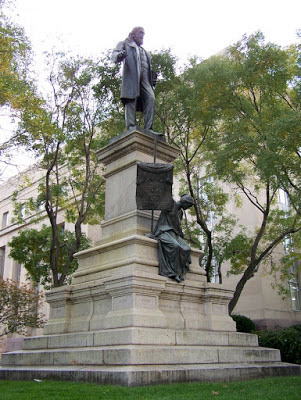
The sculpture did NOT depict Pike as a Confederate soldier, nor did it commemorate or celebrate the five months in which he served as a general in the Confederate army. It was a Masonic representation of Pike's lifetime accomplishments as an author, philosopher, orator, lawyer, historian, polyglot, and a soldier (not only in his brief stint in the Confederate army, but also in the Mexican-American War). He wasn't atop a horse; he had no sword dangling from his belt; there was no declaration of heroship, and no phony bromide about 'healing a divided nation' that are the hallmarks of Civil War statues. Pike stood there with a book in his hand and the inscription Vixit Laborum Ejus Super Stites Sunt Fructus. "He has lived. The fruits of his labors live after him." Yet few - if any - who tore it down had any interest in actually looking up what the fruits of his labors really were.

There were no references to the Confederacy, only that Pike had been a "soldier" and the banner in the hand of the Grecian figure is not a Confederate flag or symbol, but a Scottish Rite one featuring the double-headed eagle. It was purely a Masonic statue and an homage to his life's many accomplishments. Nevertheless, it was felled by the mob and hauled away to an unspecified location by the District's Parks Department.


This morning, an NPR reporter sent me an email asking for a comment about the statue's restoration. Unfortunately, I returned her call too late for her deadline. The last thing any Freemason wants is for this whole controversy to bubble up again and used to fling mud on the fraternity. I've never been of the opinion that Pike needed to be beatified by Masons, and he didn't either, if his own writings were any indication. He once wrote: “When I am dead, I wish my monument to be builded only in the hearts and memories of my Brethren of the Ancient and Accepted Scottish Rite, and my name to be remembered by them in every country, no matter what language men may speak there, where the light of the Ancient and Accepted Scottish Rite shall shine, and its oracles of Truth and Wisdom be reverently listened to.”

Besides, Washington Masonic sites get enough vandalism from the lunatic crowd without giving them another one. But I despise it when the hysterics go out of their way to spread lies about the fraternity, especially when the truth is easily discovered.

For more than you'll ever want to know about Pike and the statue, see Albert Pike, Statues, History and Hysteria from back in 2017. In the 1980s and 90s, it became something of a crusade for perennial presidential candidate and famed nutcase Lyndon LaRouche to demand its removal.

Every time this particular subject arises, I always add the same post script. In February 1993, the Philalethes magazine published a piece about the Pike statue controversy that was raging back then. It was written by the Reverend Howard L. Woods, a Christian minister who served for ten years as the Grand Master of the Most Worshipful Prince Hall Grand Lodge of Arkansas F&AM. In 1991, he had been invited as the Lecturer for the Philalethes Society, the first Prince Hall Mason ever asked to do so, and still many years before Prince Hall recognition became widespread. GM Woods wrote before more recent scholarship has brought to light more of Pike's writings and verification that Pike did indeed provide his revised Scottish Rite rituals to help the Prince Hall aligned Scottish Rite.*(see note)

The Reverend Grand Master Woods' perspective in 1993 deserves to be repeated now, both for our own members and the general public. It still rings true 32 years later.
The Albert Pike Statue: Let It Stand
There is no love lost between Prince Hall Masons and the memory of the late Albert Pike, Masonic Historian, writer, alleged ritualist for the Ku Klux Klan, but, if Freemasonry is to remain the bulwark of free-thinking people, then, "Let the statue remain!"
Like the natures he wrote about, Albert Pike showed the light and dark sides of his own soul, when with one breath he spoke of his willingness to give up his Freemasonry rather than recognize the Negro as a 'Masonic Brother' and with another breath, declared that every man should be free, for a free man is an asset, while a slave is a liability. Mankind is that way, and as long as the statue stands, America and Freemasonry will survive.
Let the statue be torn down and America and Freemasonry will be in jeopardy, for one would have to wonder, "What would be next?" As a Prince Hall Mason, an African American and supposedly free-thinker, I can see a higher power than the mortal mind of Albert Pike guiding his pen as he wrote such beautiful words of life without an occasional helping hand from someone "bigger than you or I."
Let the statue stand, even if it is proven that Albert Pike did write ritual for the Ku Klux Klan; more ignoble deeds have been done by others without sacrifice of their historic heroism.
Let the statue stand as a reminder that the good and evil of men are in equilibrium within us, and we all should strive for perfection now and in the future, not in the past. Let the statue stand!
 --Rev. Howard L. Woods, Grand Master, Prince Hall Masons of Arkansas.

*NOTE: Between 1887 and 1891, Albert Pike happily shared personal, autographed copies of his Scottish Rite Masonic degree rituals with his counterpart, Thornton A. Jackson, in the parallel Scottish Rite Southern Jurisdiction for black Prince Hall Masons, in order to assist their fledgling organization. Pike's correspondence has not survived, but in writings of the period, Jackson described Pike as his friend. Later comparisons of their two sets of rituals confirmed that the Prince Hall AASR-SJ today remain very close to those Pike wrote in the years before 1887.

Post-riot photos by Brother Efrian Olujimi Dalle

Monday, March 18, 2024

Guthrie, Oklahoma Scottish Rite Spring Reunion April 5-7


by Christopher Hodapp


The Guthrie, Oklahoma Valley of the Ancient Accepted Scottish Rite - SJ has one of the most magnificent Masonic buildings in the U.S., and they are understandably proud of their architectural treasure. But Guthrie also is renowned for its outstanding presentations of the complete AASR Southern Jurisdiction’s Pike-derived rituals of the 4th-32nd degrees.


Their Spring 2024 Reunion will be held April 5-7th. Registration opens Friday at 7AM, and the opening ceremonies will begin at 8AM. (Click the schedule below to enlarge.)


If you’re an existing Scottish Rite member in either the NMJ or SJ, don’t miss the opportunity to experience these degrees as they were meant to be staged, in person, in this beautiful temple, and in full pageantry. If you’re not a member and you are a recognized Master Mason in Guthrie’s jurisdiction, contact them directly and ask about membership.


Friday, June 03, 2022

Monumental Sphinxes at Scottish Rite's House of the Temple in D.C. Damaged By Vandals


by Christopher Hodapp

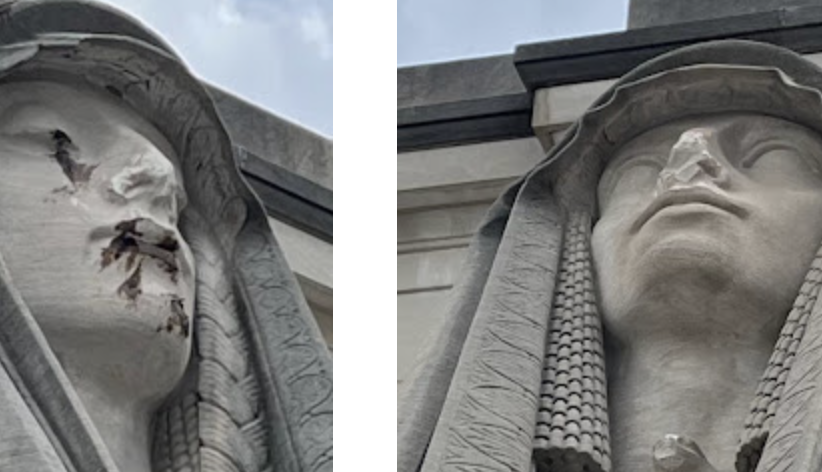
Arturo De Hoyos at the Scottish Rite (SJ) House of the Temple in Washington, D.C. reports that the two monumental sphinx sculptures flanking the entrance were vandalized sometime between Thursday night and this morning.

Enlarged for detail

Two years ago today (June 3, 2020) I reported that vandals spray-painted ”BLM” and “FTP” on the House of the Temple.
Today, however, I have sadder news to report. Vandals severly damaged the two symbolic sphinxes which grace the sides of our front outer steps. They not only broke pieces from their faces, but smeared them with filth.
The sphinxes were carved, on site, by master sculptor Adolph Weinman, who was also a US coin designer and engraver. He’s best remembered for creating the Mercury Dime and Walking Liberty Half Dollar.
Art is correct – the sphinxes were doused with paint during escalating demonstrations and rioting across the U.S. two years ago this very day. That same week, several Masonic buildings throughout the U.S. and Canada had been hit with paint, suffered broken glass doors and windows, and several arson attempts.


Less than three weeks later, on June 19, 2020, the iconic bronze statue of Albert Pike in Washington D.C.'s Judiciary Square was toppled by rioters, covered in paint, and even doused with lighter fluid and ignited. 

Pike's statue had first been erected by the Scottish Rite SJ across from the location of their original 'House of the Temple' headquarters. For thirty years, protesters and the press characterized Pike's sculpture as a "Confederate monument," despite the fact that it was never anything of the kind. His statue was not erected by pro-Confederate veterans groups, or by alleged Ku Klux Klan members (it predated the 1920s resurgence of the KKK by many years). The 11-foot tall bronze sculpture by Italian artist Gaetano Trentanove was erected in 1901 and donated to the city by the Scottish Rite Southern Jurisdiction to commemorate their own 100th anniversary. It's location marked the former home of the AASR's headquarters for its first 90 years. 


Pike was sculpted in civilian clothes, and there were eight inscriptions on its granite base describing his accomplishments: Author, Poet, Scholar, Soldier, Philanthropist, Philosopher, Jurist, and Orator. On the front was a Latin phrase, Vixit Laborum Ejus Super Stites Sunt Fructus. ("He has lived. The fruits of his labors live after him.") Detractors objected to it on the grounds that Pike had owned several slaves when he lived in Arkansas, and served for just five months in the Confederate Army before resigning in disgust, making it the only statue of a "former Confederate soldier" in the District. But the sculpture did NOT depict him as a Confederate soldier. 

There were no references to the Confederacy, only that Pike had been a "soldier" and the banner in the hand of the Grecian figure is not a Confederate flag or symbol, but a Scottish Rite one featuring the double-headed eagle. It was purely a Masonic statue and an homage to his life's many accomplishments. Nevertheless, it was felled by the mob and hauled away to an unspecified location by the District's Parks Department.


If anyone happens to know one single person whose life was improved in any way as a result of the destruction of Pike's statue, please let me know. 

And the same is true concerning the defaced House of the Temple's sphinxes now. Whom did that help? What imaginary blow against equally imaginary tyrants did that strike?

I will admit, in passing, that there MAY be a twisted, paranoid connection some miscreant cooked up in his mind to justify attacking the sphinxes on this particularly date. More than 120 of the globe's most elite leaders from politics, business, big tech, media, and academia are convening in Washington for the notoriously secretive 68th Bilderberg Meeting from June 2 to 5th. Conspiracists have long perpetrated the shaggy dog story that the Bilderbergers are a secret society of ultra-elite Freemasons who control the levers of government and industries throughout the world. (Never mind that they issue to the press the list of invitees every year, along with the conference's agenda topic headings). Members in the group exchange information (studies, reports, demographics, surveys, etc.) and they aren't forbidden to talk about any of it. The only restriction is that they may not publicly disclose the exact source of their specific information.

Plenty of conspiracists claim that these meetings are where the "New World Order" was planned and set in motion. To be fair, the first proposal of the current European Union, and the conversion of European nations' myriad currencies into the Euro really were hammered out by Bilderberg attendees.

(I do wonder if they serve "New World Hors d'ouvers" at their cocktail parties.)

Unfortunately way too many conspiracy peddlers sloppily smear together the Freemasons, the "Illuminati", the Bilderbergers, the Conference on Foreign Relations, the Trilateral Commission, the Bohemian Grove, and the United Nations into one big fat group of invisible puppeteers running everything. Heck, even Yale University's Skull and Bones Society gets stuck with being on the list.

Sunday, June 21, 2020

Washington's Albert Pike Statue: After the Fall


by Christopher Hodapp

On Saturday morning, the fallen bronze carcass of Albert Pike's once noble statue in Washington, DC's Judiciary Square was ignominiously hauled away on the back of a flatbed truck to an unspecified location. Pike's figure was toppled and defaced by a mob of protesters late Friday night. 

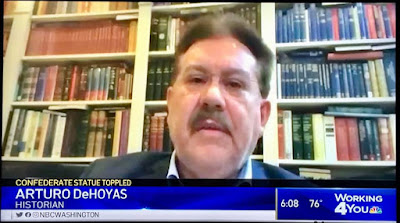
The Scottish Rite's Art De Hoyos was interviewed on the local NBC affiliate in Washington DC on Saturday for his comments on the incident. Unfortunately, little of Art's interview actually made it into the segment, which was edited to reinforce the false narrative that this was a 'Confederate monument.' NBC-4's 'fact checkers' were in such a hurry to do so that they misspelled Art's name.

https://www.nbcwashington.com/news/local/albert-pike-statue-brought-down-in-dc/2339487/?fbclid=IwAR2K3S8MXeL63pIo2X6sKAdrHwfmj_Sgd-ndtSiQJqDgFYB7DdsX0Kn4-n4

To me, that's most frustrating about the incident — the dishonest media coverage and deliberate mischaracterization of Albert Pike and the statue itself. Of course this wasn't a 'Confederate monument.' It was a Masonic representation of Pike's accomplishments as an author, philosopher, orator, lawyer, historian, polyglot, and a soldier (not only in his brief stint in the Confederate army, but also in the Mexican-American War). He wasn't atop a horse; he had no sword dangling from his belt; there was no declaration of heroship, and no phony bromide about 'healing a divided nation' that are the hallmarks of Civil War statues. Pike stood there with a book in his hand and the inscription Vixit Laborum Ejus Super Stites Sunt Fructus. "He has lived. The fruits of his labors live after him." Yet few - if any - who tore it down had any interest in actually looking up what the fruits of his labors really were.

I find myself in a curious position over ol' Albert. I have never been a staunch fan of Albert Pike's writings. In the very first edition of my book Freemasons For Dummies written in 2004, I wrote about him because he was such a dominating influence on a large part of the fraternity, and because he was such a lightening rod for conspiracy theories. Albert Pike never had an unexpressed thought in his entire life — he wrote thousands of pages of books, letters, articles, rituals, poems and more, on top of his legal career, newspaper editorship, translations of foreign and ancient texts, and his role on the Arkansas Supreme Court before the war. Just by committing so many words to paper across his 82 years on Earth, that alone left an enormous pile of material that permits conspiracists to claim literally anything about him. And they have.

I had been a Mason for barely six years at the time I was writing, and I was not (and am not today) a member of the Ancient Accepted Scottish Rite - Southern Jurisdiction. In the Northern Masonic Jurisdiction we read and know almost nothing about Pike, nor did we adopt his rituals. The Northern and Southern Jurisdictions have almost nothing in common, ritualistically. Those of us in the fifteen northeastern states of the AASR-NMJ have never been handed copies of his masterwork, Morals & Dogma (as opposed to ALL Southern Jurisdiction members until the 1970s). So we have never particularly revered him or even studied his work, unless it is done independently by individuals. Until the advent of the easy circulation of information wrought by the Internet, quite literally half of the Masonic population of the United States and an enormous part of it outside of the U.S. would hear the name of Albert Pike and tell you, "Never heard of him." And they weren't lying.

In a sidebar section of my book called 'Mysticism, magic, and Masonic mumbo-jumbo,' I was speaking about a group of intellectual 19th century Masons who chose to believe that Masonry had far more mystical and esoteric origins than it likely had. I put Pike in that group of writers who had "dazzling intellectual and spiritual knowledge."  

"The works of these men were filled with fabulous tales of beliefs and cultures and cryptic theories of the deepest and earliest origins of Freemasonry," I confidently wrote.  

"In short," I said, "they wrote a lot of crap." 

Let's just say that in 2004, I had a less than serviceable appreciation of Pike's true scholarship. Since that time, I revised that passage of the book and removed that offhanded and ill-chosen dismissal of Pike and writings. Nevertheless, I find myself in the bizarre position today of pleading his case posthumously to an uncaring and prejudicial mob of press, civic officials, destructive protesters, and casual observers who have an even more superficial comprehension of Pike than I did 16 years ago.

There's no way of knowing how many people encountered the Pike statue over the last 119 years and said "Who the hell was this guy?" and actually tried to find out. But that is always the lingering hope when civic leaders erect statues to former icons - that future generations will try to discover why that person was considered honorable or admirable or heroic enough to be cast in bronze for the Ages. 

Apologists for the mob's destruction claim Pike's bronze figure's very existence caused 'pain,' but not because of anything actually on the statue itself. It could only cause distress if a person believed the lopsided message that Pike's brief time in the Confederate army was the defining aspect of his life (which it certainly was not). Or the completely unproven allegation that he had anything whatsoever to do with the Ku Klux Klan (which he disparaged). Or that he was an ardent proponent of slavery (he was not, and wrote against it on numerous occasions). Or that he was a bigoted racist who really hated people of color (he lived among the Indians, defended their rights and interests to the U.S, Supreme Court, learned numerous languages, studied and admired numerous non-Western cultures, religions and peoples, and assisted the Prince Hall-descended Scottish Rite by becoming friends with its African-American Commander and giving them copies of his revised ritual).* 
Scraping Pike's image from the face of the Earth doesn't change a single person's life, save a life, sustain a life, or improve anyone's life in any way. 

Yet, passing by or reading about Pike's statue and making a note to follow up and see WHY he was revered can, and has, changed lives of men who joined the Masons because they were intrigued by Morals & Dogma or Esoterika or other writings of Pike's they stumbled into by accident. No real way of knowing how many, but I'll bet a functioning kidney that far more were influenced positively by it than those who truly were genuinely emotionally distraught over its existence. 

And now, that influence no longer going to be possible. 


As society changes, so do the people we admire and honor as a combined culture. I occasionally ponder who the current society we have really admires now by general agreement and acclaim. We don't erect many statues of individuals anymore in the West, not because they have fallen out of favor, but because we as a society no longer agree on admiring ANYONE anymore, unless it's a sports figure or some anonymous 'Everyman' sort of generic representation of the Common Man/Woman. Politicians, explorers, writers, artists, musicians, scientists, inventors, theologians, philosophers, military figures – all those areas of achievement used to be celebrated and honored, and sometimes even rose to the stature of 'heroic.' But we've become so used to tribalizing, trivializing, snarking, digging for dirt, picking at scabs, and otherwise seeking the tarnish on every person who rises to prominence because they don't fulfill some impossible level of perfection and purity. Miserablism as a teaching method has triumphed, 
and we have become incapable of discovering individual heroes worthy of memorializing For the Ages anymore. The best we can seem to work up in 2020 is a participation trophy-style of group heroism and admiration, like 'our first-responder heroes,' our 'medical personnel heroes,' our 'brave restaurant workers.' One idly wonders if 50 years from now anyone will propose a Washington DC memorial installation to their memories.

The social commentator Theodore Dalrymple writes, 
“[T]hose who want to manage the whole of society love the kind of history that sees no grandeur, beauty, or achievement in it, but only a record of injustice and misery (which, of course, really existed, and all of which they, and only they, will put right). The real reason for the enthusiasm for pulling down statues is to destroy any idea of the past as having been anything other than a vast chamber of horrors, and since everyone has feet of clay, and the heroes of the past always had skeletons in their cupboard (to change the metaphor), reasons for destroying statues, even of the greatest men, can always be found.”
I wonder what Joseph Campbell would make of our civilization right now, knowing that humans have always craved the lone figure of 'The Hero' for inspiration and emulation, and seeing that Western society is incapable of it anymore.


In February 1993, the Philalethes magazine published a piece about the Pike statue controversy that was raging back then. It was written by the Reverend Howard L. Woods, a Christian minister who served for ten years as the Grand Master of the Most Worshipful Prince Hall Grand Lodge of Arkansas F&AM. In 1991, he had been invited as the Lecturer for the Philalethes Society, the first Prince Hall Mason ever asked to do so, and still many years before Prince Hall recognition became widespread. GM Woods wrote before more recent scholarship has brought to light more of Pike's writings and verification that Pike did indeed provide his revised Scottish Rite rituals to help the Prince Hall aligned Scottish Rite.

The Reverend Grand Master Woods' perspective in 1993 deserves to be repeated now, in light of what has happened this weekend.
The Albert Pike Statue: Let It Stand
There is no love lost between Prince Hall Masons and the memory of the late Albert Pike, Masonic Historian, writer, alleged ritualist for the Ku Klux Klan, but, if Freemasonry is to remain the bulwark of free-thinking people, then, "Let the statue remain!"
Like the natures he wrote about, Albert Pike showed the light and dark sides of his own soul, when with one breath he spoke of his willingness to give up his Freemasonry rather than recognize the Negro as a 'Masonic Brother' and with another breath, declared that every man should be free, for a free man is an asset, while a slave is a liability. Mankind is that way, and as long as the statue stands, America and Freemasonry will survive.
Let the statue be torn down and America and Freemasonry will be in jeopardy, for one would have to wonder, "What would be next?" As a Prince Hall Mason, an African American and supposedly free-thinker, I can see a higher power than the mortal mind of Albert Pike guiding his pen as he wrote such beautiful words of life without an occasional helping hand from someone "bigger than you or I."
Let the statue stand, even if it is proven that Albert Pike did write ritual for the Ku Klux Klan; more ignoble deeds have been done by others without sacrifice of their historic heroism.
Let the statue stand as a reminder that the good and evil of men are in equilibrium within us, and we all should strive for perfection now and in the future, not in the past. Let the statue stand!
 --Rev. Howard L. Woods, Grand Master, Prince Hall Masons of Arkansas.

*NOTE: Between 1887 and 1891, Albert Pike happily shared personal, autographed copies of his Scottish Rite Masonic degree rituals with his counterpart, Thornton A. Jackson, in the parallel Scottish Rite Southern Jurisdiction for black Prince Hall Masons, in order to assist their fledgling organization. Pike's correspondence has not survived, but in writings of the period, Jackson described Pike as his friend. Later comparisons of their two sets of rituals confirmed that the Prince Hall AASR-SJ today remain very close to those Pike wrote in the years before 1887.


Photos by Brother Efrian Olujimi Dalle; H/T to Brother Michael Wright


As a final post script to this entry, the following message about the Pike statue incident was issued on Sunday by MW Michael D. Nicholas, Sr., the Grand Master of the District of Columbia:


Grand Master's Statement

My Brethren,

This communication is directed to the Freemasons in the Grand Lodge, F.A.A.M of Washington, DC.

Most of you know of the recent destruction of the statue of Albert Pike in our Nation’s Capital. Regardless of your personal opinions about Albert Pike, I hope we can all agree as Masons that mob violence is not the way to resolve differences of opinion. The statue, which belongs to the U.S. National Park Service, was erected by an Act of Congress in 1898 and has been controversial from the beginning. Since its placement, neither the Scottish Rite nor our Grand Lodge has had ownership, responsibility, or control over the maintenance or fate of the statue.

To ignore the many positive contributions that Albert Pike made to Freemasonry later in his life, or to ignore the several controversial issues that his biography raises, would be equally disingenuous and dishonest. None of us are perfect human beings. Were we each to be judged solely by our bad decisions, rather than the totality of our life’s work, there would be very few statues indeed.

Those who vandalized the Pike statue are entitled to receive that same consideration. I hope you will choose to focus on the values of redemption, forgiveness, and love when forming your perspectives of this incident – towards both factions. Our task as Freemasons is to build bridges of communication and understanding. By looking forward instead of backward, we make progress in improving ourselves and our nation as we strive to build a more perfect Union.

The main purpose of this message is to address the here and now. What happened last Friday night is neither the beginning nor the end of these struggles toward the realization of the more egalitarian and representative society that our ritual teaches. And many of you are rightly passionate about these issues.

As we engage as members and leaders of our communities, I ask you to remember some of our core lessons, where we are instructed to “keep our passions within due bounds.” The ‘secrets’ of Freemasonry are not about some hidden treasure, but about how to control ourselves. It is a daunting challenge. Today’s abundance of social media outlets offers each of us almost countless opportunities to stress the limits of that control.

For your consideration I offer here the “Conclusion” of our Grand Lodge Social Media Policy, available on our website:

"Posting a comment related to the Fraternity and then posting a disparaging comment about a social or political stance can easily mislead a reader to believe your stance is representative of Masonry and all Masons. Remember that the public and members of the Masonic Fraternity are reading your posts online. You should always maintain your online conduct in a manner that elevates non-Masons’ image of the Craft and of your own dedication to it, and avoids any implication of improper or un-Masonic behavior as defined in the Code of our Grand Lodge."

Brethren, I ask you to heed this advice. Help to lower the temperature, not raise it. Be extremely conscious of the choices you make. And when you choose to comment on social media or provide remarks to the press, be aware that you speak as an individual. You are certainly – and hopefully – informed by your Masonic knowledge, but you do not speak for our Grand Lodge, nor Freemasonry in general. There is only one voice temporarily burdened with that responsibility.

In the absence of a clearly evident rationale for it, we must control our ego and avoid associating ourselves with our Craft in social postings. Let us be particularly vigilant to avoid using our wonderful but confusing honorific titles that cause further consternation among non-Masons.

Brethren, be part of the solution and do not exacerbate the problems. Together we can take up the challenge to circumvent divisiveness and act to help heal our Nation.

I want all of you to know that the leadership of your Grand Lodge is very much aware of the situation, and we are constantly looking to foster and promote the concepts of Freemasonry in our wonderful city of Washington, DC.

Thank you. May the Grand Architect continue to bless your families and your endeavors.


Sincerely & Fraternally,

Michael D. Nicholas, Sr.
Grand Master
The Grand Lodge, FAAM of Washington, DC


And the following statement was issued by the Grand Commander James Cole of the Supreme Council of the Scottish Rite Southern Jurisdiction (click image to enlarge):


Freemasons For Dummies is the internationally bestselling guide to the Masonic fraternity.

Saturday, June 20, 2020

De Hoyos on Pike: "The fruits of his labors live after him"


by Christopher Hodapp

As reported last night, the bronze statue of Freemason Albert Pike in Washington, DC was toppled by a mob of demonstrators, wrongly claiming it to be a 'Confederate monument.' Later reports detailed that the crowd (described as 'peaceful' in numerous reports all night) spent nearly two hours working to drag the Federally-owned statue from atop its tall stone plinth while scores of D.C. police officers stood by at their adjacent precinct building and just watched. Only after the statue fell and was set on fire with lighter fluid did officers move in, and only to extinguish the flames.


I've seen no report in the aftermath this morning as to what will be done with the fallen sculpture. And there has been no word as to whether anyone in the crowd will be charged with destroying Federal property.

Arturo De Hoyos
For those who haven't seen it this morning, Illus. Arturo De Hoyos posted the following statement on his Facebook page. As the Grand Archivist of the Scottish Rite Southern Jurisdiction, Art is arguably the world's foremost expert on Albert Pike's writings. If there is anyone on Earth who could claim to be intimately familiar with the record of Pike's life and works, it is Art. 

I quote him in his entirety:


** He has lived! The fruits of his labors live after him **

Like many of you, I watched the news last night as a mob pulled down and burned the statute of Albert Pike. Earlier in the day I gave a TV interview in which I said that Freemasons did not want the statue to be a point of conflict, but that it was property of the United States, under the Parks Service. I preferred that it be moved to a museum where he could be understood in context.

Last night, as the mob did their work, the news media called it a “Confederate Statue,” the presence of which was “painful.” In truth the statue had nothing to do with the Civil War. It was Pike as a Freemason, in civilian clothing, holding a copy of Morals and Dogma.

Pike was a man of his times who embodied the strengths and weaknesses of his generation. Freemasons acknowledge Pike’s personal foibles and frailties, and revere his ethical and moral teachings. They respect what he accomplished, and see in him an example of a person who was willing to abandon personal prejudices on the path to self-improvement.

Among his strong points was his pursuit of knowledge and self-improvement. Within one lifetime he seems to have lived multiple lives that sometimes overlapped each other. He was, for example, an advocate for Native American rights, an accomplished attorney, an author, an educator, an explorer, an historian, a military leader (Brigadier General), a philosopher, a poet, and a translator.

A Boston native, Pike’s wanderlust led him to explore the South and follow the Santa Fe Trail. He had a particular fascination with Native Americans, and became a friend to several tribes, compiling personal dictionaries of their languages and dialects. Later in life, as an attorney, he became a legal advocate for Native Americans, trying to secure the rights which they had been promised by the government.

As with other “larger than life” vocal personalities, he was occasionally controversial. Strongly in favor of the Tenth Amendment (States rights) Pike, like many other Americans, sided with the South during the American Civil War. Although his wife’s family owned slaves he personally considered slavery a great evil, and the greatest calamity of the South. In 1856 he walked out of the Southern Convention saying, “he would suffer himself to be torn by wild horses before he would justify the renewal of the African slave trade.” He was ridiculed for his hope that a time would come for all men to be free, but he failed to condemn slavery outright. Following the war, under President Johnson’s amnesty proclamation, Pike returned to private life and in late 1869/early 1870 he moved with the Scottish Rite to reside in Washington, DC.

Pike has been quoted to say that he preferred to leave Freemasonry than sit in lodges with Black men. If this was his earlier view, he matured and changed. In fact, he became a supporter of Black Freemasonry and enjoyed a friendship with Thornton A. Jackson, Grand Commander of the Prince Hall Affiliation. Pike even shared his rituals with the Prince Hall Freemasons, and exchanged cordial and fraternal letters.

After Pike’s death he was maligned when it was falsely alleged that he had been a member of the KKK. Pike’s enemies claimed he was one of the founders and/or chief judicial officer of the KKK. However, when the US Congress investigated the KKK in 1871, its report failed to support these allegations. (Testimony Taken by the Joint Select Committee to Inquire into the Condition of Affairs in the Late Insurrectionary States, 13 vols. [Washington: Government Printing Office, 1872]). The allegations were so prevalent and persistent that even some Masonic writers were fooled and repeated them. However, there are no primary documents, membership records, or letters from Pike’s time which suggest his participation in any way. In the vast collection of the Supreme Council’s archives, there is not a single document connecting him with the KKK.

Another false claim is that Pike was a “Luciferian.” The French hoaxer Leo Taxil (Gabriel Jogand-Pages) asserted that Pike was the “Sovereign Pontiff of Universal Freemasonry,” and that he taught the worship of Lucifer in the Scottish Rite’s highest degrees. Taxil later publically admitted this was a hoax, at the expense of the Catholic church. Although Freemasonry admits good men of any faith, Pike was himself a Bible-believing Christian, who encouraged Masons to respect Jesus “Above all the other great teachers of morality and virtue” (Morals and Dogma 28:573). In several long passages, Pike implored Masons to follow Jesus’s example, calling him “the Great Master” whose life was an “undeniable Gospel” (M&D 28:575). Pike urged us, “Believe that there is a God; that He is our father; that He has a paternal interest in our welfare and improvement; that He has given us powers, by means of which we may escape from sin and ruin; that He has destined us to a future life of endless progress toward perfection and a knowledge of Himself—believe this, as every Mason should, and you can live calmly, endure patiently, labor resolutely, deny yourselves cheerfully, hope steadfastly, and be conquerors in the great struggle of life” (M&D 12:22). 


Throughout his writing Pike encouraged us to make the most of ourselves, to see ourselves as part of a human family, and to do good to all: “Learn, that you may be enabled to do good; and do so because it is right, finding in the act itself ample reward and recompense. To attain the truth, and to serve our fellows, our country, and mankind—this is the noblest destiny of man” (M&D 4:8-9).

Perhaps, however, his most famous saying is engraved near his bust at the House of the Temple: “What we have done for ourselves alone dies with us; what we have done for others and the world remains and is immortal.” These wise words remain as true today, as when he spoke them.

Freemasons honor Albert Pike for the several reasons: for his love of a fraternity which seeks to improve the social order and encourages humankind to find commonalities to form bonds of friendship; for his willingness to discard personal prejudices when confronted by better information; and perhaps, most of all, for his love of the truth and commitment to share whatever truth he discovered.

Like the rest of us, Albert Pike was far from perfect. But he had the moral courage to abandon the past and move forward. He tried to make his personal weaknesses into strengths, and his writings encourage us to do the same. The remainder of his life was dedicated to a Fraternity that seeks to transcend barriers, both real and artificial, to make strangers into Brothers. This is why, when his statue was erected in Judiciary Square in 1901, it was attended by men who had previously faced each other on the battlefield.

Pike never wanted a statute of himself. Rather, he said:

“When I am dead, I wish my monument to be builded only in the hearts and memories of my Brethren of the Ancient and Accepted Scottish Rite, and my name to be remembered by them in every country, no matter what language men may speak there, where the light of the Ancient and Accepted Scottish Rite shall shine, and its oracles of Truth and Wisdom be reverently listened to.”

Friday, June 19, 2020

Albert Pike Statue in Washington, DC Toppled, Burned By Protesters


by Christopher Hodapp

Fox5 TV in Washington, D.C. is reporting late Friday night that the bronze statue of Albert Pike in Judiciary Square has just been toppled and burned. Between 80 and 100 people were gathered around the statue shortly after 11PM when it was yanked off its pedestal and knocked to the ground. Once on the ground, the cheering crowd reportedly attempted to set fire to to it (a forlorn waste of time and lighter fluid, as the bruised and battered bronze figure stubbornly refused to burn, proving its tormentors all flunked out of high school chemistry class).


There really should be no surprise, since Popular Mechanics magazine helpfully published an article online earlier in this week that was a How-To Guide to toppling or otherwise destroying statues anyone finds offensive.


News reports this evening continue to characterize Pike's sculpture as a "Confederate monument," despite the fact that it was never anything of the kind. His statue was not erected by pro-Confederate veterans groups, or by alleged Ku Klux Klan members (it predated the 1920s resurgence of the KKK by many years). The 11-foot tall bronze sculpture by Italian artist Gaetano Trentanove, towering high above its massive limestone plinth, was erected in 1901 and donated to the city by the Scottish Rite Southern Jurisdiction to commemorate their own 100th anniversary. It's location marked the former home of the AASR's headquarters for its first 90 years. 

There are (or were) eight inscriptions around the corners of its granite base: Author, Poet, Scholar, Soldier, Philanthropist, Philosopher, Jurist, and Orator. On the front was a Latin phrase, Vixit Laborum Ejus Super Stites Sunt Fructus. ("He has lived. The fruits of his labors live after him.") Despite the fact that detractors objected to it on the grounds that Pike had served for just five months in the Confederate Army before resigning in disgust, making it the only statue of a former Confederate soldier in the District, the sculpture did NOT depict him as a Confederate soldier. There were no references to the Confederacy anywhere to be found (not even symbolically), and the banner in the hand of the Grecian figure is not a Confederate flag or symbol, but a Scottish Rite one featuring the double-headed eagle. It was purely a Masonic statue.

Before it fell to the mob
Pike's statue has been considered 'controversial' since 1989 when famed whacko Lyndon Larouche first raised a stink over it. The most recent attempts by Washington DC's non-voting delegate to Congress, Eleanor Holmes Norton to have it removed used all of the same (and more) false accusations and outright fabrications that ignored the volumes of truthful information available about the life of Albert Pike and his accomplishments. Despite allegations by conspiracists and activists, there has never been any proof that Pike had written the rituals of the Ku Klux Klan, or had anything to do with the post-Civil War Klan. For more than you'd ever want to know about this, have a look at previous articles: 


Oh, what's the use? Mobs can't be reasoned with, and history doesn't matter anymore. So now that Albert's figure has been dashed to the ground, I suppose it can't be 'controversial' anymore. It is perhaps best that the argument about the statue is finally at an end. Freemasonry must not be the cause of division or controversy, among ourselves or the community in which we reside. Pike would agree, were he here today.


The statue was originally bought and paid for by the Scottish Rite, but it was handed over to the National Park Service shortly after it was erected. It will be up to them to decide the fate of what remains cometh the dawn, since it is Federal property on Federal land (you can bet no one will be charged with destroying Federal property). I'm sure Pike himself would have waxed philosophical about the whole affair – he actually didn't want any monuments to himself after he died, hoping his life's works would stand or fall as his epitaph, letting history judge his worth. But it's tough to simply shrug this off as we watch events unfold in real time.


https://www.amazon.com/Freemasons-Dummies-Christopher-Hodapp/dp/1118412087/ref=as_sl_pc_qf_sp_asin_til?tag=chrishodappsf-20&linkCode=w00&linkId=EHLBENRWFIAN7UWW&creativeASIN=1118412087