"To preserve the reputation of the Fraternity unsullied must be your constant care."

BE A FREEMASON

Showing posts with label Christianity. Show all posts

Saturday, November 11, 2023

Ancient & Accepted Rite for England and Wales Drops Trinitarian Christian Requirement


by Christopher Hodapp

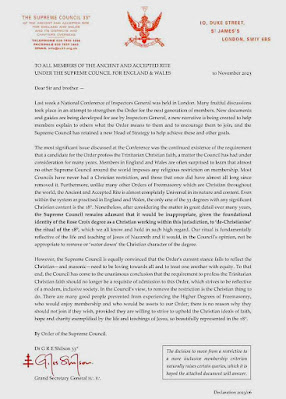
The Supreme Council 33° of the Ancient and Accepted Rite for England and Wales (what American Masons know as the Scottish Rite) announced a significant policy change in its jurisdiction this week. Following a National Conference of Inspectors General, a letter was issued Friday stating that they are removing their longstanding requirement for petitioners to specifically declare a belief in Trinitarian Christianity.

This is an important change in this jurisdiction's membership prerequisites. Prior to this, the requirements for Masons seeking membership in the Ancient and Accepted Rite for England and Wales were as follows: 

"All candidates for membership of the Ancient and Accepted Rite under the jurisdiction of the Supreme Council for England and Wales must profess the Trinitarian Christian faith and have been Master masons for at least one year in UGLE, or have joined a lodge under UGLE from a recognized Grand Lodge."

Friday's announcement reads, in part:

Members in England and Wales are often surprised to learn that almost no other Supreme Council around the world imposes any religious restriction on membership. Most Councils have never had a Christian restriction, and those that once did have almost all long since removed it. Furthermore, unlike many other Orders of Freemasonry which are Christian throughout the world, the Ancient and Accepted Rite is almost completely Universal in its nature and content. Even within the system as practiced in England and Wales, the only one of the 33 degrees with any significant Christian content is the 18°.

Nonetheless, after considering the matter in great detail over many years, the Supreme Council remains adamant that it would be inappropriate, given the foundational identity of the Rose Croix degree as a Christian working within this jurisdiction, to 'de-Christianize’ the ritual of the 18°, which we all know and hold in such high regard. Our ritual is fundamentally reflective of the life and teaching of Jesus of Nazareth and it would, in the Council's opinion, not be appropriate to remove or 'water down' the Christian character of the degree.

However, the Supreme Council is equally convinced that the Order's current stance fails to reflect the Christian—and Masonic—need to be loving towards all and to treat one another with equity. To that end. the Council has come to the unanimous conclusion that the requirement to profess the Trinitarian Christian faith should no longer be a requisite of admission to this Order, which strives to be reflective of a modem, inclusive society. In the Council's view, to remove the restriction is the Christian thing to do. There are many good people prevented from experiencing the Higher Degrees of Freemasonry, who would enjoy membership and who would be assets to our Order; there is no reason why they should not join if they wish, provided they are willing to strive to uphold the Christian ideals of faith, 
hope and charity exemplified by the life and teachings of Jesus, so beautifully represented in the 18°.


As alluded to in the letter, the traditional Rose Croix 18° as it is worked in the majority of Scottish Rite jurisdictions today is founded upon Christian imagery and symbolism — events in the life of Christ are used as an allegory for its lessons of monotheistic universality and the importance of Faith, Hope, and Charity. 

In many Scottish Rite systems around the world, the 18th is the culmination of the first half of the Rite's degrees, and it can take many years to attain that level outside of the U.S. It's not uncommon for many Scottish Rite members in certain jurisdictions to never rise above the 18th — their degrees are taken one at a time, in order, often months (or even years) apart. This dramatically differs from the U.S. where a candidate generally becomes a full 32° Scottish Rite Mason in a single day or weekend. 

Albert Pike's post-Civil War revision of the 18° for the Southern Jurisdiction of the Scottish Rite in the U.S. kept the original structure and allegory of the Rose Croix degree that had originally come to America from France through Etienne Morin as part of the hauts grades making up the Rite of Perfection. (Refer to the Francken Manuscript for this early version.) While it tells the story of the life, death, and resurrection of Jesus Christ, Pike removed the original degree's obligation to live a specifically Christian life and accept all of the tenets of Christianity. He felt such an obligation violated the most basic Masonic principles of universality and tolerance. So he kept the story, but reworked the obligation of the degree.

The Northern Masonic Jurisdiction of the Scottish Rite in the U.S. took a bit longer to remove the specifically Christian obligation from the 18°. In the degree, Jesus of Nazareth is the Exemplar, and any monotheistic believer can confidently take the obligation. 

The NMJ's website explains their own current version of the 18° (as revised in 1941 and later, in 1964) this way:

In 1941, Sovereign Grand Commander Melvin M. Johnson appealed to revise the 18° so it could be better suited for men of all faiths. He said: "This is the heart of what the Rite seeks to inculcate in its degree of Rose Croix, this common faith. (That good will overcome evil) When the battle is won, Freemasonry’s greatest secret – secret only, because the world will not learn it – will be secret no longer for then humanity will find peace in brotherhood."

[snip] 


[T]he Knight of the Rose Croix of H.R.D.M (Heredom), relays the life and death of Jesus. The allegory is based on the New Law he declared at the Last Supper: the law of love, which all men everywhere may understand and practice. His teachings exemplify the universal principles of life and encourage candidates to be virtuous, endeavor to eliminate vice, and practice tolerance and love. Upon the doctrine of Universality, the 18° should be interpreted by each Brother according to his own faith.

While Craft Lodge Freemasonry has been historically non-sectarian in its membership requirements since at least 1717, there are several Masonic-related appendant organizations that a Freemason can join that do have a specifically Trinitarian Christian requirement. These include the Knights Templar, the Masonic version of the Rosicrucians (SRICF), the Red Cross of Constantine, the White Shrine of Jerusalem, and more. The Supreme Council 33° for England and Wales has been unusual by having such a requirement, since no other Scottish Rite jurisdiction does.

Just as a bit of background, in May 1801, the first Supreme Council 33° for the Ancient Accepted Scottish Rite was opened in Charleston, South Carolina, and eventually became known as the Southern Jurisdiction of the USA. It was followed by France (1804), Spain (1811) and the Northern Masonic Jurisdiction of the USA (1813). Ireland (1826) was the sixth, England and Wales (1845) — receiving its Patent from the Northern Masonic Jurisdiction — was the eleventh, and Scotland (1846) the twelfth. There are now independent Supreme Councils in over 60 countries.

Sunday, October 08, 2023

Outpouring of Sympathy and Support for Grand Lodge of Israel


by Christopher Hodapp

In the wake of the horrific terrorist attacks on Israel this past weekend, the Grand Lodge of the State of Israel AF&AM has posted a statement on its Facebook page acknowledging the enormous outpouring of support by the world's Freemasons. 

Click the image below to enlarge.


It reads:

Sunday, October 8, 2023

Dear Brothers of all the world.

We would like to express our heartfelt gratitude for the letters and phone calls from all over the world of fraternal support and solidarity during these challenging times in the State of Israel. It is truly moving to receive so many expressions of identification with the Grand Lodge of Israel, its Dear Brethren, and the entire populace in Israel.

We find solace in being part of this worldwide movement where fraternal unity among Dear Brothers transcends all forms of hatred. Our Grand Lodge serves as an exemplary illustration of this, as we have Dear Brothers from all faiths, races, languages, and countries living together in harmony with genuine brotherly love.

We have received unwavering support from our Dear Brothers living in the North, who stand in solidarity with the Dear Brothers and families residing in the South. Our building is soon to be opened and made available to those in need, and we are voluntarily bringing our Lodge of Magicians to entertain the children. This is how a fraternal society is built, and we are the ones who must lead the way.

Thank you for your attention.

Sincerely and fraternally.

M.W. Bro Man Segev, Grand Master 

R.W. Bro Jose Cohen, Grand Secretary

The official seal of the Grand Lodge of Israel includes a Star of David, a Christian cross, and a Muslim crescent, all superimposed over a Masonic square and compass and encircled by a Chain of Union. The Grand Lodge was established in 1953, and the country has almost 50 lodges at work today. Jewish, Christian, Muslim and Druse brethren all work together, and their various holy books are all opened side by side on the lodge altars. Despite decades of violence in the Middle East centering around the creation of the State of Israel in 1948, finding a better illustration of of true brotherly love in that nation would be difficult.

Thursday, March 31, 2022

Louisiana Grand Master's Edict Requires Bible Readings For Meetings: Internet Masons Go Crazy


by Christopher Hodapp

The brand new Grand Master of the Grand Lodge of Louisiana, MW Jay B. McCallum, kicked off his first week in the Grand East yesterday by issuing Edict 2022-1, and Masonic social media immediately erupted into a divisive public donnybrook. 


The edict reads, in part: 

Whereas the Holy Bible is the Great Light in Masonry; and
Whereas the Holy Bible is the rule and guide to our faith and practice; and
Whereas Freemasonry opens this Book upon its alters, with the command to each of its votaries that he diligently study therein to learn the way to everlasting life;

Therefore, by the authority vested in me as Grand Master of the grand Lodge of Louisiana, Free & Accepted Masons, I do hereby issue and proclaim the following edict:

“Effective upon the date hereof, the  Worshipful Master of each lodge shall cause a verse or passage of Scripture from the Holy Bible to be read aloud immediately after the lodge has been opened and before the reading of the minutes or any other business of the lodge shall be transacted.”

(Click image to enlarge.) 

When I first joined the fraternity in 1998, our Grand Master Robert E. Hancock issued an edict that added a new bit of business to the rubric. As the lodge was closing, instead of closing the Bible and placing the square and compass on the closed cover, the Chaplain was to turn the book to Matthew 5:16:

Let your light so shine before men, that they may see your good works, and glorify your Father which is in heaven.

It was to remain open to that passage at all times until the next lodge meeting, when it would be turned to the degree-appropriate pages. Hancock wasn't attempting to shoehorn a deliberately Christian New Testament message into the lodge. He simply felt that the words themselves succinctly described Freemasonry's mission, along with a charge to each of us to spread Masonic Light as an example to others. It wasn't so much a religious message as it was a reminder to us as Masons about our conduct, and it was to remain visible at all times as a symbol of the duty we all have as Masons. Nevertheless, when the annual Grand Lodge session came around in May 1999, Hancock's edict went down in flames, in part because many Masons voting that day couldn't see anything beyond the fact that it was a New Testament quotation, and therefore automatically an overt Christian message.

What disturbs me about the online reaction to GM McCallum's edict is that it has resulted in a toxic wave of insults and accusations between purported Masons who seem to have a lopsided hatred of anything that even smells like Christianity creeping into lodge business. Suggestions for readings from the steamier parts of Song of Solomon or giggly recommendations of passages referring to Biblical figures "sitting on an ass" and other idiocy that was worn out in third grade Sunday Bible School all came tumbling out. Yet, many of these same online commentators are the first to whip out "Whattabout the Koran? Or the Veda? Huh? Huh?" And then, of course, comes the wave of "Can I read out of Harry Potter?" "I'm a pastafarian - can I read the ingredients off of a Creamettes angel hair pasta packsge? Huh? Huh?"

It's sort of like being trapped into sitting at a bar next to a drunk who won't shut up until you hate his ex-wife as much as he does.

And then there are the characters who actually say with a straight face (or a straight keyboard, in this case) that "If this edict is allowed to stand, I'm not setting foot in lodge ever again! I didn't join a Christian church!" 

No, you didn't. But it's been astonishing to encounter Masons who honestly claim that passages from the Bible have no business being read in open lodge. Moreover, they contend that reading scripture from the Bible means excluding Jews, Muslims, Hindus, and all other non-Christian members. A bizarre claim for members of an organization that bases its entire structure on the symbolism of Solomon's Temple as described in two books of the Old Testament, which is made up of the Hebrew Tenach. Yes, I know, there are currently more than 4,000 religious varients in the world today. But Solomon's Temple is a shared icon of the three Abrahamic religions that comprise the vast, VAST majority of the religious believers on the globe. And there's a certain amount of unintentional comedy that our own internal critics are screaming their collective heads off over this when our ritual's central story was dreamed up by a bunch of middle-class British Anglicans trying to emulate Old Testament Jews in the first place.

Put it another way: I don't see a further commands from the Grand Master that passages from the Qur'an, the Veda, the Tao Te Ching, the Bahagavad Gita, the Book of Common Prayer, Khordeh Avesta, the Tripitaka may NOT be read in a Louisiana lodge.

Partially wrapped up in these exchanges are clear situations of Masons believing that all jurisdictions, grand lodge rules, and degree rituals are exactly the same as their own. In the case of Louisiana in particular, the history of the development and growth of Freemasonry in that state  is dramatically different than the rest of the U.S. because of its early French influences. Because of their pre-1800 French origin, eleven Louisiana lodges are permitted to use English translations of Craft rituals for EAs, FCs and MMs that are not worked elsewhere in the U.S. (with a couple of noteworthy exceptions in New York and Washington DC, and – I think – California). These are sometimes referred to, somewhat improperly, as the "red lodge degrees" or "Scottish Rite Craft degrees."

It's been a long time since I've seen these degrees performed in person, but Louisiana Masons have told me that there are no biblical passages read during their degree rituals. That's a MAJOR difference in their ceremonies. With the exception of Louisiana and the Grand Lodge of Pennsylvania, the majority of U.S. Masonic lodges all use slight variations of Preston-Webb rituals of English origin. In each of the three P-W Craft degrees, the circumambulation of the candidate is accompanied by the reading of a specific Old Testament Bible verse:

Entered Apprentice: Psalm 133
Behold how good and how pleasant it is for brethren to dwell together in unity! It is like the precious ointment on the head, that ran down upon the beard, even Aaron's beard: that went down to the skirts of his garments; As the dew of Hermon, and as the dew that descended upon the mountains of Zion: for there the Lord commanded the blessings, even life for evermore.

Fellowcraft Degree: Amos 7: 7,8
Thus he shewed me: and, behold, the Lord stood upon a wall made by a plumbline, with a plumbline in his hand.
And the Lord said unto me, Amos, what seest thou? And I said, A plumbline. Then, said the Lord, Behold, I will set a plumbline in the midst of my people Israel: I will not again pass by them anymore.

Master Mason Degree: Ecclesiastes 12: 1-7
Remember now thy Creator in the days of thy youth, while the evil days come not, nor the years draw nigh, when thou shalt say, I have no pleasure in them;
While the sun, or the light, or the moon, or the stars, be not darkened, nor the clouds return after the rain;
In the day when the keepers of the house shall tremble, and the strong men shall bow themselves, and the grinders cease because they are few, and those that look out of the windows be darkened,
And the doors shall be shut in the streets, when the sound of the grinding is low, and he shall rise up at the voice of a bird, and all the daughters of musick shall be brought low;
Also when they shall be afraid of that which is high, and fears shall be in the way, and the almond tree shall flourish, and the grasshopper shall be a burden, and desire shall fail: because man goeth to his long home, and the mourners go about the streets:
Or ever the silver cord be loosed, or the golden bowl be broken, or the pitcher be broken at the fountain, or the wheel broken at the cistern.
Then shall the dust return to the earth as it was: and the spirit shall return unto God who gave it.

But lest a big clot of you think the whole Masonic world uniformly includes these verses in their ritual work, that's simply not the case. Even in the U.S. I'm told some state grand lodges, including Idaho and Mississippi, do not use them. On the other hand, some states include the 133rd Psalm as an official part of their opening of all meetings. So, like so much else in Freemasonry, differences in rituals and customs are entirely jurisdictional.

In the rest of the world, some lodges to open with the passage, "In the beginning God created the heaven and the earth. And the earth was without form, and void; and darkness was upon the face of the deep. And the Spirit of God moved upon the face of the waters. And God said, Let there be light: and there was light." (Genesis 1:1-3). Others use, "In the beginning was the Word, and the Word was with God, and the Word was God." (John 1:1 - another New Testament passage, for those of you keeping score). Just because your lodge doesn't do this doesn't make it irregular, clandestine, or otherwise offensive to the spirit and purposes of Freemasonry. Our founders and forebears took their inspiration and philosophy from wherever they found it, and the Bible remains the most important and widely read book of any kind in human history that has inspired literally hundreds off millions of people for three millennia. So what's all the screaming about, especially from men and Masons who are purportedly adults and who are taught the lessons of universal tolerance and benevolence? 

The Grand Lodge of Louisiana has a different pedigree than any other grand lodge in the U.S. From the time of its formation and growth (partially by English and Irish expats in France in the late 1720s), French Freemasonry was populated by Roman Catholic members. Even the early emigres from the British Isles were Stuart supporters desperate to place James on the throne(s) back home and return the monarchy to Catholic rule. Roman Catholicism was the state religion for centuries in France, a situation that wouldn't change until the outbreak of the Revolution. By 1773 when the Grand Orient de France was officially established, there were more than 600 Masonic lodges at work in France. By the time of the French Revolution in 1789, almost 1,000 lodges had been chartered. 

The Revolution aimed to bring an end to monarchial rule in France, and almost as vehemently, the removal of Catholicism from its positions of power over government and its monopoly over the education of French children. Equally hated were the vast properties held by the Church which were untaxed by the state. And there was the usual hatred of the elite nobility that festers in almost every social uprising. The Abbé Barreul capitalized on the involvement - real and imaginary - of Freemasons in fomenting the Revolution in his book,  that helped create the modern conspiracy theory (but that's another conversation).

At the the formation of the Grand Lodge of Louisiana in 1812, numerous Masons from post-revolutionary France had turned anti-Catholic. And back in France, the Grand Orient itself would become quite politically active throughout the 19th century. In the late 1800s, Grand Orient Masons in the military brewed up a huge scandal when they went on an anti-Catholic purge of the ranks by using Grand Orient membership files to weed them out. And Grand Orient members were deeply involved in drafting France's laicité laws that vehemently banned any open show or support of any religion by government or government employees. (Laicité laws today are still in full force in France, and have been used to prevent teachers and government workers from wearing religious head scarves or veils, or crucifix jewelry on the job.  So, the early founders of Louisiana Freemasonry came from that kind of background.)

Not every grand lodge ever officially adopted a specific list of "unchangeable landmarks" (mine never did, while those who have them have a huge variety and number of them, lest anyone be under the misapprehension that The Landmarks are in any way universal). The GL of Louisiana officially adopted 24 Landmarks of the Order. Number 24 reads:

Healing Day – June 24,1813.

Moderns and Ancients had separated and formed separate Grand Lodges over one question: The religious belief of a candidate.

They agreed – June 24, 1813 on this statement:

“Let a man’s religion or mode of worship be what it may, he is not excluded from the order, provided he believes in the Glorious Architect of Heaven and Earth and practices the sacred duties of Morality.”

Many other grand lodges have differences in stated or implied policies concerning the Bible. For instance: the Grand Lodge of Texas Monitor published in 1922 contains this notation :

[The first section of the Entered Apprentice] degree teaches the candidate, by Symbols, many important lessons, and among other things, that Masonry is a moral institution, founded upon the morality as taught in the Bible, and that he has to take the Holy Bible as the rule and guide to his faith and practice; it being the great light in Masonry and the source whence we, as Masons, derive all our ethics.

Texas' Charge to the Entered Apprentice includes this:

As a Mason, you are to regard the Holy Scriptures as the great light in your profession; they are the unerring standard of truth and justice; and you are to regulate your life and actions by the divine precepts therein contained. No institution was ever raised on better principles, or a more solid foundation than that of ours, which takes the Holy Bible as its corner-stone; nor were ever more excellent rules or useful maxims laid down, than are inculcated in the several Masonic Lectures, which you will learn at your leisure, by conversing with well-informed Brethren, who will be always as ready to give as you will to receive instruction.

 The 2013 revision of the Grand Lodge of Kentucky's Constitutions has this to say:

The Supreme Being.
Masons believe that there is one God and that people employ many different ways to seek and to express what they know of God. Masonry primarily uses the appellation, “Grand Architect of the Universe”, and other non-sectarian titles, to address Deity. In this way, persons of different faiths may join together in prayer, concentrating on God, rather than differences among themselves. Masonry believes in religious freedom and that the relationship between the individual and God is personal, private and sacred.

Volume of the Sacred Law.
An open volume of the Sacred Law, “The rule and guide of life,” is an essential part of every Masonic meeting. The Volume of the Sacred Law in the Judeo/Christian tradition is the Bible, to Freemasons of other faiths, it is the book held holy by them. (2000)

The Oath of Freemasonry.
The obligations taken by Freemasons are sworn on the Volume of the Sacred Law. They are undertakings to follow the principles of Freemasonry and to keep confidential a Freemason’s means of recognition. The much discussed “penalties”, judicial remnants from an earlier era, are symbolic, not literal. They refer only to the pain any honest man should feel at the thought of violating his word.

Freemasonry Compared with Religion.
Freemasonry lacks the basic elements of religion:
(A) It has no dogma or theology, no wish or means to enforce religious orthodoxy.
(B) It offers no sacraments.
(C) It does not claim to lead to salvation by works, by secret knowledge, or by any other means. The secrets of Freemasonry are concerned with modes of recognition, not with the means of salvation.

Freemasonry Supports Religion.
Freemasonry is far from indifferent toward reli- gion. Without interfering in religious practice, it expects each member to follow his own faith and to place his Duty to God above all other duties. Its moral teachings are acceptable to all religions.

By the way, since I'm on the subject of VSL readings, I'll pass this along. More than 20 years ago, this subject was being debated on the old Philalethes Society mailing list. WB Rashied K. Sharrieff Al Bey (who, 20 years later, is now the current president of that esteemed society) gave these recommendations if the Holy Qur'an was being used on the Altar during a Muslim's circumambulations:

Entered Apprentice - Surah 3: 103
And hold fast all together, by the Rope which G-d stretches out for you, and be not divided amongst yourselves; and remember with gratitude G-d's favor on you; for ye were enemies and He joined your hearts in Love, so that by His Grace, ye became Brethren; and ye were on the brink of the Pit of Fire, and He saved you from it. Thus doth G-d make clear His Signs to you: that ye may be guided. 

Fellowcraft - Surah 2: 255
G-d! There is no god but He, -- the Living, the Self-subsisting, Eternal. No slumber can seize Him, nor sleep. His are all things in the heavens and on earth. Who is there that can intercede except as He permitteth? He knoweth what (appeareth to His creatures as) before or after or behind them. Nor shall they compass aught of His knowledge except as He willeth. His Throne doth extend over the heavens and the earth, and He feeleth no fatigue in guarding and preserving them for He is the Most High, the Supreme (in glory).

Master Mason - Surah 85: 12-16
Truly Strong is the grip of thy Lord. It is He Who creates from the very beginning, and He can restore (life). And He is the Oft-Forgiving, full of loving-kindness, Lord of the Throne of Glory, Doer (without let) of all that He intends.

The more you read from the past, the more you learn from it. Our Founding Brethren could have picked any symbols or sources they liked when crafting our rituals. I suppose one could argue that you could just as effectively teach "wise and serious truths" using Gulliver's Travels instead of the Book of Kings (the mind reels - think of THAT initiation!)

But the greatest lesson Freemasonry was designed to teach was NOT that Freemasonry must be blanched of any whiff of religious-sounding influences. Nor must Freemasonry as an institution be dramatically changed so that MY religious faith or YOUR's (or our lack of it) get accommodated so neither you nor I be offended. No, the lesson is that YOU and I must accept its methods of teachings, and be tolerant of our brethren's beliefs, while ALL of us find the universal truths in Masonic teachings themselves. The Founders wanted lodge to be a place where men who had been quite literally killing each other for seventy years over whether they believed in seven sacraments, or three, or two, could sit in the same room, break bread together, and celebrate their commonality, while happily accepting their differences. Masonic philosophy had no equal at that moment in time.

Somewhere, somehow, modern Masons got mixed up into thinking that religious faith, questions of the soul and eternity, can't be talked about in lodge. On the contrary – lodge is EXACTLY where men should be able to openly and unashamedly discuss their own beliefs with each other without reproach or scorn. Even goldfish desperately want to know who changes the water in the bowl. These are questions that have haunted every single one of us since the Dawn of Man. And if we can't freely exchange our thoughts and fears and joys and heartbreaks with our Brothers, we're a piss-poor excuse for the dream our Founders expected us to fulfill.

Saturday, January 25, 2020

Vegans, Vinyl and Masonic Aprons


"The lambskin, or white leather apron, is an emblem of innocence and the badge of a Mason..." 
So goes the Masonic description of the aprons we Freemasons wear in the rituals commonly used throughout North America and most of the world.

Like nearly everything else in Freemasonry, the white lambskin apron is symbolic of a pure, spotless and unblemished character to which we all aspire to achieve in our own lives. It comes from the Torah/Old Testament accounts of the Passover sacrifice of the paschal lamb, which was to be a young, unblemished male lamb or goat. In Christianity, Christ was called the Lamb of God by John the Baptist, and His crucifixion, death and resurrection fulfilled the Passover sacrifice by dying for the sins of the world.

And so, our Masonic lambskin is emblematic of the lamb's symbol of innocence and purity.  It is given to us as Entered Apprentices, and we are told to wear it throughout an honorable life, to keep it unspotted and unblemished by the world, and that it is to be laid to rest with our eternal remains when we pass away.

A peculiar article appeared in The Scottish Sun yesterday, announcing that the Grand Lodge of Scotland has broken its 280-year tradition and is now "allowing vegans" to join the fraternity by permitting *gasp* vinyl Masonic aprons. 

Exclamation point.

Who knew vegans WEREN'T allowed to join in Scotland? I'm no pescatarian, but something seems fishy about this story. It's either a solution in search of a minor brouhaha, or somebody had a slow news day and tried to manufacture a headline.

VEGANS will now be allowed to become Freemasons in a move that has seen the Grand Lodge of Scotland change centuries-old traditions.

For years, masons have work lambskin aprons while taking part in rituals - but a vegan alternative is now being offered.
Lambine, an artificial fabric that imitates lambskin, is available for those wishing to join the Lodge without using animal products.
A spokesperson for the Grand Lodge, which once included Robert Burns in its ranks, said there were no reason why vegans could not join the 280-year-old fraternal organisation.
 
In a social media post seen by The Times, they said: "Many lodges now use vinyl [aprons]. Please remember that it is symbolic and does not need to be real."
And the Freemasons' sister organisation down south, the United Grand Lodge of England, has been allowing vegans and vegetarians to use lambine for decades. 
"Our Districts, which are spread across areas such as Asia and Africa include thousands of members from a variety of religions which are primarily vegetarian.
"Since the 1960s both vegan and vegetarian Freemasons of the United Grand Lodge of England have been able to use lambine regalia, which is made from a high grade, soft feel plastic as an alternative to traditional regalia.
"We sold 1,200 lambine aprons in 2019 and 1,900 traditional aprons so they are a popular options here."
However, some masons were not too keen on the idea of breaking tradition.
Speaking to The Times, Gordon Kilgour, a lodge member from Glasgow, said: "In the address to the apron would the ritual be changed from 'You will observe that it is made from the skin of a lamb' to 'You will notice that it is made of vinyl?"
And Sotiris Sakellarios, a Greek mason, said: "Some traditions and symbolism should remain intact."


[snip]

A spokesperson said: "We have 200,000 members and a 300 history of welcoming people from all walks of life, regardless of their race, religion, sexual orientation or socio-economic position in society.

I hate to break it to the Sun, The Times, Brothers Kilgour and Sakellarios, or anyone else, but non-lambskin Masonic aprons have been around since at least 1717 and probably before. While there are early, oddly-shaped white leather Masonic aprons in museums, many of the earliest surviving American and European aprons from the mid-1700s are silk, and often hand-painted with extensive decoration. 


Different from Scottish, English and European traditions, it's common in the U.S. for a Mason to be given a plain, white lambskin apron as an EA — frequently with a storage tube for safekeeping — that he never again wears after his MM degree conferral. Instead, American lodges usually provide stacks of plain, white cloth aprons to members and visitors for general lodge meetings, and only officers have more elaborate aprons that accompany each position. Our original leather apron is meant to be stored away until our death, and our families are to be informed of what is to be done with it when we depart for the Celestial Lodge.


As for the vegan glories of "Lambine,"  white vinyl Masonic aprons have been marketed in the US for decades. Vinyl's been around for a long time - it was developed in the 1930s, and vinyl leather substitute was marketed under the name of Naugahyde starting in 1936, along with the mythological 'Nauga." 

 The J.P. Luther Company in Wisconsin (where they raise plenty of sheep, by the way) has been selling aprons made of "Luthertex" for well over 30 years now, and probably longer. In truth, vinyl aprons are far more durable and long-lasting than actual lambskin, which is very susceptible to yellowing and cracking. Examining hundred year old lambskin aprons that haven't been stored very carefully can be a depressing exercise, because the leather dries out when improperly stored. It's also devilishly difficult to clean if it gets stained, marked or scratched. Vinyl is also considerably less expensive the lambskin leather. And it survives being rolled up or folded in a small apron case or tube better than the real macoy does.

So I suspect the large proportion of vinyl vs. leather aprons sold as cited in the article has almost zero to do with welcoming vegans into Freemasonry and almost everything to do with budget and practicality. Nevertheless, if this dramatic change of heart brings unforeseen hordes of vegan petitioners pounding on the doors of Scotland's venerable lodges heretofore kept away by our perceived cruelty to sheep, who am I to scoff?

Monday, May 30, 2011

Poll: "Is Freemasonry compatible with Christianity?"

The UK's Church Times has an article about the recent situation with the Church of England in which Reverend Jonathan Baker was encouraged to resign his Masonic membership by the Archbishop of Canterbury before his consecration as the next Bishop of Ebbsfleet.

If you have an opinion on the matter, the Church Times also has an online poll asking the question, "Is Freemasonry compatible with Christianity?"

Currently, out of 12,094 votes, 95% of the responses are "yes."

I'd say that's pretty overwhelming.

See also: More Masonophobia in the Church of England

============================

UPDATE June 3rd

An interesting lineup of letters in the Church Times this week, including a response from the Grand Secretary of the UGLE. I don't know about other U.S. Masons, but I was a little surprised to read that UGLE made changes in its ritual to respond to Church of England objections in the 1980s.

Really. The word J--b-l-- was removed from the English Royal Arch degree.

As to his note that Freemasonry does not prohibit women from joining, we concur in the U.S. Mainstream Freemasonry merely requires its members to not be present at the making of women Masons, and not to communicate Masonically with them. But just as in England, I think we all realize there are female Freemasons here and all around the world who are every bit as passionate about the Craft as we are.

As to allegations of Freemasons secretly scratching each others' backs for job advancement and pecuniary reward, good for Mr Christopher Haffner for asking, "does anyone know how much back-scratching goes into the secret process of making senior appointments in the Church of England?"

Friday, May 27, 2011

Palestinian is Grand Master of Grand Lodge of Israel AF&AM

Over the last week or so, political news in the U.S. has been filled with headlines about Israel. President Obama called for a return to Israel's 1967 borders. President Benjamin Netanyahu pushed back and explained why such a move would be a suicidal act of madness. Meanwhile, President of the Palestinian National Authority, Mahmoud Abbas, has embraced partnership with the terrorist group Hamas, whose leadership continues to vow to eviscerate the Jews and push them all into the sea. And next door over in Egypt, in the midst of the much vaunted "Arab Spring," Coptic Christians are being slaughtered in the streets and their churches burned.

With all of that going on, it is perhaps a faint glimmer of light in that part of the world that shines from the seal of the Grand Lodge of the State of Israel of Ancient, Free & Accepted Masons. That single image contains the Hebrew Star of David, the Muslim crescent, and the Christian cross, along with the square and compasses of Freemasonry. In all of the Middle East, it is in the Masonic lodges of Israel where men of all faiths regularly put aside their differences and seek to meet each other on the level as true brethren. The Grand Lodge of Israel has approximately 1,200 members who comprise at least five major religions and meet in 56 lodges, working in ten languages.

On January 25th, Most W:.B:. Nadim Mansour was installed as Grand Master of the Grand Lodge of Israel 2011-2013. He is a Greek Orthodox Palestinian Arab, who was born in Haifa, and moved to Acre at the age of 5. He was initiated as a Lewis in 1971 into Lodge Akko, a lodge of which his father was a founding member. In 1980, he was elected Master of his lodge. He is also a 33rd degree Mason in the Ancient & Accepted Rite, where he is Grand Orator of the Supreme Council, State of Israel.

GM Mansour is the third Palestinian Arab to serve as Grand Master of Israel since the 1950s.

A belated Mazel Tov is in order.

See this extensive website for more information about Freemasonry in Israel.