"To preserve the reputation of the Fraternity unsullied must be your constant care."

BE A FREEMASON

Showing posts with label esoteric. Show all posts

Sunday, February 15, 2026

Indiana's Circumpunct Lodge 777 Symposium: April 18th


by Christopher Hodapp

Indiana's Circumpunct Lodge No. 777 announces its Inaugural Symposium on Saturday, April 18th, 2026 in Indianapolis. This one day gathering of Masonic brethren dedicated to engage in the deeper philosophical, ritual, and esoteric dimensions of Freemasonry and its allied traditions.

Outline for the Day:

8:00 AM — Breakfast
8:15 AM — Optional: Guided Meditation

9:00 AM — Worthy Brother Jonah Butler - “Laboring in the Temple: The Middle Pillar of the Masonic Lodge”
In a Lodge of Masons, we are told of the specific Temple geographies of the three Ancient Craft Degrees (EA in Outer Courtyard, FC in Middle Chamber, MM in Sanctum Sanctorum) in which a Lodge of each Degree operates. This presentation seeks to provide a brief symbological overview of these Temple geographies and an argument for how these mental/spiritual venues can inform the particular labor of each Degree, both collectively and individually, and invite each Lodge to consider how this opens up new avenues for a Lodge's operation, ceremony, and education.

10:30 AM — Worshipful Brother Turner England - “The Discipline of Light”
The Discipline of Light explores the metaphor of Light in relation to preparation, gradual advancement, and sanctification before illumination is granted. You are invited to consider what it means to be in darkness before being brought to Light.

12:00 PM — Lunch 


1:00 PM — Worshipful Brother Kevin Fuller -"Astrology and Freemasonry: The Masonic Lodge and the Astrological Chart"
This presentation will highlight some correspondences with the layout of the Masonic Lodge room and Astrological chart reading. It will go over the similarities in orientation, emphasize the likeness in the important stations, and offer a glimpse into the possibility of an Astrological allegory.

2:30 PM — Worthy Brother Nathan Norris - “Rosicrucian Atrium Convocation Ritual”
An Atrium Convocation is a formal contemplative gathering rooted in the Rosicrucian tradition. The space is symbolically oriented toward the East and prepared with traditional ritual elements. The convocation includes ceremonial light, sacred intonation, silent meditation, and a brief philosophical discourse, concluding with a communal affirmation.

4:00 PM — Panel Discussion: Featuring all speakers, with a moderator.
5:00 PM — Social Hour
6:00 PM — Festive Board

Each presentation is followed by a structured 40-minute interval.

Monday, September 16, 2024

Esotericism In Freemasonry 2024 Conference in Seattle: Sept 27-29


by Christopher Hodapp

The 4th Esotericism In Freemasonry 2024 Conference will be held the weekend of September 27-29 at Occidental Lodge in the Ballard Masonic Center in Seattle, Washington, featuring a lineup of some of the top contemporary writers and researchers in Western esotericism, comparative religion, and much more. 

An increasing number of men coming to Freemasonry are thirsting for esoteric knowledge that goes far beyond the usual Blue Lodge fare of Masonic education. Expressing interest in 'esotericism' covers a LOT of territory, and there are plenty of bunny holes one can fall into without being suitably grounded and prepared. Esoteric topics are complex, and in fairness, not every Mason or every Masonic lodge has the desire, patience, or enough collective knowledge to truly delve into centuries of historic, philosophic, religious, mathematic, symbolic, and alchemical threads that influenced 'modern' Freemasonry by the 1700s. The conference provides an opportunity to gather with like-minded brethren and explore some of these topics.

Once again, this event is being partially organized by my friend, WB Troy Spreeuw from Vancouver, host of the Mystic Tye podcast.

The weekend program:
  • Friday evening will start with a mediation session, followed by entertainment and a pub meetup. Everyone welcome.
  • Saturday will feature keynote speaker Brother Ike Baker of the Arcanum Podcast, presentations by Dr. Nathan Schick, and more to be announced. There will also be a panel discussion about Masonic buildings. The evening will end with a VIP dinner and pub meetup. Everyone welcome.
  • Sunday 29th there will be two practical workshops led by Br. P.D. Newman and Jaime Paul Lamb. This will be for Master Masons only.
Take note: Speakers and presentations on Friday and Saturday are open to the general public, while Sunday's will be restricted to Master Masons only.

Tickets are free for Friday night; $50 for speakers and panels on Saturday plus $175 for the VIP dinner; $50 for Sunday's Masonic sessions.

In order to purchase tickets, you need to visit the conference website HERE and click the RSVP button.

For blog entries from some of the event's speakers, CLICK HERE.


Saturday, August 24, 2024

California Masonic Symposium: 'Fringe Freemasonry and the Mysteries That Bind Us'


by Christopher Hodapp

The California Masonic Symposium is hosted annually by the Grand Lodge of CaliforniaThis year's event will be held next Wednesday, August 28th and will feature presentations on some of the most mysterious and esoteric Masonic-related rites and organizations that are often referred to as “fringe Masonry.” Many have borrowed styles, substance, symbolism, and practices from the Masonic fraternity, but while "fringe" may sound derogatory at first blush, the label isn't meant to be pejorative. 

As the Symposium's website explains:
According to the online site CasueIQ there are 3,361 fraternal organizations in the State of California, employing 16,194 people, and earning more than $18 billion dollars in revenue each year. Freemasonry is one of the oldest in the world. With the collected mix of fraternal orders it makes us contemplate the questions: Out of all the fraternal orders, how many were influenced by the Freemasons? And what aspects of Freemasonry were borrowed by these orders? Why did they feel a need to branch off and create their own bodies? These are the questions that will be explored in the 2024 Grand Lodge of California Symposium:Fringe Masonry: Exploring the Mysteries that Bind Us 

The interest in “Fringe Masonry” has grown in recent years as Brothers have turned their attention, once again, towards the esoteric. Yet, the term itself may be alien to many regular Freemasons. Writing in Ars Quatuor Coronatorumin 1972, Ellic Howe states that Fringe Masonry is “not irregular Masonry because those who promoted the rites did not initiate Masons, i.e. confer the three Craft degrees or the Holy Royal Arch degree. Hence they did not encroach upon Grand Lodge’s and Grand Chapter’s exclusive preserve.”
Simply stated, these orders did not bother the Grand Lodge because they did not mock or rewrite the blue lodge degrees; this is probably the reason they were left alone – they were not a threat to blue lodge Masonry. 

Nevertheless, Howe’s description is too broad. Fringe Masonic Rites and Orders are not those (such as the Order of the Temple or the Ancient and Accepted Scottish Rite) that are recognized by regular Grand Lodges. Rather, active Fringe Masonic organizations are those that exist outside of the world of regular Masonry but that often rub up against it (often claiming to be, in some sense, Masonic). Such organizations have included the Rite(s) of Memphis and Misraim, the Swedenborgian Rite, the Ancient Order of Zuzimites and the Egyptian Rite of Freemasonry to the Asiatic Brethren, that claim, in one way or another, to connect to regular Freemasonry. 

Other orders include, but are not limited to: The Hermetic Order of the Golden Dawn and the Builders of the Adytum (B.O.T.A), an order influenced by Masonic principles and the Tarot, and Aleister Crowley’s Ordo Templi Orientis, in which he tried to create rituals acceptable to regular Freemasons. 

Historically, the members of these organizations have taken a serious interest in spirituality and, as Howe says of Fringe Masons in England during the late 19th century, many were “identified with occultism.” 

The Fringe Masonry of that place and time was composed of “a small and amorphous group of men, most of whom knew one another,” says Howe. Nevertheless, Memphis and Misraim, the Swedenborgian Rite, the Zuzimites, and many other Rites and Orders of the 19th century, represent a continuation of the explosion of “Masonic” and quasi-Masonic Rites and rituals of the preceding century. 

Extremely popular during their day, some of these rites and orders were absorbed into regular Freemasonry (the Rite of Perfection forming the basis of the Ancient and Accepted Scottish Rite, for example), while others collapsed and disappeared or were absorbed into later Fringe Masonic Rites. 

During our symposium we will notice certain themes or the names of individuals reappearing. Some of these themes (such as Kabbalah, alchemy, and Rosicrucianism) also appear in the degrees of Ancient and Accepted Scottish Rite (most obviously in the alchemical- and Rosicrucian-influenced Rose Croix degrees). 

 Our aim is not to endorse individual esoteric orders, magical practices or fringe Masonry, as such; rather, in keeping with previous symposiums, it is to be part of the current cultural zeitgeist, in pursuit of a deeper understanding of our complex world.  
PLEASE NOTE: This year's symposium will be held online, and there will be no in-person program. The Symposium will begin Wednesday, August 28th at 7:00PM Pacific Time (10:00PM Eastern), and is expected to last approximately 90 minutes. 

The program will be moderated by Gabriel G. Mariscal, Senior Grand Steward of the Grand Lodge of California. He is currently a member of the Grand Lodge Leadership and Development Committee, which serves as the think tank of the Grand Lodge and creates content for the leadership retreats. He is also a member of the Grand Lodge Masonic Education Committee. He is the chairman of the Public Education Advisory Committee of Sacramento for the California Masonic Foundation.

Speakers will include:
  • Angel Millar, editor-in-chief of the Fraternal Review publication and author of Three Stages of Initiatic Spirituality: Craftsman, Warrior, Magician; as well as The Crescent and the Compass: Islam, Freemasonry, Esotericism and Revolution in the Modern Age.
  • Jaime Paul Lamb, author of Myth, Magick & Masonry: Occult Perspectives in Freemasonry (2018), Approaching the Middle Chamber: The Seven Liberal Arts in Freemasonry and the Western Esoteric Tradition (2020), and The Archetypal Temple and Other Writings on Masonic Esotericism (2021).
  • Joe Martinez, Grand Orator of the Grand Lodge of the District of Columbia and co-host of the Masonic Roundtable podcast.
There is no charge to view the Symposium, but you must register in order to get access to the program online. To register, CLICK HERE.


Tuesday, July 19, 2022

BBQ For The Brain in Nashville August 12-14: Randall Carlson and "The Ancient Art Of Design"


by Christopher Hodapp

I received this message last week from WB Ryan Turbeville, WM of West Nashville Phoenix Lodge 131 in Nashville, Tennessee:
"In [a recent post] you mentioned how some lodges are focused on community involvement and fundraising, and others are focusing on education and the esoteric. This is our attempt to blend the two. We hope this is a new model that still provides events for the public and charitable fundraising while focusing on Masonic philosophy, education, and bringing light to the world. Consider this a "BBQ for the brain" :) 
We are hosting a workshop with Brother Randall Carlson titled:

There will be a Masons Only Friday night dinner and presentation titled Freemasonry and Sacred Geometry, and a workshop on Saturday and Sunday that is open to the public. Sunday will conclude with a tour of Nashville's Parthenon, the only full scale replica of the Parthenon in the world.

The schedule is as follows:

Friday August 12, 2022
  • 6 - 7:30pm Freemasons Only Presentation 
  • 7:30pm Freemasons Only Dinner
Saturday August 13, 2022 
  • 7:30 Registration Begins
  • 8 - 9am Breakfast On-Site
  • 9 - 11:30am Workshop
  • 11:30 - 1pm Lunch Break
  • 1 - 6pm Workshop
  • 6 - 7:30pm Dinner On-Site
Sunday August 14, 2022
  • 8 - 9am Breakfast
  • 9 - 11am Workshop
  • 11 - 12pm Lunch
  • 12:00 - 2pm Tour of the Nashville Parthenon 
All proceeds go to charity. The Friday night Masons only ticket includes dinner. The Saturday and Sunday workshop includes 4 meals, $125 worth of drawing materials including a handmade wooden compass by Randall Carlson, free parking, and a tour of Nashville's Parthenon.

There is a livestream option for the workshop for those who can't join us in person.

The promo video, tickets and all information can be found at: https://www.westnashvillephoenix.org/geometry

The direct link to the video is https://youtu.be/EmB_-MATt60

Saturday, July 16, 2022

South Pasadena Masonic Lodge's Masonic Con 2022: "Masonry in the New Millennium" July 22-24


by Christopher Hodapp

Beginning next Friday, July 22 through Sunday July 24th, I'll be in Pasadena, California to take part in the South Pasadena Masonic Lodge's Masonic Con 2022. The theme of this year's event is "Masonry in the New Millennium." 

Masonic scholars from across the country will participate in discussions on various topics geared to enlighten the listener on the far-reaching impacts Freemasonry has among men, and the best practices for Freemasons to become better equipped in the New Millennium. There will also be three panels of well-qualified Masons discussing topics such as: Innovations in Freemasonry; Masculinity and The Craft; and The Masonic Legacy Society,

This event will be open to all Masons and to the interested public. The weekend kick's off on Friday evening with a gala Festive Board that will include a seven-course meal—punctuated with traditional Masonic toasts and songs.

In addition to myself, speakers include:
  • Jaime Paul Lamb - "The Archetypal Temple"
  • Robert G. Davis - "It is Time to Cross the Rubicon and Battle Our 20th Century Ruffians"
  • Chuck Dunning - "Nurturing the Renaissance of Masonry in the 21st Century"
  • Brad Drew - "The Masonic Legacy Society"
  • Chris Murphy - “Upon the Tablets of his Heart”: Creating Harmony through Masonic Myth-making"
  • Kirk White - "Nones in the Temple"
  • Akram Elias - "The Masonic Legacy Society"
  • Michael Jarzabek - "The Masonic Legacy Society"
  • Angel Millar - "Manhood and Freemasonry"
  • Rod Duncan - "Innovations In Masonry"
  • Cesar Rubio - ""Innovations In Masonry"

Three Masonic films will be screened during this weekend, followed by an audience Q&A featuring at least one of the filmmakers.
  • Brian T. Evans - "The Masonic Table: The Art of Dining in Freemasonry"
  • Mitch Horowitz - "The Kybalion: Hermeticism(s) and Modern Spirituality"


Moderators for the weekend include:
  • Erik Strom
  • Robert Johnson
  • Ian E. Laurelin
For tickets and information, visit the Masonic Con website HERE.


Monday, December 13, 2021

'When Were You Born?' - Manly P. Hall's Metaphysical Murder Mystery


by Christopher Hodapp

Late one Saturday night a few weeks ago, Alice and I were buttoned up in the Airstream as wind, rain and snow swirled around us outside. Winter isn't really the ideal time of year to be driving and camping across the country. So instead of sitting around a glowing campfire in the Great Outdoors, we gathered around the glowing neon lavender of our TV screen, fired up the streaming service, and went sculling for buried treasure on the Turner Classic Movies app. We've been on a kick for about three years of hunting down rarely seen mystery movies from the 1930s and 40s, and on this particular evening we stumbled onto a peculiar artifact of which we had been blissfully unaware. It was an odd Warner Brothers B-picture from 1938 called When Were You Born? And as the opening credits flickered across the screen, we both suddenly let out the sort of collective yelp often made in unison on TV shows about ghost hunters and haunted house investigators when a moth flits by their infrared camera.

"Wutthehellizzat?!"


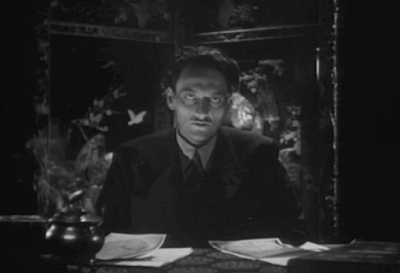
The original script for the movie was written by none other than 20th century esotericist, mystic and founder of the Philosophical Research Society, Manly P. Hall. (Yes, the title card misspelled his name.) In fact, the movie begins with a 7 or 8 minute introduction featuring Hall himself, sitting behind his desk, explaining what each of the twelve signs of the Zodiac mean, and how they purportedly affect people's behavior. At the conclusion of his monologue, Hall stares into the camera with earnest intensity, and intones: 

“A crime has been committed. Astrology CAN solve crime. It has solved many crimes in the past," he assures the audience. "Astrology is the strangest of the sciences, but it IS a science.”


Well, okay, I guess.

The picture features Chinese-American actress Anna May Wong as astrologer Mei Lei Ling aboard an ocean liner bound for San Francisco from the Orient. One by one, she casts the horoscopes of twelve people (one for each Zodiacal sign) and warns one of them that he will be murdered within 48 hours. Sure enough, the arrogant chiseler is found toes up at room temperature and stiff as a carp two days later. In the course of the film, Ling – accompanied by her pet rhesus monkey – uses the astrological signs and horoscopes of the passengers and crew instead of physical evidence to assist the police and determine the murderer. 


Eventually, more killings up the body count before the solution is finally determined. Along the way are skeptical cops, drug smugglers, a shifty butler, spooky chases through hidden passageways, and even a Chinese dragon-shaped 'silent' gun that fires chunks of jade instead of bullets at its targets!

No wonder the Chinese are beating us at hypersonic weapon development these days. 


Ling uses horoscope sessions to solve the murders instead of interrogation, investigation, or even physical clues, and the picture carries the whole astrology-as-science theme throughout, right from the start. In the opening credits, each member of the cast is pictured along with their Zodiacal signs. (Their names don't even appear in the movie's theatrical trailer - only their signs!) 

In truth, it does get annoying every time Mei Ling meets someone new, she raises an eyebrow and immediately demands, "When were you born?"


If you only know of Manly Hall from his Masonic books — The Lost Keys of Freemasonry, The Secret Destiny of America, Freemasonry of the Ancient Egyptians, and Masonic Orders of Fraternity — you might wonder how he managed to get this odd little picture made and distributed by Warner Brothers. We don't have many celebrities these days whom everyone just seems to uniformly recognize because pop culture is too fractured anymore. But Manly P. Hall was hot stuff in the 1930s. Just four years before When Were You Born? was released, Hall had established the Philosophical Research Society in Los Angeles, dedicated to the study of religion, mythology, metaphysics, and other occult subjects. He was wildly popular as a public speaker, and filled auditoriums to capacity. His masterwork, Secret Teachings of All Ages, had been published in 1928, and the public was fascinated with all things metaphysical and occult-ish at the time. 

"See it! It's different!"

Detective pictures and murder mystery stories were a mania throughout the 1930s, especially yarns about private dicks with a character quirk or two. And mysterious mystics (usually wearing turbans on their noggins and taking advantage of rich addlepated widows by peddling metaphysical mumbo jumbo) were common staples in 1930s movies. But When Were You Born? took a different approach, elevating astrology to the status of serious science. 

Warner Brothers reportedly wanted to make an entire series of Mei Lei Ling mysteries featuring Anna May Wong's astrologer character solving more crimes – a sort of metaphysical variation on the wildly popular Charlie Chan/Mr. Moto/Mr. Wong oriental detective characters of the period. (My favorite quote by a villain in Mister Moto's Gamble: "I'm not afraid of a little Japanese dick!"). But disappointing box office receipts for this movie scuttled that plan. And once America entered the war in the Pacific three years later in the wake of Pearl Harbor, audiences almost immediately gave up their enjoyment of brainy Asian detectives.


Lots of new Masons stumble across Manly Hall's early books about Masonry written when he was in his 20s and are fascinated by his theories and explanations. But modern Masonic scholars regard most of what he wrote about the fraternity to be flights of fancy. Although Manly Hall wrote about Freemasonry in the early part of his career, he didn't actually join the fraternity until 1954 when he was initiated into San Francisco's Jewel Lodge 374. The following year, he joined the Scottish Rite in the Valley of San Francisco. In 1973, he was crowned as a 33° Scottish Rite Mason. It should be noted that he never wrote about Freemasonry again after joining the fraternity.

Sunday, February 16, 2020

Angel Millar's 'Three Stages of Initiatic Spirituality' Now Available


Students seeking to explore the esoteric symbolism, concepts and philosophy of initiatic traditions like Freemasonry, Order of the Golden Dawn, Rosicrucianism and countless others, take note. Brother Angel Millar has just announced the release of his new book, Three Stages of Initiatic Spirituality: Craftsman, Warrior, Magician from Inner Traditions Publishing. 

Angel Millar is a New York Mason and a popular lecturer on Freemasonry, initiation and esotericism, as well as an artist and student of martial arts. He is the author of several books, including Freemasonry: Foundation of the Western Esoteric Tradition and The Crescent and the Compass: Islam, Freemasonry, Esotericism and Revolution in the Modern Age


Now in his newest book he discusses the craftsman, warrior, and magician archetypes that echo the traditional three-part division of societies. He explores how these three classic initiatic archetypes represent the three successive stages of spiritual growth in an individual’s life. He investigates their symbolism, rituals, and metaphysical aspects and shares meditations, practices, and transformational techniques for each archetype.

For an excerpt of the new book, the Introduction can be read HERE.


Wednesday, January 15, 2020

UCLA International Conference on Freemasonry - April 18th


The 9th annual UCLA International Conference on Freemasonry will take place on Saturday, April 18th.  This year's theme is 'Esotericism and Masonic Connections.'

As part of its collaborative partnership with the history department at the University of California, Los Angeles (UCLA), the Institute for Masonic Studies presents an annual International Conference on Freemasonry on the UCLA campus. 

The UCLA International Conference is sponsored by the California Masonic Foundation and the Grand Lodge of California. These events seek to educate and inspire scholars of the Craft. The International Conference welcomes all Masons, Masonic and academic scholars, UCLA faculty and students, and members of the general public.

Freemasonry offers everyone a pathway to self-improvement, fellowship, and community. For the committed few, it holds the promise of even more. For more than 300 years, Masonic teachings and symbolism have attracted those in search of deeper, secret meanings about the natural and even supernatural world. These esoteric pursuits, shrouded in mystery and mysticism, have endured through the centuries and even today continue to fascinate seekers around the world.

On April 18, experts and scholars on Freemasonry will meet on the campus of UCLA to discuss the eternal quest for esoteric knowledge and its broader relationship to the Craft. The ninth annual UCLA International Conference on Freemasonry is a rare chance for Masons and non-Masons to dive deep on metaphysics, antiquity, and the occult.


This year's presentations have been announced:

Freemasonry and the Esoteric: Elitism, Insecurity, and Unenlightened Self-Interest
Ric Berman, author of several books on Freemasonry including Espionage, Diplomacy & the Lodge

Although Masonic esotericism hints at ancient secrets, it was in fact not widely introduced into the craft until the 1730s—a means of appealing to an elite aristocratic and mostly French audience. The success of that marriage in the eighteenth century led to Freemasonry’s systematic introduction into the United States, a consequence not of politics or spirituality but economic self-interest.

The Esotericism of the Esoteric School of Masonic Research
Henrik Bogdan, professor of Religious Studies at the University of Gothenburg

The founding of London’s Quatuor Coronati research lodge in 1884 gave birth to a new school of Masonic history and research, based on legitimate texts and study rather than the subjective or “inspired” Masonic writers of the past. However among this new school were a subset of scholars approaching research from what historian R.A. Gilbert called the “Esoteric School of Masonic Research”—part of a broader milieu of fin-de-siecle occultism.

Hidden and Visible: Mormon Garments in Community
Nancy Ross, assistant professor of Interdisciplinary Arts and Sciences, Dixie State University

Weighted with meaning, sacred (and secret) undergarments have long been a highly important, though seldom discussed, part of the Mormon church. Indeed, across religions, sacred garments like these have presented profound dilemmas and indicated deeper meanings for wearers and their broader communities.

Freemasonry and Neoplatanism
Jan Snoek, historian of religions at the Institute of Religious Studies, University of Heidelberg

Several philosophers, expanding on the teachings of Plato, developed theories without which Freemasonry could never have found its form. From Abbot Suger’s construction of the church of St. Denis—Europe’s first gothic cathedral, dedicated to light and beauty—to the third-century parable of the sculptor who must perfect himself, meet the thinkers who paved the way for modern Masonry.

Stephen Freeman on Antigua and London: A Respectable Rosicrucian
Susan Mitchell Sommers, professor of history, Saint Vincent College

The recent discovery of a single surviving pamphlet by a quack doctor, Stephen Freeman, living in Antigua in the late 18th century offers a rare glimpse into not only the thinking of a fringe medical professional, but also paints a stunning portrait of the lives of striving middle-class emigrants in the West Indies struggling for respectability. Largely by leaning on connections through societies including the Freemasons and esoteric Rosicrucians, those like Freeman hoped to improve their lot in society and find deeper meaning—in both cases, often unsuccessfully.

Saturday, April 18, 2020
9:00 AM - 5:00 PM (Pacific Time)

University of California, Los Angeles
330 De Neve Drive
Covell Commons-Grand Horizon Room
Los Angeles, California


To register, CLICK HERE 
Registration is $25 for the conference only, or $30 with the optional buffet lunch (which must be purchased in advance via the registration page).


England's WB Ric Berman, noted Masonic scholar, past Prestonian Lecturer, and Past Master of Quatuor Coronati Lodge No. 2076 (EC), regarded as the premier lodge of research, will be in Los Angeles in mid-April to speak at the UCLA Symposium. 

Ric says he would be happy to stay over and give talks or presentations elsewhere in Southern California before or after that event, or even elsewhere in the U.S. if he can arrange his airline flights and connections. Hosting lodges need only cover local transport/accommodation. Ric is a world-class Masonic speaker and this is a rare opportunity while he's on our side of the Atlantic. 

But be aware that Ric has to finalize his travel plans very soon, so if you have any interest in hosting him during this trip in April, you need to contact him immediately before his tickets get purchased.

If interested, please email april2020@quatuorcoronati.com.

Ric will be back in the U.S. again in September when Quatuor Coronati will be hosting another North American Conference at the Grand Lodge of Massachusetts in Boston. Details about that event are available at www.quatuorcoronati.com.


For a list of his books, see his Amazon author page HERE.

Tuesday, January 14, 2020

The Stonecutter


One thing always leads to another, and connections are funny things. While I was back in Indianapolis over the weekend I came across this unusual artifact we uncovered from a long-forgotten storage locker in the downtown Temple. I've never seen a sculpture quite like it, and it has the look of something from the 1930s or so. Then my friend David Hosler posted this old Chinese folk tale today on Facebook that I first read many, many years ago and had forgotten about. It was popularized in the disarmingly philosophical little volume, The Tao of Pooh by Benjamin Hoff, which used the classic children's stories of Winnie the Pooh to introduce the basic fundamentals of Taoism.


Thanks for the reminder, Dave.


The Stonecutter

There was once a stonecutter who was dissatisfied with himself and with his position in life.

One day he passed a wealthy merchant’s house. Through the open gateway, he saw many fine possessions and important visitors. “How powerful that merchant must be!” thought the stonecutter. He became very envious and wished that he could be like the merchant.

To his great surprise, he suddenly became the merchant, enjoying more luxuries and power than he had ever imagined, but envied and detested by those less wealthy than himself. Soon a high official passed by, carried in a sedan chair, accompanied by attendants and escorted by soldiers beating gongs. Everyone, no matter how wealthy, had to bow low before the procession. “How powerful that official is!” he thought. “I wish that I could be a high official!”

Then he became the high official, carried everywhere in his embroidered sedan chair, feared and hated by the people all around. It was a hot summer day, so the official felt very uncomfortable in the sticky sedan chair. He looked up at the sun. It shone proudly in the sky, unaffected by his presence. “How powerful the sun is!” he thought. “I wish that I could be the sun!”

Then he became the sun, shining fiercely down on everyone, scorching the fields, cursed by the farmers and laborers. But a huge black cloud moved between him and the earth, so that his light could no longer shine on everything below. “How powerful that storm cloud is!” he thought. “I wish that I could be a cloud!”

Then he became the cloud, flooding the fields and villages, shouted at by everyone. But soon he found that he was being pushed away by some great force, and realized that it was the wind. “How powerful it is!” he thought. “I wish that I could be the wind!”

Then he became the wind, blowing tiles off the roofs of houses, uprooting trees, feared and hated by all below him. But after a while, he ran up against something that would not move, no matter how forcefully he blew against it – a huge, towering rock. “How powerful that rock is!” he thought. “I wish that I could be a rock!”

Then he became the rock, more powerful than anything else on earth. But as he stood there, he heard the sound of a stonecutter's hammer pounding a chisel into the hard surface, and felt himself being changed. “What could be more powerful than I, the rock?” he thought.

Friday, July 05, 2019

Tim Wallace-Murphy Passes Away


Dr. Tim Wallace-Murphy has passed away this week after a very long struggle with COPD. He was 89 years old. The Irish-born writer and lecturer—known for his works about the Knights Templar, as well as spiritual and esoteric subjects—was the author of thirteen books over the years, and appeared in countless documentaries. His books included: Hidden Wisdom—Secrets of the Western Esoteric Tradition; Rosslyn—Guardian of the Secrets of the Holy Grail; and The Enigma of the Freemasons—Their History and Mystical Connections.

Brother Wallace-Murphy was a Freemason and a member of Lodge Robert Burns Initiated No. 1781 in Edinburgh, Scotland. He was devoted to the support, excavation, and restoration of Rosslyn Chapel over the years.

Tim Wallace-Murphy was born in Galway, Ireland, on the 13th of January 1930. After attending the University College Dublin from 1953-58, he obtained a degree in Medicine, and later one in Psychology. 

Tim spent his final years living in the Languedoc region of southwest France with his wife, Cyndi.

The following message appeared on his Facebook page on Wednesday, July 3rd:
It is with profound sadness that we wish to announce that Dr Tim Wallace-Murphy, 89, has passed away at his home in the South West of France, having been in a ‘slow hurry’ with his battle with COPD. Dying as he put it ‘was not all it cracked up to be’. He was surrounded by loved ones. 
A father, an inspiration and a friend to many, his death will be felt not just in Espéraza but around the world. He was born on 13 January 1930 in Galway to Timothy and Mae Murphy, later describing himself as a Franco-Irish Yiddisher boy with both feet firmly stuck in mid-air. After attending the University College Dublin from 1953 - 1958, he obtained a degree in Medicine and later one in Psychology. He then travelled across Europe and Africa for ten years before returning to England and beginning work as a clinical psychologist.
Through his work, Tim met author Trevor Ravenscroft with whom he co-authored his first book Mark of the Beast in 1988. Following this tome, Tim then devoted his life to the writing and research of the Knights Templar, Rex-Deus and pathways of spirituality.
 
Tim was a dedicated supporter of the restoration and preservation of Rosslyn Chapel, near Edinburgh, Scotland, undertaking excavations and field work with a team of like-minded people, whom would become lifelong friends. From this experience, he produced the book Rosslyn: Guardian of the Secrets of the Holy Grail. It is from this book that Dan Brown used as source material for his own work The Da Vinci Code. Tim found himself subsequently featuring in TV documentaries and began to settle in the South West of France or to Tim, ‘paradise’. 
Tim has had a proud career in community work and politics, having served as the Governor of South Devon Technical College, a TUC secretary, town councillor and a volunteer for the Leukaemia Research Fund. Tim dedicated his life in service to others and helping those who were also brought up spiritually confused on to a spiritual pathway. 
A service for friends and loved ones will be held to remember Tim at a later date; however as in life and death, funds are limited. If you wish to help with the arrangements financially, please use the following link: https://www.gofundme.com/funeral-for-tim-wallacemurphy 
Tim left many memories and many will be fondly remembered, such as his remarkable singing ability and razor sharp intellect. When asked shortly before his passing how he was feeling, he commented that “I will feel much better when this bloody thing is all over.” As we grieve, Tim’s humour lasted out to the last.
Requiescat in pace.

Sunday, March 17, 2019

Piers Vaughan Speaking in South Bend, Indiana: 3/23

Click image to enlarge
Masons in northern Indiana and Ohio, southern Michigan, and the Chicago area take note.  Worshipful Brother Piers A. Vaughan will be speaking this coming Saturday, March 23rd, at the Scottish Rite Valley of South Bend, Indiana. 

His presentation in South Bend will be an exploration of the Archangel Raphaël from a Scottish Rite perspective. He has a unique way of thinking through and explaining complex (and simple) ideas, and I promise that you will discover surprises and connections you were never aware of before when seen through Piers' always fascinating viewpoint.

Piers is the most recently named Friar in the The Society of Blue Friars, an organization founded in 1932 for the express purpose of recognizing outstanding Masonic authors.


Piers Vaughan has one of the most diverse and fascinating backgrounds for the study and understanding (and explanation) of Masonic, appendant, and other esoteric orders you will ever encounter. Originally, he is from England, and he belongs to lodges in England, Canada, and the U.S. Throughout his life he has lived in several European countries, Canada, and now resides in New York. He has a Master's degree in Divinity and another in Experimental Psychology; experience in both the Anglican and Catholic denominations and traditions; an MBA in Business Studies; a teaching diploma in Music; and much, much more. 

Piers has made extensive studies in history, alchemy, language (he has translated many texts from French to English), symbolism, cultures—truly what anyone would acknowledge to be a "Renaissance Man." Appropriately, one of his most recent books is 2017's outstanding Renaissance Man & Mason
He is also is the proprietor of Rose Circle Publications that is a source of other fascinating books along similar explorations of esoteric thought that mirror his eclectic mind and interests. 

Originally initiated in Brighton, England, Piers has belonged to Masonic Orders in England, France, Belgium, Canada, and the United States> He is a Past Master, a 33° Scottish Rite Mason, a Past Grand High Priest in the Royal Arch, and one of the custodians of the famed George Washington Inaugural Bible owned by New York's St. Johns Lodge No. 1.


The Indiana event will be Saturday, March 23rd, 2019 at the Scottish Rite Valley of South Bend. The cost is $25, and includes dinner and an open bar. Doors open at 5:30PM; dinner at 6:00PM; and the presentation is at 7:00PM. Piers will have some of his books available and will be signing afterwards.

Register online at www.SouthBendScottishRite.org or by calling 574-233-3158.


Wednesday, March 13, 2019

Rochester, NY: College of Freemasonry 3/30

In 2006, the Scottish Rite Valley of Rochester, New York (NMJ) established their College of Freemasonry educational symposium, and it has been held bi-annually for the last eight years. Each event has an over-arching theme, and past speakers have explored Masonic history, symbolism, and issues facing the current and future craft.

The 2019 College of Freemasonry will take place on Saturday, March 30 at Genesee Community College in Batavia, New York. (The Masonic irony of that infamous location is not lost on the organizers. Be sure to stop by the cemetery and see the monument to William Morgan.)

This year's theme will is "The Mysteries of Freemasonry." Speakers this year will be: 

Arturo de Hoyos - “The Mystery of Masonry: Albert Pike’s Esoterika.”
Grand Archivist and Grand Historian of the Scottish Rite SJ House of the Temple, and author, editor or translator of more than 50 books and articles, including the massively annotated edition of Pike's Morals and Dogma. Art has also just been named as the new Grand Abbott of the Society of Blue Friars.

Piers Vaughan - "The Magician, The Mystic and The Mason"
Past Master of St. John's Lodge No. 1 in New York City and Past Grand High Priest Royal Arch Masons of New York State. Piers is a Masonic and esoteric lecturer and writer, a translator of old French texts, and the publisher of Rose Circle Books. He is the author of Renaissance Man and Mason.

Chuck Dunning - "Gnothi Seauton -- You are the Mysteries!"
A member of Blue Lodges and Scottish Rite Valleys in both Texas and Oklahoma, Chuck is the author of the recently published book Contemplative Masonry: Basic Applications of Mindfulness, Meditation, and Imagery for the Craft.

• Round table panel discussion exploring the mysteries of Freemasonry facilitated by R.W. Oscar Alleyne 32°

• Presentation of the Thomas W. Jackson 33° Award for Excellence in Masonic Education

Cost of the event is $30, which includes continental breakfast and lunch. Check in begins at 8:30AM, and the event starts at 9:30AM.

There is no online registration, so the mail-in form is below. Click images to enlarge. Lacking that, contact the Secretary directly to reserve at secretary@valleyofrochester.org


Tuesday, March 22, 2016

Huge Stash of Nazi-Confiscated Masonic and Occult Books Discovered

The grand lodge building of the Norwegian Order of Freemasons in Oslo.

A collection of 13,000 books on occult subjects, including Freemasonry, were amassed by Nazi SS-Reichsfuhrer Heinrich Himmler's forces during Germany's wartime occupation of Norway. The collection was stolen, in part, from the Norwegian Order of Freemasons' grand lodge library in Oslo. 

Shortly after the war ended, the collection was put into a storage building near Prague, Czechoslovakia.  In 1948, the Communists took power, and as part of the Warsaw Pact nations, they were effectively lost behind the Iron Curtain for many years.  Even after Czechoslovakia's opening to the West, they remained hidden away without any record since the 1950s.

These were just a small part of an enormous library of works on Masonic, occult, esoteric and witchcraft subjects that were confiscated throughout occupied Europe by a division of the Nazi SS.

From a story on the Prague Post website:


Books on witchcraft and the occult collected by SS chief Heinrich Himmler were found in a storage depot near Prague used by the Czech National Library.
The depot has not been accessed since the 1950s, according to UK tabloid the Daily Mail, which cited Norwegian newspaper Verdens Gang. 
Bjørn Helge Horrisland, a Norwegian Freemason historian, told Verdens Gang he was involved in identifying some of the books. “Many of them belonged to the central Norwegian Order of Freemasons library in Oslo,” he said.
The collection of books totals some 13,000 volumes, some 6,000 of which allegedly came from a library of books owned by the Norwegian Order of Freemasons. The Masonic library [was] seized by Nazis when Norway was occupied during World War II.
Himmler began amassing the collection in 1935 and had a strong interest in the occult, He had a special unit within the SS to collect and manage information on witchcraft.
Many of the books deal with witchcraft trials in Germany, and Himmler reportedly believed that the trials were part of historical plot to weaken the Germans. He also claimed to be descended from a witch that was executed.
 Himmler also believed that knowledge of the occult could be used to benefit the Third Reich.
The books were not meant for Prague but for Wewelsburg Castle in Germany. Himmler intended to make that castle a modern-day Camelot with a round table of SS officers in the place of knights. Himmler signed a 100-year lease on the triangular castle in 1934. The building is now a museum.
The books will now be examined by scholars, and a Norwegian TV company is planning a documentary.
The project to recover the library of books received European Economic Area funds from Norway and is a result of a cooperation between Stiftelsen Arkivet, the National Library of Norway and the Czech National Library, according to Norwegian new server TheLocal.no.
Himmler's interest in collecting occult items has been well-documented and has inspired works of fiction including the 1981 film 'Raiders of the Lost Ark.'
Himmler was captured May 21, 1945. He committed suicide with a cyanide capsule May 23 and was buried in an unmarked grave near near Lüneburg, Germany. The exact location is not known.

In 1935, Himmler founded the Ahnenerbe Forschungs-und Lehrgemeinschaft (the Ancestral Heritage Research and Teaching Society), to use the methods of science to bend history and archeology enough to back up the Nazis’ racial and cultural policies. (In the film Raiders of the Lost Ark, the Nazi group looking for the Ark of the Covenant is supposed to be a contingent of Ahnenerbe archeologists.)

The tales of Himmler's alleged fascination with the occult have waxed and waned over the years. The Reich Security Main Office (RSHA) was formed in 1939 as part of the SS, combined with the SD, and was subordinate to Himmler.  It's purpose was to fight all enemies of the Reich both inside and outside of Germany.  It eventually grew to become a massive bureaucracy with close to one hundred sub-sections, divided into seven main divisions. Amt II was headed up by SS-Brigadefuhrer Professor Franz Albert Six, and was dedicated to "Ideological Investigation." 


Not long afterwards, Amt II was reorganized and split off as Amt VII for "Ideological Research and Evaluation," again headed by Franz Six (and after 1943 by SS-Obersturmbannführer Paul Dittel.) Their mission was partially to create anti-semetic and anti-Masonic propaganda, as well as surveying occupied Nazi population's public opinion.


Modern scholarship has dug into captured Nazi documents long held by Warsaw Pact countries, which have revealed Amt VII's other activities, including the collection of stolen  esoteric libraries. They also, allegedly, created an extensive card catalog on publications and other resources regarding witchcraft, a special interest of Himmler's (it was long whispered that a relative of his had been burned at the stake for being a witch). 


After the Soviets took parts of Berlin, and Germany was divided into East and West after the war, many of the records and books from their confiscation of occult, esoteric and Masonic libraries eventually wound up in Russia, the Silesia region of Poland, and Czechoslovakia, and were not researched until the 1990's.

In 2002, 750 crates of Masonic objects and papers stolen from occupied lodges and Grand Lodges across Europe and held by the Russian Military State Archive were delivered to the Museum of Freemasonry of the Grand Orient of France in Paris. These included membership lists that were used to help round up Freemasons to be sent to concentration camps. (The entire library of the Grand Orient of France was confiscated when the Nazis occupied Paris, and the books were taken to Berlin and subsequently burned.) 

A lengthy work, Restitution of Confiscated Art Works - Wish Or Reality?, was published in Czechoslovakia in 2008 as a collection of presentations from a conference in the city of Liberec. Buried in it are several references to the RSHA Amt VII unit's activities in assembling a vast library on the occult, witchcraft, esoteric, and Masonic books, eventually estimated to be in excess of 160,000 volumes:


Most of the books that traversed Sudeten crossroads had been held before August 1943 as part of the RSHA Amt VII (Seventh Office) library in Berlin, seized by the SD Main Office (Hauptamt) and the Gestapo starting in 1936. With the merger of the security services in late 1939, most of the collected books and archives preserved by the SD Main Office came under control of the newly formed RSHA Amt II (Second Office), headed by SS-Brigadeführer Franz Alfred Six, charged with investigation of political opponents (Gegnerforschung).
Starting in December 1941, Six organized the Seventh Office (Amt VII), specially for “Ideological Research and Evaluation” (Welt- anschauliche Forschung und Auswertung), split off from the other more  operational offices. Having inherited most of the SD/RSHA library and archival loot, Amt VII was responsible for organizing the RSHA library and archival centers, although some of the books went to other RSHA units. Most of the Amt VII staff, which Six headed until 1943, were members of the SS. Most of the books and archives were held in the buildings of two liquidated Masonic lodges the Gestapo had commandeered (Emserstrasse 12/13, and Eisenacherstasse 11/13), although some were stored in other depots in Berlin. From the spring of 1943, SS-Obersturmbannführer Paul Dittel, who from the start had been particularly involved with the collected Masonic materials, was the last head of Amt VII. Yet his title remained “acting,” indicative of the reduced importance and “mysterious twilight” of that unit towards the end of the war, as he made clear to his British interrogators afterwards.
During the Cold War, little was known about Amt VII, because its major surviving records were not publicly accessible. The Soviets found many SD Main Office administrative files among the massive RSHA-plundered archives they captured in Silesia (Wölfelsdorf), along with those of later Amt VII operations, and they seized a few more in the bombed-out RSHA Eisenacherstasse building in Berlin. Some of those files they passed on to the Stasi in the 1950s, and those are now being processed with other Stasi RSHA holdings by the Bundesarchiv in Berlin. Others were captured in Silesia by the Poles, came out of hiding in 1989, and were traded to the Bundesarchiv in 1997. However, many important SD Main Office and subsequent RSHA Amt VII files remain in Moscow, not all of them open for research. Combining clues from documents now in Moscow and Berlin provides hitherto unknown revelations about RSHA library operations, especially those in the Sudeten castles.
[SNIP]
Alleged occult elements in the Nazi ideology and Himmler’s interest in neo-paganism and Masonic rituals have aroused widespread interest since the defeat of the National Socialist regime. Even the History TV Channel produced a documentary on“Hitler and the Occult,”suggesting what would seemingly be a sensationalist theme. The popular internet Wikipedia suggests that ‘Nazism and Occultism’ is usually “a topic for sensational authors in pursuit of strong sales,” but it prominently cites Nicholas Goodrick-Clarke, and his serious Oxford doctoral thesis on the Austrian Arisophists. Other important scholarly studies have analyzed occult themes in Nazi circles, especially under Heinrich Himmler, and the Masonic Library, confiscated from one of the alleged ‘enemies of the regime,’ was one of the most important components in the RSHA Amt VII holdings. Himmler’s interest in witchcraft and the supernatural was highlighted in Amt VII’s special unit devoted to Witchcraft (C 3), Sonderauftrag H, and Himmler’s card file on witches (Hexenkartothek), all of which are well documented. Reportedly, the materials gathered for the Witchcraft unit were sent to Schlesiersee [in Poland] with the Masonic collections, rather than the Sudeten castles, and that unit had ceased to function by the time of evacuation.
In the Sudeten castles, on the other hand, we find Amt VII SS specialists busily sorting and cataloguing occult literature, which the SD Main Office and Amt VII library had been collecting. Suddenly, that section of the library assumed a major prominence, and a top- secret project was launched on its basis—another important example of Nazi preoccupation with the occult. 

Himmler saw the SS as a kind of reimagining of the of the chivalric Teutonic Order, who were originally founded  in 1190, much like the Templars, to protect crusading pilgrims to the Holy Land.


Wewelsburg castle in Germany


He came to the town of Buren in the Westphalia region of western Germany in 1934, and took over the imposing castle of Wewelsburg. The castle was to become the center of a college for new SS officers and Himmler’s own elite Knightly Order. The castle became the place of initiation of his new order and the new spiritual center of the Nazi paganism that was based on Germanic legends. Ahnenerbe’s headquarters were based in Wewelsburg Castle.

Himmler planned very big. His goal was to make the surrounding village a complete SS colony, only for members of the SS and their families. In 1939, a concentration camp was established to provide 3,900 prisoners to work on the project. More than 1,200 were worked or starved to death building Himmler’s dream.


Himmler saw Wewelsburg as his own private Camelot which, of course, needed a Round Table for its knights. In the north tower, a round chamber was constructed, with a sunken area in the floor and a round, oak table.

There were just twelve seats around it, for the top dozen officers of the SS. In the domed ceiling a stylized, golden swastika set in stone can still be seen today, modified with the symbol of the SS at each corner. A different subterranean round chamber immediately below it was to be a crypt for the ashes of all dead SS members, complete with an eternal flame. Another one of Himmler’s goals was to find the Holy Grail, and a special room in the castle was set aside for the Grail when it was found.

The Nazis went to great lengths to engineer an elaborate explanation that Jesus was descended from Jacob, who, they said, was not Jewish at all, but an Aryan. Another part of Ahnenerbe’s mission was to prove the origin of the Aryans, and they even sent archeological expeditions to India, Tibet to seek evidence of the earliest appearance of their “Master Race”.

As a footnote to this post, I came across a brief account of Freemasonry in Norway under the Occupation, and especially about the grand lodge building in Oslo. From Freemasonry Under The Nazis by David Lewis, published in 2012:

When Norway was invaded in 1940 the Masonic temple in Oslo was converted to an army barracks and the order dissolved. Major Vidkun Quisling, the Nazi collaborator, had Freemasonry as point no. 1 for action on his agenda and emptied Masonic buildings and destroyed some of them. The main Temple in Oslo was converted to officers’ quarters but, according to one brother who visited it recently, amazingly it was not vandalised -- the only one in Europe known to have been left untouched by the Nazis. A number of masons were murdered. When he was tried after the war his trial, ironically, took place in a former Masonic temple before he was convicted and shot. 


“I was personally involved in identifying some of the books. Many of them belonged to the central Norwegian Order of Freemasons library in Oslo,” Bjørn Helge Horrisland, a Norwegian Freemason historian, told VG.