"To preserve the reputation of the Fraternity unsullied must be your constant care."

BE A FREEMASON

Showing posts with label vitruvian. Show all posts

Monday, October 28, 2024

Hoosier Brother Speaking on Rubicon Podcast Tonight


by Christopher Hodapp

A young Indiana filmmaker joined the Masons at Broad Ripple Lodge 643 in Indianapolis, where he quickly became very active and was appointed to the Senior Steward's chair. Within a year of his degrees, he also signed on with Lodge Vitruvian 767, one of just a few 'Observant-Style' or 'Best Practices' Masonic lodges in Indiana. And he became Junior Steward at Indiana's Dwight L. Smith Lodge of Research U.D. where he similarly jumped in and began giving Masonic talks. 

He visits far and wide – often, too – frequently attending lodges out of state, and always in search of as much Masonic education as he can manage to scare up. His activities and enthusiasm for the fraternity haven't gone unnoticed by the Grand Lodge and its officers. Last year he received the Grand Lodge of Indiana's Rookie Award, a program designed to help Indiana Lodges recognize new Master Masons who become actively involved in their symbolic Lodge, and Freemasonry in general, during their first year in our fraternity.

No, this is not some self-serving, back-patting, fulsome autobiography chock full o' myself, even though his Masonic trajectory has been remarkably parallel to my own back in the pre-smartphone days of 1998-99. 

I'm speaking of Brother Jeremiah Beaver. And I'm proud to say he'll be presenting a program tonight on the Rubicon Masonic Society webcast, 21st Century Conversations on Freemasonry. Jeremiah's topic will be 'Notes From the Beehive: Doing the Work in an Indiana Best Practice Lodge.' 


I can't praise the Kentucky brethren at Rubicon lavishly enough for their quality programming, their increasingly famous Festive Boards, and the seriousness with which they take their Freemasonry. Rubicon hosts virtual Masonic education programs on the 4th Monday of each month, starting at 7 pm Eastern. These programs are open to Masons of all degrees, as well as non-Masons.

For the complete archived lineup of the 63 previous Rubicon programs, CLICK HERE.

To RSVP for tonight's talk by Brother Beaver, CLICK HERE.

Saturday, May 21, 2022

Indiana's Lodge Vitruvian 767 Celebrates 20th Anniversary


by Christopher Hodapp

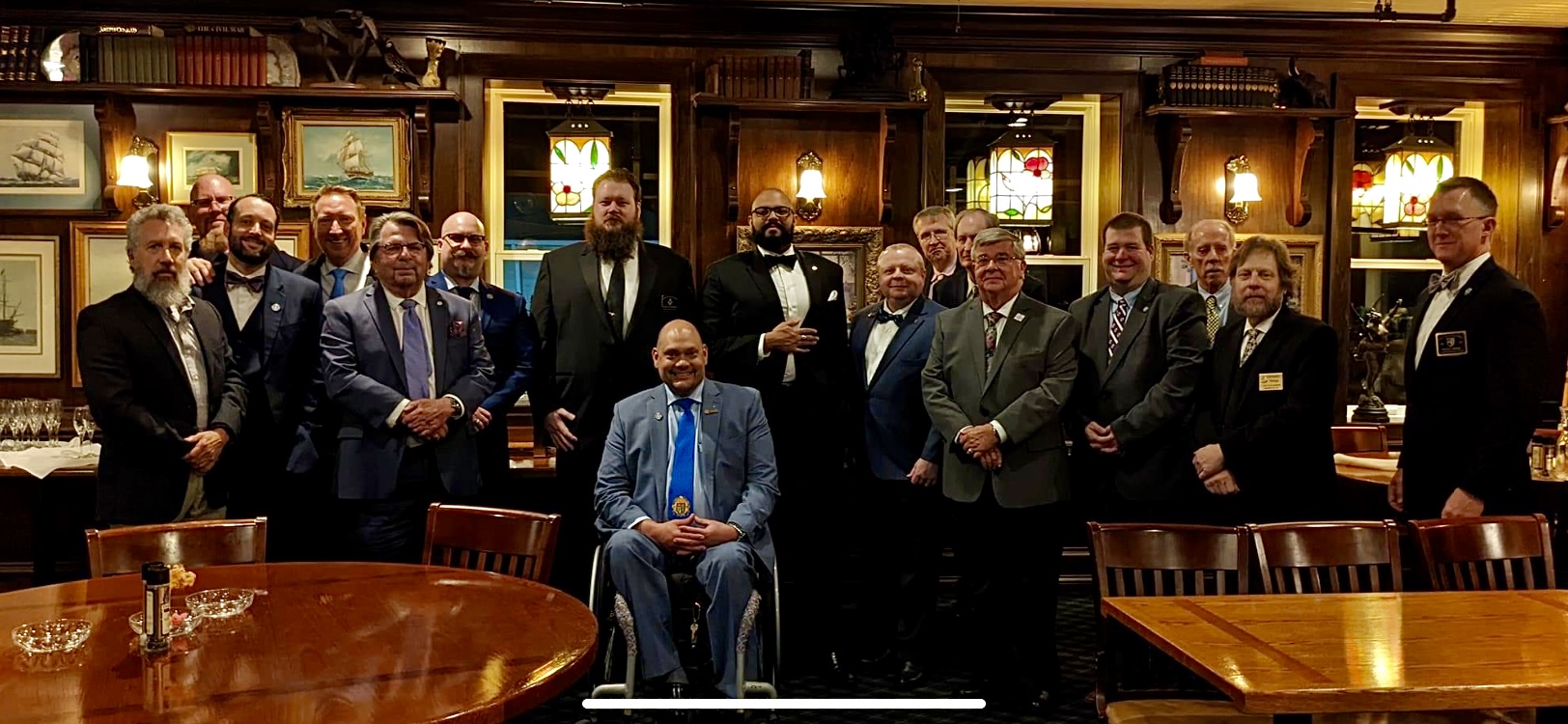
Friday night was the 20th anniversary of the founding of Lodge Vitruvian 767 in Indianapolis. It was a wonderful evening and it was especially great to be with WB Jeff Naylor, our founding Worshipful Master. Many thanks to WB Christopher Bentlage for arranging this event at the Aristocrat.

Twenty years ago today - May 21st, 2002 - a year after first receiving a dispensation to work, a group of Indiana Masons assembled at the Temple of Broad Ripple Lodge on the north side of Indianapolis to receive our official charter for Lodge Vitruvian No. 767

Technically, that makes us 21 years old today, but it's 20 under our official charter.

Jeffrey D. Naylor was our founding Master, and he received the charter that day from Roger S. VanGorden, Grand Master of the Grand Lodge of Indiana. Jeff would serve in the East for the first two years, and was responsible for much of what we did, how we "looked," and the philosophy that guided us (and still does even today).

It started as a conversation between Jeff, Eric Schmitz, Roger VanGorden, Nathan Brindle, and myself one Saturday afternoon in 2000 about how to create a new kind of lodge, and it turned out that other Masons around the U.S. and elsewhere at the time were (or had already been) coming to many of our same conclusions. (Sort of a Masonic version of Hodgkins' Law of Parallel Planetary Development... Yes, I'm just that sort of nerd.) 

Kent Henderson in Australia first noodled some of these ideas in a paper called Back To the Future back in 1992, along the lines of a “European concept," and he and a handful of brethren established Lodge Epicurean 906 there. Meanwhile in College Station, Texas, Pete Normand labeled their local experiments as "traditional best practices" and established St. Alban's Lodge 1455 along similar notions. John Mauk Hilliard applied many of these ideas as well, with Independent Royal Arch Lodge 2, in New York. 

Around the time we were scheming in Indiana, a different group of brethren was assembling their own philosophy under the umbrella term "traditional observance," and Dennis V. Chornenky and others came up with the Masonic Restoration Foundation to promote their similar evangel. (Dennis would be one of the founders of Academia Lodge in Oakland, California.) 

Independent from all of these others, our own growing circle of guys explored concepts and collected our thoughts into what became an extended paper called Laudable Pursuit.

All of us sought to approach the problem of the dull monthly lodge business meeting that offered Masons no education or enlightenment, bad or no food, under-financed programming, lackluster participation and retention, and little actual brotherhood - in short, any sense of "specialness" that Freemasonry had promised us all, but sadly, rarely delivered. We all went at it a little differently, but we all knew that lodges could be better than what most of us were experiencing if they would only demand excellence from themselves and their members.

Those of us starting Vitruvian established several primary tenets:
  • Dignity and high standards are to be maintained by the Lodge in all its undertakings.
  • Nothing short of excellence in ritualistic work is acceptable.
  • Masonic education - especially original papers or guest speakers - will be expected for every meeting.
  • Candidates shall be advanced only after having undertaken an intensive program of Masonic education and proving themselves proficient in open Lodge.
  • The Lodge enjoys the fellowship of the Festive Board at a local restaurant following all Regular and Emergent Meetings of the Lodge.
  • Members are expected to dress properly to attend to the duties of the Lodge. 
  • The Lodge shall create its own distinctive regalia, within the limitations of Grand Lodge regulations.
  • Attendance is mandatory. Members receive a summons for meetings and are required to attend or provide apologies. Those unable to do so will be politely asked to demit after a year and find another lodge.
  • The Lodge officers are to be elected based on merit and active participation alone, and not merely advanced through the chairs as an annual expectation.
  • A Lodge of excellence and high caliber must be paid for.
  • Explore and exemplify alternative degree rituals from other recognized foreign jurisdictions as a demonstration of the worldwide variations in regular Masonic practices (i.e. Emulation ritual, Rectified Rite ritual, etc.). We wanted very much to use Emulation ritual. In fact, we entertained the idea of passing legislation that would give us the kind of flexibility Masons have in the United Grand Lodge of England to use another set of rituals instead of the standard Preston-Webb formula that almost all U.S. lodges require. (That turned out to the one major disappointment we were unable to rise above.)
We agreed to meet quarterly, not monthly. We also informally agreed that we would deliberately not accept more than 36 members, because a man can't truly get to know and care about more than three dozen members or so. We felt that if we got that popular, the answer would be to spin off a "daughter lodge," not expand our own size. At the time, we set the most expensive dues in the state, and numerous predictions of our eminent demise were commonly expressed by naysayers. Nevertheless, when we circulated the word about what we were proposing, twenty-three brethren eagerly jumped on board:


· W. Bro. Dale Adams, Mt. Moriah Lodge No. 77 (*)

· Bro. Wallace K. Aiken III, Broad Ripple Lodge No. 643

· W. Bro. William K. Bissey, North Park Lodge No. 646

· W. Bro. David Bosworth, PM, Calvin W. Prather Lodge No. 717 

· W. Bro. Nathan C. Brindle, PM, Broad Ripple Lodge No. 643

· W. Bro. Jerry T. Cowley, PM, Broad Ripple Lodge No. 643

· W. Bro. Howard A. Farrand, Centennial Lodge No. 541

· W. Bro. James Guffey, PM, Millersville Lodge No. 126 

· W. Bro. Christopher L. Hodapp, PM, Broad Ripple Lodge No. 643

· W. Bro. Michael W. Klepper, PM, Morristown Lodge No. 193

· W. Bro. Rodney A. Mann, PM, Farmers Lodge No. 147, Current Grand Master of Indiana (2017-2018)

· W. Bro. Jeffrey D. Naylor, PM, Losantville Lodge No. 674 (*)

· W. Bro. Irwin H. Sacks, PM, Monument Lodge No. 657

· Bro. Travis G. Sandifur, Monroe Lodge No. 23

· W. Bro. Eric T. Schmitz, PM, Monroe Lodge No. 23

· W. Bro. Edward R. Smith, PM, Spencer Lodge No. 95(*)

· W. Bro. John B. Stevens, PM, Grant Lodge No. 637

· W. Bro. W. Keith Stiner, PM, Quincy Lodge No. 230 (*)

· Bro. Louis P. Tompkins, Monroe Lodge No. 22

· M.W. Bro. Roger S. VanGorden, Grand Master of Indiana (2001-2002)

· Bro. Jack D. Weagley, McCulloch Lodge No. 737

· W. Bro. Roderick V. Welker, PM, Jonesboro Lodge No. 109

· W. Bro. Cleon H. Wright, PM, Eureka Lodge No. 397


(*) Past Master of Vitruvian

All of our members at the time communicated electronically - unheard of then. We also regularly had a 90+% participation rate among all of our members - also unheard of. 
And when we strolled into a local restaurant for our festive boards in our tuxedos - a supremely unusual scene in America anymore, outside of a wedding reception - we actually turned heads, and attracted questions from other diners merely because of the group of Masons they saw. 

Vitruvian's first festive board 5/21/2002 at the
Corner Wine Bar's private dining room in Broad Ripple

Founding Worshipful Master Jeffrey Naylor
addresses the  brethren


Is that "shallow?" Maybe. 

"Elitist" looking? Possibly. 

Putting forth a public image of the fraternity as the world's premiere society of gentlemen? You betcha. We still do today.

Sadly, some grand lodge jurisdictions have actually banned anything remotely looking or sounding like what are now being generally branded as "observant" styled lodges, under a mistaken and unfounded fear that we are practicing something odd, foreign, elitist, spooky, or even antithetical to the equality of Freemasonry's basic tenets. That is a shame. Those of us who are members of these lodges or just visit them know that nothing could be further from the truth. 


Twenty years after we started, there are about 70 lodges similar to Vitruvian around the U.S. and Canada - a lot maybe, but not an overwhelming flood of acceptance - though Indiana has another one now, with Crowned Martyrs Lodge 771. And long-established Pentalpha Lodge 564 in Indianapolis (chartered in 1881) has been transforming itself to an observant style lodge over the last couple of years. 

No other lodge or grand lodge has anything to fear from these observant-styled lodges. None of us actually proclaim (or we shouldn't be, anyway) that anyone else is practicing Freemasonry incorrectly, nor that we have some higher moral ground and that only we are "doing it right" Observant lodges have not taken the Masonic world by storm, nor are they some silver bullet that will magically save the fraternity from plummeting membership numbers each year. But they have become a home to numerous Freemasons who might otherwise have left the fraternity because their longing for a more affecting personal and intellectually stimulating lodge experience was not being fulfilled.

For two decades we've been proud to host many of the top Masonic authors and speakers in the country, kicking off our first year with Dr. S. Brent Morris, longtime editor of the The Scottish Rite Journal and Heredom. Others have included: Robert G. Davis, PGM of the Grand Lodge of Oklahoma and author of The Masons Words; Chuck Dunning from Ohio, author of Contemplative Masonry; John Bizzack from Lexington Lodge 1 in Kentucky and author of Island Freemasonry; Arturo DeHoyas, grand archivist of the Scottish Rite SJ; Oscar Alleyne from the grand Lodge of New York; Andrew Hammer, author of Observing the Craft; Joseph Wäges, author and editor of The Secret School of Wisdom; Shawn Eyer, editor of The Philalethes magazine; Mark Tabbert, author of A Deserving Brother; and many, many more. They are on top of our own members whose works are admired throughout the fraternity. 

Vitruvians haven't been slouches over the years. The creation of the Masonic Society was spearheaded by several of Vitruvian's founding members: Roger Van Gorden, James Dillman, Kenneth Davis (who all served as early presidents of the Society), Nathan Brindle, founding and current Secretary; and myself, who was the founding editor of the Society's Journal.

The result is that we actually look forward to Vitruvian's lodge night, enjoy our meetings and Festive Boards, learn something new each time, linger late into each evening, and are truly "happy to meet, sorry to part, happy to meet again." I'll take that to be a good development, and one I encourage every lodge to emulate, no matter how they choose to accomplish it.


Today, Vitruvian has more members than we started with, and demits have been rare for the last eight or ten years now. We've had our ups and downs, our family fights, and other challenges. But we solved them as men and Masons should. We still have not bumped up against our limit of 36 members, although we've come close a few times over the years. That's okay, because what is more gratifying is that we regularly have handfuls of visitors from across Indiana, other states, and even international visitors who are eager to see what we are doing differently. They return to their own lodges and argue for their officers to adopt some of our practices because they've seen how successful we have been and how much they actually enjoyed a stated meeting, maybe for the first time in their Masonic lives.

Perhaps that is the most satisfying aspect of Vitruvian's model in these 20 years in Indiana. Maybe we haven't turned the whole U.S. Masonic culture on its ear, or solved every issue. But we are influencing the leaders of tomorrow to go home and make their own lodges the very best they can be, following whatever path that leads them. By doing so, a rising tide raises all boats - or lodges, as the case may be. And that is a success to which our little lodge has happily contributed.

Friday, October 18, 2019

Arturo De Hoyos Speaking In Indianapolis Tuesday 10/22


This Tuesday, October 22nd, renowned author, researcher, translator, and historian Arturo De Hoyos will be speaking at Lodge Vitruvian No. 767's Stated Meeting and Festive Board in Indianapolis, Indiana.


Art is the Grand Archivist and Grand Historian for the Supreme Council of the Scottish Rite SJ, and his body of work over the last three or so decades has been nothing short of astonishing. To my knowledge, he has not spoken in the Indianapolis area before.

Please alert our Secretary if you intend to be there so he can plan accordingly.

Here is the official summons:
Come join us for fellowship and scholarly discussion on the evening of Tuesday, October 22nd, 2019 AD, 6019 AL.
We are determined to complete our business in one hour.
NOTE: We will be conducting our annual election of Lodge officers at this meeting, but will do our best to complete this process quickly.
Also, please note that our Festive Board dinner is to be tiled, and is open to Master Masons only.
7:00 – 8:00 PM Stated Meeting
Lodge Vitruvian No. 767 F&AM
Broad Ripple Masonic Temple
1716 Broad Ripple Avenue
Indianapolis, IN 46220-2338
“In the style of European Lodges, members are expected to dress in tuxedo for all Communications of the Lodge. Members also purchase their own regalia, (apron, collar, gloves, case), according to Lodge Vitruvian specifications.”
Visitors dress should be tuxedo, or business attire.
8:30 -10:30 PM Festive Board
The Aristocrat - Oxford Room (upstairs)
5212 North College Avenue
Indianapolis, Indiana 46220
Each attendee will be responsible for the cost of his and their guest’s meal.
Keynote Speaker:
Arturo de Hoyos, Grand Archivist and Grand Historian, Supreme Council, 33°, will be presenting his topic, "A discussion on Albert Pike’s Esoterika, his once-secret unpublished text on the symbolism of the blue lodge degrees."

(Be aware that the Red Line boondoggle has eliminated some on-street parking around the Aristocrat, and their parking lot is not large. Be prepared to park on side streets and have a longer walk. Car pools to the restaurant would not be a terrible idea. Of course, you could ride the Red Line wiz-bang electric bus down I suppose, but you'd still have to drive to the Broad Ripple Avenue station and park on the street somewhere just to ride it south for ten blocks - which defeats the whole point. And you'd arrive at about dessert time.)

Friday, October 28, 2016

Addressing Clandestine Freemasonry: Why It's Important

Lodge Vitruvian No. 767 October 2016 Festive Board with Oscar Alleyne

I'm going to be a blatant fanboy with this post about a Brother each and every one of you needs to know.

WB E. Oscar Alleyne made a whirlwind trip to Oslo, Norway, Rochester, NY, and then Indianapolis earlier this week - an astonishing feat that is frankly exhausting to even contemplate for most of us. Despite little sleep over those several days (and having to be back in New York by 9AM for a meeting on Wednesday morning), he gave a remarkable presentation at Lodge Vitruvian No. 767 on Tuesday night (above). His topic was Clandestine Freemasonry.


I will not exaggerate: Oscar's presentation needs to be heard far and wide, in lodges, districts, and grand lodges. Far more important, it should be seen and heard at the Conference of Grand Masters in North America, AND the Conference of Grand Masters Prince Hall Masons, no matter how uncomfortable the subject may be to some. And I mean that with all sincerity and insistency. If you are reading this and are involved in the programming for either of those national conferences, I strongly urge you to put him on the program next February for all attendees.

"Clandestine Freemasonry" is probably one of the most misunderstood terms we casually sling around in the Masonic world, and in many corners, it results in a highly charged confrontation. We mention it obliquely in our obligation, and then never officially refer to it, or even define it, ever again. As Oscar's presentation made evident Tuesday night, while it is overwhelmingly an artifact in the African-American community, it is by no means just isolated there (he showed a list of no fewer than 70 such groups in the US that are predominantly made up of caucasian or Hispanic men).


What makes his talk of such importance to us all is multi-layered. He explains the breadth and ancestry of the situation starting with the initiation of Prince Hall and his 14 compatriots and the issuing of a regular charter to them by the premiere Grand Lodge of England, up through the various schisms within that sphere, their National Compact experiment and breakaway groups, and finally what has become the many self-created national, state, and local organizations and individual, independent lodges. So, for those Masons who know little or nothing about this world, he goes from zero to 60 in less than an hour.


But he also shows how all of this is extremely important to each of us. The Internet in particular has made it all too easy for these clandestine groups to sign on to LegalZoom, file a proper notice of incorporation with the Secretary of State's office with the correct paperwork, pick up a copy of Duncan's at the bookstore, buy a blank charter and a stack of very impressive grand officer aprons and jewels from Macoy's or an online Pakistani embroidery company, pick out dazzling Masonic rings, start a lavish website, and print out posters inviting folks to come on down to the rented Masonic lodge (once owned by a legitimate lodge or even grand lodge, but sold years ago) on Saturday with their $1000 check and be a 33° Mason that night. They'll have a dues card, and they'll have all of the right words and signs. 


(Just as an aside, what makes their process any different from one of our own One Day Classes that take them "from sidewalk to Shrine" in a dozen hours, I'm not entirely certain. But I digress.) 

Only after those men try to interact with regular, recognized Masons do they discover, too late, that no, they cannot visit lodges all over the world (or town), and their dues card won't really get them out of jail.

Many of these groups often engage in severe hazing practices, such as punching blindfolded candidates, branding, actual blood letting, and far worse. Petitions that contain releases to hold the organization harmless from liability if the candidate is injured are common. Their members frequently tell of fees, dues, insurance premiums and fines costing thousands of dollars a year. When they encounter mainstream and PHA lodge members and are rebuffed, or if they complain about the hazing, they are told that "those regular guys" will do a whole lot worse to them if they try to join us instead. 


One of the largest, the International Free and Accepted Modern Masons, Inc., is principally an extremely successful money-making scheme (as are many others). They are frequently depicted as wearing a Masonic apron along with a Shrine fez. The Internationals pay their members a bounty for bringing in new recruits and require payment into what is a massive pyramid scheme. Like many of the larger clandestine groups, they have a board of directors and officers like President and CEO, instead of grand lodge line officers and trustees. They have a large and active Eastern Star "Department" and youth groups. They do often operate very visible charities in some communities. 


After numerous lawsuits, they were forced to change their trademark from a standard S&C by adding a key underneath it. It is not uncommon for their members (and many other clandestine "Masons") to shake hands with an unsuspecting regular Mason while "trying" him with a ritual question, then snatch the Masonic ring from his finger, telling him he's "not worthy."

How pervasive is this problem for us all, ultimately? Well, the Master of Vitruvian went to the Indianapolis airport to pick up Oscar Tuesday, and because they didn't know each other, he wore a ball cap with a S&C on it. Before Oscar arrived, two men walked up to him and started openly displaying due guards and signs at him, giving him the grip. For a moment, he thought perhaps Oscar had sent them ahead just to fool with him. But no, when he asked their affiliation, it was an organization he had never heard of.

Oscar fully understands this situation. He spent 14 years as an active member of a clandestine New York "grand lodge," a town (and state) that is filled with these groups. It was only when he started asking questions and investigating that he found out just what he had joined. Oscar is not some bumpkin, by anyone's metric. He just simply didn't know, and no one ever explained it, in person, in lodge, or online. And there are thousands of men just like him all over the country. It is a vast underground culture that uses our symbols, our literature, our rituals, and our reputation, to make money and defraud unsuspecting men. 

One of the principal reasons they have gotten away with it is our historic institutionalized racism. For over two centuries, most state grand lodges openly said black men couldn't be Masons at all (mis-defining that whole "freeborn" business made it easy to pervert the meaning). And even if they let it slip that black men could be Masons, well, that Prince Hall lodge downtown was where they had to go. Likewise, PHA lodges often told white men looking for Masonic membership to go elsewhere.

I'm not flogging anyone over the past, but the future starts right now. Even in the 42 US jurisdictions that share recognition with their PHA counterparts, there is a prevailing attitude on the part of BOTH organizations that if you are a "man of color," the Prince Hall world is really their "proper" destination. Lodges on both sides have not largely desegregated, and joint recognition has in its own way been harmful by simply enforcing our separation, generally unknowingly and with the best of intentions, and most often out of our own confusion and discomfort in addressing the complex question of race in this country.

As Oscar points out, the African-American clandestine groups thrive, in part, by turning our own past history on its ear now. When their members are turned away by a local mainstream lodge or rebuffed by regular Masons on Facebook and elsewhere, it must be because of "racism," not their lack of regularity, and the "I told you not to go there" admonitions fall trippingly from the tongue. Their Masters and Grand Masters will ask their members, "If you're drowning and give a distress call, will those so-called Masons come and save you? If you are broken down by the side of the road and give a sign, will they stop for you?"
But what is more concerning are the outward signs of this phenomenon. 


In New York City, it is common for literally a dozen or more of the phony Masonic groups to march in parades, proudly sporting their flashy regalia, and carrying banners to draw in potential members. They sometimes operate charities that are highly regarded in the community.

In a photo (right) released by his attorney when he was accused of complicity in Michael Jackson's death, Doctor Conrad Murray was wearing a grand lodge jewel that proclaimed him to be the "Grand Medical Director" to prove he was somehow "connected" and a "high-ranking Mason" to the outside world. His Masonic background was explored by news sites like Fox and People Magazine. Never mind that he held that position in a phony "grand lodge" that solely encompassed the metropolitan area of Houston, Texas. Such distinctions are ignored or simply never spotted or known by non-Masons (and even by many Masons themselves). The Jackson family alleged Murray was part of a Masonic cabal that controlled the music business who had ordered Jackson's murder, and the jewel in the picture "proved" that. Because many hip hop stars refer to Masonic symbolism or use it in their stage shows and album artwork, it becomes harder to just shrug off this nonsense.


Starting in 2015, a story hit the news from southern California about the arrest of three people in connection with impersonating law enforcement officers, and proclaiming themselves to be part of a "Masonic Police Department." In their trial appearance (below) that was covered by the Associated Press and other news outlets, "Absolute Supreme Sovereign Grandmaster" David Inkk Henry, Brandon Kiel, and Tonette Hayes proudly sported their Masonic regalia. Hayes wore a jeweled Shrine pin and a minister's collar, while Kiel and Henry wore their grand officer collars. 


In a bizarre video released by Hayes around the same time (that has since disappeared from YouTube), he defended his activities from the criticism by other Masons and said that anyone who did not understand his actions needed to consult their own grand master for clarification.


In neither case did reporters, prosecuting attorneys, or law enforcement contact the regular, recognized grand lodges of their states for information, or even to check their claims of association. They don't largely because Freemasons are all thought to be just part of just one, same, big, happy, secretive, global treehouse. Regularity and recognition are arcane and meaningless to everyone but us.

Starting in the 1980s and 90s, the late historian and author Joseph A. Walkes, Jr. helped to establish the Phylaxis Society to specifically research issues and history surrounding Prince Hall Freemasonry. At that time, much misinformation and even less authentic research material existed about their unique and historic branch of US Freemasonry, and the Phylaxis Society under Walkes' early leadership provided a haven for Masonic scholarship. 


As part of their mission, they embarked on a daunting task that was astonishing in an age before computerized, online public records. They went state by state, and often into municipalities, and researched the incorporation records for what became the Joseph A. Walkes, Jr. Commission on Bogus Masonic Practices to identify the hundreds of phony organizations in the US claiming to be Masonic. 


The list is now ten years out of date, and hasn't kept up with the most recent proliferation of these instant lodges and grand lodges, but it is a good starting point for anyone wanting to get a taste of just how massive the problem really is. Check your own state. Illinois and New York have in the several hundreds, and there are thousands nationwide.


At the very least, EVERY SINGLE regular, recognized grand lodge in the U.S. should have a menu item on its website defining "clandestine" Freemasonry (and acknowledging its existence in the first place), explaining why regularity is important for potential petitioners, AND if a man is ALREADY a member of a clandestine group, how he can join a regular, recognized one. If your grand lodge has a specific process for such men (retaking the obligations of all three degrees, a simple "healing" by the Grand Master, a committee hearing with the candidate, or even completely starting from scratch and retaking the degrees completely - or some other option), your website should openly spell it out. We need to address the problem, not ignore it, because this is a much larger and more widespread phenomenon than most of us understand - more such organizations pop up every week, in every state. Members of these groups CAN be brought into our fraternity family, and we make a big mistake by not telling them how. And if your grand lodge does NOT have a process, you should formulate one. 

If you happen to be in one of the nine PHA jurisdictions left that is not recognized by its mainstream counterpart, you STILL need to address this problem - maybe even more than everyone else, because these groups use the historical racism of the past to flourish in your own backyards. The lack of joint recognition only bolsters their arguments, and they cannot be as easily refuted, solely becuase of the current situation there. If for no other reason, BOTH of the regular grand lodges in each of those states need to stop ignoring each other, finally leave the old bigotry and distrust in the past where it belongs, and find common ground.

I'll wrap this up, but I strongly urge all regular, recognized jurisdictions to invite Oscar to present, and more important, to invite members of their state or PHA counterparts, as well as the general public to that event. Cast a wide net and make special attempts to encourage attendees from these clandestine groups to attend, as well. It can open their eyes, as Oscar's own eyes were opened. Moreover, consider the very important demographic he represents: he is young, African-American, extremely educated (a doctor of epidemiology in New York) and well traveled, he was once a member of a clandestine Masonic lodge himself, and is now extremely active and respected in the Grand Lodge of New York. He has walked a path that many of these men have themselves. He will appeal to the very men we seek in our own lodges, and who most of our grand officers freely admit they do not fully understand. Oscar does. 


I'm not his shill or booking agent. I get nothing by promoting his message. But please consider adding him to your upcoming Masonic program. It's vital to us all to pay attention to his message and to fully understand an issue we are all obligated to fight.

Monday, July 11, 2011

Burns Night at Indianapolis' Lodge Vitruvian July 26th

"Then fill up a bumper and make it o'erflow,
And honours Masonic prepare for to throw;
May ev'ry true Brother of the Compass and Square
Have a big-belly'd bottle when harass'd with care."
—Robert Burns, No Churchman Am I

Brother Robert Burns (sometimes referred to as Rabbie Burns) is Scotland's favorite son and is regarded as the poet laureate of Freemasonry. He was born on January 25, 1759 and died on July 21, 1796. He was a prolific poet and lyricist and may be best known for writing the New Year's anthem, Auld Lang Syne, which is also frequently sung in Masonic lodges and gatherings.

The officers and brethren of Lodge Vitruvian #767 in Indianapolis cordially invite all Freemasons of any degree and their ladies to join us for our annual Robert Burns night on Tuesday, July 26th. The stated meeting will open at 7:00 P.M. at the temple of Broad Ripple Lodge located at 1716 Broad Ripple Ave., Indianapolis. The business meeting is restricted to Master Masons, but brethren of any degree and the ladies may join us for the festive board and program scheduled to begin at 8:00 P.M. at the Snooty Fox Restaurant, 1435 E. 86th St., Indianapolis. This is just west of the intersection of 86th St. and Westfield Bl. on the south side of the street. A buffet dinner will be served and there will be a cash bar. The menu will be the classic roast beef and tatties (with a pasta dish for those so inclined), served buffet style. The price for dinner is $20 per person, and there will be a cash bar available.

Dress for the evening will be tuxedo for officers and members and tuxedo or business attire for visitors. And kilts are certainly in order.

The evening's program will commence immediately after dinner. There will be a short presentation on the life of Robert Burns, featuring Samuel Lawson (see notes below). This will be followed by the reading of several Burns poems, the toast to the laddies and the lassies, and will conclude with the seven traditional toasts. There will be pipers to provide musical entertainment.

This is always the highlight of the Lodge Vitruvian year. In past years, this celebration has been held in January near the date of Burns's birthday of January 25. In order to avoid the inclement weather that has plagued us in recent years, we have moved the date to our July stated meeting to correspond closely to the date of Burns's death on July 21. The evening is always a lighthearted affair, with plenty of good food and lots of laughs. Polish up your most bilious Scottish brogue, bring your favorite Burns poem, and join us for what promises to be another night to remember. Please send your RSVP's to James Dillman, WM at jrdill1955@yahoo.com

Program Notes:

Every traditional Burns' Dinner features some words to the immortal memory of Scotland's Ploughman Poet-Laureate, Robert Burns. This presentation will include a traditional telling of the story of certain facts and episodes of Burns' life, but with an added inclusion of a taste of his influence outside the borders of Scotland from just a few years after his death. Italian guitarist/composer Mauro Giuliani and Spaniard Fernado Sor composed solo guitar works for classical guitar based on Burns' songs, The Soldier's Return, This is No My Ain Lassie, and Ye Banks and Braes of Bonnie Doon. To conclude the presentation, all are welcome to join in singing a traditional rendering of 'Ye Banks and Braes'.

Samuel Lawson is a classical guitarist with the degree of Master of Music from Butler University in Indianapolis, IN, and has recently entered the Doctor of Arts program at Ball State University. He has made his own way performing, teaching, and writing music in Indiana, South Carolina, and Pittsburgh, PA, and has toured performing classical and jazz guitar with his wife and vocalist, Rebekah, through the south-eastern U.S., parts of California and the hostels of Scotland. While studying under Brett Terrell, professor of guitar, and Dr. James Briscoe, professor of music history, at Jordan College of Music, Butler University, Samuel gained a preference for a lecture-recital format rather than a traditional recital. Recently he has also started gaining a reputation as a public speaker for the Scottish Society of Indianapolis, the Indiana Society of the Classical Guitar, and his own recital-lectures. One of these concert-lectures demonstrates parallel movements in music and visual art history, and another leans more towards his cherished Scottish heritage. He also performs on Sunday afternoons 12:30-2:30 at Barcelona Tapas restaurant in downtown Indianapolis.
Monday, March 21, 2011

Vitruvian Crop Circle

My fellow brethren of Indianapolis' Lodge Virtuvian No. 767 should find inspiration from this crop art spotted on Google Maps in the north edge of Utting am Ammersee, Germany (see here).

Thursday, January 22, 2009

Lodge Vitruvian Robert Burns Night Tuesday 1/27/09

Lodge Vitruvian No. 767's January Quarterly Feast in Indianapolis is lining up to be one of our most memorable evenings each year. Tuesday, January 27th, we will meet for our brief Stated Meeting at 7:00PM at the Temple of Broad Ripple Lodge #643.

Following the meeting, we will adjourn to the Corner Wine Bar in Broad Ripple at approximately 8 PM where we will be celebrating the 250th birthday of Scotland's - and Freemasonry's - poet laureate, Robert Burns. Dinner will be the traditional Burns' Night fare of beef and tatties.

Our ladies are cheerfully invited to attend, as we will be making the traditional Toast to the Lassies (and, of course, receiving the Return Toast to the Laddies). Those wishing to join in the reading of the Bard of Scotland's prose need only bring along their favorite Burns poem. Bawdy songs and Scottish tales are joyously welcomed, as long as they are recounted in your most bilious Scots burr. The price of dinner is $25 per person. A cash bar will also be available.

Brethren with proper knees for the wearing of the kilt are welcome to do so for the evening. Otherwise, proper dress for Vitruvian members is tuxedo, and either tuxedo or business attire for visitors. Those unable to be with us are asked to remember your brethren, wherever you may be, at the stroke of 9:00 PM, when the clock forms the fourth part of a circle, and drink a toast to us, as we shall to you.

We need to notify the restaurant by noon this Friday 1/23/09 of our final head count, so please respond immediately to our secretary at secretary@vitruvian.org

Ours Burns night has been cited by its attendees as the most fun they've ever had at a Masonic function. Don't miss it!