"To preserve the reputation of the Fraternity unsullied must be your constant care."

Proudly serving the fraternity since 2006
BE A FREEMASON

Showing posts with label demographics. Show all posts

Friday, June 06, 2025

God and the Odd Fellows


by Christopher Hodapp


Over the last few years, the Independent Order of Odd Fellows fraternal organization has been attempting to grow by reaching out to a younger demographic. Some have been embracing their decidedly offbeat name as a welcoming place for men and women who proudly celebrate themselves as being 'odd', an image the organization didn't really have of itself before. Many IOOF lodges have tried to expand with this strategy, but some apparently fear that local lodge officers are doing so by shunning or ignoring some of the most basic precepts of the IOOF that date back since time immemorial. And the national Grand Lodge for the U.S. has just fired a warning shot across the collective bows of those who have been selectively dodging the rules.

The Odd Fellows' 300+ year history parallels Freemasonry in many respects. Formed in London in the 1730s, they are non-sectarian, but require a belief in a non-specific God or Supreme Being. Their name stems from the medieval period of the craft guilds in England, purportedly for craftsmen who didn't belong to a specific guild of their own (or who had no such guild to join). Like the Masons, they expanded worldwide during England's colonial period. They created their own national grand lodge in America in the 1820s, flourished during the Golden Age of Fraternalism, and their popularity briefly exceeded that of Freemasonry in the early pre-Depression 1900s. Part of that popularity had to do with the perceived snobbishness and expense of joining the Masons, and they unfortunately got branded in many minds as the "poor man's Masons." The core organization, the Odd Fellows, is closely allied with the women's' group known as the Rebekah's, which was created originally as a sort of women's auxiliary group, much like the Order of the Eastern Star's association with the Freemasons. Also like the Masons, when white lodges refused membership to black men in the 1800s, the parallel Grand United Order of Odd Fellows was formed by and for blacks in America, much like Prince Hall Freemasonry did.

In town squares all across the U.S., lodge buildings sporting the 'three chain links' of the IOOF were as commonly seen as the square and compasses of the Masons. In many towns, the Masons and the Odd Fellows even shared lodge buildings. Like the Masons, they have three 'degrees' of membership within the lodge: the Lodge, which teaches Friendship; the Encampment, which teaches Love; and the Patriarchs Militant (similar to Masonry's Knights Templar), which teaches Truth. Their symbolic charts look remarkably like the Freemasons, and are often mistaken for being Masonic. They even wear lodge aprons. And their requirements for membership were historically the same as the Masons: men only, of lawful age of consent, of good character, and recommended by other members. In efforts to attract new members in recent years, they lowered the age requirement to just 16, and began admitting women. In many states these days, women commonly serve as grand lodge officers. But one thing that hasn't changed is that they still require all members to declare a belief in Deity, regardless of their personal conceptions or religious affiliation.

And therein lies the source of the current problem. 


More and more younger people in America have shown a dramatic increase in having no religious beliefs at all, at best claiming to be 'spiritual, not religious' (whatever THAT means), and often without any concept of a supreme deity of any kind. (That trend may be receding after more than a decade - see the note at the bottom of this article.) Consequently, some IOOF lodges have been lax about admitting men (and now women) who openly say they have no real belief in deity, or who dodge the question entirely.

Last week, the Grand Secretary of the Odd Fellows issued a sternly worded warning to all IOOF lodges that the core tenets of Odd Fellowship have not changed, and that all members must declare as part of their petitioning process, in writing, that they have a belief in a deity. More than a few local lodges have been glossing over that requirement, or ignoring it altogether. 

According to the letter, initiates have been told to ignore the requirement (or it's not mentioned it at all), lodges have been failing to display the Holy Bible on altars during meetings, the role of Chaplain has gone unfilled, and required prayers have been ignored or eliminated from their degree ceremonies. (Like the Masons in most jurisdictions these days, multiple books deemed sacred by an Odd Fellows lodge's members may be on the altar at the same time, although the Christian Bible must be there, regardless. )

Apparently, the situation has become widespread enough that the Grand Secretary's office is demanding that the entire letter be read at their next regular meeting, and that the order must be mailed directly to every lodge member within 30 days. (Click images below to enlarge.)


There have been calls within Freemasonry for more than two centuries to eliminate our fraternity's requirement of a declaration of faith, as the Continental Masons of the Grand Orient de France did in 1877 – and there's no denying that the Grand Orient has long been the largest (and continuously growing) Masonic jurisdiction in that country. But as has been the case there, the elimination of such a vital landmark of the fraternity was followed by the loss of others, such as overt political involvement and the eventual admission of women into their lodges. And it must be remembered that France has had a contentious and tumultuous history regarding religion ever since their revolution in 1789, and even before. French society is not directly analogous to American society when it comes to widespread attitudes regarding religion and secularism. We can't simply transplant their brand of Masonry to our own without dramatically changing the core of what has made American Freemasonry so successful in the past.

Despite all of the many changes to their fundamental membership requirements over the last few years, Odd Fellowship in America continues to dwindle. In my own hometown of Indianapolis, with well over 1 million people in the metropolitan area (plus burgeoning populations in other nearby communities) there is a single lodge hall location on the city's far west side that remains open, and it's part of their statewide Grand Lodge office building. If their newsletter numbers are to be trusted, the tiny number of new members taken in nationwide last year are shocking. 

It doesn't appear that their many changes have borne fruit.

So is there a cautionary example for Freemasonry to avoid this sort of change, or to embrace it as we watch our own numbers continue to decrease (albeit at a far, FAR slower rate than the IOOF's)? 
  • Should we remain true to our most basic foundations, or make alterations to appeal to men (and maybe women) who give us the go-by now? 
  • If such changes were to eventually be made, how can we honestly believe that Masonic membership would suddenly become desirable to our critics? 
  • Would the detractors of our own fraternity rush out to join a local Masonic lodge if we permitted women to join, dropped our faith requirement, and openly took on partisan political stands of one viewpoint or another? 
  • Or would they simply shrug and say, "Well, it's about time you dinosaurs crawled into the 21st century, but I'm really not much of a joiner..." ?
It’s worth keeping an eye on what transpires with the Odd Fellows in the next few years as they grapple with these very challenges.


*NOTE: People with no definable religious beliefs have, in recent years, been referred to by researchers as the "nones." In Pew Research Center’s 2023 polling, 28% of U.S. adults were religiously unaffiliated, describing themselves as atheists, agnostics or simply “nothing in particular” when asked about their religion. That was lower than surveys done in 2022 and 2021, and identical to the statistics in 2020 and 2019. After more than a decade of dramatic growth in "nones" (from just 16% in 2007), religious leaders are cautiously optimistic that faith may be making a slow comeback in this country.

Pew describes the "nones" this way:
  • Most “nones” believe in God or another higher power. But very few go to religious services regularly.
  • Most say religion does some harm, but many also think it does some good. They are not uniformly anti-religious.
  • Most “nones” reject the idea that science can explain everything. But they express more positive views of science than religiously affiliated Americans do.
Attempting to woo less than a third of the adult population in this country by removing the declaration of faith requirement may be a dwindling goal for the Odd Fellows. For an all-male fraternity like the Masons, that number shrinks to just about 15% of adults as a raw statistic, and that doesn't take into account the vast numbers of "I'm-not-a-joiner" folks who wouldn't give any such club a second glance. 

Call me a a bitter old curmudgeon who smells like fetid four day-old Brussels sprouts if you like, but altering your organization that dramatically to chase such a small number of possibly potential members seems like a fool's errand to this insouciant whelp...

Sunday, May 09, 2021

'Bowling Alone' Author Robert Putnam Webinar May 21st


by Christopher Hodapp

Social science researcher Robert Putnam will be featured in a free webinar on May 21, 2021 between 10:00 am and 11:30 am. The author of Bowling Alone will be discussing his latest book, The Upswing: How American Came Together a Century Ago and How We Can Do It Again.


Back in 2000 when Robert Putnam first published Bowling Alone, his landmark study of the decline of social and civic engagement over the previous 50 years, Masonic leaders jumped on it like ducks on a Junebug. His study began when he noticed that bowling alleys in the 1990s were doing a booming business, yet organized bowling clubs were vanishing. More Americans were bowling by themselves than ever before, but it was no longer the group-participation activity it had been for decades before. And the more Putnam and his Harvard team poked around, they found that pattern repeated over and over: Americans were turning in on themselves and choosing solitary pursuits, while shunning in-person groups, clubs, associations and group activities. People were more disconnected from family, neighbors, friends, and — perhaps most alarming of all — from civic participation in democratic institutions and activities than at any time before.

Putnam's study laid out the sobering truth in black and blue that nearly every in-person, voluntary associative organization — from the Red Cross and the Boy Scouts, to PTAs and card-playing clubs — had diminished in participation, size and influence. People were still technically joining clubs and groups, but they were most commonly distant, non-participation organizations like the Sierra Club, the National Rifle Association, the ASPCA, the International Fellowship of Christians and Jews, etc. Send them your credit card payment every year and you get an ID card, a bumper sticker, maybe a magazine subscription. But none of them place any demand on your time, effort or participation. And you sure don't get to know your fellow club members, much less go out for a beer with them.

Masonic leaders, in particular, could at least comfort themselves in knowing that our straight-line decline in membership ever since 1958 wasn't peculiar only to our fraternity. At least we weren't alone. And we still aren't. We're twenty years beyond Putnam's first examination of the issue, and our declining membership numbers have stayed on their same downward trajectory that started 63 years ago.

Putnam's book became a huge bestseller, and he popularized a social science concept called social capital: the shared values, norms, trust, and sense of belonging that make social interaction possible. Social capital is what binds people together for their mutual benefit. And when we share less and less in common with our neighbors and fellow citizens, society falls apart. (I also strongly recommend Charles Murray's outstanding book, Coming Apart.)

That brings us back to the mission of Freemasonry, which is to improve society by binding together men from all walks of life with shared concepts and philosophy, while avoiding sectarian and political differences that so frequently divide people, "to spread the cement of brotherly love and affection which unites us into one sacred band or society of friends and brothers, among whom should exist no contention, except that noble contention, or rather, emulation, of who best can work and best agree."


Last year, Putnam released a 20th anniversary edition of Bowling Alone with a new, additional data-filled chapter in the end that examines what has occurred since its initial publication. His new book, The Upswing: How America Came Together a Century Ago and How We Can Do It Again (2020), is a broad study of 20th century American economic, social, political, and cultural trends.


To join the May 21st webinar, see the Social Capital Research & Training website HERE. There is also a form to fill out in case you want to pose a question directly to Robert Putnam.

Friday, August 14, 2020

All Five Michigan Scottish Rite Valleys Vote To Merge


by Christopher Hodapp

On Thursday this week, it was announced that the five valleys of the Scottish Rite NMJ in Michigan have voted to merge to become one single Scottish Rite Valley for the state. The vote took place during the Michigan Council of Deliberation meeting, and now moves to the Supreme Council for final approval. 

Because of the COVID pandemic restrictions, the Council of Deliberation meeting was held this year as a virtual event.

According to the presentation made during the program, the combined Scottish Rite Valleys of Michigan are currently down to just 3,700 members statewide, and just 2,072 of those members (about 56%) pay full, regular dues. The other 44% of Michigan's SR members do not, for a variety of reasons — some are exempted entirely, some pay only the NMJ per capita, some are active military. But the bottom line is that 44% are largely getting a free ride. Moreover, a whopping 80.8% of Michigan's Scottish Rite members currently are over the age of 61, while just 1% are between 21 and 30.

All of that points a boney finger at the future if something isn't done to turn their membership around. Demographics don't lie, and Michigan isn't unique or an outlier. I suspect you are going to see this happen in more states with too many Scottish Rite and York Rite bodies to be supported by an ever-shrinking membership.

According to the presentation, the state will be divided into four regions, and each region will be expected to hold one reunion each year. The Lodge of Perfection, the Princes of Jerusalem, the Rose Croix, and the Consistory administrative bodies will be divided among the four regions - four bodies, but only one to each region. Each region would only have to concentrate on presenting the degrees of its assigned chapter (just to illustrate, imagine that Grand Rapids would do the Lodge of Perfection degrees, Detroit does Princes of Jerusalem, Marquette does Rose Croix, etc.). That way, the regions will cooperate to present more degrees, while concentrating their own efforts on the degrees of their body. 

My thumbnail description here does not do it justice. If you have a Facebook account, you can see the presentation and the merger details HERE.

Saturday, May 30, 2020

Check In Regularly With Your Masonic Brothers: Suicide Rates Rising Under COVID

Photo: @chantaldgarcia via Twenty20

by Christopher Hodapp

Back in March, I wrote an article, Rising Farmer Suicides: Are These Your Brethren? It talked about the alarming increase in self-inflicted deaths among the American farmer population and why that should be important to the Masonic fraternity. Many Masonic lodges (arguably the majority in the U.S.) are in rural areas, and these incidents strike very close to home.

Now the COVID-19 enforced lockdowns have had their own damaging effects on people everywhere, not just in rural areas. Case in point: an article on May 21st reported that San Francisco Bay area hospitals had already clocked more suicide attempts in just four weeks than in all of 2019. That means that more people in their region had died by suicide at the time than from the COVID virus.


From ABC-7 in San Francisco: 'Suicides on the rise amid stay-at-home order, Bay Area medical professionals say' by Amy Hollyfield:

"Doctors at John Muir Medical Center in Walnut Creek say they have seen more deaths by suicide during this quarantine period than deaths from the COVID-19 virus.
"The doctor in charge of a Bay Area, Calif. trauma center said the state should end its lockdown orders after an “unprecedented” spike in suicide attempts amid the coronavirus pandemic.

“We’ve never seen numbers like this, in such a short period of time,” Dr. Mike de Boisblanc, head of trauma at John Muir Medical Center, told local station ABC7... “I mean, we’ve seen a year’s worth of suicide attempts in the last four weeks.” He added that he thinks “it’s time” to end the state shutdown. Trauma nurse Kacey Hansen, who has worked at John Muir Medical Center in Walnut Creek for over three decades, said she had “never seen” so many attempts, most being young adults. “I have never seen so much intentional injury . . . it’s upsetting.”
"I think people have found themselves disconnected from the normal supportive networks that they have, churches and schools and book clubs, you name it," Tamura said.
Whether these suicides are rooted in economic uncertainty caused by loss of jobs, livelihoods and businesses, or media-stoked fears of viral infection, or the inability to confront their own mortality for the first time, or just plain loneliness, it's far too early to say. But what is clear is that the isolation from human contact and near total lack of social interaction is contributing greatly to the dramatic rise in self-inflicted deaths.


Even before the COVID virus came along, the Centers for Disease Control reported that between 1999 and 2016, the second leading cause of death in Americans aged 15-34 was suicide. The report at the time was authored in 2018, and their statistics ran out at 2016. There were nearly 45,000 suicides in 2016. Middle-aged adults between 45-64 had the largest rate increase, rising to 19.2 per 100,000 in 2016 from 13.2 per 100,000 in 1999. Twenty-five states saw percentage rate increases of more than 30% over the 17 years that were studied. 

The report also looked at the underlying reasons surrounding suicides and found that the effects of economic downturns like job loss, career upheavals, business failures, and financial catastrophes were major causes of the increases, especially during the Great Recession of 2008. And suicides don't just happen to people with pre-existing mental problems - more than half of suicides in 2015 in a subgroup of 27 states were among people with no known mental health condition.


This should be one more wake-up call to Masons everywhere to find ways to communicate and contact our lodge brethren more regularly. Be especially attentive if a Brother is in danger of losing (or already has lost) a child, spouse or parent over the last few months. Business failures are already going up steadily, and job losses have hit records not seen since the 1930s. During the lockdowns, families have been denied the traditional ceremonies and customs we have required for centuries to purge ourselves of the grief from death, as mortuaries are essentially shut down for even small funerals for the duration. All of these situations can have corrosive effects on people who might otherwise appear outwardly fine. Generic e-mails or Facebook posts to grieving friends and Masonic brothers aren't sufficient.

Consider another aspect of the current societal trends that affect Freemasonry today. One of the most fundamental lessons that Masonic rituals teach us is to live each day with the awareness that Death can happen at any instant. In earlier ages, death was an omni-present spectre for most of the world. Americans and Europeans have fewer children today which results in smaller and smaller families that are spread out nationwide by instant mobility. Ease of divorce, live-in relationships and single parenthood all have conspired to fray extended family connections and support networks to the thinnest level in history. Having many children was the rule in prior centuries, in part as a guard against infant mortality and premature deaths from disease, war, or accident. Extended families cared for their elderly relatives at home, not in distant retirement communities by anonymous healthcare workers. So it was not uncommon for children to lose their siblings, grandparents or parents who died under the same roof. Death was a regular visitor.

(The very term 'living room' was promoted after the turn of the last century as a substitute for 'parlor' to blunt the 'dying room' association between death and the home's parlor where funerals were often held for a family member.) 

Up until about 50 years ago, the vast majority of men seeking Masonic membership had some rooting in a religious, faith-based tradition. Most of those religions offered their adherents and congregants hope of some form of 'eternal life' once we shuffled off this mortal coil. Masonic rituals reinforced that belief in an afterlife and a hope of eternal reward for leading a virtuous life on Earth. The most common American rituals feature as part of the Entered Apprentice degree a lecture accompanying the bestowing of the new Mason's apron upon him that says, in part,
"When at last your weary feet shall have come to the end of life's toilsome journey, and from your nerveless grasp shall have dropped forever the working tools of life, may the record of your life be as pure and spotless as this fair emblem which I place in your hands. And when your soul shall stand, naked and alone, before the Great White Throne, may it be your portion to hear from Him who sitteth as the Judge Supreme, 'Well done, thou good and faithful servant. Enter into the joy of thy Lord."
It's unfortunate that anti-Masonic fundamentalist Christian critics almost always point to this very passage as 'proof' that Freemasonry offers a false promise of eternal salvation based upon good works on Earth, not faith and redemption in Christ. It's one of the top reasons many Christian critics wrongly allege that Freemasonry is a false religion. That argument actually goes much farther back to a longstanding theological battle that still rages today in Christian denominational feuds between Faith vs. Acts. Interestingly, it didn't get added to American Masonic ritual throughout the country until sometime after the Civil War. And I don't even find references to it in print until Thornburgh's Monitor out of Arkansas in 1903.

But Masonry doesn't 'promise' anything of the sort. Freemasonry is concerned with improving life on Earth, for its members and the wider world around us. Masonry doesn't concern itself with the afterlife, apart from an everlasting expression of hope for one, and it has always ceded that role to each members' own religious faith tradition. 
You don't need to be suicidal yourself to call a prevention hotline. It could be someone you are worried about. You can explain what the person is going through and see what the counselor suggests to intervene, since they are an expert on suicide.
If you need help or know of someone in need, the National Suicide Hotline is there for you: 800-273-8255 or suicide and crisis hotline (855) 278-4204.

Saturday, April 04, 2020

SRRS Posts 'Future of Freemasonry' Issue of Plumbline Online - Read It Now

by Christopher Hodapp
http://scottishriteresearch.com/wp-content/uploads/2020/04/SRRS-The-Plumbline-Winter-2019-Angel-Millar.pdf

About a month ago I called attention to the Winter issue of the Scottish Rite Research Society publication, The Plumbline and the feature article by Angel Millar, The Future of Freemasonry and What We Have To Offer.  At the time, I said it was important enough that every Masonic leader today needs to get hold of a copy and read it - Worshipful Masters, Wardens, and absolutely every grand lodge officer of any jurisdiction.

It really is that important.

The SRRS normally doesn't post their publications for free online, but they've just done so with this particular issue. It is available in its entirety at the link below:


The nationwide COVID pandemic shutdown makes this the perfect time to read this issue and ponder on the issues it discusses. In six pages, Brother Millar encapsulates a whole raft of topics and articles I've been posting about for three years now concerning the current social, economic and emotional issues facing men in American (and Western) society, and the generational changes over the last decades that are all having a transformative effect on our fraternity. 

We don't exist in a vacuum, and what happens in the world around us has good and bad transformational effects on our lodges and the men in them. The longstanding bonds that passed the traditions of Freemasonry from one generation to the next have almost all been shattered in the last 50 years. Diminishing male role models, single mother households, fewer (if any) siblings, the decline of religious worship and its related group activities, and the rise of the nebulous "I'm spiritual, not religious" mindset are all having measurable repercussions for us. Angel covers a lot of ground in this essay, and especially cites recent, vital survey results by Jon Ruark about attitudes of our members.

For two decades I've been weary with Masons who only want to proclaim, "Ya know what's WRONG with this fraternity...?" Those types of articles and speeches have little more value than the average barstool philosopher. That's not what this is. Angel is not trying to do an autopsy on a dead organization. The rest of the article discusses the new wave of bottom-up changes being made in local lodges that are reinvigorating — and redefining — Masonic education, and driving the evolution of the fraternity at the grassroots level. He spends time especially discussing the MasonicCon concept pioneered by Ezekiel Bates Lodge in Attleboro, Massachusetts, and notes its growing numbers of imitators. He also discusses a New York program, 'Brothers For Brothers,' that teaches the basic life skills to new generations who haven't otherwise had the opportunity to learn them before: communication, public speaking, personal grooming and sartorial care, professional development — all are confidence-building skills that used to be passed from father to son, but rarely are anymore.

Freemasonry started out as a fraternity of gentleman with the aim of educating and improving a growing class of rough and rugged middle-class men - making those good men into better ones by example and education. We have that very same mission today, and society needs us just as much as it did in London in 1717, or western Kentucky in 1800, or California in 1849.

Most of us have just been given a long period of time away from our day to day grind at this bizarre moment in time. Don't waste it. Use it to study the past, contemplate the present, and plan for the future. Our fraternity needs all of us going forward, and we can't waste our efforts just doing the same things we've been doing that have been shrinking our membership rolls and our roles within our communities for decades. It's long past time to act for positive and constructive programs and changes. And this issue of the Plumbline is a good starting place.

Thanks to everyone at the SRRS for making this happen. 

If you're not a member of the Scottish Rite Research Society, the Plumbline is their excellent quarterly publication of papers and articles, edited by Adam Kendall. This is in addition to the annual collection of Heredom, AND their annual bonus book or publication. It's truly the greatest value in the entire Masonic research world.


Additional reading from this site on these topics:


Robert Putnam's seminal study of the decline in social capital since the 1950s that is cited in countless articles, Bowling Alone, was released twenty years ago, yet it seems that frustrated Masonic leaders just keep freshly discovering it year after year. 

Putnam is releasing a new, updated edition of the book in June of this year: Bowling Alone: Revised and Updated: The Collapse and Revival of American Community. 

It is available for pre-order now.

Two good starting references for recent examinations of the post-Bowling Alone era breakdown in social capital and the current results on U.S. society are Charles Murray's Coming Apart, and Timothy Carney's Alienated America: Why Some Places Thrive While Others Collapse. There are many more, but these are good beginnings.

And every Masonic leader needs to be conversant with the General Social Survey, taken since 1972, which is the baseline study for almost anyone with an interest in studying the attitudes and activities of Americans.

http://gss.norc.org

Monday, March 23, 2020

Can We Quit With the Requiems for Freemasonry?

by Christopher Hodapp


As we all sit barricaded in our private COVID dens of ill health, there's no time like the present to go through the rubble on our deskstops - real or virtual - to see what's been buried over the last few years. I myself haven't seen the flat, uncovered surface of my desk since before the first Clinton administration, and the very prospect terrifies me. So instead, I'm going through some old unposted and unfinished blog entries and came across this one.

Back in 2018, Lance Kennedy over at the FreemasonInformation.com website posted two thought-provoking articles about the future trajectory of American Freemasonry, and I can summarize them for you pretty easily: Freemasonry, as a large, institutional fraternal organization, is rapidly marching towards the tar pits. Of course, making that claim is something akin to shooting a school of carp trapped in your bathtub with a 12 gauge shotgun.

Brother Kennedy chose the subtle approach by entitling his requiem: Freemasonry Is Dying. 


Click that link and give it a read. Also read Lance's companion piece, Two Trajectories For American Freemasonry: Consolidation Or Implosion. 

After having spent more than twenty years worrying about this and doing what I can to halt this trajectory almost every day of my life, I freely admit that I had frustration with reading more of these obituaries of the fraternity. I've been reading them since before I was raised, and there's nothing new about staring at the undeniably alarming historic membership statistics from the Masonic Service Association and considering an aborted suicide attempt. Figuratively, of course. 


I even wrote a swollen chapter in Heritage Endures about the steady 60-year erosion of Masonic membership and what grand lodges have attempted to do to halt it over the last three decades: 

  • advertising
  • dropping petitioning age to 18
  • reduced proficiency and near elimination of memorization
  • open solicitation
  • one-day classes
  • lifetime memberships
  • easier to read ciphers
  • and even fully-written ritual books

None of it has had a substantive effect on attracting and retaining enough new members to reverse, or even slow, the trend.

Brother Kennedy is approaching this as a numerical or statistical issue, and it's almost impossible to argue with his conclusions, which grand secretaries have been telling us all for several decades now. As the numbers in Masonry continue to decline, more of these sentiments are being expressed nationwide, especially by the younger Masons who see a bleak future. There's zero comfort in knowing that these "If We Don't Do Something Immediately To Fix This..." articles have been rephrasing the same ideas for at least a quarter century. Then the traditional/observant/European concept/best practices Masons roar up and declare "Good! Smaller is better, Masonry is elite, and we're supposed to be no bigger than a group of Japanese tea cozy collectors!" 

Lance's contention is:
"[I]t is necessary for every Mason to come to terms with our present state. This awareness was the goal of this article and I hope you will take a moment to soberly ponder the very real possibility that Freemasonry in the US will go the way of the Elks or Odd Fellows, that is into the fraternal graveyard."
The problem with these dirge-like examinations of Masonry's decline is that everyone wants to dance around the societal issues involved that are much larger than "what are we doing wrong?" We're NOT doing anything overwhelmingly wrong per se (although every jurisdiction has its own Big Issues to deal with). 

Sociologists and demographers have been exhaustively studying the steady erosion of local community adhesion for more than 30 years, and time and again the smarter brainboxes in the room zero in on the closures of churches, local committees, and civic and social groups like fraternal lodges that were the hallmark of America for more than two centuries. How and why that happens is a long and twisting lineup of falling dominoes, and because history is fluid, you can't pinpoint the very first domino that tipped over to smack down all the rest. (I explored some of these factors in previous posts, like How the 1960s Really Killed American Freemasonry's Future.) You CAN pinpoint a raft of contributory factors after 1959 that snowball into a veritable avalanche of destructive forces and influences that led to isolation and tribal atomization we have now that caused the destruction of local middle class communities. An excellent starting place if you're new to the subject is Charles Murray's seminal work, Coming Apart.

Roger Van Gorden has been quoting an old Allen E. Roberts saying since the day I met him: "All Freemasonry is local." Roberts was actually paraphrasing the long-gone Speaker of the House Tip O'Neill who always said, "All politics is local." O'Neill said it in the 1980s, and he was absolutely right then. Yet, paradoxically, it's not quite right anymore, and hasn't been ever since we all put smartphones in our pockets. Suddenly in the last dozen years, Americans don't know or seem to care what goes on in their towns, cities or states anymore. The only politics we know about are national ones now, and I'll bet fifty quatloos that 95% of American citizens can't name their own mayors anymore. 

Local businesses and business owners are gone, in favor of massive chains and franchises that are faceless. Newspapers? What's that? No one knows or cares what the city council or the state legislature does anymore, what legislation they pass, or what bureaucratic annoyances they suddenly baked up. Nobody knows their local banker through whom you always got your loans - now you apply over your phone to a faceless corp in another state, and never once speak to a human being. Human beings? What are those? Ditto with your old, friendly insurance agent or investment broker or furnace repair guy or dog groomer or the kid who cut your grass. There are now apps for all of that, and if you play your cards right, you will never have to actually see any of those people again. How often has someone told you, "Don't bother to call me, I never talk on the phone. Text me." Use the self-check at the grocery and you don't even have to chat with the girl in line behind you or be forced to mumble an answer to the cashier when he asks, "Did you find everything today?" 

In short, what's gone is the one-on-one human interaction between physical neighbors that must exist if any community is to thrive. And THAT, my Brethren, is why Freemasonry is headed to the boneyard to be buried with a sprig of acacia through its heart. It's because our communities died first, or at least at the same time. The isolating development of suburbia in the 1950s that let more people get away from each other began the slow dismantling of the close-knit communities that used to result in a Masonic lodge every five miles in America. And after multiple generations of increasingly acquired numbness to that indifference to the people next door and down the block, this is where we are today. 

My friend Ed Sebring once suggested that the real murderer of widespread fraternalism was, of all things, the credit card. And he's not wrong.
About 1900, business was conducted with a handshake. There were no credit bureaus. A merchant extended credit based only on his view of the customer's character -- and a lapel button or ring instantly vouched for a man's character. Remember how Rose Hovik, Gypsy Rose Lee's mother, in the musical "Gypsy" had a piece of silk in her purse with dozens of different lodge buttons to claim assistance from men when her family was in financial difficulties. That is my point. My dad was born in 1889. I remember hearing a tone of pride in his voice when someone's name came up in conversation, and Pop would say about him, "He's a Mason," or "He goes to our church." Today, anybody can whip out a piece of plastic. Where is the honor, pride and character in business today?
*(To explore some more of this in depth, read From Mutual Aid to the Welfare State by David Bieto. And have a look at Brother Stanley Bransgrove's essay about fraternal groups on the now-defunct Mill Valley Freemasonry website, that fortunately still exists on the Internet Archive.)

Members of fraternal groups like the Masons were deemed admirable because admittance into a lodge meant other important people in your community decided you were worthy of their trust and respect, too. Your membership signaled to the outside world that you were honest, trustworthy, a good risk, and that you had been vetted by other equally trustworthy men. That was back when it still mattered that "the neighbors might talk" and a man's reputation was paramount. Now, a person can obtain a home mortgage for hundreds of thousands of dollars entirely through an online application and automatic approval without ever seeing or speaking to a human being. Trust, honor and respect never enter into the equation anymore. Much less, reputation. In fact, such judgements are now considered illegal in most transactions in 21st Century America.

This is usually when the traditional/observant Masons leap up and declare that the fraternity must again become tiny, rare, more urbane, more scholarly, and - face it - more impressive. That train of thought is that we must "again" become the premiere society of gentlemen and be more like the lodges that attracted the men of the Royal Society, royalty itself, scientists, diplomats, composers, and the like. 

The Masons (and grand lodges) who recoil from this vision deride these Masons and their lodges as a collection of overdressed snobs. Two centuries ago, the sneer against them was that they were 'silk stocking lodges,' (or 'blue stocking lodges') suitable only for rich, college educated men and other highfalutin' riff-raff. 

Both sides declare the other guys are doing it all wrong.

In short, we're living through a modern day Moderns vs. Ancients fight. The English Moderns wanted to attract the cream of English society, while the Ancients sought to improve the common working man through their Freemasonry. The Ancients' side largely won the argument after the American Revolution. That brand of Freemasonry was sent westward into the wilderness to help educate and civilize a rough and rugged frontier collection of mostly uneducated pioneer settlers. And the rest, as they say, is history.

If you've only hung out in shrinking city lodges or struggling suburban ones, take a drive to the country. To this day, some of the most successful, most active, most close-knit and happiest Masonic lodges you will visit are in tiny, usual rural, communities. It's not a rule, but fewer city and suburban lodges anymore have the kind of total involvement and cheerfulness you'll find in a lodge that exists in a smaller town where everybody cheers on the local high school teams, and everybody knows everybody else. People there don't move in, move out, or move away all that often. Most work at local businesses, and the big box stores and franchises are rarely seen unless it's out on the highway. You'll still find the yard sales, the bake-offs, the local fund raising, the family nights and picnics, the pitching-in to help the guy whose house burned down or crops needed harvesting while he was hospitalized, and the pride in their lodges. Coming to lodge isn't a chore, frequently their ritual work is exemplary, and their wives and children are often hanging out in the dining room during meetings. Those lodges are an extended family for their members, which is ehat was always intended.

It is in those places that Freemasonry is not dying, and never will. And they won't take too kindly to being told they're doing it wrong, because they aren't.
In short, all Freemasonry is local. 

Lodges should always have the latitude to adapt to the needs, desires and preferences of their own members. 

At this precise moment in history, consider the global experiment we are living through, as the Coronavirus has quite literally shut down the entire world. Nothing has ever accomplished that before in all of human history. Suddenly, people everywhere are deprived of most in-person, human contact on a wide scale. And more than a few are suddenly reaching out and discovering (or rediscovering) their neighbors, and gaining heightened awareness of their local governments - maybe for the first time in their adult lives. Only time will tell if a sea change happens and communities rediscover themselves again, or if everyone goes back to staring into their phones and remaining isolated again once the bread and toilet paper shipments return to normal. 

Saturday, September 07, 2019

Seniors, Loneliness and the Lodge

(Getty Images)
A study was just done in the United Kingdom that brings up a sobering problem, and Masonic lodges in particular need to take notice of it.  Grand lodges are single-mindedly obsessing about the Millennial generation, but the truth is that, right this moment, the biggest growth cohort for new Masons is currently the Baby Boomers - men over about 55 years of age.


If you read the Path Forward survey done by the Scottish Rite NMJ three years ago, you'll discover that our current TARGET now should be the Baby Boomers, aged 55-75. They are settled, with time and money, stable, more likely to be married and with older kids and grandkids, frequently bored now that their careers are slowing (or ended), and most important, still have a grounding in the virtues and morals from the remnants of any shred of religious traditions or connections from their own upbringing. Sadly, more Millennials don’t have that and are rudderless, which means more heavy lifting on our part to teach what they don’t have just to reach and retain them. That’s all why the Boomers are currently our growth target right now.

We already have a major percentage of Brethren over the age of 65, and more are joining every day. Moreover, if you look at the precipitous decline in the birthrates in the U.S. and most European countries over the last 40 years, the simple law of supply, demand and aging are all combining to further skew our demographics to the older range. As fewer of our own members have children and even get married less, by their retirement years they will have even less of a close support network than seniors have today.

Which brings me back to the study in Old Blighty. A group called AgeUK partnered up with Cadbury Dairy Milk for a study on aging in the U.K. They surveyed 1,896 seniors over age 65, and they veered into a situation that is alarming, depressing, or just plain sad, depending on how you look at it. 

And our lodges can actually do something about it, if only among our own members.

According to their survey, about 22% of seniors over 65 (around one in every five) will speak to no more than three fellow human beings in an average week. In the U.K. that translates into about 2.5 million seniors who don't have any human contact on a daily basis. Bore into it a little deeper and you'll see they found that 225,000 seniors there will go a whole week without talking to anyone face-to-face. And one out of eight seniors say they don't leave their homes at all because of loneliness.

So, sure. That 225,000 sounds like a lot until you step back and see that the UK has 67 million people. In that light, a quarter million is a rounding error statistic. But it isn't.

From the article Lonely Lives: Alarming Number Of Seniors Go Entire Week Without Talking To Anyone:
“Loneliness is a huge problem because retirement, bereavement and ill health mean many older people find they are spending a lot less time enjoying the company of others than they’d like,” says [Caroline Abrahams, charity director at Age UK]. “Loneliness can affect your health, your wellbeing and the way you see yourself – it can make you feel invisible and forgotten.”
About 40% of seniors say they’d feel more confident to head out each day if they knew their neighbors. Just the thought of someone stopping to chat with them brightens their outlook: 54% of respondents agree that even a short conversation with a neighbor or acquaintance would greatly improve their day overall. And a quarter of older adults say it makes them feel good when someone smiles or acknowledges them while waiting in line at places like the bank or grocery store. One in five would be thrilled if someone stopped to ask them how their day had gone.
Meanwhile, another survey of 2,000 people ages 16-45 in the UK shows that 55% of younger folks admit to worrying about being lonely in their elder years. With that in mind, two-thirds of this segment say they’re willing to do something to help boost the confidence of a lonely senior, but 37% worry that such a gesture wouldn’t be well-received. Another 30% feel too shy to spark up a conversation with seniors, 27% admit they aren’t sure how to help, and a quarter say they’re simply too busy themselves.
As you age, your connections with the past are more important than at any other period in your lifetime, and yet they get yanked away at an ever increasing rate. Talk to literally anyone over about 70 and you'll begin to hear the same thing over and over. "All my friends I've known are dead, dying, or moved far away to retire or be with their grandkids" (if they have any). It's highly probable that they've lost their spouse, all their contemporary friends, and even the house they lived in and treasured for 30 years gets replaced by a 8x10 room in a retirement community. That's where the loneliness sets in described in the study.

How many times have we all contacted a Brother whom no one in lodge ever heard of to pin a 50-year (or 75-year!) pin on their lapel, and heard him say,"Gee, I haven't been in a lodge in 45 years?" As a lodge Secretary, I heard variations time and again. "I still proudly keep my card in my wallet. But I couldn't work my way in, I've forgotten everything. And besides, I don't know anybody there. All the guys I joined with, and my mentor, the officers - all gone now. It's not even the same building I was raised in. Why don't you just mail me that pin?" 

You hear it over and over.


Freemasonry's core principles are Brotherly Love, Relief and Truth. If your lodge has a group of aged members you've never seen or heard from, make it a point to call them all. Visit them. Sit in their living room, hear their old stories, learn their histories, and invite to drive them to lodge events. Become their new mentor to bring them back to their lodge again. Ask them to just come and describe the old lodge to your members as your education for a night. Tell then they are the connection with the lodge's past that the rest of you need. Make them a star for the evening. 

Within reason, be a pest in the most fraternal way possible, because what you're really fighting against is his firmly held desire not to be a burden to anyone. Just like your old physics teacher said, objects at rest require far more energy to get moving. It goes for people, too.

Do the very same thing for your lodge widows, because those ladies may be every bit as lonely and bereft of human contact as your senior Masons. 

And don't just do it once, keep it up. Because in addition to actually engaging in Brotherly Love and Relief, you're also setting an example to your fellow lodge brothers to follow when the day comes that it's YOU sitting alone in a retirement home.

Monday, May 27, 2019

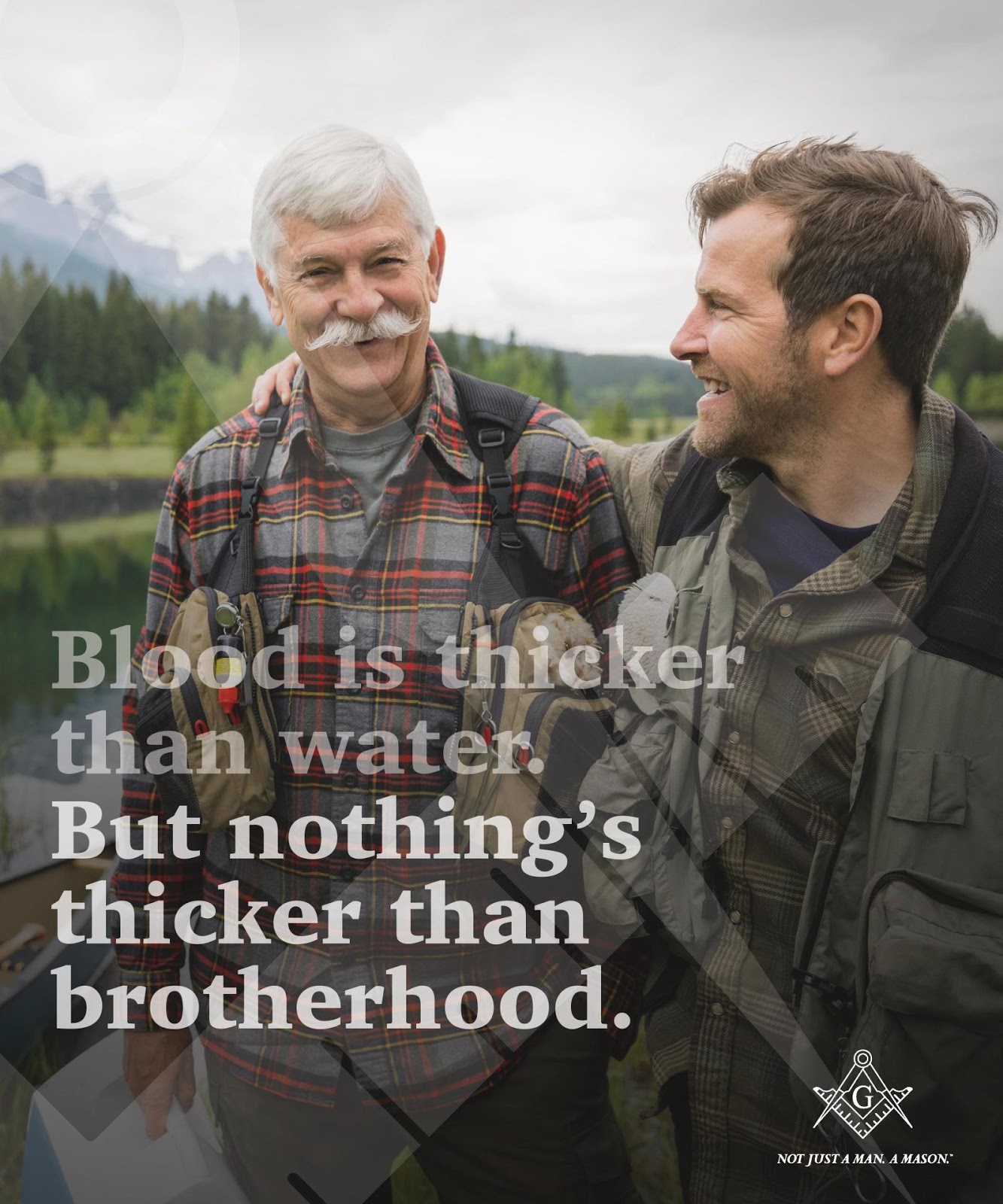
New Video Ads from Scottish Rite NMJ's "Not Just A Man" Campaign


The Scottish Rite Northern Masonic Jurisdiction's comprehensive "Not Just A Man. A Mason." advertising campaign for Craft Freemasonry has been enthusiastically adopted all across the U.S. by grateful grand lodges and individual lodges alike. 

The most recent video, "Nice Guys," (above) is now available in both :30 and :60 second lengths. 


I believe I heard last week that the print and video campaigns are now being used far beyond the borders of the NMJ, and are appearing in some 44 states and six countries. That is how starved this fraternity has been for a quality and effective message, and well produced material.


This professional campaign can be customized to a certain extent for any lodge or grand lodge, provided certain guidelines are followed and the material is not substantially altered. The Scottish Rite is making all of this material available at no cost to the entire fraternity, and the overall message and the approach is based on extensive market and demographic research done two years ago. Results of those surveys and a wealth of data can be found in Reclaiming The Soul of Freemasonry by John William McNaughton.


The complete set of campaign materials can be found at the www.notjustaman.org website.