"To preserve the reputation of the Fraternity unsullied must be your constant care."

BE A FREEMASON

Showing posts with label Philalethes Society. Show all posts

Tuesday, February 11, 2025

Masonic Week 2025: Ric Berman Named As Newest Blue Friar, and Philalethes Names Four New Fellows

Friar No. 113 Ric Berman
by Christopher Hodapp

At quite literally the very last minute on Thursday, I flew to Washington D.C. to catch a couple of events at Masonic Week: the Consistory of the Society of Blue Friars, and the Friday night banquet for the Philalethes Society.

The Society of Blue Friars was founded in 1932 for the express purpose of recognizing outstanding Masonic authors throughout the world. Traditionally, the Society convenes each year during Masonic Week in the Washington, D.C. vicinity to induct a new Friar, and its gatherings are open to the public, unless the presenter specifies otherwise. 

Authors like Arthur E. Waite, Harold V.B. Voorhis, Dwight L. Smith, Brent Morris, Allen Roberts, Thomas Jackson, Yasha Beresiner, Alain Bernheim, Robert G. Davis, Alton Roundtree, Mark Tabbert, Shawn Eyer, Michael R. Poll, Robert D. B. Cooper, Josef Wäges, Piers Vaughan and Adam Kendall are just a few prior Blue Friar honorees. In a rare moment of weakness, they even let a Dummy in. (After all - their prior Abbott is an Idiot, so I was in good company.) I was very sorry to have missed last year's Masonic Week festivities, when my friend John Bizzack was named as Friar No. 112.

This year's newest Blue Friar is the extremely prolific Richard ('Ric') Berman, author of numerous historical works about both English and American Freemasonry. Ric concentrates his studies and writings on 18th and 19th century Freemasonry in both the British Isles and America, and if you've never read any of his books, he always brings unique insights as to the social forces going on around the changes in the fraternity at key moments in history.


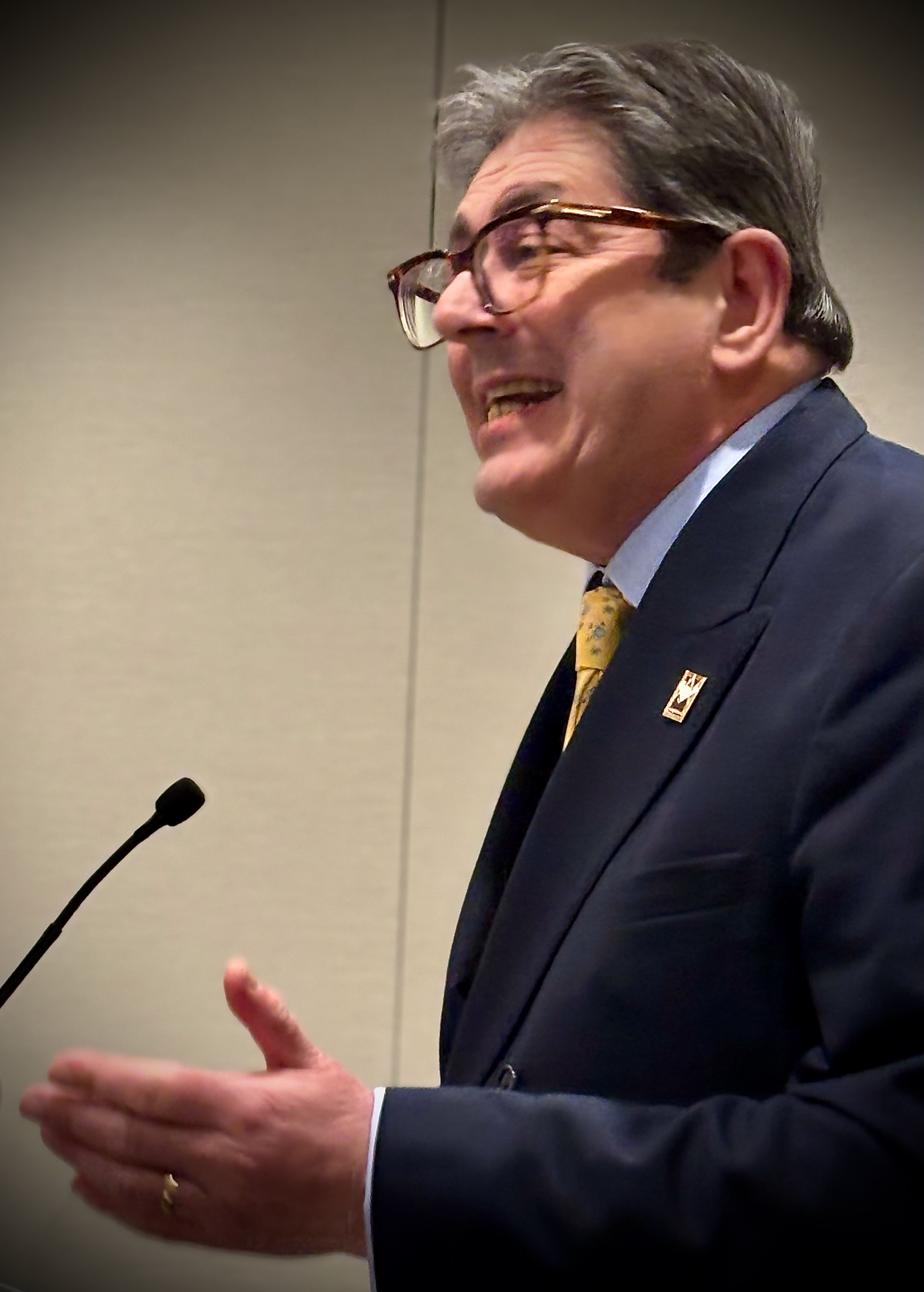
Ric Berman addresses the Society of Blue Friars 
(Photo: Billy Hamilton)

When a Friar is named each year, he is expected to present a paper at the Consistory, and Ric spoke on the political and religious background in England in the years leading up to the formation of the Premiere Grand Lodge of England. There had been a great influx of Huguenots (French Anglicans) fleeing severe persecution from France into London just prior to the founding of grand lodge Freemasonry in 1717, and they had been welcomed into the English lodges with open arms. If things had gone just slightly differently, we Masons would have had to learn how to spell John Theophilus Desaguliers instead of James Anderson when referring to the Constitutions. Thank your stars our rituals aren't in French.

Ric holds a Masters in Economics from the University of Cambridge and a Doctorate in History from the University of Exeter. His post-doctoral research was carried out at the University of Oxford's Modern European History Research Centre and as a Visiting Research Fellow at Oxford Brookes. A Fellow of the Royal Historical Society, he is the author of numerous journal articles and books, and has presented keynote papers globally. A Freemason for more than forty years and twice a Prestonian Lecturer, Ric holds Grand Rank in the United Grand Lodge of England and is a Past Master of three English Lodges, including Quatuor Coronati Lodge # 2076, the premier lodge of Masonic research. He is also an American Freemason, a member and honorary member of lodges in California, Georgia, North Carolina, Texas and Washington D.C., and a Fellow of the Philalethes Society.

Saturday, December 17, 2022

Masonic Week Feb 8-12, 2023


by Christopher Hodapp

The website for making reservations for the 2023 AMD Masonic Week is up and running. This year's festivities will be held February 8th -12th, once again at the Hyatt Regency Hotel in the Crystal City area of Arlington, Virginia (a mere cocktail glass' throw from Reagan International Airport, across the Potomac from Washington, D.C.).

Eighteen Masonic appendant bodies, invitational groups, research organizations, and others will be holding their annual meetings, degree conferrals, elections, banquets, speeches, and other assorted sundry activities. There is also always a healthy dose of Masonic product vendors on hand. 

The direct link to reserve a room at the Hyatt with the convention rate is HERE.

If you've never been to Masonic Week before, the real benefit of going is that it is the largest concentration of seriously proactive Masons from across the country and around the world you'll find on an annual basis, along with many of the best known Masonic researchers, authors, editors, and other personalities. While the bulk of the groups holding their meetings and ceremonies require existing York Rite membership as a precondition for their own admission (and some are invitational only), you will still find plenty to keep you more than occupied for these three and a half days, even if you're not a member of any of those groups. And there is as much to be absorbed in the hallways, at the bar, or in the hospitality rooms as in the meetings themselves. Make new friendships from around the world, and rekindle old ones. Be sure to bring plenty of filthy lucre as there will be numerous vendors on hand to separate you from your hard-earned simoleons.

On a selfish note, I'll announce the annual Masonic Society Dinner on Friday, February 10th, 2023. Our guest speaker will be Brother Robert Dupel who is the Sovereign Grand Master of the Grand Council of the Allied Masonic Degrees of Canada as well as the Deputy Grand Master of the Grand Lodge of Quebec. The tantalizing title of his talk is “It’s About Me” which promises to be a refreshing approach to a tantalizing subject.

If you've never been to the Washington, D.C. area before, this is the perfect excuse to go. I will tell you from experience that there is a 50/50 chance of the weather either bringing three feet of blowing snow, or 70 degree sun-drenched days. Sometimes both. That's just Washington in February. (Pack your toothbrush and an extra set of underwear in your carry-on bag in case your flights get canceled. Old hands know this.) But add a day to your trip to sightsee, and be sure you visit the Scottish Rite's House of the Temple no later than Thursday, because it is CLOSED Fridays and weekends. Visit the Capitol, the monuments, the Smithsonian, the unique Egyptian-themed Potomac Lodge, and much more. Have drinks and cigars at the Old Ebbitt Grill around the corner from the White House (you'll find Masons there nearly any night that week). Or go the other direction to Alexandria and visit the George Washington National Masonic Memorial, and have dinner at Gadsby's Tavern. There's no shortage of historic sites tied to Masons concentrated in the area.

Historically, Masonic Week was long tied to the scheduling of the annual Conference of Grand Masters (COGMMNA), which was scheduled, in turn, to coincide with George Washington's Birthday. That was back in the days when the Grand Masters met every year in Washington D.C. at this time. Consequently, Masonic Week would happen the weekend before at the venerable Hotel Washington, which sat in the shadow of the White House. But sometime in the early 1990s, that connection got frayed by the Grand Masters taking their annual meetings on the road and cycling around the country. Still, Masonic Week has always tried to arrange itself to happen the weekend before, or thereabouts. Weather in D.C., the Super Bowl, and other factors have put pressure on organizers over the years, but after this year's Masonic Week, the COGMMNA will return to the Washington area, at the nearby Crystal Gateway Marriott, also in Arlington.

Coinciding with THAT event, the George Washington National Masonic Memorial will also be celebrating the 100th anniversary of the laying of its cornerstone on Monday, February 20th.

Indiana Masons are excited to know that one of our own members, Brother Tyler Whittaker, is an operative mason from Muncie, and he has created a new cornerstone to celebrate the occasion that will be dedicated at that Monday event. (Tyler will be making a live presentation at the Dwight L. Smith Lodge of Research in Indianapolis following the Grand Lodge of Indiana's annual Founder's Day festivities on January 14th.)

Friday, March 25, 2022

Philalethes Society Award of Merit 2022


by Christopher Hodapp

I had been unable to attend the 2022 Masonic Week festivities in Alexandria in February, and thus missed the annual gathering of the Philalethes Society. And so, at the spring equinox meeting of the Indiana College of the SRICF, our Chief Adept Roger VanGorden presented me with a very special award on behalf of the Society — their Award of Merit. Roger had been in Alexandria last month and was similarly honored with his own Award of Merit for being the founding force behind the creation of the Masonic Society.

Specifically, the Award of Merit was bestowed for “efforts to see the Light of Freemasonry disseminated without prejudice or animus” and for “contributions to create The Masonic Society as a new journal of Masonic education.”

For one research organization to give a couple of upstarts an award for starting another, arguably competing, research organization doesn’t happen every day. 
The Philalethes Society had been started back in 1928 by some of the biggest names in the fraternity at that time. But for those who were around in 2008 when we started The Masonic Society, you know that it grew out of turmoil, frustration, and bitterness within this very Society. 

Our hope fourteen years ago was never to beat down or sink the Philalethes, but to fill a niche that wasn’t being addressed by anyone else on a national or international basis. The Philalethes at that time was being dominated by a single man’s hubris, who fought beak and claw against anyone who challenged his authority. Such things do happen in Masonry, almost never out of malice, but almost always from a belief that no one else can save the ship. And so, in the lobby of the Alexandria Hilton, Roger formulated a framework for our nascent organization that skewed heavily towards serving the rank and file Freemason, and not just the same well-worn list of ‘celebrity’ Masons. 

As most of you probably know, after serving as the founding editor of the Journal of the Masonic Society for several years, I was compelled by a stack of health challenges to relinquish that position and turn the magazine over to Michael Halleran to edit, who was subsequently followed by Michael Poll, who has done a wonderful and masterful job over many years now; and John Bridegroom, our longtime art director continues to make it the best looking Masonic publication available. While it might have been momentarily gratifying to know it took two or more people to replace me at that time, I was arguably a moron for trying to do it all myself back then. Or at least, that's what the guy in the ambulance said. That's why I'm uniquely qualified to write Dummies books.

While these awards to Roger and me have been bestowed on individual Masons, the gesture is, in reality, a kind and generous acknowledgement between our peer societies. When PS Secretary Terry Tilton spoke in Alexandria last month as he gave Roger his award, he said, “Every organization needs to step up and own its past.” Perhaps, but I regard this much more as an acknowledgement that what we did was worthwhile and beneficial, and, in turn, did as we really intended: a rising tide really did lift everybody's dinghies.  Our sudden appearance compelled the Philelethes Society to do better for itself, to improve the quality of its own journal and organization, not in imitation of what we were up to, but to reestablish its own important place in Masonic scholarship, research and thought. Our publications and goals are quite different, deliberately so, and that only helps the wider fraternity. I salute the many years of fine work Shawn Eyer has done in the pursuit of that mission.

Paths often cross in life, only to join up again at the strangest of moments. Back in the days when the Philalethes had its own internet mailing list and Yahoo group, that collection of ‘electronic’ Masons from all over the world deeply affected and influenced me in my first few years in the fraternity. One Mason in particular stood out as being one of the most remarkably philosophical, thoughtful and deeply spiritual men I’d ever encountered in my life. His name was Rashied Sharrieff-Al-Bey, and whether or not he knew it at the time, his public posts, and several private ones we exchanged, made a profound impact on me all those years ago. And so I find it especially poignant that this award of merit bears his name and signature as the President of the Philalethes Society this year.

So, my deepest thanks to Rashied, Terry, the officers and members of the Philalethes Society for this award and for all it represents. I shall endeavor to be at your next meeting in Alexandria in 2023 so I can thank you in person.

Sunday, November 24, 2019

Universal League of Freemasons: How Masons and Esperanto Were Going to Save the World


The journal Ritual, Secrecy and Civil Society Volume 6/Spring 2019 included a fascinating paper by Denis LeFabvre about a group of starry-eyed Masons who created the 'Universal League of Freemasons' - a global association of lodges that began in 1905 to help affect the spread of Esperanto,  a newly-created, neutral and purportedly "universal" language. But their ultimate dreams were much greater than that. They hoped that a universal language combined with a universal fraternity would ultimately save the world.

Esperanto is mostly a strange curiosity these days (pre-Star Trek William Shatner starred in the first notable movie ever made in the language, Incubus in 1966, proving he could overact and chew scenery in any language), but it had its enthusiastic supporters in an earlier age. 

L.L. Zamenhoff
Esperanto was created in the 1870s and 80s by a linguist and Polish Jew named L.L. Zamenhoff using elements of Russian, German, English, French, Polish, Hebrew, plus Greek and Latin. His goal was to create an easy to learn and adopt second language that would transcend all national borders, tribal and cultural divisions. His ultimate hope was that Esperanto would be adopted as the new lingua franca for diplomacy, science, commerce and international understanding, and ultimately end, or at least defuse, the dangers of fervent nationalism that had so torn Europe apart for so long. His dream was born in reality, because those very divisions would plague Europe and kill millions for another 70 years. He himself had been raised in the Jewish ghetto and was surrounded on all sides by people who spoke numerous different languages and were in constant conflict. He saw the two issues linked together - that misunderstanding your neighbors' words often led to violent misunderstandings on a much larger scale. Rinse and repeat.


Zamenhof initially called his language Lingvo internacia ('international language') and attempted to publish a book in Russia to introduce it to the public in the mid-1880s. When the Russian government prevented its initial publication, author Leo Tolstoy became a public supporter and the authorities at last relented. 

The book was published under the pseudonym of 'Doktoro Esperanto' ('Doctor Hopeful'), and the growing fan base for the language soon began to call it Esperanto instead. It had a slow but steady increase in popularity over the next three decades, and Zamenhof was even nominated for the Nobel Peace prize in 1910.


7th International Esperanto Congress in Antwerp, Belgium - 1907
Zamenhoff wasn't a lone dreamer, and the horrors of World War I between 1914-18 ushered in a new sense of commitment to find drastic ways to prevent such future devastations from ever happening again. 

Zamenhoff died while the war still raged, but after hostilities ended in 1918an awful lot of people came to agree with his point of view – that if only stubborn nationalism and artificial divisions could be licked, countries would stop shooting at each other. Esperanto became a sensation. In fact, the newly established League of Nations came within one vote of adopting Esperanto as their official diplomatic language. 

At the same time, some Esperanto utopianists and other advocates sought ways to incorporate Freemasonry and its philosophy of universal brotherhood as one of several ways to unite the people of Europe and the world to prevent future wars. Originally formed in 1905 as 'Esperanto Masona,' ('Hopeful Masonry') the creators of the UFL - Universala Framasona Ligo (Universal League of Freemasons) believed Esperanto, combined with the universal brotherhood of Freemasonry, could ultimately unite the entire world in brotherhood and finally bring global peace. 

The first practical mission of the UFL was to break through Freemasonry's own artificially erected barriers of recognition and regularity and accusations of clandestinism so that Masons could enjoy fellowship with each another in a non­-tyled Masonic environment, all without breaking their respective obligations. The notion was that Freemasons could meet informally from all different jurisdictions and obediences and find that they shared much more in common with one another than what divided them. 


But the harsh realities of the 1930s and the rapid rise of fascism in Germany, Spain and Italy, the atrocities and deprivations of Communism in Soviet Russia, along with the brutal spread of the Japanese Empire in the East, briefly brought the UFL's lofty dreams to a halt. In Mein Kampf, Hitler had declared that 'Esperatism' was a tool of the dreaded world-wide 'Jewish-Masonic Conspiracy.' During the WWII, only the Swiss group of the UFL remained active and their headquarters remained in Geneva.

Bust of Zamenhoff in Budapest
Both the Nazis and Josef Stalin's Russia persecuted and killed advocates for Esperanto. Zamenhof himself died of a heart attack in 1917, but he and his wife Klara Silbernik raised three children, a son, Adam, and two daughters, Sofia and Lidia. All three children were murdered in the Holocaust.

Nevertheless, there are still some 2 million people around the world today who speak or read Esperanto, and it's commonly known enough in pop culture that it even appeared in a Simpsons episode. The Internet has breathed new life into the spread of the language, and some foreign language programs teach Esperanto first as a stepping stone for then teaching more difficult languages. It's a simple one to master with few basic grammar rules that have no irregular exceptions, and advocates say teaching it to toddlers makes mastering many other languages later in life much faster. They regard Esperanto almost as the next step after learning the basic alphabet.

The Universal League of Freemasons didn't die after WWII, but very few Masons know about it these days. While you may never have heard of it, this was not some insignificant little discussion club — at their peak, the Universal League of Freemasons was spread into 72 countries with upwards of 12,000 members worldwide. 

Back in the 1960’s and 70’s the UFL generated an uproar in mainstream U.S. grand lodges who condemned the organization as clandestine because its members associated with irregular and unrecognized, clandestine Masons. There was an American group of the UFL founded by Harvey Newton Brown, who was also a major force behind bringing awareness to mainstream Masons about Prince Hall Freemasonry. Harvey Brown was a powerful advocate for broaching the artificial divisions of regularity and recognition among the world's Freemasons, so naturally he was treated by many American Masons like he had horns and a forked tail sprouting from his body. 

Interestingly, California's own Past Grand Secretary and 2014 PGM, John L. Cooper III (photo) was the last official Secretary for the American wing of the UFL in the 1980s when he was forced by the GL of California to drop out of it. 

The U.S group died soon afterwards, but John wrote his own paper about them. 

See 'The Universal .League of Freemasons: A Twentieth Century Experiment in Masonic Dialogue.'

Although they were pretty free-wheeling in their makeup, the UFL nevertheless restricted their membership to male Masons for a variety of practical reasons — not the least of which being that they knew accepting female Masons into the group would kill it in the cradle among even the most progressive-minded jurisdictions throughout the 20th century. At their World Congress in Berlin in 1992, the UFL voted to also include female and co-Masons for the first time. But they were already diminishing in popularity.

After the UFL faded, the international research group The Philalethes Society took on this same sort of role in the 1980s and 90s after the UFL disappeared, and they frequently invited "irregular and unrecognized" Masons to participate in their conferences and contribute to its magazine. PSOC presidents and editors Allen E. Roberts and later, Nelson King were both strong advocates of encouraging these types of cooperation, participation, education and understanding. It was this sort of informal Masonic interaction that both promoted Prince Hall recognition and stirred up a major brouhaha in the early 2000s in Minnesota over recognizing multiple French grand lodges.


In truth, the Internet did what the UFL couldn't do by the end of the 20th century. Masons from every jurisdiction — regular, recognized or not — began to communicate through online BBS systems, instant messages, chat rooms and forums, much to the chagrin and frustration of grand masters everywhere. 

Those freewheeling years of the CompuServe Masonry Forum and the later PSOC (Philalethes Society) Mailing List did more to advance international communication, understanding and scholarship between mutually unrecognized Masons all over the world than anything in the previous 275 years. Issues like Prince Hall recognition, almost the entire basis for so-called 'traditional observance' and 'European concept' lodges and practices, 'Chambers of Reflection,' and much more that are commonplace topics today would not exist had it not been for those early resources.


If you believe Internet websites, the Universal League of Freemasons still hangs on today. Last updated in 2011, there appear to be groups in Switzerland, Germany, Italy and Canada.

Meanwhile, Denis LeFabvre's paper in Ritual, Secrecy and Civil Society is a fascinating snapshot of these early UFL Masons who gallantly – albeit naively – attempted to use their fraternalism to achieve what politics, religion and traditional avenues of diplomacy could not. And it helps to explain some of the differing attitudes about Freemasonry's role in society between what we in the U.S. and the wider "regular, recognized" Masonic world practice, versus the very politically- and policy-minded attitudes in unrecognized obediences like the Grand Orient de France that developed in Europe. Those differences in philosophies about Freemasonry's proper role in the world and society didn't grow out of a vacuum, and this paper goes a long way in putting that into its proper perspective.
It's just one of the many fascinating papers you will find in the journals of  Ritual, Secrecy, and Civil Society

As I said, John Cooper's paper on the ULF is also well worth reading. He poignantly ended it with a quotation from Socrates to Meno in about 400 B.C., that appeared in the December, 1972, issue of the U.S. Group of the ULF's Newsletter, La Heroldo:
“That we shall be better and braver and less helpless if we think that we ought to enquire, than we should have been if we indulged in the idle fancy that there was no knowing and no use in seeking to know what we do not know; ­­ that is a theme upon which I am ready to fight, in word and deed, to the utmost of my power.”


Wednesday, August 17, 2011

Nelson King (1945-2011) RIP


Brother Nelson King passed away peacefully this morning, August 17, 2011, according to a brief statement by his wife Ellen and his daughter Vicki Rout. Nelson had fallen and was hospitalized over the weekend. He was released to go home Sunday, but fell again, breaking his right shoulder and collarbone, and was readmitted yesterday.

UPDATE: There will be a visitation on Friday August 19, 2011 between 7:00 pm and 9:00 pm at Ogden Funeral Homes, 4164 Sheppard Avenue, East Scarborough Ontario M1S 1T3. There will also be a Masonic service and memorial reception on Saturday August 20, 2011 starting at 2:00 pm at Ogden Funeral Homes, 4164 Sheppard Avenue, East Scarborough, Ontario M1S 1T3
There will be a notice posted in the Toronto Star on Thursday August 18 and Friday August 19.


Nelson served as editor of the Philalethes Magazine from 1994 through 2009. On a personal note, he kindly served as the technical editor when I was writing Freemasons For Dummies, to make sure I didn't completely put my foot in it. When I was in hospital back in 2008, he was among the first to call and ask after my situation. Nelson was forceful, opinionated, and he stood by his beliefs.

He also stood by Freemasons.

The world today is a darker place from his passing.

From his website:

Born June 13, 1945 in Montreal, received his primary education in Perth Ontario, and graduated from Banting Institute, University of Toronto, 1967. Married to Ellen, and has two children, Christopher, and Victoria and two granddaughters. Nelson was appointed Assistant Editor in 1992 and Editor in August 1994] of The Philalethes Society Journal of Masonic Research and Letters, the first non-United States Citizen to hold these positions.

He is also only the second Mason to ever hold the position of President and Editor of The Philalethes at the same time. He retired as Editor in June 2009. Nelson is a well-known Masonic speaker, having spoken in the jurisdictions of Alberta, Arizona, California, Connecticut, Costa Rica, Cuba, The District of Columbia, Georgia, Indiana, Iowa, Jamacia [EC], Kansas, Kentucky, Louisiana, Massachusetts, Maine, Maryland, Minnesota, Missouri, New York, North Carolina, Nova Scotia, Ohio, Oklahoma, Ontario, Pennsylvania, Quebec, Texas, Virginia, and Washington.

Nelson developed the highly successful Internet Masonic Leadership Course. His book "Confessions of a Born Again Fundamentalist Freemason" has become a Masonic Best Seller. VoicePrint®, The National Broadcast Reading Service Inc. an international broadcasting reading service for the visually impaired has recorded some of his historical articles. Nelson was instrumental if the formation of the Masonic Relief for Cuba Committee. And he serves as the Executive Director of that program. He is also one of the few Canadian Freemasons, listed in latest Edition of the "Who is Who of Freemasonry.