
"To preserve the reputation of the Fraternity unsullied must be your constant care."

BE A FREEMASON

Saturday, October 19, 2019

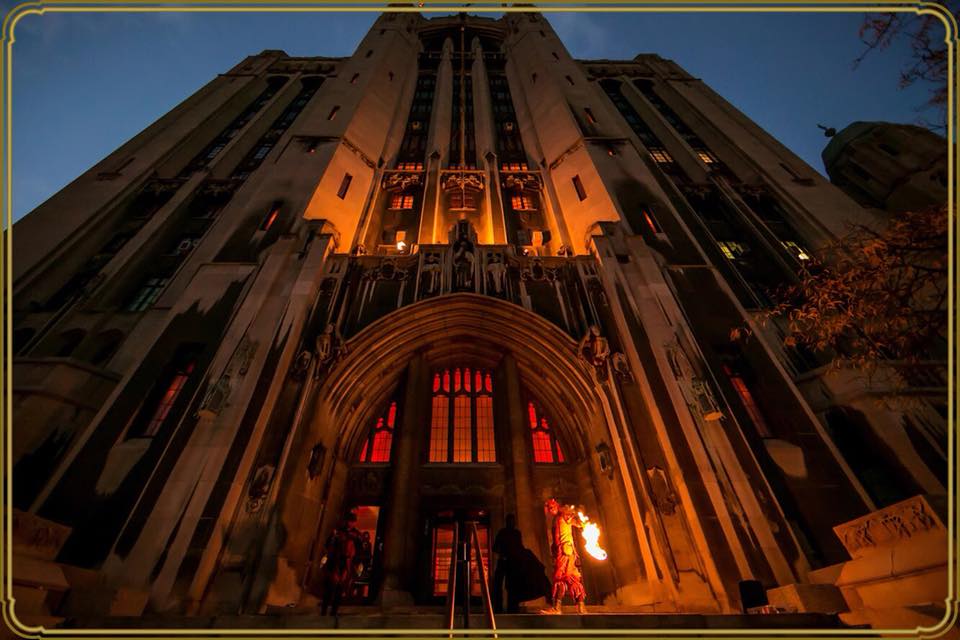
'Theatre Bizarre' 2019 at Detroit's Masonic Temple


Every October since 2011, the massive Detroit Masonic Temple has been turned over to the ever expanding Halloween bash known as Theatre BizarreThis type of massive production defies adequate description. 

Theatre Bizarre is a giant, surreal entertainment extravaganza that essentially takes over most of the twelve-story fraternal tower of the Detroit Temple each October. Spread across eight of the sprawling building's levels, each lodge room, ballroom, and public area becomes a venue for a wild carnival atmosphere that combines theatre, burlesque, haunted house, circus sideshows, tattoo artists, punk bands, masquerade balls and other "immersive events." This is all about audience participation on a grand scale, and the organizers take advantage of a huge international movement of performers and artists who travel the world to create these types of shows. 


Pearl-clutching Masons who feel our buildings are no place for such public spectacles need not read further, and this will surely have generations of venerable Masonic figures from our past spinning in their graves at high speed. Some might even regard it as ghastly. But brethren who know our most significant buildings are always in need of income and public exposure to our communities need to read up on this innovative use of the world's largest Masonic building.


The good news for Detroit's Freemasons is that, apart from much needed income, it draws quite literally thousands of people into their building who would otherwise never have encountered it. While the performers and acts themselves would have shocked our predecessors and rung up the vice squad, the actual attendees at its two Gala Nights are strictly required to dress in formal masquerade attire. The general public is invited to attend throughout the week. And the Detroit Temple's uniquely varied architecture and design is the perfect backdrop. The designers and organizers take full advantage of the public's vague sense of secretive, occult spookiness with which Freemasonry has been suffused in the popular culture for decades. 


It takes weeks (starting each September) to install all of the scenery, props, lighting, effects, and more. Resident lodges change their rooms and meeting schedules to accommodate the show.
I fully realize that many Masons may absolutely recoil in horror at the sort of onstage acts this particular program hosts and want no part of seeing it in a Masonic building. 'Community standards' are an ever-shifting landscape, while Masonic ones tend to be less changeable.  Many years ago, one of our local Grand Masters became quite agitated against the notion of renting out our large and abandoned auditorium to theatre groups because he was terrified of potentially seeing an ad for "Come and see The Vagina Monologues at the Masonic!" Fifty years ago a different Indiana Grand Master made a very public condemnation of our magnificent Murat Shrine theatre and forbade them from booking the musical Hair because of its language, disrespect of the flag, and its notorious nude scene. He threatened to expel any Masons who rented their buildings out to "obscene" productions. The story hit the national news. He was lauded by the entire community and the police department for weeks, on the news and in print, for protecting the city from licentiousness. 

That was 1969, the summer after the so-called Summer of Love. Today, grade schools wouldn't hesitate to take kids on a field trip to see that same show.


I won't condemn or defend anyone who would agree today that a program like Theatre Bizarre is just beyond the pale of what many Masons regard as our sacred spaces. There's no hiding that this year's Detroit event will present (among others) a burlesque show called the Dirty Devil's Peep Show, dominatrixes at the Fistitorium, and punk-rock bands like Messer Chups, Mother Feather, and Death. I'll just say that our lodge rooms only become sacred spaces when we meet as Masons, and that extends to caves and quarries, taverns and cabins, and anywhere else. 


Our most significant buildings were almost always meant by our predecessors to be open to and welcoming of the local community, to be part of the fabric of our towns. For way too long, so many of our most important temples have been slipping away from us specifically because we have failed in that mission. Detroit's brethren need to be applauded for recognizing this and shining a spotlight on their Temple in a way that the community appreciates and enjoys.

If you've never visited the Detroit Masonic Temple for yourself and had the COMPLETE tour, put it at the very top of your Masonic list of things to do. It is the largest Masonic building in the world, and was designed to accommodate 50 different Masonic organizations. Including its on-site hotel rooms on the former Shrine end of the building, it contains over a thousand different rooms, and no detail was left out. 

Friday, October 18, 2019

Arturo De Hoyos Speaking In Indianapolis Tuesday 10/22


This Tuesday, October 22nd, renowned author, researcher, translator, and historian Arturo De Hoyos will be speaking at Lodge Vitruvian No. 767's Stated Meeting and Festive Board in Indianapolis, Indiana.


Art is the Grand Archivist and Grand Historian for the Supreme Council of the Scottish Rite SJ, and his body of work over the last three or so decades has been nothing short of astonishing. To my knowledge, he has not spoken in the Indianapolis area before.

Please alert our Secretary if you intend to be there so he can plan accordingly.

Here is the official summons:
Come join us for fellowship and scholarly discussion on the evening of Tuesday, October 22nd, 2019 AD, 6019 AL.
We are determined to complete our business in one hour.
NOTE: We will be conducting our annual election of Lodge officers at this meeting, but will do our best to complete this process quickly.
Also, please note that our Festive Board dinner is to be tiled, and is open to Master Masons only.
7:00 – 8:00 PM Stated Meeting
Lodge Vitruvian No. 767 F&AM
Broad Ripple Masonic Temple
1716 Broad Ripple Avenue
Indianapolis, IN 46220-2338
“In the style of European Lodges, members are expected to dress in tuxedo for all Communications of the Lodge. Members also purchase their own regalia, (apron, collar, gloves, case), according to Lodge Vitruvian specifications.”
Visitors dress should be tuxedo, or business attire.
8:30 -10:30 PM Festive Board
The Aristocrat - Oxford Room (upstairs)
5212 North College Avenue
Indianapolis, Indiana 46220
Each attendee will be responsible for the cost of his and their guest’s meal.
Keynote Speaker:
Arturo de Hoyos, Grand Archivist and Grand Historian, Supreme Council, 33°, will be presenting his topic, "A discussion on Albert Pike’s Esoterika, his once-secret unpublished text on the symbolism of the blue lodge degrees."

(Be aware that the Red Line boondoggle has eliminated some on-street parking around the Aristocrat, and their parking lot is not large. Be prepared to park on side streets and have a longer walk. Car pools to the restaurant would not be a terrible idea. Of course, you could ride the Red Line wiz-bang electric bus down I suppose, but you'd still have to drive to the Broad Ripple Avenue station and park on the street somewhere just to ride it south for ten blocks - which defeats the whole point. And you'd arrive at about dessert time.)

Tuesday, October 15, 2019

Speech: Indianapolis' Masonic Temples At The Center of the Community


On Friday night I gave a presentation at the Indianapolis Masonic Temple to an audience of Masons and theatre folks about the role that our city's three Grand Lodge buildings have played in the community ever since the first one opened in 1851. 

Many thanks to WBro. Patrick Elmore for recording this event and editing my presentation into a watchable video (see above). My apologies in advance for the audio. It's one of the deficiencies of recording on a phone.

As I pointed out, each of our three Temples' auditoriums (all officially known as  'Freemasons' Hall') were designed to accommodate our two large statewide Masonic meetings each year – but those massive rooms weren't really built for us. These big spaces were really designed to be used by the city for the rest of the year. And use it they did.

The First Temple

The first Indianapolis Masonic Temple 1850

All three of our Masonic Temples over the years were intended to be an integral part of the community. In Indianapolis our large halls were used for theatrical shows, concerts, speeches, travelogues, public assemblies and debates, and much more. There were magic acts and circus performers, traveling authors and musical prodigies, famous scientists and inventors, story tellers and celebrities. Despite our strictures against the discussion of politics and religion in lodge itself, Freemasons Hall was the setting for Indiana's second Constitutional Convention in 1851, political rallies (Abraham Lincoln spoke there in 1859), stump speeches and tax debates, anti-slavery protests and rallies. It was even rented out to two different churches for their Sunday services. 


In 1855 our Masonic Hall was the site of the inaugural public procession and "sumptuous banquet" of Indiana's 'African Freemasons,' descended out of Prince Hall's African Lodge in Massachusetts. The next year they would form the Independent Union Grand Lodge (Colored) of Free and Accepted Masons of the State of Indiana, which was the precursor to today's MW Prince Hall Grand Lodge of Indiana.

In the 1870s it held the distinction of becoming the first noteworthy building in the city outfitted with gaslights—apropos, since Masons are always desirous of "more light...".

The Second Temple

The second Indianapolis Masonic Temple 1875
Indianapolis' second Masonic Temple was built in 1875, and there was a huge uproar when the architectural firm failed to include an auditorium in the initial design. The Indianapolis lodges and Grand Lodge were far more interested in having downstairs rental income property.  The protests became so heated that they were forced to purchase the next lot to the south at great expense to hastily add an auditorium to the new Temple's backside. It became just as popular as the first one had been to the city. 

When the second Temple caught fire in 1905, thousands of people swarmed downtown to watch it burn and mourn its passing. They lined the streets and the small hillside of the State House across the street to watch in horror as the roof collapsed and was consumed by the flames. One brave firefighter ran into the building and emerged from the flames moments later carrying a massive silver drill team trophy of Indianapolis' nationally famous Raper Commandery No. 1 to safety. The crowd erupted in cheers.  Indianapolis' Masons were considered a vital part of the city then, and our loss was a loss to the whole community.


The Third Temple
Cornerstone ceremony of the third Indianapolis Masonic Temple on June 6, 1908

When the Grand lodge of Indiana laid the cornerstone of the third Indianapolis Masonic Temple in 1908, 5,000 people attended the event to cheer us on. The whole city knew that the Masons would be erecting yet another significant building that the community could be proud of. When it opened in 1909, 1,500 people crammed into the building, and another 3,000 surrounded it outside. The Governor couldn't manage to squeeze through the crowd to give his scheduled speech, and finally went home out of frustration.

Freemasons' Hall auditorium of the present Indianapolis Masonic Temple as it appeared in 1913.
Note the pipe organ at the back of the stage(one of seven in the whole building). It was removed a few years 
later to increase the depth of the stage.

During Word War II, our present auditorium made up a portion of the Masonic Service Center that expanded throughout the Temple – similar to a U.S.O. It provided services, meals and entertainment for 10,000 U.S. servicemen between 1943 and 45. It was considered the premiere relaxation and service facility in the city for members of the military and their families. The whole community knew they could count on the Freemasons.

In the 1950s Freemasons' Hall was regularly used for swearing-in ceremonies for newly naturalized immigrants. The federal judges who oversaw these events expressed the belief that Freemasonry embodied the American rights of freedom of assembly, expression and religious practice. So our auditorium was the ideal setting in which to express these values to new citizens embarking on their new lives in a new land.

After the 1960s our present Hall fell into disuse. We have not one, but three, major Masonic buildings in downtown Indianapolis, and that meant that the Grand Lodge could take advantage of those other venues without investing in and upgrading its own. The Scottish Rite and the Shriners both built bigger and better theaters, and so Indiana's Masons used them instead.

Indianapolis Scottish Rite Cathedral auditorium
Grand Lodge moved the annual communication to the larger, more comfortable (and air conditioned) Scottish Rite Cathedral theater across the street. It's been there ever since.

The Murat Shrine Theatre (operated today as the Old National Center)
Founders' Day didn't begin until 1961 and was first held at the Murat Shrine Theater (operated today as the Old National Center). That event eventually moved to the Cathedral. 

By the 1980s the Masonic Temple's auditorium had become an elaborate broom closet, and Grand Lodge used it to pile up junk, old paperwork and floor buffers. Despite a couple of promising fits and starts in the late 90s and again in the early 2000s, the auditorium again went dark, the doors closed, and it remained largely unseen by our own members. Years of ego fights, hurt feelings, neglect, burnout, frustration and a one-foot-out-the-door attitude all took their toll. The city itself had long ago forgotten it even existed.


Sometimes you have to hit rock bottom before you can rise again. 

In May of this year the Grand Lodge F&AM of Indiana officially took over the management of the Indianapolis Masonic Temple. Decision making has been streamlined, the logjam of inaction has been been broken at last, and great things are on the horizon. A fundraising and preservation foundation for the Temple has been reactivated, and major news is coming. 

More important, this presentation on Friday was part of what will soon be announced publicly about an exciting new chapter in the Indianapolis Masonic Temple's history.  Stay tuned!


Sunday, October 13, 2019

Issue 46 of the Journal of the Masonic Society


Issue 46 of the Journal of The Masonic Society got crammed into the back of my mailbox last week by my postal carrier (who has all of the grace and caring finesse of an old Soviet Aeroflot airline hostess and with much the same looks). 

As always, the lineup for this issue is an impressive one. 

Papers include:
  • "Personal Ritual: A Contemplative Tool for Masonry Beyond the Lodge" by C.R. Dunning, Jr.
  • "Ancient Charges Scroll Case: Putting Craftsmanship Back into the Craft" by Martin Bogardus
  • "Who Are We, and Where Do We Stand?" by Robert L. Poll
  • "The Boyer Model of Scholarship: Application to the Craft" by Michael L. Moran and  Seth C. Anthony
  • "The Symbolism of Preparation" by Mark St. John
  • "Brother, Brother - Brother, Brothers" by Anthony Whitehawk Cabello
  • "Concept of Masonic Renewal: What does it mean to you now and in the future?" by Christian M. Christensen
  • "Why Freemasonry?" by Barry A. Searle
  • "Freemasonry and Rosicrucianism: Ludibrium or Logic?" by Michael E. Ludwig

The great collection of reading in this issue also includes the regular book reviews, Editor's Corner, Greg Knott's great Camera's Lens feature, John Bridegroom's Masonic Treasures and more. 

Hard to believe that we started the Masonic Society just eleven short years ago. If you are not a member or subscriber, you should be! Visit the Masonic Society's website at www.themasonicsociety.com


Thursday, October 10, 2019

Molotov Cocktail Thrown at NYC's Masonic Hall


The New York Post reports that an unidentified suspect threw a Molotov cocktail at the entrance of New York's landmark Masonic Hall on 23rd Street Wednesday night at about 11:45PM. 

According to the report, the glass incendiary device ignited and quickly burned out. Firefighters were called, but the flames had been extinguished by the time they arrived. There were no injuries and there is currently no word yet on any damage.

The suspect was seen on video surveillance cameras and was wearing a grey sweatshirt and green track pants with white stripes down the legs (click the photo above to enlarge). New York Crime Stoppers is seeking tips on this suspect at 800-577-8477.


The Masonic Hall is home to dozens of Masonic lodges and related organizations, and is the headquarters of the Grand Lodge of New York F&AM.

Wednesday, October 09, 2019

Video: Differences Between the Two U.S. Scottish Rite Supreme Councils


Did you ever wonder why the U.S has two different (VERY different) "mainstream" Ancient Accepted Scottish Rite Supreme Councils - one for the Northern (NMJ) and one for the Southern (SJ) jurisdictions? 

The AASR-SJ's Illus. Grand Archivist Arturo De Hoyos and the two Sovereign Grand Commanders - Jim Cole (SJ) and David Glattly (NMJ) -  spell it all out for you in this video that was recently posted by the Scottish Rite of the District of Columbia.

In the first ten minutes, Art explains where the two groups originated and why, the differences in practices and philosophies of their dramatically dissimilar degree rituals, even the "wings up/wings down" controversy. The second half of the program is a back-and-forth interview with the two SGCs.

The message this video conveys is a celebration of the differences and similarities, not a claim as to which of the two jurisdictions is "better or worse." And as Art points out, if you are truly obsessive about it, you can be a member of both jurisdictions simultaneously (although you have to decide on an official "home" valley through which you receive your honors and benefits).

Tuesday, October 08, 2019

Former Aurora, Illinois Masonic Temple Destroyed By Fire


And another one gone.

The former Aurora, Illinois Masonic Temple was destroyed by fire last night. It has been empty since 2006. The cause of the fire is unknown.


From the NBC affiliate in Chicago:
Crews continued to battle the massive fire into Tuesday morning. Officials said the ceiling caved in on the five-story structure overnight and it remained unknown as of early Tuesday which portions of the building, if any, would be salvageable.
The blaze rendered the temple structurally unstable, Aurora Fire Chief Gary Krienitz said at the scene early Tuesday. Krienitz added that the temple's roof and part of the facade had already collapsed, and that the entire area was blocked off out of fear that the walls could come down as well.
He also said that debris from the blaze hit an electrical line, forcing ComEd to shut off power in the area and causing a small outage.
No injuries were reported in the fire, officials said, but five homes in the area were evacuated. Fire officials said crews will likely remain on the scene all day Tuesday, with the focus on securing the area and getting people back into their homes safely.
The cause of the blaze remains under investigation.


The 1921-24 neo-classical landmark in suburban Chicago was originally built by the proud members of Jerusalem Temple Lodge 90, and was designed by architect William Q. Bendus. It had two large lodge rooms that could seat 200, and an unfinished ballroom. 


But in less than 60 years the neighborhood shifted, membership dwindled, and it was fled by the Masons, like so many other giant Masonic temples in and around Chicago. The Aurora Temple became a banquet center in the 1980s, but has been totally abandoned since about 2006. Local attempts at restoration and reuse had been made over the years, but to no avail. 

Now all that remains of the once proud Masonic presence is a burned out shell.

Preserve and protect what we still have, Brethren. We will never build their equals again.

H/T Scott Dueball

UPDATE: A drone flyover video of the burned out temple has been uploaded to Youtube.


Monday, October 07, 2019

Prince Hall Recognition - Is Mississippi Next?

MW Jason A. Jefcoat, Grand Master of the
Grand Lodge of Mississippi F&AM
(UPDATE: This story was previously posted with an incorrect photo that showed Brother Maurice F. Lucas, JUNIOR instead of MW Maurice F. Lucas, SENIOR, who is the Grand Master of the Stringer Grand Lodge of Mississippi (PHA). That corrected photo has been updated below. My apologies for the error, which was mine entirely.)

The historical segregation between the predominantly white "mainstream" Masons and African-American Prince Hall grand lodges in the American South continues to mosey its way to the well-deserved tar pits. While this post is a little less timely than it probably should have been, I wanted to wait a few more days before circulating it.  


Mississippi's "mainstream" and Prince Hall Scottish Rite Masons
were represented at the Scottish Rite in Memphis last week.
The world did not stop spinning on its axis.

The news from last week about the Memphis (TN) Valley of the Scottish Rite and their Prince Hall Affiliated counterparts cooperating wasn't just confined to Tennessee's Masons. As reported, Mississippi had representatives from their own Scottish Rite bodies - "mainstream" and Prince Hall - attending as well. But there's a little more to the story out of Mississippi. 

Back on September 27th, Mississippi's Grand Master, MW Jason A. Jefcoat posted the following message on the Grand Lodge of Mississippi's official Facebook page:
Brethren,
Not long after I was installed as your Grand Master I received an invitation and a request from the Grand Master of the Most Worshipful Stringer Grand Lodge of Mississippi F&AM, Prince Hall Affiliated for a meeting to discuss the possibility of some type of mutual recognition. As your newly installed Grand Master, with what I still consider an extremely important agenda and a very full schedule, I dismissed this invitation.
Five months later while I was representing our State at the Scottish Rite Biennial Session, I was given the opportunity to meet Brothers from all over the world. In some of these conversations the topic of Prince Hall Masons was discussed. I was made aware of some future events concerning Prince Hall Masonry and our counterparts in the Southeastern Masonic Conference. I talked with Grand Masters whose States have recognized Prince Hall Masons for decades, and I talked to Grand Master whose States are voting on this topic in the very near future. There was a lot of talking, but for once in my life I kept my mouth shut and listened.
Because I know how strongly some of our Brothers feel about this topic, I took my burden to God. I considered the consequences and benefits of what some type of recognition would mean for Mississippi, and I asked Him for help.
Within 24 hours I received a phone call from Grand Master Most Worshipful Brother Maurice Lucas, Most Worshipful Stringer Grand Lodge, Prince Hall Affiliate. I immediately accepted his invitation for lunch the next week. The following is a result of our meeting. The request has been turned over to the Fraternal Relations Committee, and will be presented for a vote at our next Annual Communication.


MW Maurice F. Lucas, Sr.
Grand Master of Stringer GL of Mississippi (PHA)
The letter GM Jefcoat posted was an official written request by MW Maurice F. Lucas, Sr., the Grand Master of the MW Stringer Grand Lodge of Mississippi F&AM (the regular Prince Hall Affiliated grand lodge in that state - see footnote) to discuss joint recognition and arrange a treaty of amity to share concurrent jurisdiction in Mississippi:


Click image to enlarge

Part of the thing that frustrates new and old Masons alike is the glacial speed with which the fraternity operates, especially when topics like recognition arise. When annual meetings are required to make changes, and simple yes/no decisions to proceed or not are measured in years instead of days or minutes, it's easy to assume nothing is happening. 

So.


What this all means to the uninitiated or the frustrated is that Mississippi's Prince Hall (PHA) Masons will be voting on whether or not proceed with this official request at THEIR next annual communication. THEN the Grand Lodge of Mississippi F&AM will take up the question. Presuming both pass the votes, THEN the two grand lodges will officially meet to hammer out details. THEN the two grand lodges will have to both ratify the agreements. And all of this presupposes that both bodies of historically entrenched Masons even agree to undertake any of this in the first place.


All of this creaky back and forth seemed normal in the 18th and 19th centuries when these types of processes were worked out. Unfortunately, when it comes to potentially controversial topics like anything involving race and the American South, the rest of the world can't refrain from hurling accusations and insults south of the Mason-Dixon Line. This isn't an apologia for this longstanding wall between Freemasons there, but let's give fair-minded Masons the proper opportunity to finally solve it at long last. If they do, this map may be changing again sooner than later.


*Just a note for clarity: since after the Civil War, Prince Hall Freemasonry has long been most active and widespread in the American South. If you don't know the history of the National Compact era and the battles between PHA (Prince Hall Affiliated) grand lodges versus the former Compact-era PHO (Prince Hall Origin) grand lodges, this blog can't really do that justice in a short space. If you read online arguments between Masons on both sides, you might see them calling each other "three-letter" or "four-letter" Masons (F&AM vs the Compact's AF&AM). In some states, the early- to mid-20th century attempt to standardize all PHA grand lodge names by changing to "The Most Worshipful Prince Hall Grand Lodge of [your state here], F&AM" was frustrated by legal counter-claims over corporate entity names on a state by state basis. 

Consequently, Mississippi's PHA grand lodge is officially named the "Most Worshipful Stringer Grand Lodge of Mississippi F&AM." The Compact-era's PHO grand lodge got to the courthouse first, so it snagged the simpler name .

For related reasons Florida's ungainly regular, recognized PHA name is the "Most Worshipful Union Grand Lodge Most Ancient and Honorable Fraternity F&AM PHA Florida & Belize, Central America Jurisdiction, Inc."

Tuesday, October 01, 2019

Simon LaPlace Departs Masonic Service Association


After three years' of serving as its Executive Secretary, Simon R. LaPlace has left the Masonic Service Association as of October 1st. He will be seriously missed by all of us who know just what he has been accomplishing during his time in the position. 

The October Emmessay Notes arrived today with the following message:
For the past three years, I have had the pleasure of working at the greatest job in the world. The friendships my wife and I have made throughout the country have been truly fulfilling. The work of the MSA Representatives and volunteers at Veterans homes and hospitals is inspiring. The dedication I have seen by Grand Secretaries and many Masons is reassuring.
When I made the commitment to serve as Executive Secretary for three years, I anticipated the position would continue for a longer period. MSA’s commissioners are working to reorganize the Association, and after 100 years, one of these changes may be the elimination of an Executive Secretary. Despite my presentation to them in February that would turn a deficit into a surplus, they have chosen a different path with an uncertain future.
I hope what has made MSA so important continues—disaster relief, education, and comforting veterans, but I am not so sure it will. But I will continue to help these programs as long as I can. - Simon R. LaPlace
The assorted past grand masters who comprise the MSA's Commissioners have decided in their infinite wisdom to eliminate the position of Executive Secretary completely - thereby robbing the internationally known organization of its public face, most visible cheerleader, and central ringleader. Apparently, the Commissioners will now divvy up the roles that Simon and his long line of high-profile, storied predecessors have fulfilled since the 1920s. 

The Executive Secretary has played a vital role in being the personal contact between grand lodge officers who know little or nothing about it and the range of services MSA provides. I know just from my own observation that Simon has overseen major updating and streamlining of the MSA since he arrived three years ago. 

Under his leadership the MSA cooperated with the Amity software folks to integrate information and Short Talk Bulletins with their phone app, making it more useful to all Masons. The entire library of over 1,000 previous STBs were indexed, reformatted, and republished in easily referenced hardback editions, making almost a full century of collected wisdom accessible once again to a whole new audience of Masons and researchers. MSA finally began accepting online credit card donations, which dramatically increased the Disaster Appeal fundraising efforts. Even the most recent dead tree version of the STB arriving in the mail today represents a major change in the printing format and vendor. To say nothing of his work for the many Disaster Relief Appeals he has shepherded and the ongoing Veteran's visitation programs that make up the backbone of MSA's services since before World War II. 

Simon's nearly non-stop travel to grand lodges throughout North America have kept the story of the MSA in front of Masons everywhere, just as his predecessors did over the years. Apparently, it's been decided that's no longer needed. 

The old advertising man in me is screaming that this is a terrible idea.

In addition, the central office for MSA will soon be moving from Maryland to the bustling community of Cedar Rapids, Iowa.  By my own dull-witted 30 second calculation, the current office sits less than a six hour drive from at least fourteen different US grand lodges, and even closer to at least five major international hub airports with easy, direct flights to quite literally anywhere commercial aircraft fly today. This isn't a hit on Iowa, but let's just say Cedar Rapids does not.

I don't believe that any of this is a good development for the MSA, and I hope the Commissioners take big deep breath before they jump off this cliff.

Many thanks to Simon and his lovely bride Deborah for their hard work, leadership and devotion. They will both be sorely missed as the MSA's most visible ambassadors.


Monday, September 30, 2019

Fire Destroys New Hampshire's Morrison Lodge 90


The historic 1885 temple of New Hampshire's Morrison Lodge 90 in Northwood was completely destroyed by fire on Saturday night. By Sunday morning, the entire 134 year old wooden structure and all of its contents has been reduced to nothing but smoldering rubble.


According to multiple news reports, fighting the fire was hampered the lack of fire hydrants in the surrounding streets. Cause of the four-alarm blaze is not known and is being investigated by fire officials. 


Morrison Lodge in better days
Chris Busby, chairman of the communications committee with the Grand Lodge of New Hampshire, released the following statement:
“Last night, our beloved Brethren from Morrison Lodge No. 90 and Sisters from Crescent Chapter No. 45, Order of the Eastern Star lost their Masonic Temple in Northwood to a devastating fire. While the building and its precious contents are gone, the generations of memories made and the spirit of those that have occupied it will always endure...
“The Grand Lodge and the Brethren of New Hampshire offer our deep and sincere sympathy to our Northwood Masonic family for this tragic event. Even more, we extend our assistance and love to our brothers and sisters to assure that Masonry and star in Northwood will arise from this adversity stronger than ever."
Both Morrison Lodge No. 90 and Crescent Chapter No. 45, Order of the Eastern Star met in the building that was destroyed. According to Chris, the lodge was chartered as Northwood Lodge in 1874. The lodge’s current Master, Anthony Tuttle, is the fourth generation of his family to serve as Master of this lodge. 


All of the lodge's historic records and objects perished. Everything was destroyed by the fire, including paintings of Revolutionary War scenes. “Things you can’t replace, all things that were hand painted back in the 1800s. It was horse hair plaster walls, an old building that has a lot of character,” WBro. Tuttle said.


At the time the fire broke out, no one was in the building. Morrison Lodge and Crescent OES members were busy working at the Deerfield Fair. The lodge was to be one of more than 30 lodges taking part in an October 19th open house across the state.

Nine fire departments responded to the blaze. One firefighter was treated for heat exhaustion, but no other injuries were reported.

According to Chris Busby's statement, officials with Morrison Lodge No. 90 are working through the process of a claim with their insurance company. While countless Masons have already reached out to help, they are not asking for monetary donations at this time:

“We would ask the public and our Masonic family to withhold any financial donations at this time. We will keep everyone apprised of the process of rebuilding but rest assured that the spirit of Freemasonry is alive and well in Northwood.”
Read the complete statement HERE.