"To preserve the reputation of the Fraternity unsullied must be your constant care."

BE A FREEMASON

Showing posts with label theater. Show all posts

Tuesday, September 09, 2025

TempleLive Abruptly Closes; Operated Former Masonic Temples in Four Cities


by Christopher Hodapp

A bold vision to try and save historic Masonic temples has tragically failed, apparently. Or at least struck a sizeable reef. News sources in Cleveland, Ohio reported last week that TempleLive, the company operating the Cleveland Masonic Temple and several other landmark Masonic theater venues, seems to have folded. Shows have been canceled, performers have been unable to get responses, and the company isn't answering phone calls. The company website is also down. 

If they really have folded, it's a sad setback for the historic Masonic temples in Cleveland, and Columbus, Ohio, along with Wichita in Kansas, and Ft. Smith in Arkansas, all recently renovated by TempleLive to the tune of tens of millions of dollars. But TempleLive wasn't owned or affiliated with the two or three mega-promotion companies that monopolize the concert business in the U.S. Squeezed out of the most lucrative acts in show business, they have fallen into the economic reality of trying to do things independently.


Cleveland Masonic Temple

The company was started several years ago by Lance Beaty's Beaty Capital Group and Rob Thomas, who had two goals for their venture. One was to preserve, renovate and operate theaters, specifically in endangered Masonic halls. Like so many of us, they realized these incredible, one of a kind temples built by our brethren a century or more ago needed to find new life in order to be saved from the wrecking ball. Their secondary notion was to serve smaller towns outside of the usual lineup of big cities for touring music, theater, comedy and other entertainment acts. Their first purchase was the 1928 Fort Smith Masonic Temple, and all of the venues they took over had large stages and auditoriums built originally for fraternal productions. Our forefathers also intended for these beautiful theaters to be used by their communities, not just a couple of annual events for Masons only.


Fort Smith Masonic Temple

An extended story in Crain's Cleveland Business on Monday quoted an Arkansas interview with the company's founder, Lance Beaty, who placed a lot of blame on being in independent concert promotor in a world dominated by a few massive, monopolistic corporations who control the business:
BCG CEO Lance Beaty told Arkansas news outlet Talk Business & Politics (TB&P) over the weekend that TempleLive operations are being shuttered in short order. This follows Beaty previously indicating just a few days prior that owners were looking at ways to keep the concert promoter going.
“We determined it was best to be definitive so the decision was made to pull down the remaining shows,” Beaty told the outlet.
Beaty cast blame on a mix of factors for TempleLive’s apparent struggles, including the impact of the COVID-19 pandemic and a ticketing system that can put independent promoters at a disadvantage.
 
“We are simply an outsider in an insider’s business,” Beaty told TB&P. “No matter how much money you throw at it or how creative you think you are, if you’re not on the inside, you’re not in.”


The Columbus Athenaeum was built in 1899 as a Masonic temple. 
After an expansion in 1913, it was claimed to be the largest specifically-Masonic building in America (a mantle that was soon surpassed in the fraternal building craze of the 1920s).


Wichita Scottish Rite

The article continued:

According to the 2025 State of Live report from the National Independent Venue Association (NIVA), 64% of indie venues did not turn a profit in 2024.
“Their survival is threatened by inflation, monopolistic pressures, and predatory ticket resale practices,” NIVA writes. “Yet their economic footprint is vast, their community impact is undeniable, and their importance to the national economy is backed by hard data.”

A debt collection complaint has been filed against BCG by Arkansas’ Partners Bank for an alleged default on a $1.5 million line of credit, according to Phillips County Circuit Court records. That related promissory note was signed in October 2023 and matured on May 2, 2025.

BCG established its TempleLive subsidiary upon acquiring and renovating a Masonic temple in Fort Smith, Arkansas, in 2017. This set a blueprint for TempleLive for purchasing similar Masonic auditoriums in other markets, improving them and opening them as concert and event venues.

As it expanded, TempleLive’s footprint grew to include additional venues in Cleveland and Columbus as well as Peoria, Illinois and Wichita, Kansas.
The Masonic Auditorium at 3669 Euclid Ave. in Cleveland was purchased by TempleLive in March 2017 for $725,000, according to county property records. In the years since, upwards of $14 million has been pumped into renovating the space over at least a couple of phases of redevelopment. Plans at the site also at one time included a vision for a massive adjacent hotel, the project for which was estimated to be around at least $60 million.

Friday, March 27, 2020

Mississippi Lodge Partners With Local Developer To Save Historic Hall


A month can't go by without a story appearing about the loss of another significant Masonic hall or temple. But every once in a while, I get positive messages like this one. WB Matthew Farmer, Worshipful Master of Abert Lodge 89 in Starkville, Mississippi writes, "To all those whose historic Lodges are being sold or mismanaged, the potential is there, expand your minds and look at all opportunities..."

Our lodge has partnered with a local historic developer to completely renovate our lodge to it's historic glory. It will be a $1.2 million renovation to keep and improve our historical status in this city. Our lodge hosted the Rex Theater downstairs in the '20s. The Rex Theater was the first building in Starkville to receive air-conditioning.

This project will not cost the lodge a dime. (besides increased insurance and tax of course), but it otherwise ensures that the entire building will be around and in "lodge" hands for a while. We have signed a 55-year lease with the developer ensuring income for the lodge, more than accounting for inflation.

From a February 25th story on the WTVA website:

Mark Castleberry, a property developer in the Golden Triangle and owner of Castle Properties, partnered with local business, Glo, and the Masonic Lodge to restore the Rex Theater. The building is located on West Main Street.
He plans to transform the former theater into an office space for Glo. Glo sells liquid-activated, light-up cubes that are designed to be placed into drinks for a colorful sip.
[snip]
The redevelopment of Rex Theater will provide a larger space for the business to operate.


The Starkville Masonic Lodge has occupied the property for more than 100 years. A fire destroyed the first building in 1929. When it was rebuilt in 1931, the theater was constructed on the first floor.
Castleberry plans to work with the National Parks Service and the Mississippi Department of Archives and History to maintain the property’s historic integrity.

Wednesday, January 29, 2020

Waco and Dayton Stress Community Roles Of Masonic Temples


After being on the road for almost two full months we've finally made our way home and I'm slowly catching up on some past stories that I missed.

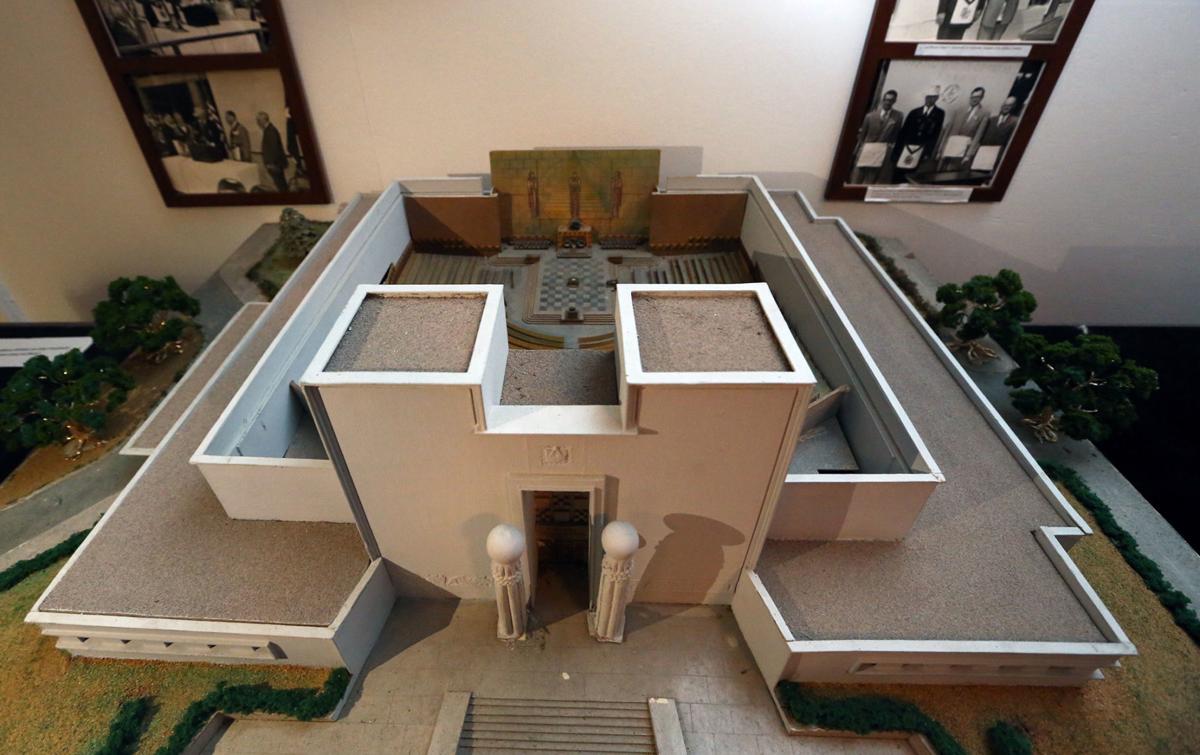
The Waco Tribune-Herald highlighted the Grand Lodge of Texas' impressive headquarters in Waco back on January 11th. Their imposing granite Temple, built in 1948, was designed as a modernist depiction of Solomon's Temple on the exterior, based on then-current archeological theories of its style (which have varied wildly according to fantasies and winds of fashion for a thousand years). 


This amazing 150,000 square foot Temple has a 3,700 seat auditorium and was built at least two decades after the greatest Masonic building boom in the U.S. during the City Beautiful movement of 1900-1929. According to the article it was designed by a team of Texas modernist architects that included Robert Leon White, who helped design the distinctive University of Texas Tower; Thomas Broad, who designed the Love Field Administration Building in Dallas; and Donald Nelson, who designed the Dallas Mercantile Bank building. The resident Waco architect was Walter Cocke Jr. Texas Masons spared no expense and lavished $2 million on it in 1948 (more than $23 million today):

From Grand Lodge of Texas an overlooked treasury of history, architecture by J.B. Smith:

The building façade includes a stained-glass depiction of the origins of Texas Freemasonry near an oak tree in Brazoria. At ground level is a carved bas-relief sculpture of the construction of Solomon’s Temple by the French sculptor Raoul Josset, known for his sculptures at Dallas Fair Park, the 1939 World’s Fair and the La Salle statue in Indianola, Texas. He also designed the giant pillars that hold celestial and terrestrial globes.
The article also features WB Robert Marshall of Waco Lodge 92, who shows off the extensive Grand Lodge library and museum in the building.


An important aspect stressed in the article is the role of the Temple in the community of Waco - how it has been used in the past, and the importance it needs to retain in the future:

The building has been used in the past for community events such as Waco Symphony Orchestra concerts, and it is still available for rent. Marshall said the two-level auditorium was designed to give everyone the best seat in the house, and the acoustics are superb.

About three years ago, climate control was installed for the auditorium, making it suitable for events year-round.

Marshall said he believes the facility needs more community use if it is to continue serving Waco through the coming decades.

“As Masons, we use this three weekends out of the year,” he said. “The other 49 weeks, it could be used for anything. … I think there’s a giant gap between the potential value and the actual value of the building. It could really be a hotbed of culture.”

On a similar note, Dayton, Ohio's 1928 Masonic temple (now known as the Dayton Masonic Center) has recently undergone $2 million worth of renovations and has formed an independent, local promotions team to book more weddings, concerts and public events.

From Dayton Masonic Center gets upgrade and new focus as concert venue by Don Thrasher in the Dayton Daily News on Tuesday:


“The Masonic Center’s main Schiewetz Auditorium space is a pristinely preserved, one-of-a-kind theater,” Dayton Masonic Live’s facilities manager Brian Johnson said. “As a still independently owned and operated facility, this sizable investment to updates is yet another milestone in Dayton’s renaissance that we’re excited to help actualize through great concerts and events.”

The Masonic Center, formerly known as the Masonic Temple, was completed and dedicated in April 1928. It has been the site of meetings, conferences, dinners, concerts and more. Dayton Masonic Live, which has a seating capacity of about 1,700, is now booking “a diverse mix of entertainment options, including nationally touring bands, renowned tribute acts, spoken word performers, along with family-centric and local events.”

[snip]

“The Masonic Center has always had a commitment to Dayton through hosting a variety of local events over the years,” Johnson said. “As we continue to activate the space more and more, we still want to have a strong commitment to our neighbors. We want Dayton Masonic Live to be a space where everyone feels welcome.”

The points made in both articles cannot be stressed enough. If our most significant Masonic halls and temples are to survive and thrive in this age of shrinking interest in our fraternity, we need to remind our communities (and ourselves) that these were meant to be places for the public, too. Our predecessors were active civic participants and leaders - they built and grew our towns and cities; they founded, ran or worked at the local industries; and they contributed mightily to local charities and causes long before we became obsessed with national, industrialized charities on a massive scale. The temples were an extension of their insistence that Masonic ideals were transmitted to the public and infused their actions every day. Time after time, local citizens would comment when some project was funded or completed, "Oh, the Masons did that." Masonic buildings, like Masons themselves, made up the very fabric of our communities. It's long past time we took up that banner again. We can start by opening our halls and temples as meeting and gathering places for everyone.

Saturday, October 19, 2019

'Theatre Bizarre' 2019 at Detroit's Masonic Temple


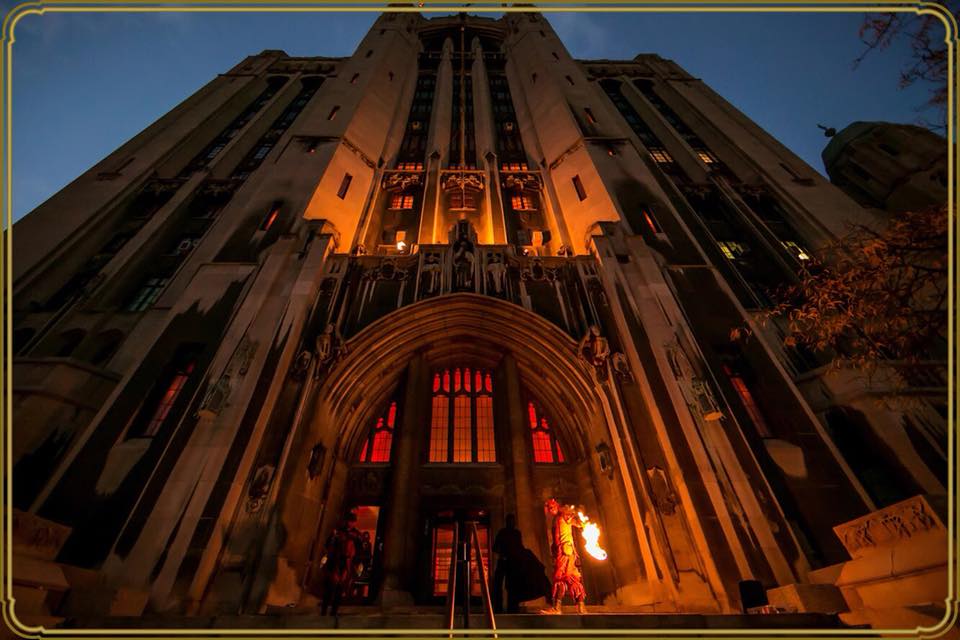
Every October since 2011, the massive Detroit Masonic Temple has been turned over to the ever expanding Halloween bash known as Theatre BizarreThis type of massive production defies adequate description. 

Theatre Bizarre is a giant, surreal entertainment extravaganza that essentially takes over most of the twelve-story fraternal tower of the Detroit Temple each October. Spread across eight of the sprawling building's levels, each lodge room, ballroom, and public area becomes a venue for a wild carnival atmosphere that combines theatre, burlesque, haunted house, circus sideshows, tattoo artists, punk bands, masquerade balls and other "immersive events." This is all about audience participation on a grand scale, and the organizers take advantage of a huge international movement of performers and artists who travel the world to create these types of shows. 


Pearl-clutching Masons who feel our buildings are no place for such public spectacles need not read further, and this will surely have generations of venerable Masonic figures from our past spinning in their graves at high speed. Some might even regard it as ghastly. But brethren who know our most significant buildings are always in need of income and public exposure to our communities need to read up on this innovative use of the world's largest Masonic building.


The good news for Detroit's Freemasons is that, apart from much needed income, it draws quite literally thousands of people into their building who would otherwise never have encountered it. While the performers and acts themselves would have shocked our predecessors and rung up the vice squad, the actual attendees at its two Gala Nights are strictly required to dress in formal masquerade attire. The general public is invited to attend throughout the week. And the Detroit Temple's uniquely varied architecture and design is the perfect backdrop. The designers and organizers take full advantage of the public's vague sense of secretive, occult spookiness with which Freemasonry has been suffused in the popular culture for decades. 


It takes weeks (starting each September) to install all of the scenery, props, lighting, effects, and more. Resident lodges change their rooms and meeting schedules to accommodate the show.
I fully realize that many Masons may absolutely recoil in horror at the sort of onstage acts this particular program hosts and want no part of seeing it in a Masonic building. 'Community standards' are an ever-shifting landscape, while Masonic ones tend to be less changeable.  Many years ago, one of our local Grand Masters became quite agitated against the notion of renting out our large and abandoned auditorium to theatre groups because he was terrified of potentially seeing an ad for "Come and see The Vagina Monologues at the Masonic!" Fifty years ago a different Indiana Grand Master made a very public condemnation of our magnificent Murat Shrine theatre and forbade them from booking the musical Hair because of its language, disrespect of the flag, and its notorious nude scene. He threatened to expel any Masons who rented their buildings out to "obscene" productions. The story hit the national news. He was lauded by the entire community and the police department for weeks, on the news and in print, for protecting the city from licentiousness. 

That was 1969, the summer after the so-called Summer of Love. Today, grade schools wouldn't hesitate to take kids on a field trip to see that same show.


I won't condemn or defend anyone who would agree today that a program like Theatre Bizarre is just beyond the pale of what many Masons regard as our sacred spaces. There's no hiding that this year's Detroit event will present (among others) a burlesque show called the Dirty Devil's Peep Show, dominatrixes at the Fistitorium, and punk-rock bands like Messer Chups, Mother Feather, and Death. I'll just say that our lodge rooms only become sacred spaces when we meet as Masons, and that extends to caves and quarries, taverns and cabins, and anywhere else. 


Our most significant buildings were almost always meant by our predecessors to be open to and welcoming of the local community, to be part of the fabric of our towns. For way too long, so many of our most important temples have been slipping away from us specifically because we have failed in that mission. Detroit's brethren need to be applauded for recognizing this and shining a spotlight on their Temple in a way that the community appreciates and enjoys.

If you've never visited the Detroit Masonic Temple for yourself and had the COMPLETE tour, put it at the very top of your Masonic list of things to do. It is the largest Masonic building in the world, and was designed to accommodate 50 different Masonic organizations. Including its on-site hotel rooms on the former Shrine end of the building, it contains over a thousand different rooms, and no detail was left out. 

Tuesday, October 15, 2019

Speech: Indianapolis' Masonic Temples At The Center of the Community


On Friday night I gave a presentation at the Indianapolis Masonic Temple to an audience of Masons and theatre folks about the role that our city's three Grand Lodge buildings have played in the community ever since the first one opened in 1851. 

Many thanks to WBro. Patrick Elmore for recording this event and editing my presentation into a watchable video (see above). My apologies in advance for the audio. It's one of the deficiencies of recording on a phone.

As I pointed out, each of our three Temples' auditoriums (all officially known as  'Freemasons' Hall') were designed to accommodate our two large statewide Masonic meetings each year – but those massive rooms weren't really built for us. These big spaces were really designed to be used by the city for the rest of the year. And use it they did.

The First Temple

The first Indianapolis Masonic Temple 1850

All three of our Masonic Temples over the years were intended to be an integral part of the community. In Indianapolis our large halls were used for theatrical shows, concerts, speeches, travelogues, public assemblies and debates, and much more. There were magic acts and circus performers, traveling authors and musical prodigies, famous scientists and inventors, story tellers and celebrities. Despite our strictures against the discussion of politics and religion in lodge itself, Freemasons Hall was the setting for Indiana's second Constitutional Convention in 1851, political rallies (Abraham Lincoln spoke there in 1859), stump speeches and tax debates, anti-slavery protests and rallies. It was even rented out to two different churches for their Sunday services. 


In 1855 our Masonic Hall was the site of the inaugural public procession and "sumptuous banquet" of Indiana's 'African Freemasons,' descended out of Prince Hall's African Lodge in Massachusetts. The next year they would form the Independent Union Grand Lodge (Colored) of Free and Accepted Masons of the State of Indiana, which was the precursor to today's MW Prince Hall Grand Lodge of Indiana.

In the 1870s it held the distinction of becoming the first noteworthy building in the city outfitted with gaslights—apropos, since Masons are always desirous of "more light...".

The Second Temple

The second Indianapolis Masonic Temple 1875
Indianapolis' second Masonic Temple was built in 1875, and there was a huge uproar when the architectural firm failed to include an auditorium in the initial design. The Indianapolis lodges and Grand Lodge were far more interested in having downstairs rental income property.  The protests became so heated that they were forced to purchase the next lot to the south at great expense to hastily add an auditorium to the new Temple's backside. It became just as popular as the first one had been to the city. 

When the second Temple caught fire in 1905, thousands of people swarmed downtown to watch it burn and mourn its passing. They lined the streets and the small hillside of the State House across the street to watch in horror as the roof collapsed and was consumed by the flames. One brave firefighter ran into the building and emerged from the flames moments later carrying a massive silver drill team trophy of Indianapolis' nationally famous Raper Commandery No. 1 to safety. The crowd erupted in cheers.  Indianapolis' Masons were considered a vital part of the city then, and our loss was a loss to the whole community.


The Third Temple
Cornerstone ceremony of the third Indianapolis Masonic Temple on June 6, 1908

When the Grand lodge of Indiana laid the cornerstone of the third Indianapolis Masonic Temple in 1908, 5,000 people attended the event to cheer us on. The whole city knew that the Masons would be erecting yet another significant building that the community could be proud of. When it opened in 1909, 1,500 people crammed into the building, and another 3,000 surrounded it outside. The Governor couldn't manage to squeeze through the crowd to give his scheduled speech, and finally went home out of frustration.

Freemasons' Hall auditorium of the present Indianapolis Masonic Temple as it appeared in 1913.
Note the pipe organ at the back of the stage(one of seven in the whole building). It was removed a few years 
later to increase the depth of the stage.

During Word War II, our present auditorium made up a portion of the Masonic Service Center that expanded throughout the Temple – similar to a U.S.O. It provided services, meals and entertainment for 10,000 U.S. servicemen between 1943 and 45. It was considered the premiere relaxation and service facility in the city for members of the military and their families. The whole community knew they could count on the Freemasons.

In the 1950s Freemasons' Hall was regularly used for swearing-in ceremonies for newly naturalized immigrants. The federal judges who oversaw these events expressed the belief that Freemasonry embodied the American rights of freedom of assembly, expression and religious practice. So our auditorium was the ideal setting in which to express these values to new citizens embarking on their new lives in a new land.

After the 1960s our present Hall fell into disuse. We have not one, but three, major Masonic buildings in downtown Indianapolis, and that meant that the Grand Lodge could take advantage of those other venues without investing in and upgrading its own. The Scottish Rite and the Shriners both built bigger and better theaters, and so Indiana's Masons used them instead.

Indianapolis Scottish Rite Cathedral auditorium
Grand Lodge moved the annual communication to the larger, more comfortable (and air conditioned) Scottish Rite Cathedral theater across the street. It's been there ever since.

The Murat Shrine Theatre (operated today as the Old National Center)
Founders' Day didn't begin until 1961 and was first held at the Murat Shrine Theater (operated today as the Old National Center). That event eventually moved to the Cathedral. 

By the 1980s the Masonic Temple's auditorium had become an elaborate broom closet, and Grand Lodge used it to pile up junk, old paperwork and floor buffers. Despite a couple of promising fits and starts in the late 90s and again in the early 2000s, the auditorium again went dark, the doors closed, and it remained largely unseen by our own members. Years of ego fights, hurt feelings, neglect, burnout, frustration and a one-foot-out-the-door attitude all took their toll. The city itself had long ago forgotten it even existed.


Sometimes you have to hit rock bottom before you can rise again. 

In May of this year the Grand Lodge F&AM of Indiana officially took over the management of the Indianapolis Masonic Temple. Decision making has been streamlined, the logjam of inaction has been been broken at last, and great things are on the horizon. A fundraising and preservation foundation for the Temple has been reactivated, and major news is coming. 

More important, this presentation on Friday was part of what will soon be announced publicly about an exciting new chapter in the Indianapolis Masonic Temple's history.  Stay tuned!