"To preserve the reputation of the Fraternity unsullied must be your constant care."

BE A FREEMASON

Showing posts with label lawsuit. Show all posts

Thursday, January 04, 2024

Texas PGM BIllings Files Defamation Lawsuit Against Grand Lodge and 5 Officers


by Christopher Hodapp


(A brief post from the road as we pass through Gallup, New Mexico...)

As the clock ticks down to the GL of Texas annual meeting later this month, a new broadside has been shot across the bow of the Grand Lodge. Texas' Immediate PGM Brad Billings has just filed a $250,000 lawsuit in civil court for defamation of character, naming the Grand Lodge and five officers.


Bradley Scott Billings is seeking up to $250,000 in his lawsuit, filed Tuesday in Waco’s 170th State District Court, against the Grand Lodge of Texas, Timothy P. Simmons, Lance Lawrence Kennedy, George Clay Smith, Howard Bart Henderson and Russell Clay Brown.
Billings, who served as grand master from January 2022 to January 2023, alleges that the manner in which theft charges were initiated against him within the lodge has denied him due process, are false and defamatory and could hurt his chances to be elected grand secretary of the Grand Lodge of Texas at its annual meeting this month.


[snip]

Billings alleges in his lawsuit that he met “great resistance” from lodge members during his tenure as grand master.

“As the highest officer of the Grand Lodge of Texas who was elected by an overwhelming majority as the leader of an organization of 60,000 Texas men, the plaintiff undertook efforts to energize his constituents, raise money for the various charities supported by the Grand Lodge, and to modernize the operations and practices of the Grand Lodge,” according to the lawsuit.

A masonic trial was set for Jan. 6, 2024, with Brown being appointed “trial master” by Smith, the current grand master. Kennedy was appointed “prosecutor,” the lawsuit states.

Billings alleges in the suit that the charges do not meet the “certainty requirements” under Texas law and don’t sufficiently provide him notice of the allegations against him.

“Specifically, it does not notify such required information as from whom he is supposed to have stolen money, the amount of money stolen, and how the money was supposed to be appropriated,” the lawsuit alleges.

The defendants denied discovery matters to Billings, overruled his objections to procedural errors and ruled that Billings’ masonic counsel was disqualified from representing him, according to the suit.

They also denied his request to postpone the “trial,” Billings alleges.

Besides damaging his reputation and possibly costing him election as grand secretary, Billings also alleges the “allegations and potential conviction” make him ineligible for holding office and may cost him his membership as a Texas mason.

“The plaintiff is at risk of being found guilty of theft in violation of Texas law by a non-court body that does not have jurisdiction under Texas law to make such findings,” the suit claims. “The plaintiff has the risk of all the potential ramifications of being found guilty of a crime of moral turpitude and even possibly of a felony offense by a non-court body that is violating all constitutional and statutory rights that the plaintiff enjoys under Texas law.”


When the reporter tried contacting the grand lodge or Billings' attorney, no one would comment, so nobody's sayin' nuthin... 

Saturday, December 16, 2023

Family Of Murdered Texas Mason Suing Lodge For Negligence

Brother Robert Wise, 55, was killed in July after officer's installation
(Photos: McAllen Lodge 1110 Facebook page)

by Christopher Hodapp

The family of a Texas Mason who was murdered outside of a Masonic hall following an officers' installation ceremony has just filed a civil lawsuit against McAllen Lodge 1110 alleging negligence.

Brother Robert Wise was shot and killed in the lodge parking lot the evening of July 10, 2023, allegedly by an anti-Mason named Julio Diaz, who actually shot a video of the murder as it happened and posted it to his social media page.

A story on the MyRGV.com website reads, in part:

The surviving family members of a McAllen Masonic Lodge member’s summer murder filed a lawsuit saying the organization should have known about what they say is growing anti-Masonic resentment across the country.

And Robert Wise’s wife and children said they should have known about 35-year-old Alamo resident Julio Diaz, who is accused of fatally shooting Wise, 55, and posting a video of the murder to social media.

His surviving family members filed a lawsuit against McAllen Masonic Lodge No. 1110 on Nov. 27, alleging their negligence killed Wise because they ignored what they call a national trend of vandalism and threats against Masons, and because they did not install a light and security camera system purchased in 2022 until after Wise’s murder.

They also allege that the organization failed to warn its members about Diaz, who was known to the organization, because Diaz allegedly committed an act of arson at a Weslaco Masonic Lodge, which the McAllen members frequented, according to the petition.

McAllen Masonic Lodge No. 1100 is located at 118 N. 11 Street.

Wise walked out of that building on July 10 after being a member for more than two years and after a ceremony where he was named a “Junior Deacon.”

Police allege that’s when Diaz fatally shot him.

[snip]

Following Wise’s murder, on July 28 at the McAllen Lodge, McAllen Police Chief Victor Rodriguez met with members and “stated the obvious.”

“At night, when one enters or exits the McAllen Lodge, the parking lot and surrounding area and the front of the building had no lighting. It was pitch black,” the petition stated. “The premises was unlit, unfenced, and completely unprotected from any trespasser at the time of Wise’s murder.

“The McAllen Lodge knew how vulnerable it and its members were, but did nothing.”

But even before this meeting, the petition says a popular blogger who writes about Masonic news, had been reporting that ever since the COVID lockdowns that “there has been an alarming increase throughout the U.S. and Canada in incidents of vandalism and arson against Masonic halls by admitted paranoid anti-Masonic extremists and conspiracists.”

(NOTE: I believe this is in reference to stories appearing on this website, which in no way could have predicted – or prevented – what happened. - CLH)

Then, on Dec. 6, 2021, the McAllen Lodge was vandalized and the location “became emblematic of the national trend on a local level.”

“Aware of the national trend and seeing it play out in their front yard, leaders of the McAllen Lodge pushed for the purchase of the light and camera system after this incident,” the petition stated. “Despite the full knowledge of the national and local trend of violence toward Masons, it took another act of vandalism in December of 2021 at the McAllen Lodge to prompt the purchase of a light and camera system.”

That happened sometime in 2022 when the McAllen Lodge purchased a light and camera system for about $2,000, according to the lawsuit.

“However, the light and camera system was not installed until months AFTER the murder of Robert Wise. In the wake of this security failure the criminal activity targeting the McAllen Lodge continued,” the lawsuit stated.

(NOTE: I have no way of knowing the veracity of these claims, but early reports immediately following the murder stated there was surveillance footage of the lodge's parking lot that provided details to law enforcement. The petition goes on to make the bizarre claim that the lodge wasted money on an entertainment event that would have been far more responsibly spent on security systems, as though lights and cameras could have in any way dissuaded the murderer from his premeditated action. - CLH)


On March 30, 2022, someone vandalized the location with graffiti that read “Sorcery against the Holy spirit and the human race must all be stoned to death.”

After that happened, the person who was the third in command sent text messages to the top two people in charge and the petition said nothing was done.

“Five months later, on September 15, 2022, the criminal struck again. The McAllen Lodge was vandalized, the front glass door smashed and fuel thrown into the building to start a fire,” the lawsuit stated.

After this incident, the petition said a high-ranking member on a state level sent out a message warning people to be vigilant and to secure the lodge building.

“Both the McAllen Lodge and the Grand Lodge had actual knowledge of the national trend and the specific threats to the McAllen Lodge,” the lawsuit stated. “What happened to Robert Wise was completely foreseeable and yet no action was taken.”

(NOTE: For decades, Masonic lodges have often received non-specific, threatening messages, accusing Masons of heresy, secret plotting, devil worship, mind control, and a raft of economic, political and religious conspiracies. Allegations like these date back as far as the early 1700s, and several states have reported numerous instances of finding anonymous warning letters plastered to lodge doors or stuck in mailboxes. It's infinitesimally rare for any actual harm or damage to come from these kinds of threats, but it's still unnerving to find them. Police won't act until an actual crime is committed, and judges often don't like sentencing obviously nutty people to jail time over their beliefs in conspiracies or overzealous religious beliefs. So what exactly is a lodge supposed to do when faced with these kinds of messages? – CLH)

The petition then cites two more arson attacks on Mason buildings on a national level and then another arson attack at the Llano Grande Masonic Lodge on Feb. 21 in Weslaco.


Julio Diaz remains held in the Hidalgo County
Adult Detention Center on an indictment charging 
him with murder and arson. He has a $1 million 
bond on the murder charge and a $5,000 bond
on the arson charge.


“This act should have prompted action. Julio Diaz, the alleged murderer of Robert Wise, videoed the Weslaco Lodge fire and uploaded it to his Instagram page,” the petition stated. “Now violence had a name and a face and it lived right next door. The McAllen Lodge routinely met at the Weslaco Lodge and Diaz knew it." 
 
[snip]

On Aug. 7, Masonic leadership finally ordered the McAllen Lodge closed permanently.

“Too little … too late. Robert Wise was dead,” the lawsuit stated.

Read more at the myRGV.com website HERE.

Reviewing this long, sad story tonight, my heart ached once again for Brother Wise's grieving family. Understand that I am in no way making light of his family's grief and loss. But there's no way the lodge should be blamed for his murder. The arson fires, graffiti, online threats and other hate-filled actions of anti-Masons around the world that have been spotlighted by this blog are infuriating to all of us. But when you consider the tens of thousands of local Masonic halls around the globe that have NOT been attacked in any way, trying to predict and prevent every four-alarm lunatic's deranged attacks ahead of time isn't possible, or even feasible. All the lights and cameras in the world wouldn't have prevented this horrible act of hatred and extreme religious zealotry.

Moreover, suing the lodge won't bring Brother Wise back to life, nor will it do anything to prevent future anti-Masonic attacks on other Masons.

So why the lawsuit? 

Many decades ago, my brother and I were ardent teenaged railfans, and we would travel far and wide to photograph and make audio recordings of trains. One particular trip, I had a new Super8 film camera with an especially wide-angle lens I wasn't quite used to yet. As a train came blasting out of a tunnel in rural Tennessee, I was crouched low on the ground capturing an incredibly dramatic angle of the action, while peering only through my viewfinder. My brother Mike suddenly realized with horror that I was mere inches from having my head ripped off by the locomotive's low-riding front step. He leapt over to me, reached down, grabbed me by the scruff of the neck, and hurled me out of its path at the very last second.

As we both lay on the ground gasping for breath, I wondered aloud if some slick lawyer might have talked our parents into suing the railroad, had I been decapitated by one of their trains, even if we were trespassing and I had clearly been a completely irresponsible moron. 

"No," Mike said, rolling it over in his mind. "This railroad is declaring bankruptcy. You never sue anyone poor."

"Who would they sue then," I asked.

"Why, Eastman Kodak, of course," he replied. "Kodak manufactured the film that went into your camera, and you wouldn't have even been here if it weren't for that damned film. Definitely Kodak."

Monday, November 27, 2023

Grand Priory of America (CBCS) Tries To Halt Texas Educational Lecture


by Christopher Hodapp

UPDATED - Wednesday, November 29, 3:55PM: An earlier version of this post wrongly identified Bryan Leroy Hill as the current Great Prior of the Grand Priory of America. He was succeeded in office by Allan Surratt. I've also made corrections to Roberto Sanchez' Masonic record. Both errors were mine alone, and I apologize for any confusion they may have caused.

MW Roberto Sanchez is an extremely energetic and dedicated Texas Freemason, and has been for more than two decades. If you regularly attend Masonic Week outside of Washington DC, you might very well have met him. In addition to his Texas membership, he's also a Past Grand Master and the sitting Grand Chancellor of the Gran Logia del Estado de Mexico (Grand Lodge of the State of Mexico). He served as Master of Gray Lodge 329 in Houston back in 2011, and was part of a group determined to provide a high-quality lodge experience to their members. Since then, he’s gained an international reputation as a popular speaker, and served as an officer in several appendant organizations. 

Back in 2006 WB Sanchez, along with Gray Lodge's Past Masters Lex Leckie and Greg Weisinger created what they hoped would become an American equivalent of the English Prestonian Lecture. It was named after the lodge's charter Master, Alfred Stephens Richardson. Roberto was an early speaker, and it continues through today. Gray Lodge's A.S. Richardson Lecture is usually held at a hotel or restaurant, and some of the top Masonic authors and historians have been invited to speak there over the years. (2011 must have been a lean year, as they invited me.)


This year will be the 15th annual A.S. Richardson Lecture, and the speaker will be Alun Thomas-Evans, a fascinating U.K. Mason who is well-versed in the history, development and philosophy of countless esoteric organizations, some related to Masonry, and some not. He will be speaking about the Chevaliers Bienfaisants de la Cité Sainte (in English, the Knights Beneficent of the Holy City, or CBCS, using its French initials), the Rectified Scottish Rite, and a closely related body known as the Waite Order (named after Arthur Edward Waite, who is a topic all by himself). The event is to take place on December 1st at the Embassy Suites in the Energy Corridor in Houston ($80 apiece, in case you’re interested deadline for tickets is Thursday, November 30th). CLICK HERE to register through Facebook. Act fast. 

Now, longtime readers here may or may not remember over a dozen years ago when a dispute over this obscure, invitational, Masonic-related side organization most commonly referred to as the CBCS blew up into a national and international Masonic food fight. It was a mess. A BIG mess. This was truly Masonic minutiae of the most arcane kind, and to fully understand what was going on at the time took lots of explanation (here are some old links in case you really want to wade into this morass, or see the cheat sheet below). 

Well, just in case you thought the whole ugly, stinky mess finally died out, it’s back again.

Now it seems that Allan Surratt, the current Great Prior of the Grand Priory of America (the U.S. wing of the CBCS) has sent a letter to the Grand Master of the Grand Lodge of Texas demanding that the A.S. Richardson Lecture be blocked because of its subject matter. It seems that the GPA doesn’t want anyone to even speak about their organization and its various related topics, and they are demanding that the Grand Master shut it down.

Only a tiny problem with making such a demand: the Grand Lodge of Texas has a swollen rule book that’s the size of the last Dallas phone book: it’s more than 500 pages long, which may be a sad record for US grand lodges. Texas Masons over the years have inserted reams of new and ever more tediously minute regulations into their Masonic code, and a big section of it deals with appendant and other Masonically-related organizations operating within their jurisdiction: the Grand Lodge must approve every single group that requires their participants to first be a Freemason. Every such group must petition the Grand Lodge of Texas for recognition, and must be approved by a vote of Grand Lodge. If it ain’t listed in their Code by name, it ain’t recognized in Texas. And it doesn’t matter how many Past Grands, 33rds, Sovereign-Thises-and-Thats, or Big Name Celebrity Masons happen to belong to it. It’s just like getting backstage at the Taylor Swift concert. You gotta be on the list, or the exit door is that way. And the Grand Priory of America (CBCS) isn’t on the list. 
It seems its storied and privileged officers and members never bothered to ask over almost 100 years. Whoops.

The Great Prior’s other objection is that WB Alun’s lecture will be talking about other versions of the CBCS and its related bodies outside of the US that the GPA isn’t part of.

So. 

The Great Prior of an unrecognized Templar-related organization that’s spent more than a decade and untold thousands of dollars in lawsuits defending their lineage, sovereignty and exclusivity in order to remain a tiny invitational supper club (“because them 33rds let in too much riffraff)” never got around to getting recognition in Texas, which is the home to several of its very own high-profile officers, members and – interestingly enough – attorneys. They include Reese Harrison, Michael Wiggins, and Brian Dodson – all Past Grand Masters of Texas. And the GPA doesn’t want anyone talking to Texas Masons about ANY un-recognized CBCS body, even though they themselves aren’t recognized in Texas, either.

Confused? 

The good news is that, as of Wednesday, November 29th, the Grand Master is apparently siding with the lodge in this little imbroglio, and was unmoved by the GPA's demand. The lecture will go forward.

If you don't know anything about this mess (or tried to put it out of your mind), here’s the cheat sheet on the history of this long tale of woe and misery: 

  • Portions of the European CBCS/Rectified Scottish Rite rituals and origins involve the Knights Templar, and have done so since the 1700s; 
  • The Grand Encampment of the Knights Templar (GEKT) found the GPA to be infringing on their sovereignty over all US Masonic Templary, in part because their charter clearly states that the CBCS is a Templar organization; 
  • The American wing of the CBCS – the Grand Priory of America (GPA), organized in the 1920s - promised by the 1930s not to work their Templar degrees or ever publicly claim they were Templars; 
  • The GPA stopped conferring the degrees and became a tiny, invitational, exclusive dinner club for Past Eminent Grand Masters of the KT and celebrity Masons; 
  • By 2000, officers of the GPA began representing themselves on foreign visits as a Templar organization, and protested that US Masons were receiving CBCS degrees in England, France, Belgium and elsewhere, violating their “exclusive” status - GPA would not permit CBCS members who joined European Priories to attend their meetings and would not honor their credentials; 
  • GEKT declared that the GPA was again illegally violating THEIR sovereignty; 
  • The GEKT's GM William H. Koon received a warrant from a French CBCS body to create their own American Grand Priory, and subsequently suspended existing GPA members who refused to drop their “old” GPA membership; 
  • Lawsuits more lawsuits and counter-lawsuits flew like bats out of a belfry; 
  • GPA leaned heavily on the Conference of Grand Master Masons of North America to withdraw recognition agreements from the GEKT and shut down all US Templar Commanderies; 
  • ME Grand Master Dixon of GEKT reluctantly shut down its “new” CBCS Priory; 
  • A decade later, GM Nelson of the GEKT acted to remove any holdover language from their regulations, reinstate the suspended GPA members, and finally put this quagmire to rest. (Knightly News from 2021 Grand Encampment Triennial
  • His immediate successor attempted to reverse that action, incurred the wrath of a weary mass of KT members, and got removed from office in an almost unprecedented action. (As the Sword Turns: Called Conclave Removes Templar Grand Master Michael B. Johnson

Tuesday, August 24, 2021

Knightly News from 2021 Grand Encampment Triennial


NOTE - My apologies for the delay of this post. I've been experiencing tech issues off and on for several weeks and this one somehow got caught in a queue that said it was published when it really wasn't.

by Christopher Hodapp

The 68th Triennial Conclave of the Grand Encampment of Knights Templar is wrapping up in Minneapolis this evening. The following Sir Knights have been elected to serve the Grand Encampment for the 69th Triennium: 
  • Most Eminent Grand Master: Michael Burke Johnson 
  • Right Eminent Deputy Grand Master: David Kussman
  • Right Eminent Grand Generalissimo: Jeffrey Bolstad 
  • Right Eminent Grand Captain General: Jack Harper 
  • Right Eminent Grand Treasurer: Bobby Simmons
  • Right Eminent Grand Recorder: Larry Tucker

Noteworthy Legislation

A couple of interesting pieces of legislation were voted on at this week's session. There were an incredible 28 pieces of legislation to be acted upon, but three in particular got lots of attention in online discussions:

Revival of the historic Templar apron


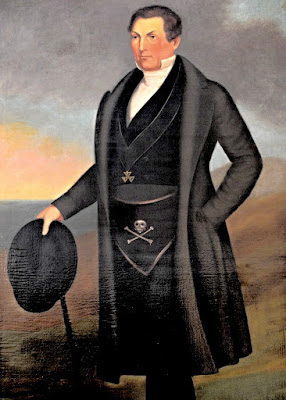
If you've visited the George Washington Masonic National Memorial in Alexandria, Virginia, you may have spotted this portrait of Marie-Joseph Paul Yves Roch Gilbert du Motier, Marquis de La Fayette, better known in America simply as General Lafayette, hero of the American Revolution. In the 1820s, Lafayette returned to the United States and made an extensive tour of the expanding nation he helped during its war for independence. While in Virginia, he posed for this portrait that depicts him wearing an unusual Masonic apron that features a skull and crossbones. What you may not have known is that it's a Knights Templar apron. 


The historic 'skull and bones' Templar apron from the 18th and 19th centuries has been approved by the Grand Encampment for use during tyled Templar meetings, and it may be worn over Class A uniforms. Honestly, I've been hearing about attempts to bring it back ever since I joined this fraternity in 1998. In fact, more than 30 years ago, a paper was published in the Knight Templar Magazine by Ron Blaisdell that will tell you more information than you'd ever want to know about this unusual bit of Templar regalia. Read it HERE.

The resolution approving the apron passed by more than 75% of the votes.

In addition to reviving the old apron, a contemporary triangular apron design (without the skull and including the crown and cross symbol on a white background) was also approved for use in public ceremonies and events. The approved apron design is such that it can be manufactured with the historic skull on one side, and the public image design on the flip side. (Click the two images below to enlarge.)


What's up with this fascination with skulls, you may ask? The medieval Knights Templar actually adopted the skull and crossed leg bones as an occasional symbol during their time in the Holy Land to frighten and intimidate the Infidels in battle. Some have claimed that the image was also used as the flag for Templar ships, and after their suppression in 1307, it was eventually co-opted by pirates. 

Today, as more and more Masons are taking an interest in the esoteric side of our rituals and symbolism, they've become quite familiar with the memento mori and its ancient warning to remember that life is fleeting, and that a man should live every day as though it might be his last. 

If you come from a Christian background and a denomination that marks Ash Wednesday by making a cross on the forehead using black ash, the words that accompany this ritual are "Remember that you are dust, and unto dust, you shall return." If you travel throughout Europe, there are many catacombs, and even chapels, with skulls and bones of the dead used for walls, arches and general cheery decor. They are a constant reminder of mortality, and as Horace reminds us, "Pale death knocks with the same tempo upon the huts of the poor and the towers of Kings."


Reminders of Death as a constant companion weren't particularly seen as creepy in earlier centuries, in part because death was so prevalent in everyday life. In large families, the death of one or more children before reaching adulthood was all too common, and life expectancy for adults was much shorter than today. Communicable diseases commonly wiped out whole families, villages and towns all across the globe. Wars with tens of thousands of casualties on all sides devastated entire nations, and during World War I, it was nearly impossible to find a family anywhere in Europe who hadn't lost a father, son or brother in that conflict. 


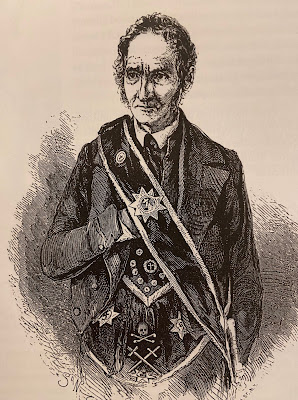
The historical, triangular 'skull and crossbones' apron was part of the Masonic Knights Templar regalia from the 1770s until the 1860s within the tyled confines of a Commandery meeting or degree – it's described as part of the uniform used in meetings in Thomas Smith Webb's Freemason's Monitor in 1808. 


Because all of the York Rite degrees were originally designed to be conferred in a Masonic lodge, the Templar apron was considered an extension of the use of a Masonic apron required for all work and meetings. By the 1830s, the black military-like uniform we're all familiar with was already taking form, but there were a lot of local variation in them from state to state and commandery to commandery. 

An attempt was made in 1859 by the Grand Encampment to demand national uniform conformity, which included a black uniform with a white surcoat or tunic, and essentially banned the skull apron (interestingly for ALL Templars, EXCEPT Washington Commandery No. 1). Think about that realistically — keep a white uniform clean while riding around on horseback. Consider that Templary was already the most expensive of all Masonic orders to participate in because of the uniform, swords, ostritch-feathered chapeau, PLUS special Templar riding accessories like decorative stirrup covers and protective cuffs if you planned to ride in a parade team. The demand for this new standard uniform by the Grand Encampment wasn't scorned or loudly protested against — local commanderies simply ignored it.

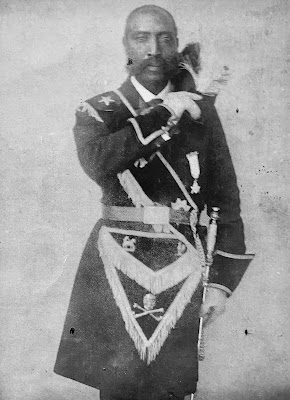
It wasn't just the U.S. Grand Encampment Templars that stuck with the skull apron. Even the Prince Hall Commanderies held on to them throughout the 19th century.


Nevertheless, after the 1860s and the end of the Civil War, the use of the skull apron in meetings as part of the KT's uniform started to fall by the wayside. Among many there was a growing concern that its symbolism might be misunderstood by the public (especially since more and more Templars were having newfangled photographic portraits made of themselves dressed in full regalia, and non-Masons could suddenly see the skull and bones apron without sneaking into a meeting). That misunderstanding would only increase in the 20th century, when skulls and crossbones became identified with poison chemical labels, pirates, horror movies and the "death's head" cap badge on Nazi SS uniforms.

In any case 75.96% of the Sir Knights at the Triennial this week approved the apron's use. While it's approved by Grand Encampment, this must be adopted and approved in your state by your Grand Commandery first, if it is not in your uniform regulations. Remember that the "historical" skull apron is for asylum use only, while the "contemporary" apron is approved for public or private use. The preference is to wear an apron over the class A uniform coat — it is NOT considered as a replacement for the uniform (in case you thought you could get out of buying a full uniform and just showing up in street clothes and the apron).

And if you're looking for a new one, Masonic Revival offers a skull apron: https://masonicrevival.com/collections/aprons/products/knightstemplar-apron

If anyone can provide a link to a supplier of the new contemporary public apron, please pass it along and I'll update this entry.


'Attestation of faith' on petitions fails

The second piece of legislation that attracted lots of attention was a proposed requirement to be placed on future Templar petitions stating that the petitioner affirms his Christian faith in writing. Unlike most other appendant organizations associated with Freemasonry, the Knights Templar requires that a petitioner must be a professed Christian, and that demand causes some heartburn with Masons who aren't Christians, or who believe that this somehow violates the spirit of Freemasonry and the Ancient Charges.

Nevertheless, the Masonic Knights Templar order has had belief in Christianity as a requirement since the 1760s when it first appeared. Such a prerequisite is without question "exclusionary," but nowhere is it promised that absolutely everyone has an absolute right to experience absolutely every single degree in absolutely every Masonic-related organization, absolutely. The Order itself is based upon the medieval Templars who held a unique position that straddled both the ecclesiastical and the temporal spheres as "warrior monks." Removing the Christian elements from the Templar ritual would leave nothing but an empty husk.

Over the decades, some local Commanderies and even state Grand Commanderies have tried to hedge on the Christian membership requirement. Some jurisdictions phrase their petitions with squishier language, requiring no more than a belief in a "higher power," while others merely ask that a petitioner be willing to "defend the Christian religion." That's a loophole big enough to drive a Sherman tank through. But the Statutes of the Grand Encampment are quite specific. Section 177(b) requires that a petitioner for the Orders must be a "firm believer in the Christian religion."

However, the amendment that was up for a vote this week went beyond merely asking a petitioner if he is a firm believer in Christianity. The proposed Attestation of Faith required the petitioner to declare himself to be a Christian specifically "as defined in the four Gospels (Matthew 16:16, John 3:15-17, Acts 4:10-12, and Romans 9-10)"

Click the image below to enlarge it and read the entire proposed statement in its entirety.


While most of the Knights in attendance at the Triennial felt the statement was well-founded and good-intentioned, the attestation itself was clumsily written, resulting in confusion and contention. While all Templars are supposed to be Christians, the enormous range of Christian denominations have variations in teachings concerning the role of the Holy Spirit. As a result, debates over the Resolution's wording quickly went into the weeds over definitions and details of Christ's crucifixion, resurrection from the dead, time spent with the Apostles including the Last Supper, and his ascension.

An attempt was made to amend the Resolution in order to simplify the statement. That amendment to the Resolution was submitted in writing in advance of the Triennial, and it was found to be in proper form by the Jurisprudence Committee. The amendment essentially struck out the entire text of the proposed Attestation to read simply:
"I profess the Christian Faith: that through the Birth, Life, Death, Resurrection, and Ascension of Jesus, believers are saved and redeemed."
According to attendees, this amended version received a simple majority (53.31%) of yes votes, but did not meet the two-thirds super majority required for an amendment to the statutes. It's possible that if the original resolution had simply been this wording in the first place, it would have passed.

Resolutions restore amity with Great Priory of America of the CBCS

If you know nothing of what this whole imbroglio was about, and you have no idea who or what the CBCS is, don't feel somehow that your Masonic knowledge is lacking. This situation is as about as deep into the waist-high weeds of Masonic appendant bodies as it gets.
The third noteworthy bit of legislation was Resolution 2021-23, rescinding 2012-01 and Duane Vaught Decision No. 5 which had previously declared the Great Priory of America (GPA) of the Chevaliers Bienfaisants de la Cité Sainte (CBCS) to be an unrecognized Masonic Templar Order. Because of that situation, members of the Grand Encampment who held membership in the Great Priory of America were deemed to be in violation of their knightly vows. This Resolution rescinding that status passed with more than 77% of yes votes.
Further, a second proposed Resolution (2021-26) which called for the automatic expulsion of any member of the GEKT who sought or held membership in the GPA, was voted down by the delegates. 
This hopefully brings an end to more than a decade of hostility, broken friendships, and scuttled Masonic careers.
The long, twisting, epic saga of the Grand Encampment of Knights Templar and attempts beginning back in 2011 to establish a new CBCS Rectified Rite priory in the US turned into an all-out war of words and lawsuits between the GEKT and the existing CBCS Great Priory of America. Sadly, this mess wound up dividing some of the most respected leaders in North American Freemasonry into two warring factions. And then the lawyers got involved.
Much of that battle played out right here on my blog, I'm sorry to say. Rather than re-describe, re-hash and re-litigate this episode, I will point to this post from December 2010 for background on what set this whole drama in motion:

Grand Priory of the Scottish Reformed & Rectified Rite of the United States of America

Over the next two or three years I wrote more posts about the situation (if you really have a burning desire to wade into it, use the search menu on this blog and look for articles with CBCS, Rectified Rite, or Grand Priory in them). 

In full disclosure, I freely admitted at the time that I was part of the group in favor of establishing the new CBCS priory under the authority of the Grand Encampment. The GPA was established in the U.S. in 1934 and quickly turned into little more than a supper club for a tiny, select group of  Masons ("Because", as one wag joked to me, "the 33rds were letting in too much riff-raff"). Their membership never exceeded about four dozen at any one time. Yet, they controlled any working of the Rectified Rite degrees in the U.S., as a result. This post is not the place to drift into a windy explanation of Martinism and the different degree systems that grew out of its three variants in the 18th and 19th centuries. But many of us at the time felt that this beautiful, philosophical and deeply complex degree system was being held hostage by a group that had no desire or intention of actually working those rituals themselves.

So, in 2012 the Grand Encampment of Knights Templar obtained a charter in France from a CBCS body there, and they sought to expand the CBCS in the U.S. to a wider Masonic membership. And that, as they say in stories about ugly divorces, is when the fight started.

Much time has passed, leadership of both the Grand Encampment and the Great Priory of America has changed, and emotions and passions have hopefully cooled. Clearly, the general membership of the Grand Encampment decided this year that they've had enough of being involved in this conflict.

As a very dear friend often says, "So it goes."

All of that having been said, the reasons for attempting to bring the CBCS degrees to a wider group of U.S. Masons still remain valid, and certainly not for some absurd notion of "let other VIP Masons in to your exclusive club." The growing interest in esoteric orders within Masonry should not be blunted and locked away out of some twisted sense that it's only for the cool kids.

Honors and Awards

• SK Brandon Mullins of Michigan was inducted as the first member of a new order of Masonic knights Templar scholars, the Order of Clairvaux. Admission to this prestigious institution is restricted to just one Sir Knight each Triennium. SK Mullins presented his paper about the use of skull imagery in Templary – a timely topic, given the apron legislation this year.

• SK W. Bruce Pruitt, the senior Past Grand Commander of California, was elected a Most Eminent Honorary Past Master of the Grand Encampment and elevated to Grand Cross Templar.

• SK Art F. Hebbeler III, Grand Prelate of the Grand Encampment, received the Knight Grand Cross.

• SK Dicky W. Johnson (Tennessee) was made a Honorary Past Grand Prelate of the Grand Encampment of Knights Templar of the USA.

(Please alert me if I missed anyone.)

And finally...

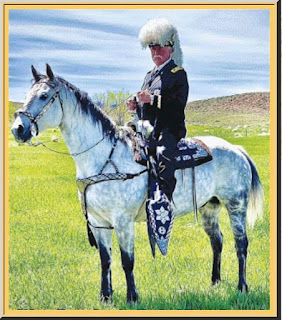
Congratulations to all Grand Encampment officers, and especially to MEGM Michael Johnson, whom I've known for many years. Mike is from Crowheart, Wyoming where he and his wife Judy own a cattle ranch, and he served as Grand Master in 2015-16. Mike became a cowboy fresh out of high school, and the Grand Encampment's webpage features an image of him in his Templar uniform while riding horseback. It's been a very long time since most of us have seen a  Grand Master of Knights Templar on horseback, but Templar horse teams were commonplace in the 19th and early 20th centuries. 


Sadly, in this Age of Snark we're all living through, right after this image was posted on Facebook, a tiny squall went up over it. 

Out of touch! 
Elite! 
Backward! 
The expense! 

Terrible image!
Grand Encampment wasting our per capita buying horses! (Um, no...)

And, naturally, 
a couple of commentators suggested that if the GM wished to be truly authentic, he should be sharing that saddle with a second Templar knight...

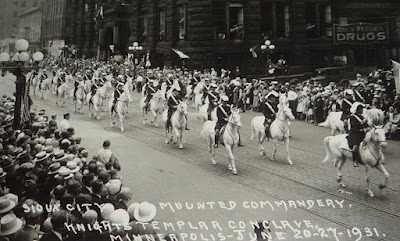
Does anyone actually engage their brain anymore before yawping on anti-social media? Mike owns his own horses, for heaven's sake, and the image was actually a homage to the Templar heritage when many drill competitions were between mounted teams. (Nothing unusual about that - how do these critics think Masons got to their meetings in the 1760s or 1850s in the first place? It might even be fair to say that in their 20th-century heyday, the mounted horse Templar teams were the ‘Shriners driving little cars’ of their era.)


UPDATED 9/8/2021 4:43PM

Two large documents were prepared for the Triennial explaining the historical origins and opposing positions of the Great Priory of America/CBCS and the Grand Encampment of Knights Templar USA. You need to read both documents to see the disagreement from both sides. These two pdf documents can be accessed HERE.


Friday, September 09, 2011

Grand Encampment Sues Grand Masters

Earlier this year, the imbroglio over the establishment of the new Grand Priory of the Reformed and Rectified Rite of the United States of America (CBCS), body by the Grand Encampment of Knights Templar of the USA was pretty well covered here. The history of the battle between the Great Priory of America (GPA) and the Grand Encampment's Rectified Rite of the CBCS can be read in great detail here, admittedly from the Grand Encampment's side.

Then came the Conference of Grand Masters in Denver and the perplexing move by the Commission on Recognition to stick its institutional nose into the sovereignty and workings of an appendant body, which was clearly in violation of its mission as established since its very beginning. The unfortunate result of that meddling has been actions by several grand lodges or grand masters to declare the Grand Encampment of Knights Templar to be irregular, or to prevent their members from being Knights Templar in their states. Oregon, Washington, Oklahoma, Tennessee and several others have issued various restrictions against the Grand Encampment over an issue that grand lodges have no business being involved in, and never would have done if the Commission had stuck to its original mission. 

The result is that Knights Templar in several states are denied membership in this organization now, and the Grand Encampment's Eye Foundation is losing valuable contributions in those states that could be helping the blind. Worst of all, much of the poison being spread against the Grand Encampment is being done behind the scenes by a tiny group of men who want to see that the only CBCS body in America remains nothing but a supper club for a handful of self-appointed elite Masons, while holding the 230 year degree system of the Rectified Rite hostage in the U.S. The Great Priory of Helvetia (Switzerland) was desirous of having the Rectified Rite practiced, with full conferral of the degrees, in the United States, and they were and remain well aware of the "supper club" dead end of the GPA. The Swiss desire to have their Order's degrees worked properly as it is all over the world except in the United States.

Unfortunately, the GPA changed its mind after the agreement in place since 1932 and became desirous of becoming a sovereign and independent Templar order in the U.S. That meant the sovereignty of the Grand Encampment was being challenged by them. That is what motivated the actions of the Grand Encampment to seek a charter.

I happened to come across a complete collection of reports by the Commission on Recognition dating back to 1962. That's just shy of 50 years. In the five decades of reports I have, not one single summary brings up an appendant body. In fact, the standard preface for decades read as follows:

"The Commission on Information for Recognition was organized in 1952 as a facility to gather, collate, and from time to time revise information on Grand Lodges in other lands, as a service to this Conference.

The Commission neither advises nor recommends that recognition be given to any Grand Lodges, but merely indicates whether or not it is considers that a Grand Lodge in question satisfies the condition of regularity."
Grand Lodges. Not appendant bodies, Shriners, Tall Cedars, Scottish Rite, Templar, Royal Arch, Grottoes, OES Grand Chapters, or anything else. Grand Lodges alone are its sole consideration. Since 1952. Because Grand Lodges do NOT recognize foreign appendant bodies. US Supreme Councils recognize other Scottish Rite bodies at their discretion. The Grand Encampment recognizes foreign Templar bodies at its discretion. Grand Lodges stay out of these situations. Until now, apparently.

Thankfully, I live in Indiana. We have a little thing called common sense here. It's why more Vice Presidents of the U.S. have come from this state than any other. We are a calming influence. I hope that's the case again with this issue. MY immediate Past Grand Master and his Deputy GM (now GM of Indiana) wrote a letter to the Conference of Grand Masters demanding the sacking of the members of the Commission on Recognition for failing to follow their own guidelines as set down by the Conference, for substantially amending the written version of their report after the oral version was read and accepted at the Conference, and for altering its own mission statement in the printed proceedings to suddenly claim appendant bodies were indeed part of their purview, without permission of the Conference. I hope that letter is taken seriously by the head of the Conference, because the ex post facto action of the Commission was not honest. And I say that even though I have friendship and admiration for several Masons on the Commission. The domino effect of what they've done because of a pissing war between Masons who used to be friends has set in motion a destructive wave that needs to stop.

But now a larger issue is about to break on the horizon. Because certain grand masters and grand lodges have branded the Grand Encampment as irregular, that is a charge that carries severe and derogatory monetary effects, as well as harm to the institutional reputation of the Grand Encampment. One GL has even threatened to seize the money of the Grand Commandery, and the Knights Templar Educational Foundation in their state. As a result, a lawsuit of defamation has now been filed against those grand masters and past grand masters who labeled the Grand Encampment as irregular, along with the Conference of Grand Masters. Meddling in the internal affairs of an appendant body is a dangerous precedent. Should GLs now look into whether all of the members of Shrine Clubs in Europe are regular or not? Should GLs start questioning the patents of Scottish Rite bodies and Supreme Councils? Really? And what of all of the various bodies that meet at Masonic Week every year? Should GLs investigate the origins of all of the AMD degrees? Or peek up the skirts of St. Thomas of Acon, the Rosicrucians, the Knight Masons, the Operatives, etc? And does anybody want to weigh in on the Jesters?

This fight is not about regularity of degree work, it is over the supposed irregularity of origin of the chartering organization. Even a low ranking air bender like me can argue both sides of that issue with conviction. So what are GLs doing involved in this? Does any Grand Lodge really believe that the Grand Master of the Grand Encampment would have seriously started a Rectified Rite body if he truly believed the charter he had in his hot little hand was irregular, or that the entire officers' line of the Grand Encampment would just drink that Kool-Aid and follow him down such a suicidal course of action?

Really?

I despise fraternal lawsuits. No one ever comes out of them in good shape, they cost a lot of money, and reputations get harmed. As I understand it, GLs that simply said their members can't join the CBCS are not named in the suit. Only those who made the statement that the Grand Encampment or their Rectified Rite is now irregular.

There is a simple way out of this mess. GMs who passed these edicts need to rescind them and let the Grand Encampment and the CBCS chartering bodies in France and Switzerland hash out the details. Let the GEKT hash this out among its members at the next Triennial. And the Commission on Recognition needs to issue a statement saying they now have zero opinion on the issue, and that they were mistaken to do so in the first place (and they might put the wording back in their mission statement the way it's been since 1952, while they're at it). Wrecking the Knights Templar in states across the U.S. is no way to solve this. And I can't honestly believe anybody really wants to have to fly to New Hampshire and hire New Hampshire attorneys to explain themselves in open court as to why they didn't follow their own internal rules. Grand lodges are sovereign over the three degrees. Appendant bodies are sovereign over their own degrees. As long as the Rectified Rite isn't conferring the EA, FC and MM degrees, this is not GL business.

Come on, brethren. Do the right thing.

(Full disclosure: I am a member of the Grand Priory of the Reformed and Rectified Rite of the United States of America)

UPDATE: The suit does NOT involve GMs who simply ordered their members not to join the Rectified Rite. Only those who chose to label the Grand Encampment AND/OR the Rectified Rite as irregular are named in the suit. It's a fine distinction, but the suit argues that labeling either the GEKT OR the Rectified Rite in any way irregular does substantive harm and is actionable. I suspect the backlash from GMs will be a damned angry one. No one likes fraternal lawsuits. However, I also suspect some GMs named in the suit will claim there was no reason for it and that there was an "easy way out" of this situation, even though such easy solutions were never forthcoming. The argument over whether the Rectified Rite charter was irregular should have been fought out internally at the GEKT's next triennial, and not duked out in Grand Lodge offices. Which goes back to the ill-fated decision of the Commission on Recognition even having an opinion on this subject, which made some GMs believe they were required to act on it. No, they weren't, and still they are not. The report was in error and in violation of its own rules. And the Commission only makes recommendations, it has zero power on its own. That makes it eminently ignorable. Now attorneys are involved, and it's going to be damned hard to stuff this one back in the bottle.

And I am expressing my personal opinion, which has nothing to do with my official capacity as editor of the Journal of the Masonic Society, which has taken no position on this controversy, and will not.

Background:
Freemasons For Dummies: Washington, Oregon and the Grand Encampment
Freemasons For Dummies: 2011 Report: Commission on Information for Recognition
Freemasons For Dummies: Grand Priory of the Reformed and Rectified Rite of the USA
Freemasons For Dummies: Grand Priory of the Scottish Reformed & Rectified Rite of the United States of America