
"To preserve the reputation of the Fraternity unsullied must be your constant care."

BE A FREEMASON

Showing posts with label jewelry. Show all posts

Wednesday, April 17, 2024

Indiana University Annual Giving Day Raising Money For the Center For Fraternal Collections & Research

by Christopher Hodapp


Three years ago, Indiana University in Bloomington, Indiana opened the new Center for Fraternal Collections & Research (CFCR), headed up by Dr. Heather Calloway. The mission of the CFCR is to collect, preserve, and protect objects and ephemera of fraternal and religious groups for study and research in a permanent and accessible collection.

Today, April 17th is #IUDay at Indiana University, and the Center is attempting to raise $10,000.

During the "Golden Age of Fraternalism" from the end of the American Civil War until the Great Depression in 1929, over a thousand different fraternal, ritual-based or "secret societies" formed in the U.S. For too long, American fraternalism wasn't considered to be important enough for respectable historians to investigate. Yet the fraternal movement with its so-called "secret societies" was critical to the building and strengthening of American communities, and every bit as important as churches, political clubs and parties, social activist groups, and other local institutions. Masons, Elks, Odd Fellows, Knights of Pythias, Knights of Columbus, Ancient Order of Hibernians, Red Men, Woodmen - these were the most widely known. But there were hundreds and hundreds more.


"Indiana University's CFCR works to collect, preserve, and make accessible historical and cultural materials related to fraternal organizations and their membership, with an emphasis on organizations that are extinct or without stable historical repositories. They promote research into the history of fraternal organizations in service of the university’s teaching, research, and service mission."

                CFCR Board Menber Seth Anthony


These societies epitomized a commitment to community and personal advancement. So many of these once-vibrant fraternities have now slipped into obscurity, putting their rich legacies in jeopardy. But as these organizations merge or shutter their doors, precious records and artifacts face the threat of permanent loss. What becomes of their enduring legacy when these groups fade away?

 The Center for Fraternal Collections & Research provides three types of scholarly support to IU students and faculty, non-IU scholars, and the public:
  • Collecting and stewarding rare fraternal organization materials donated to Indiana University for the sake of scholarly research. 
  • Creating and supporting research related to fraternal studies at the student and faculty scholarly levels.
  • Disseminating research and information related to fraternal studies via public events, academic symposia, exhibitions, media presentations, and publications.


Items donated to the CFCR are unique or rare due to their content, subject, and other special importance; therefore, they're considered special collections. Unfortunately, materials that are not protected with preventative measures will eventually deteriorate. It is their goal to save this history.

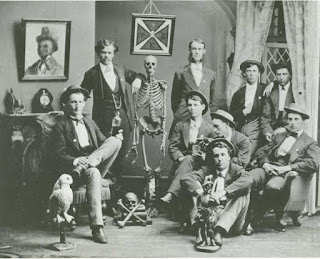


Besides camaraderie, the groups often provided insurance benefits, mutual aid, funeral funds and more. These groups weren't just for white, middle-class men or college students – there were societies that supported immigrant and ethnic communities, religious denominations, women, children, even certain professions or occupations, such as traveling salesmen (National Travelers) or logging workers (Concatenated Order of Hoo Hoo).


The CFCR is located in the IU Collections, Teaching, Research and Exhibition Center, located in the historic McCalla building on the IU Bloomington campus. Following a $6 million renovation of this one-time elementary school building, the Center now provides a safe, climate controlled facility for collections, plus seven display galleries, meeting areas, and a state-of-the-art media digitization and preservation department, all under one roof. 
Last year, the Center played host to the Scottish Rite Research Society's Fall presentation of papers.

Current generations have little or no understanding of the very existence and importance of these organizations, and too many of their publications, artwork, artifacts and jewelry disappear into the garbage or get melted down for their precious metals. The CFCR is now a welcome and secure repository for the quickly vanishing ephemera of American fraternal history.

So if you're interested in helping to support this new center, CLICK HERE to donate for #IUDay.


Sunday, July 16, 2023

Antique Collectors Discovering Masonic Bling and Tchotchkes

Photo: Antique Galleries of Palm Springs


by Christopher Hodapp

Interesting article over the weekend in the Desert Sun newspaper out in Palm Springs, California. Antique dealer Mike Rivkin has a piece on collecting Masonic regalia. According to Rivkin there's been an increase in non-Masons collecting fraternal (and especially Masonic) regalia like aprons, sashes, jewelry, and more.  He gives a slightly flawed thumbnail overview of Masonry's beginnings and its spread into America, but then turns to the regalia itself.

"Although the regalia associated with masonic ceremonies are often passed down the family tree, antique galleries like ours occasionally come across some fascinating artifacts. Most such wear is beautifully crafted from leather and silk, the aprons, robes and sashes reflecting a quality of craftsmanship all but lost today. Various symbols and initials often ornament these items, opaque to the non-initiate but conveying a special meaning to those in the know.

"Collecting vintage fraternal regalia is increasing in popularity, sometimes in tribute to past family masons, but often simply as a diverse and little-understood category. And who knows — perhaps some future initiation ceremony will include even you."
I'm glad to see interest in anything Masonic growing among non-Masons (especially when it's positive). It would be nice if that actually translated into men discovering the fraternity and having enough interest to actually petition a lodge. Unfortunately for those of us who are actually members of the fraternity already, such a trend will drive prices higher on antique fraternal ephemera, which is especially rough for us in the Masonic museum field. 

Tuesday, April 19, 2022

Crowdfunding Campaign for Indiana University's Center for Fraternal Collections & Research


by Christopher Hodapp

(UPDATED: The faulty hyperlinks to the Center's crowdfunding contribution page has been fixed. My apologies to all for the error.)

Back in August 2021, Indiana University in Bloomington, Indiana announced the opening of the new Center for Fraternal Collections & Research (CFCR), headed up by Dr. Heather Calloway. This Wednesday, April 20th is #IUDay at Indiana University and the Center is attempting to raise $5,000 with a crowdfunding campaign to help establish an endowment.


The mission of the CFCR is to collect, preserve, and protect objects and ephemera of fraternal and religious groups for study and research in a permanent and accessible collection. 

During the "Golden Age of Fraternalism" from the end of the American Civil War until the Great Depression, over a thousand fraternal, ritual-based or "secret societies" formed in the U.S. For too long, American fraternalism wasn't considered to be important enough for respectable historians to investigate. Yet the fraternal movement with its so-called "secret societies" was critical to the building and strengthening of American communities, and every bit as important as churches, political clubs and parties, social activist groups, and other local institutions. Masons, Elks, Odd Fellows, Knights of Pythias, Red Men, Woodmen - these were the most widely known. But there were hundreds and hundreds more. 


Besides camaraderie, the groups often provided insurance benefits, mutual aid, funeral funds and more. These groups weren't just for white, middle-class men or college students – there were societies that supported immigrant and ethnic communities, religious denominations, women, children, even certain professions or occupations, such as traveling salesmen (National Travelers) or logging workers (Concatenated Order of Hoo Hoo).


Current generations have little or no understanding of the very existence and importance of these organizations, and too many of their publications, artwork, artifacts and jewelry disappear into the garbage or get melted down for their precious metals. The CFCR is now a welcome and secure repository for the quickly vanishing ephemera of American fraternal history. 


The CFCR is located in the new IU Collections, Teaching, Research and Exhibition Center, located in the historic McCalla building on the IU Bloomington campus. Following a $6 million renovation of this one-time elementary school building, the Center now provides a safe, climate controlled facility for collections, plus seven display galleries, meeting areas, and a state-of-the-art media digitization and preservation department, all under one roof.


So if you're interested in helping to support this new center, CLICK HERE to donate for #IUDay.

Sunday, March 13, 2022

And you thought all we do in Indiana is sacrifice burnt offerings to the Corn God


by Christopher Hodapp

Nothing momentous with this post. Just memorializing a lunchtime gathering last week of a Dummy, a visiting Idiot, and our Hoosier pals. 

I'm 63 years old. I have to post these things in lieu of having an actual memory.

Left to right: 
Just remember: there is no cabal.

Thursday, July 11, 2019

Be On The Lookout For Stolen Masonic Jewels


A collection of twenty antique English Masonic jewels and collars has been stolen from a lodge in Warwickshire, England. 

According to a story yesterday in the Warwick Courier, the jewels were on display in a cabinet inside of a meeting room at Alderson House on High Street in Warwick. They were stolen at the beginning of July. 


Brethren are encouraged to keep an eye out for these items turning up for sale online or elsewhere.

It is believed that the items are valued between £6,000 to £10,000 [US$7,500 - $12,500].

The Alderson House Freemasons are now appealing to the community for help in tracking down the items.
[Peter Round, manager of Alderson House] said: "If anybody has been offered these please let us know. These are made of paste and silver, not diamonds like they might think.
"It is the importance of them which is valuable to someone who is a collector of these things.
"A proper collector is probably a Freemason anyway so they would want to know where they have came from.

"I think it was an opportunist theft.

Alderson House is the meeting place of Shakespeare Lodge 284 and Lodge of Warwick 8011, among others. 


Thursday, June 30, 2011

Have you seen this jewel?


When a Brother passes away, his family often has no idea what the dozens of jewels, pins, certificates, aprons, swords, hats and other keepsakes found in a drawer, cigar box or attic trunk really meant to their departed relative, or to the fraternity as a whole. They frequently become nothing more than gimcrack to be unceremoniously sent to the trash, or put out on Ebay to generate a few dollars. In many cases, they are far more important to the departed Brother's lodge or appendant chapter than any monetary price they can fetch, in terms of keeping our heritage alive.

Most of us over 50 at some point have the uncomfortable "If something happens to me" discussion with a member of our family (or we should, anyway), and most Masons at least mention the desire to be buried with our white lambskin apron. Perhaps the simplest way to let our families know not to simply send our other treasured ephemera to the dump is to put a note in storage with our apron. There are lodges that have a tradition of passing along rings from departed brethren to new members or WMs, and PM jewels passed along to the next generation of lodge leaders are a far more meaningful connection to our history than just an aging photo on the wall of the dining room.

Brother Seth Anthony in Pennsylvania was presented with a frustrating situation a few days ago, and for anyone who feels a responsibility to preserve our Masonic heritage, it can be a heartbreaker.

From Who cares about history?

Yesterday I was presented with an item of immeasurable historical importance to Pennsylvania DeMolay. There, on my screen, was the DeMolay Founder's Cross, given to Paul Miller Moore by "Dad" Land himself!

For those who don't know, the Founder's Cross is the rarest DeMolay honor ever given. It was only given by "Dad" Land to persons he desired to honor "for their personal, consistent and conspicuous loyalty to him." The jewel was to be worn over the heart. This was not a Grand or Supreme Council honor-- it was a personal expression of "Dad" Land's heartfelt gratitude. Exactly 135 were given out in his lifetime between 1937 and 1959, and they are never to be issued again. We have never seen a published list of all 135 recipients, and an extensive search of the internet only yielded the names of only a few recipients; James A. Wieland of Pittsburgh, PA; Paul Miller More of Butler, PA; Roy "Friday" Fitzgerald of Kansas City, MO; and Gorman A. McBride, of Kansas City, MO, the First Master Councilor of the Mother Chapter and the only one of the nine original members to be so honored.


In this case, "Dad" Land gave the honor to "Dad" Paul Miller Moore, a Past Grand Commander of Knights Templar of Pennsylvania, and Most Eminent Past Grand Master of the Grand Encampment of Knights Templar of the United States of America. "Dad" Moore was VERY prominent Freemason in Pennsylvania and even has a Legion of Honor Preceptory named after him (which meets in Butler.) To see "Dad" Moore's Founder's Cross for sale on eBay made my heart sink.

Somehow this important piece of PA DeMolay history made its way into the hands of an antique dealer in Pittsburgh who sold the item off to the highest bidder. PA DeMolay placed a bid on the item, which was close, but, sadly, wasn't high enough to purchase it. Unfortunately we don't know who the winning bidder was. We can only hope that it's a member of the DeMolay family. However, it's also possible that the buyer wasn't part of the Masonic fraternity. Experience has taught us that when pieces of history, like this medal, fall into hands outside of the fraternity it is very unlikely that we will ever get them back.

[snip]

AS AN APPEAL - if you are the buyer of the Paul Moore Founder's Cross, or you know who the purchaser is, we would greatly appreciate you contacting us at webmaster@pademolay.org or pa.demolay@gmail.com. PA DeMolay is willing to negotiate a fair settlement for the acquisition of this unique medal and piece of PA DeMolay history, to be displayed for all Pennsylvania DeMolay members to see.